
Bradford Pear Removal in South Carolina: Bounty and Costs
Cut Brush Team · October 1, 2026 · 8 min read

Every March, the roadsides and field edges of South Carolina turn white for two weeks, and almost none of that bloom belongs here. It is callery pear: the Bradford pears planted in front yards and parking lots for decades, and the thorny wild offspring now filling pastures, old fields and vacant lots across the state. Bradford pear removal in South Carolina is really two jobs that share a flower: an aging ornamental in the yard, and a thicket of its wild descendants taking over the field down the road.
South Carolina has also done more about it than most states. It has banned new sales, and it runs a bounty that trades your cut pears for free native trees. This guide covers the law and the bounty, why the wild thickets spread so fast, why cutting alone does not finish them, what clearing costs per acre, and how the job changes from the Upstate to the coast.
Is Bradford Pear Banned in South Carolina?
New sales are; the trees already standing are not. South Carolina added Pyrus calleryana, the callery pear, and pear trees grown on its rootstock to the State Plant Pest List, and sales became illegal on 1 October 2024, according to Clemson News. The same announcement was clear about existing trees: “it will not be illegal to possess them on their property or to keep what they have.”
So nobody has to cut down a Bradford pear in South Carolina. The state’s approach is to make replacing one worth your while.
How Does the South Carolina Bradford Pear Bounty Work?
You cut down your Bradford pears, and the bounty gives you native trees to replace them. The program is, in its own words, “a shared project between Clemson University and the SC Forestry Commission.” The rules on the Clemson Extension bounty page, as of October 2026:
- What you get: “up to five (5) Bradford Pear trees for an equal number of FREE, healthy, native, young replacement trees.”
- Who removes the tree: you. “Property owners are responsible for tree removal.”
- Proof: “Take a photo of yourself with the cut tree (a selfie, if you will) and bring it to the exchange event.”
- Registration: “Pre-registration is required, once available.”
- 2027 events: Bennettsville on 6 March, Columbia on 13 March, Fort Mill on 20 March and Clemson on 17 April.
That calendar makes this fall and winter the time to plan removal. A pear cut in the dormant season leaves you with the photo you need in hand when registration opens, and with the ground cleared before the spring flush.
Why Are Wild Callery Pear Thickets Spreading So Fast?
Because the “sterile” Bradford pear was never sterile in a mixed neighborhood. Clemson’s Home and Garden Information Center explains that “Bradford pears, by themselves, cannot produce viable seed. But, if pollen from a different flowering pear cultivar (or a wild Callery pear) pollinates a Bradford pear flower, then viable seed can be produced.” Once nurseries sold several varieties side by side, the trees began cross-pollinating, and birds carried the fruit out to every fence row.
The offspring are not the tidy ornamentals their parents were. Penn State Extension notes that “stout, sturdy spines are often found on naturalized individuals,” and Clemson describes thorns “sometimes up to 3” long!” Wild callery pear can “quickly take over a roadside, old field, pasture, vacant lot, or forest understory,” and those thorns are not a small detail: “many have reported the loss of tires from Callery pear thorn punctures.”
The result is the white stripe you see every March along interstates and field edges: dense, thorny thickets that crowd out pasture and make land hard to walk, mow or sell.
Why Doesn’t Cutting Callery Pear Finish the Job?
Because it comes back from the stump and the roots. Penn State says it plainly: “Cutting or mowing effectively eliminates the low cover and provides access to overgrown sites, but plants will readily resprout.” Fire does no better; Clemson warns that “for every stem that a fire kills, four more will resprout in its place.”
Two habits make thickets worse. Bush-hogging a callery stand every year keeps it short but can turn each stem into a cluster of new ones. And leaving a seed source nearby guarantees a return: Penn State notes callery pear “will likely reinvade areas where it has been removed as long as a seed source remains nearby.”
So the plan that works has three parts: take out the thicket, deal with the resprouts on a schedule, and remove the seed trees on your own property. Cut Brush does mechanical work only. Chemical treatment of cut stumps is work for a licensed applicator, who can be scheduled alongside the clearing.
What Does Bradford Pear Removal Cost in South Carolina?
Clearing a wild callery pear thicket typically runs $1,500 to $2,500 per acre, the brush and understory band on our Columbia pricing page. Stands that have grown into small woods price higher, and follow-up passes on the resprouts are priced per visit. Every South Carolina market uses the same bands.
| Job | Typical range | Who does it |
|---|---|---|
| One ornamental Bradford near a house, roof or power line | Priced per tree | An insured tree service; it is climbing and rigging work |
| Ornamentals in open ground a machine can reach | Starts near the $1,500 project floor | A clearing crew |
| Wild callery thicket on a field edge or fence row | $1,500 – $2,500 per acre | Forestry mulching |
| Mature callery stand with trees to fell | $1,500 – $4,500 per acre | Land clearing |
| Resprout passes | Priced per visit | Scheduled for the next one to two growing seasons |
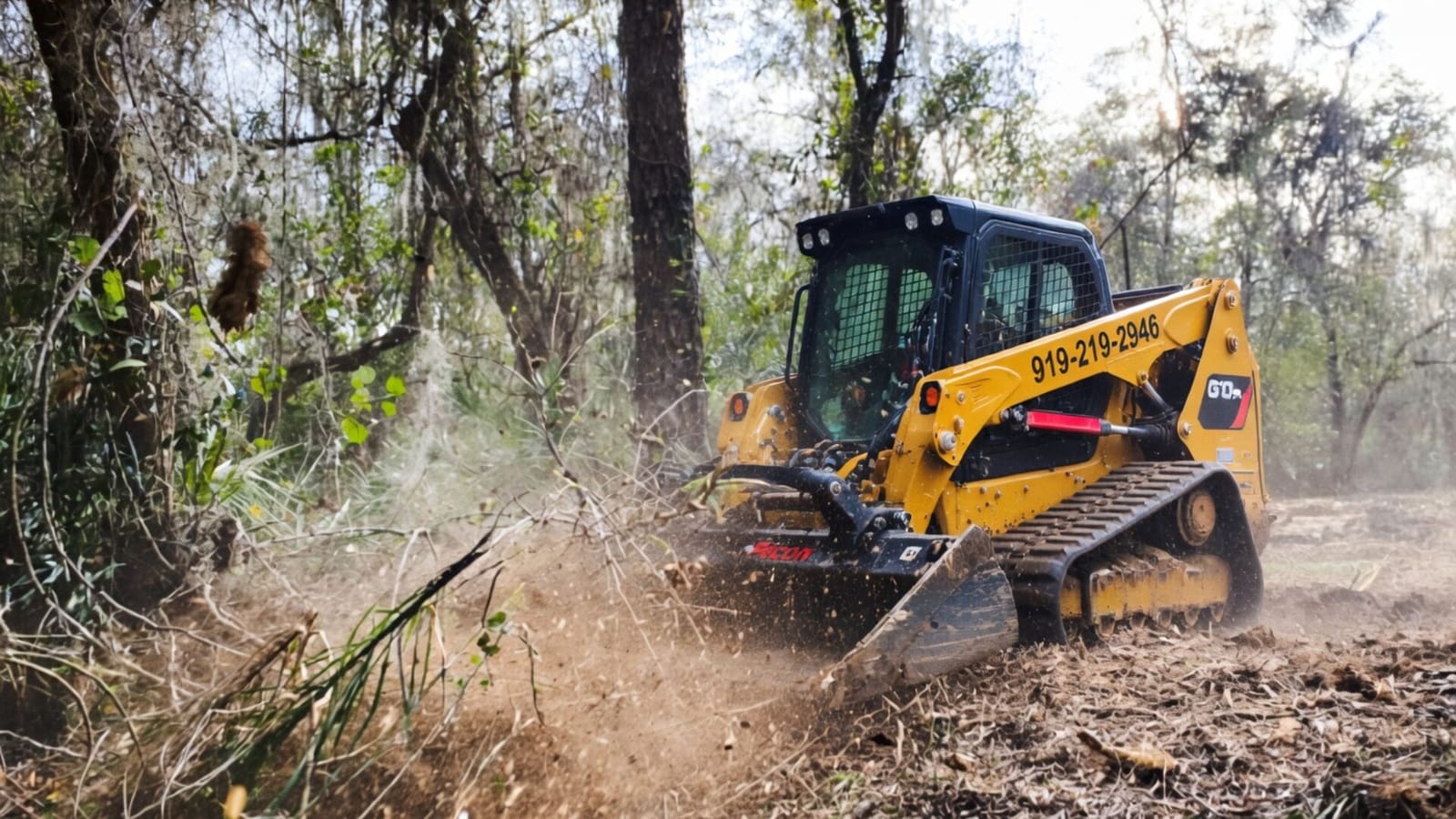
Thorns change how a crew works. Mulching grinds the thorny branches into chips on the spot, so nothing thorny is left on the ground for tires, livestock or bare feet. For the full per-acre picture, see our South Carolina land clearing cost guide.
Pro tip: If you only have one Bradford pear in the yard, call a tree service. If you have one in the yard and a white stripe along the back fence every March, the stripe is the bigger problem, and clearing it in the same visit costs less than two separate jobs.
Bradford Pear Around Columbia, Greenville and Charleston
The tree is the same statewide. What changes is the ground, the permits and where the nearest bounty event is.
Columbia and the Midlands. Columbia hosts the 13 March 2027 bounty event, so Midlands owners have the shortest trip. Callery pear can move into old fields and pine understory here as it does anywhere in the state; our Midlands pine understory guide covers clearing under pines. State land disturbance permits start below one acre, which our acreage tier guide explains. Start at land clearing around Columbia.
Greenville and the Upstate. The 2027 Clemson event on 17 April is the closest. Upstate thickets often grow on slopes and old pasture, where mulching keeps the clay covered. If the field edge is kudzu rather than pear, our South Carolina kudzu removal guide explains that job. See land clearing in the Upstate.
Charleston and the Lowcountry. Wet ground decides when a machine can work, so plan clearing for the drier months. See land clearing around Charleston.
York and Lancaster counties. The Fort Mill event on 20 March serves the Charlotte side of the state, covered in our Charlotte Bradford pear guide.
Burning. Outside town and city limits, state law requires notifying the South Carolina Forestry Commission before a debris burn. Burning thorny brush also leaves resprouting stumps behind, so mulching in place is usually the cleaner choice.
Frequently Asked Questions
Is it illegal to have a Bradford pear in South Carolina?
No. Selling callery pear has been illegal since 1 October 2024, but keeping a tree that is already in the ground is legal. Removing it is a choice, and the bounty exists to encourage it.
How do I get free trees for my Bradford pear?
Cut the tree down, take a photo of yourself with it, pre-register when registration opens, and bring the photo to an exchange event. The program trades up to five Bradford pears for up to five native trees. The 2027 events are in Bennettsville, Columbia, Fort Mill and Clemson.
Will the bounty program remove my tree for me?
No. The program says property owners are responsible for removal. You can cut it yourself, hire a tree service for a single yard tree, or hire a clearing crew for thickets and trees in open ground.
How much does Bradford pear removal cost in South Carolina?
A single yard tree near a house is priced per tree by a tree service. Wild callery thickets typically clear for $1,500 to $2,500 per acre, and mature stands can price as land clearing at $1,500 to $4,500 per acre, with a practical project floor near $1,500.
Do Bradford pear thorns really puncture tires?
The wild offspring carry thorns up to three inches long, and Clemson notes that many owners have reported losing tires to them. Mulching grinds the thorny branches in place, which leaves nothing sharp on the ground.
Will callery pear grow back after it is cut?
Yes, from the stump and roots, unless the resprouts are cut again on a schedule or treated by a licensed applicator. Removing the seed trees on your own property keeps new seedlings from coming back in.
Get Ahead of the Pears Before Spring
Whether it is a row of aging ornamentals along a drive in Lexington, a white stripe of wild pear along a fence line outside Camden or a pasture going to thorns near Newberry, every spring the thicket spreads further. Cut Brush quotes Bradford pear and callery pear removal across South Carolina with the whole job in view: the thicket cleared, the thorns ground in place, and the resprout passes priced up front, in time for the spring bounty exchange.
Related Services
Learn more about the services mentioned in this article.


More from the Cut Brush Blog
Keep reading for more tips and guides on land clearing.
 Guide
Bamboo Removal in Columbia, SC: Stop Running Bamboo
Bamboo removal in Columbia, SC fails when only the canes come down. Learn how rhizomes spread, the order of work that stops a grove, and what it costs.
 Guide
Opening Up Pine Ground in the Midlands Sandhills
Most Midlands acreage is pine with an understory closed in beneath it. What it takes to open the floor without touching the stand, and what it costs per acre.
Guide Kudzu Removal in South Carolina: Cost and Control Plan
Kudzu removal in South Carolina needs a plan, not one mowing. See how the vine regrows, the multi-visit plan that kills the crowns, and the cost per acre.
Let's Get Started on Your Land
Request a free quote. We'll contact you to discuss your property, access, and the clearing you need.
Get a Free QuoteOr call us directly: (919) 525-3950