
Forestry Mulching Cost in Kentucky (2026 Guide)
Cut Brush Team · October 9, 2026 · 8 min read

A few years ago you could walk your woods. Now bush honeysuckle fills every gap between the trees, cedar is creeping into the pasture edge, and you want it gone without a burn pile. Forestry mulching in Kentucky runs $1,500 to $4,000 an acre with Cut Brush. Our crews do this work across Greater Louisville, in Jefferson, Oldham, Bullitt and Shelby counties.
At a glance:
- Our price: $1,500 to $4,000 an acre to mulch; $1,500 to $2,500 when we take out only the shrub layer under trees you keep. Small jobs start near $1,500.
- What you get: brush and small trees ground where they stand, chips left on the ground, nothing piled, burned or hauled.
- Burn rule: in Kentucky’s spring and fall fire hazard seasons, burning within 150 feet of woods or brush is illegal from 6 a.m. to 6 p.m.
- Permit line: the state’s KYR10 stormwater permit starts at one acre of disturbance; inside Louisville Metro, MSD’s permit starts at 2,000 square feet.
- Regrowth: honeysuckle sprouts back from a cut stump, so a fall sprout spray belongs in the plan from day one.
We also work Clark and Floyd counties across the river in Indiana. Our crew works from Louisville. If your land is in Lexington, the Pennyroyal or the coal fields, tell us where it is and we will contact you about the property and access, and the sections below show where your ground would fall in the band.
How Much Does Forestry Mulching Cost in Kentucky?
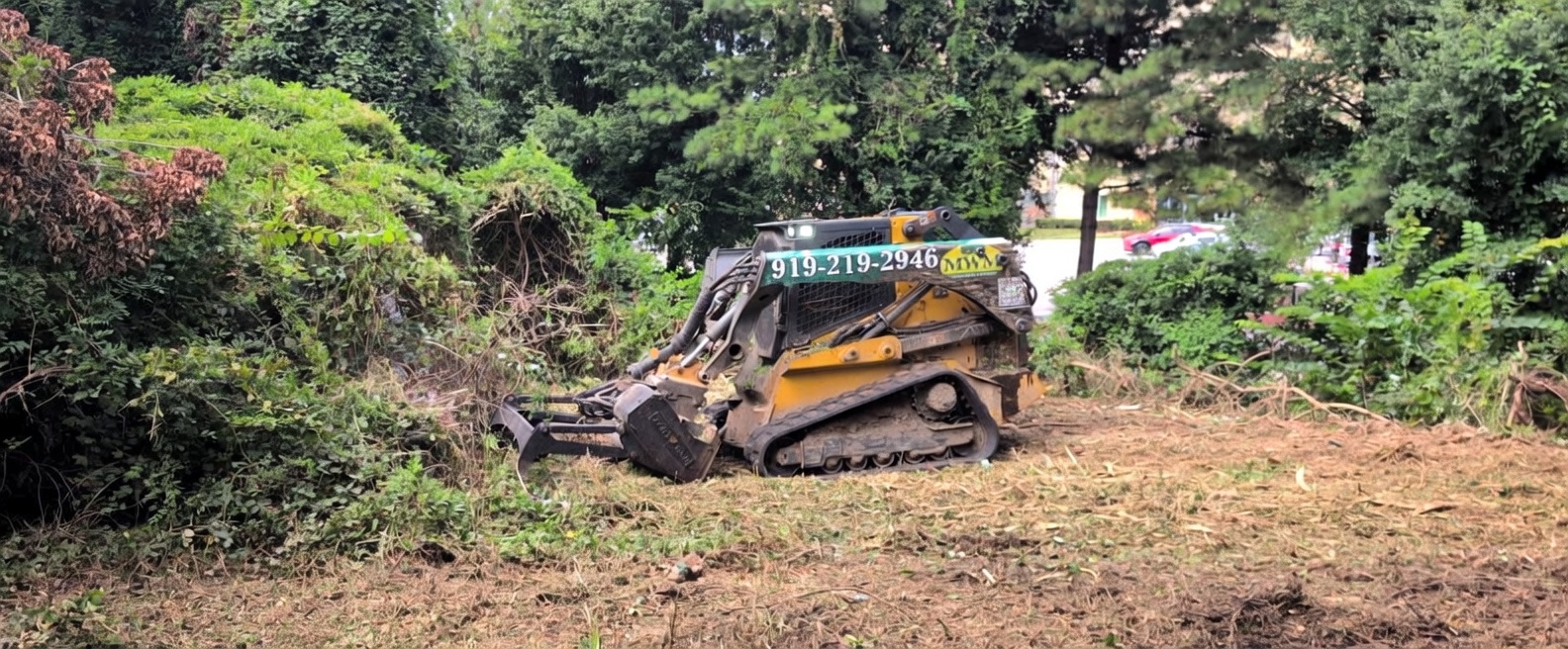
Forestry mulching is clearing with one machine. A tracked carrier with a spinning drum of teeth chews shrubs, vines and small trees into chips that stay on the ground as a mat, and stumps are cut flush instead of dug out. Here is what we charge, by what is standing:
| What is on the land | Our price per acre | What it looks like |
|---|---|---|
| Shrub layer under trees you are keeping | $1,500 – $2,500 | Honeysuckle and saplings between oak and hickory trunks; the trunks stay |
| Brush thicket you want gone | $1,500 – $4,000 | Honeysuckle, cedar or autumn olive with small trees; thin growth on level ground sits low, a closed thicket on a knob face sits high |
| Whole wooded tract | $1,500 – $4,500 | Timber and brush together, with the finish named in writing: stumps flush or pulled, material left or trucked off |
| A job under an acre | Near $1,500 | What it takes to get a tracked machine onto a property and off again |
These are the bands on our Louisville pricing page, and they are what we quote anywhere we work in Kentucky. A walk-through turns the band into one written figure for your ground. If you are pricing a whole tract by vegetation type, the Kentucky land clearing cost per acre guide covers that side.
What Changes the Price of a Kentucky Mulching Job
How thick and how old the honeysuckle is. Amur honeysuckle is the most common invasive bush honeysuckle in the state, and University of Kentucky foresters call it dense in woodlands across northern and central Kentucky. A knee-high carpet grinds quickly. A thicket taller than the machine slows the head down and moves an acre toward $4,000.
Whether a sprout plan comes with it. Cut honeysuckle comes back thicker from the stump. UK’s publication FOR-175 lays out the order we plan around: mulch right after the shrub leafs out in spring, which in Kentucky is early to mid-March, then spray the stump sprouts near the end of the growing season. Skip the second step and a July mulching job is often a thicket again the next summer.
Rock in the path of the drum. This is the Kentucky cost most landowners do not see coming. Pennyroyal ground in the Baxter soil series averages 15 to 35 percent chert, in pieces up to 10 inches across. Eden soils on the Outer Bluegrass hills hold limestone flagstone and reach soft rock 20 to 40 inches down. Every strike costs teeth and time. Inner Bluegrass Maury soil is the opposite: almost no chert and 60 inches or more of soil, so the machine runs freely.
Dead ash overhead. Emerald ash borer has killed a large number of Kentucky’s ash trees, and honeysuckle fills the light gaps they leave. Standing dead ash has to come down safely before we grind beneath it.
Slope. Bullitt County knobs rise 400 feet or more above the Salt River and Rolling Fork valleys, and the Shelocta soils of the eastern mountains run up to 90 percent slope. UK notes the spring mulching system is hard to carry out on steep terrain. We price what we can work safely and say at the walk-through which ground stays out of the scope.
Pro tip: Book honeysuckle mulching for late March or April, when the shrub is in leaf and most natives are still bare, so you can see exactly what is coming out. Before the machine leaves, put a late-fall sprout spray on the calendar. That order keeps the first bill from being the first of several.
Forestry Mulching Costs Across Kentucky
Greater Louisville. Our own ground has three surfaces. River bottom along Floyds Fork and the Salt River holds water long after the uplands dry. Tableland in eastern Jefferson County is flat and fast. The knobs south of town are steep. Thin honeysuckle on level tableland is the cheapest mulching we do; a closed thicket on a knob face is the most expensive. The Louisville forestry mulching cost breakdown and our bush honeysuckle guide go deeper on both.
The Bluegrass. Around Lexington, Georgetown and Paris, deep Maury soil with almost no stone makes a horse-farm fence line or woodlot edge some of the quickest mulching in the state. The Outer Bluegrass hills are slower. Eden soil was first mapped in Shelby County in 1916, and its steep slopes have gone back to forest or brushy pasture, often with red cedar, over flagstone.
The Knobs. Steep, cone-shaped hills of Borden shale ring the Outer Bluegrass from Bernheim Forest to Berea, according to the Kentucky Geological Survey. Shale left bare on those slopes washes, so the chip mat should stay right where it falls.
The Pennyroyal. Bowling Green, Russellville and Hopkinsville sit on a limestone plain with tens of thousands of sinkholes. Baxter chert is what costs money here. Sinkhole rims get a light pass so the throat stays open and easy to see.
The coal fields and the Purchase. On reclaimed mine land, autumn olive is the usual target. UK’s FOR-179 lists a forestry mulching attachment as one way to knock it down, with a sprout spray several months later; without it, the shrub comes back as a dense thicket. Out west, the Jackson Purchase is low and flat with sloughs and swamps, so wet ground, not rock, sets the schedule.
Permits and Burning Rules in Kentucky
Mulching leaves nothing to burn, and in Kentucky that settles a lot. The state allows only natural plant matter to be burned at all. From February 15 to April 30 and from October 1 to December 15, the Division of Forestry bars burning within 150 feet of woodland or brushland between 6 a.m. and 6 p.m. Brush from development clearing may be burned two contiguous acres at a time, and never where a local ordinance forbids it.
Summer brings a second rule. From May 1 to September 30, land clearing debris may not be burned in Boone, Boyd, Bullitt, Campbell, Kenton or Oldham counties. In Jefferson County, the Louisville Metro air district’s Regulation 1.11 has no land clearing exception; the one route is a special-case fire the district approves in writing, and no fire is allowed on an Air Quality Alert day.
For stormwater, the KYR10 general permit covers construction disturbing an acre or more, with the electronic notice filed at least seven days before work begins. Inside Louisville Metro, MSD’s Site Disturbance Permit starts at 2,000 square feet. We do not file permits, grade or build pads. If a house is the goal, the Kentucky land clearing and grading cost guide shows who takes the site after us.
Frequently Asked Questions
How much does it cost to mulch one acre in Kentucky?
With us, $1,500 to $4,000. A single acre of ordinary honeysuckle usually lands near our $1,500 minimum. A dense thicket on Eden flagstone or Baxter chert sits toward the top.
Can I burn the brush instead of mulching it?
That depends on the county and the month. Daytime burning near woods is banned in both hazard seasons, six counties ban land clearing fires from May through September, and Jefferson County allows one only with the air district’s written approval. Mulching skips all three, and the hauling bill too.
Will honeysuckle come back after mulching?
Yes, from the stumps, unless the sprouts are treated. UK pairs spring mulching with a foliar spray near the end of the growing season. Plan on that second visit.
Do you mulch in Lexington or Bowling Green?
Our crew works from Louisville. Tell us where your land is, and we will get in touch to discuss the ground, the access and the mulching you need.
Is underbrush clearing cheaper than full mulching?
Usually. Grinding only the shrub layer under trees you keep is $1,500 to $2,500 an acre; see the Kentucky underbrush removal cost guide. For open fields, the Kentucky brush hogging cost guide has our mowing rates.
Get a Forestry Mulching Quote in Kentucky
Pick the Louisville area below and request a free quote. Our crew will contact you to talk through the land, the gate or lane a trailer would use, and the finish you want: walkable woods, a cleared fence line or ground ready for your grader, plus whether it is honeysuckle, cedar or autumn olive if you know. Then we will walk it and put a price in writing.
Land across a state line? See our Indiana forestry mulching cost guide or Tennessee forestry mulching cost guide.
Sources
More from the Cut Brush Blog
Keep reading for more tips and guides on land clearing.
 Cost Guide
Forestry Mulching Cost in Louisville, KY (2026)
Forestry mulching around Louisville runs $1,500 to $4,000 per acre. See what river bottom, tableland and knob slope each do to the hours on your tract.
 Cost Guide
Brush Hogging Cost Per Acre in Kentucky (2026 Guide)
Brush hogging runs $75 to $400 an acre with Cut Brush around Louisville, with a $250 to $500 visit minimum. See what fescue, thistle and rock do to the price.
 Cost Guide
Land Clearing Cost Per Acre in Kentucky (2026)
Land clearing cost per acre in Kentucky runs $1,500 to $4,500. See how terrain, regrowth, the burn calendar and local permit rules move the real number.
Comparing states? See land clearing costs by state.
Let's Get Started on Your Land
Request a free quote. We'll contact you to discuss your property, access, and the clearing you need.
Get a Free QuoteOr call us directly: (919) 525-3950