
Forestry Mulching Cost in Tennessee (2026 Guide)
Cut Brush Team · October 9, 2026 · 9 min read

The fence line has gone to cedar and privet, or the back acres have grown so thick you cannot walk them, and you want the land opened up without a burn pile or a line of dump trucks. Forestry mulching runs $1,500 to $4,000 an acre with Cut Brush, and that is what our crews charge around Brownsville, Nashville, Chattanooga, Maryville and LaFollette. Where your acre falls inside that band depends on what sits under the brush and whether the brush comes back.
At a glance:
- Our mulching price: $1,500 to $4,000 an acre. Clearing shrubs and vines from under trees you keep runs $1,500 to $2,500.
- Smallest job: close to $1,500, because hauling the machine costs the same for half an acre as for two.
- Burning instead: the Tennessee Division of Forestry requires a burn permit for debris piles from October 15 to May 15, good for one day. Davidson County prohibits debris burning except on land being cleared for development, which needs Metro Health and Fire Department permits.
- An acre or more: TDEC’s construction stormwater permit covers clearing, grading or excavation at that size, with a $250 fee from one to four acres.
- What stays gone: cedar cut low does not come back from the stump. Privet, tree of heaven and kudzu do.
Our Tennessee crews work out of Brownsville, Nashville, Chattanooga, Maryville and LaFollette. Pick the nearest one at the foot of this page and we will walk the ground before we price it.
How Much Does Forestry Mulching Cost in Tennessee?
Our price follows what is standing on the land and the finish you want.
| What is on the land | Our price | What it looks like after |
|---|---|---|
| Privet, honeysuckle, vines and saplings under trees you keep | $1,500 – $2,500 / acre | Open woods floor, canopy untouched, chips on the ground |
| Brush and small trees, from light regrowth to a dense stand | $1,500 – $4,000 / acre | Everything ground to a mat, stumps flush, no piles |
| A whole tract taken to a finish you name | $1,500 – $4,500 / acre | Clearing scoped for pasture, a homesite or a grader |
| A small job of an acre or less | Near $1,500 per project | The floor that covers bringing the machine in |
Where these numbers come from. Every band is copied from our Tennessee pricing pages, and all five markets publish the same rows; the LaFollette pricing page shows them in full. Light regrowth over workable ground sits near the bottom of the mulching band. Heavy stems, rock at grade and a steep hillside push an acre toward the top. If you want stumps pulled and the surface shaped, our Tennessee land clearing cost per acre guide prices whole-tract work by what is growing.
What Is Forestry Mulching?
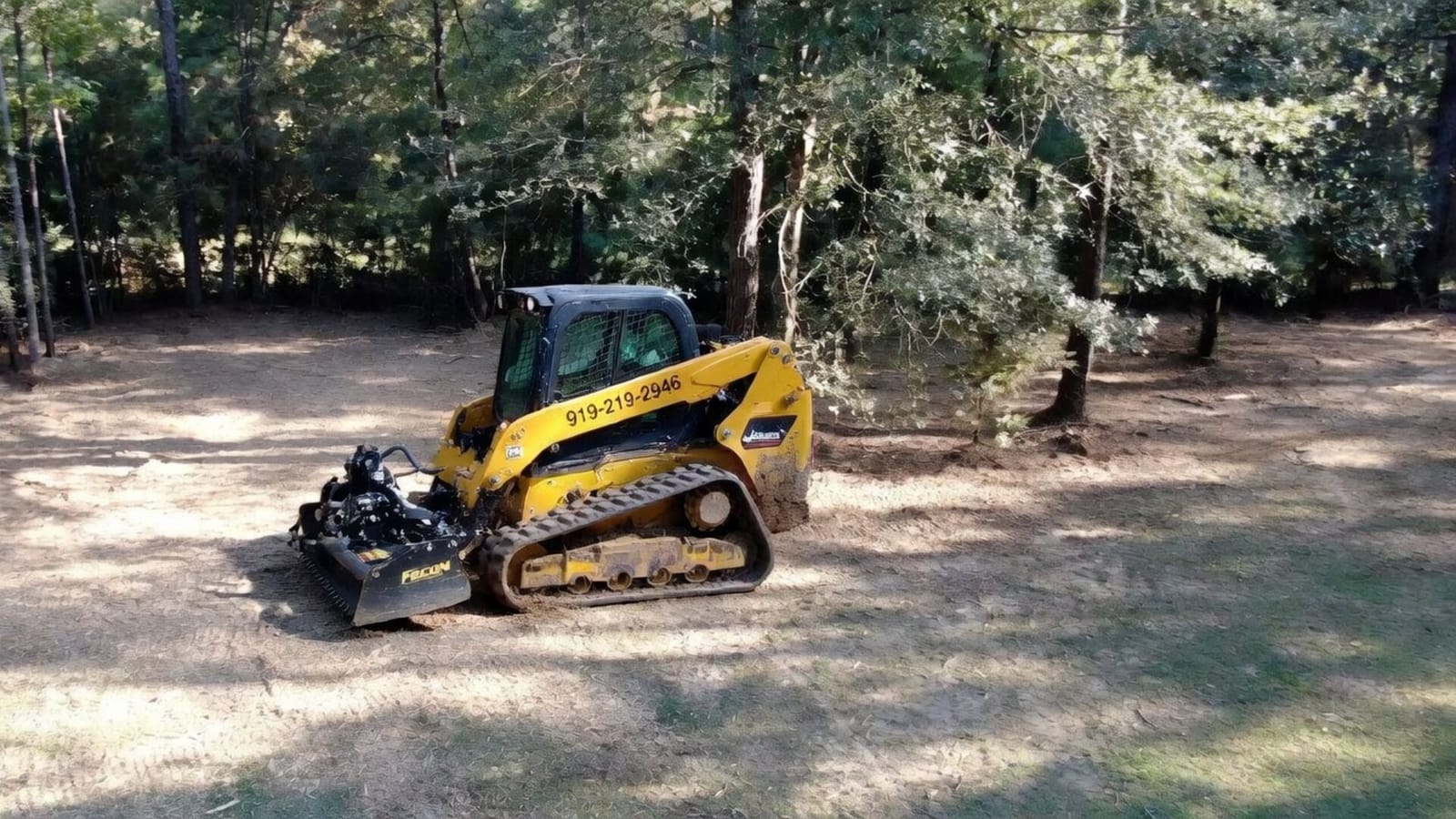
One tracked machine carries a spinning drum of carbide teeth into the brush and grinds standing growth where it stands. Brush and small trees become a chip mat, and stumps are ground flush instead of pulled. Nothing gets piled, burned or hauled off.
That mat matters on Tennessee ground. West Tennessee loess is rated for medium to very high runoff, so a bared slope there sheds silt fast. The chips cover the soil while grass comes back in.
Mulching does not leave ground ready to build on. We do not grade, build pads or pull permits; your dirt contractor takes over after us, and our Tennessee land clearing and grading cost guide shows that handoff.
What Changes the Price of a Tennessee Mulching Job
Rock under the brush. This is the first thing we look for on a Tennessee walk-through. Around Brownsville the Memphis soil is loess more than four feet deep with no stone in it, so a dry acre runs fast. In the inner Nashville Basin the Gladeville series puts flaggy limestone just 3 to 12 inches down, with outcrops between the cedars. On the Highland Rim the Bodine series carries 35 to 80 percent chert. Slab and chert both chip teeth, so the operator lifts the head and makes extra passes, and those hours are what move an acre toward $4,000.
What grows back. Cedar cut below its lowest live branch does not resprout, which is why a Basin cedar edge is usually one visit. UT Extension says Chinese privet comes back from roots and stumps and calls its control a multi-year effort. The Division of Forestry says a cut tree of heaven throws up shoots and root sprouts, and that kudzu keeps the energy for regrowth in tubers at the root crown. Where those are thick, we quote two lines: the knockdown, and the treatment visit after it.
Slope. Bodine ground runs to 70 percent slopes, and the Cumberland Mountains around LaFollette and the Walden Ridge escarpment above Chattanooga are just as steep. A mulcher on a side hill works shorter runs and backs out more often. Ground too steep to work safely comes out of the scope at the walk-through instead of being priced in.
A pine stand that qualifies for cost share. If the acre is a crowded young pine stand, the Division of Forestry’s Southern Pine Beetle Initiative reimburses half the cost of pre-commercial thinning, up to $55 an acre, or of mechanical release in 1 to 10 year old pine, up to $50 an acre, with a $20,000 cap per landowner each year. The stand must be more than half pine by basal area. Sign-ups come around four times a year, so check the current one with your Area Forester before any machine shows up.
Pro tip: Ask us to split the quote by what is growing. On a Middle Tennessee fence line the cedar stretch is often one pass near the bottom of the band, while the privet stretch needs a second visit. Seeing the two apart tells you exactly which acres carry the follow-up.
Forestry Mulching Costs Across Tennessee
West Tennessee, around Brownsville. No rock, so water and privet set the price. Bottom ground toward the Hatchie stays soft for weeks after rain, and waiting for it to dry costs you less than a machine rutting through it. More in our Brownsville mulching cost guide.
Middle Tennessee, around Nashville. Inside the Basin, Gladeville ground is cedar country, with prickly pear on the bare slab. Cedar mulches cleanly and stays gone, but shallow rock keeps the head high. Out on the Highland Rim the trees turn to mixed hardwood and the wear comes from chert instead of slab. See the Nashville mulching cost guide for the Basin counties.
Chattanooga and the plateau edge. Walden Ridge and Signal Mountain rise above the city, capped with sandstone and shale. The Hartsells soil on those ridgetops reaches sandstone at 20 to 40 inches: deeper than Basin slab, rockier than the valley floor. Down in the valleys, kudzu laid over privet is what we price around, since it must come down before the operator can see underneath.
The East Tennessee valley, Knoxville and Maryville. Ridges here are often Fullerton soil, cherty limestone ground of which about two thirds was cleared for pasture. Pasture left alone on it goes back to shrubs and saplings, which is quick work unless chert sits near the surface. If the field is still mostly grass and weeds, a mower costs far less; see our Tennessee brush hogging cost guide. The Knoxville mulching cost guide covers the valley towns.
The Cumberland Mountains, LaFollette and Campbell County. Grade is the first cost here and old coal ground is the second. Reclaimed mine benches grow up in autumn olive, which grinds fast but comes back from the stump and roots unless it is treated. Budget that follow-up from the start.
Burn Permits and Stormwater Rules in Tennessee
Mulching leaves nothing to burn, and in Tennessee that saves you a calendar as well as a pile. The Division of Forestry requires a burn permit for debris piles from October 15 through May 15, and each one is good for a single day. Counties and towns can be stricter. Davidson County prohibits debris burning except on land being cleared for development, and that exception needs both a Health Department and a Fire Department permit (Metro Nashville). Hamilton County towns from Chattanooga to Soddy Daisy issue burning permits through the county air pollution control bureau, and Maryville, LaFollette and Brownsville each set their own rules.
Clearing, grading or excavation that disturbs an acre or more comes under TDEC’s construction stormwater permit, with a $250 fee from one to four acres and $1,000 from five to nineteen. A new general permit took effect on October 1, 2026. We do not file permits, so if your project needs one, the owner or site operator has it in hand before we start.
Frequently Asked Questions
How much does it cost to mulch one acre in Tennessee?
Most single acres land near $1,500, because that is our practical floor for a project. Light regrowth on deep West Tennessee loess sits at the bottom of the $1,500 to $4,000 band. Thick privet over Basin limestone, or a steep plateau slope, sits near the top.
Will cedar come back after forestry mulching?
Not from the stump, as long as it is cut below its lowest live branch, and our mulcher takes it to the ground. Privet and tree of heaven are a different story: both come back from the roots, so plan a follow-up visit for them.
Does forestry mulching leave land ready to build on?
No. Stumps are ground flush, chips stay on the surface and nothing is graded. A house pad or driveway needs your dirt contractor after we hand the site over.
Is there help paying for forestry mulching in Tennessee?
Only for qualifying pine. The Southern Pine Beetle Initiative pays half the cost of thinning or releasing young pine stands, up to $55 an acre for pre-commercial thinning. Your Area Forester confirms eligibility before work begins.
Get a Forestry Mulching Quote in Tennessee
Pick the nearest area below and request a free quote. Our crew will contact you to discuss the land, the gate or road in, and the finish you want: open woods, a cleared fence line or ground handed to your grader, and what is growing if you know it, since cedar, privet and kudzu price differently. Then we will walk it and put one price in writing.
Land over the state line? Our Georgia and Kentucky mulching guides cover those states.
Sources
More from the Cut Brush Blog
Keep reading for more tips and guides on land clearing.
 Cost Guide
Forestry Mulching Cost in LaFollette, TN (2026)
Forestry mulching around LaFollette runs $1,500 to $4,000 per acre. How mountain slope, old mine ground, Norris Lake frontage and access change a quote.
 Guide
Clearing Old Strip-Mined Ground Around LaFollette, TN
Old coal benches near LaFollette grow autumn olive, lespedeza and kudzu over rocky fill. What mulching does on mine ground, why it regrows, and how to plan it.
 Cost Guide
Land Clearing Cost Per Acre in Tennessee (2026)
Land clearing cost per acre in Tennessee runs $1,500 to $4,500. See Chattanooga-area pricing by vegetation density, slope, and rock. Request a free quote today.
Comparing states? See land clearing costs by state.
Let's Get Started on Your Land
Request a free quote. We'll contact you to discuss your property, access, and the clearing you need.
Get a Free QuoteOr call us directly: (919) 525-3950