
Forestry Mulching Cost in Indiana (2026 Guide)
Cut Brush Team · October 9, 2026 · 9 min read

The woodlot behind the barn has gone solid with bush honeysuckle and autumn olive, you can no longer walk the fence, and you would rather not spend a season feeding burn piles. Forestry mulching in Indiana runs $1,500 to $4,000 an acre with Cut Brush. Our crews work central Indiana out of Indianapolis, and Clark and Floyd counties out of our Louisville, Kentucky market.
At a glance:
- Our mulching price is $1,500 to $4,000 an acre, with a practical floor near $1,500 on a small job, because the machine costs the same to trailer to half an acre as to five.
- Shrubs only, trees kept: clearing the brush from under a woodlot you are keeping is our lighter understory work, $1,500 to $2,500 an acre.
- Burning the brush instead needs IDEM approval when the clearing changes how the land is used, and an approved fire is capped at 1,000 cubic feet and must be out before sunset.
- Above one acre of disturbance, IDEM’s construction stormwater permit applies, with a $175 notice of intent fee.
- Honeysuckle resprouts from a cut stump, so a honeysuckle acre needs a follow-up plan from the start.
Around Indianapolis we cover Marion, Hamilton, Boone, Hendricks, Johnson and Hancock counties. Our Louisville crews handle Jeffersonville, New Albany, Floyds Knobs and the rest of Clark and Floyd. Land anywhere else in Indiana, request a free quote and we will tell you straight whether a crew can reach it.
How Much Does Forestry Mulching Cost in Indiana?
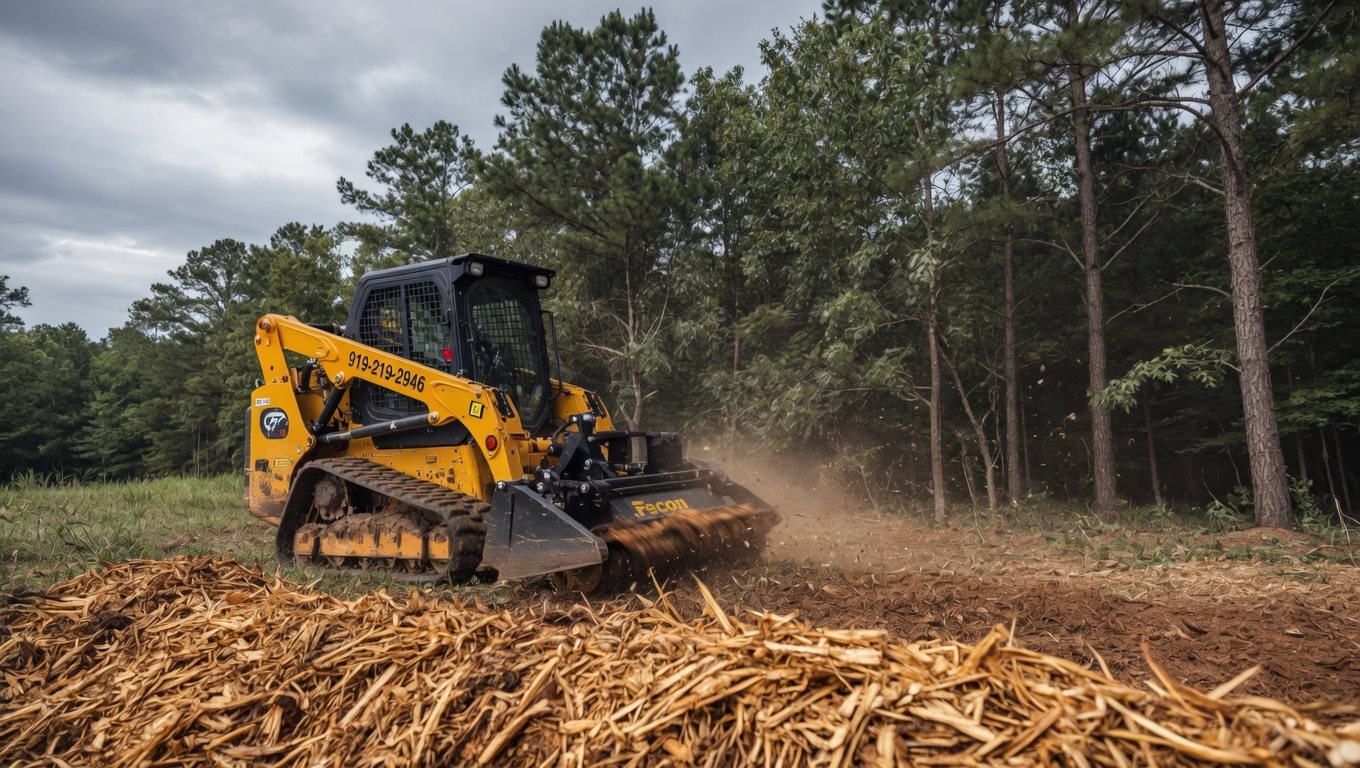
A forestry mulcher is a tracked machine with a spinning drum of steel teeth on the front. It grinds standing brush and small trees where they grow and leaves them on the ground as a chip mat. Stumps are cut flush rather than dug out, and nothing is loaded, hauled or burned. Our price follows what is standing on the acre and how firm the ground is under it.
| What is standing on your Indiana land | Our price per acre | What it looks like |
|---|---|---|
| Shrub layer under hardwoods you are keeping | $1,500 – $2,500 | Honeysuckle and autumn olive between oak and hickory trunks; every tree stays |
| Honeysuckle floor under open hardwood, firm ground | $1,500 – $4,000, low in the band | A dry woodlot in September, stems thin enough for one pass |
| Brushy field edge with heavier stems | $1,500 – $4,000, toward the top | Saplings and thick brush along a tile line or ditch bank that holds water |
| Whole tract opened, mature hardwood included | $1,500 – $4,500 | Every stem down so the ground can become pasture, a lane or a building site |
Where these numbers come from. Every band in that table is copied from our Indianapolis pricing page, and the Louisville pricing page that serves Clark and Floyd counties lists the same four. Clearing priced by cover type across the whole state is in our Indiana land clearing cost per acre guide, and the metro detail is in the Indianapolis forestry mulching cost guide.
What Changes the Price of an Indiana Mulching Job
Water sitting on the till. Much of central Indiana is Miami soil, a series first described three miles east of Danville in Hendricks County. Dense till sits 24 to 40 inches down, and water perches on it 2 to 3 feet below the surface from December through April (USDA NRCS, Miami series). A tracked machine on saturated ground has to slow down to keep from tearing the surface. We would rather mulch a Boone County woodlot in September than in March, and the September acre costs you less.
Sinkholes in the south. The Indiana Geological and Water Survey records a known maximum of 1,023 sinkholes in one square mile near Mitchell, and warns that soil washed off a worked site can plug a sinkhole until a small storm floods it (IGWS karst overview). Mulching suits that ground because the roots and the chip stay put. Our operator still lifts the head and works around each throat by eye, and a dimpled acre near Bedford takes longer than a flat one.
Stream breaks. Miami slopes reach 60 percent where creeks cut down through the till. On a bank that steep the head works short lines across the face, so a woodlot with a ravine prices above a level one.
Brush the state will not let you truck. Indiana’s Terrestrial Plant Rule lists Amur, Morrow’s, Tatarian and Bell’s honeysuckle, autumn olive and tree-of-heaven among 44 plants that are illegal to sell, transport or introduce (Indiana DNR). Grinding them where they stand settles that question. They still resprout: Purdue Extension’s advice for larger stems is to cut and treat the stump. We do not apply herbicide, so on a honeysuckle floor we price a follow-up pass, or you book a licensed applicator to work behind us.
What a burn would cost you. Indiana’s open burning rule lets IDEM weigh whether other disposal is impractical or prohibitively expensive before it approves burning brush from land changing use (326 IAC 4-1-4.1). An approved fire must be lit in daylight and out before sunset, with the local fire and health departments told 24 hours ahead, firefighting equipment on hand, and the pile kept 100 feet from any building or power line and 300 feet from a busy road. On most lots, one mulching price beats a string of permitted burn days.
Pro tip: Pace out the brush you would have to pile before you price a burn against mulching. An approved Indiana fire holds no more than 1,000 cubic feet, about a stack ten feet on each side. A two-acre honeysuckle woodlot fills several of those, and every one needs its own daylight window and its own 24-hour notice.
Forestry Mulching Costs Across Indiana
Central Indiana: Danville, Lebanon, Noblesville, Greenwood. This is the Central Till Plain, the largest of the state’s physiographic regions, and home ground for our Indianapolis crews. Farm woodlots here usually carry a honeysuckle floor under open hardwood. The price question is the calendar more than the brush: book after the winter water table drops.
Clark and Floyd counties: Jeffersonville, New Albany, Floyds Knobs. Our Louisville crews work this side of the river. The IGWS lists the Charlestown Hills among Indiana’s karst regions and among its landslide regions, where clay-rich soil and weathered shale sit at steep angles. Slope and sinkholes both slow the machine. Burning is also harder to get approved here: the rule’s criteria ask that the site not be in Clark or Floyd County, though IDEM may still allow a clearing burn under conditions it sets.
The north: DeMotte, Kouts and the lake country. The Northern Moraine and Lake region carries up to 450 feet of glacial sediment, with lakes, dunes and moraine ridges. Morocco soil near DeMotte in Jasper County is sand that drains fast. Maumee soil near Kouts in Porter County sits in depressions where water can stand two feet above the surface for part of a normal year. The wet pockets decide the week we come.
South-central Indiana: Bloomington, Bedford, Mitchell. The Mitchell Plateau runs from eastern Owen County to the river in Harrison County. Ridgetops often carry Bedford soil, first named in Lawrence County in 1922, with a fragipan 20 to 38 inches down and water perched 1.5 to 2.5 feet below the surface. Expect soft footing on the ridges and sinkholes between them.
The southeast: Scott and Switzerland counties. Avonburg soil, described near Crothersville in Scott County, is flat loess over old till with water perched only half a foot to a foot and a half down in undisturbed ground. It mulches cleanly when dry and slowly when it is not.
Permits and Burning Rules in Indiana
Burning. Burning natural growth cleared for a change in land use needs IDEM approval first; IDEM names clearing for a housing development or a private roadway as examples (IDEM). The exception is maintenance burning: vegetation from a farm, or from agricultural land in an unincorporated area, can be burned without approval if the fire is attended until it is out and the air is not windy or stagnant. A mulched acre leaves nothing to burn either way.
Stormwater. IDEM’s Construction Stormwater General Permit, in effect since 18 December 2021, covers clearing, grading and excavation of one acre or more. The notice of intent costs $175 and needs a review authority’s sign-off on the stormwater plan. Ask that authority early whether a mulching pass that leaves the root mat in place counts as disturbance on your tract.
We clear; we do not grade or file permits. If a building pad follows the mulching, our Indiana land clearing and grading cost guide shows who handles each phase.
Frequently Asked Questions
How much does it cost to mulch one acre in Indiana?
Budget $1,500 to $4,000. On a single acre the practical floor near $1,500 usually sets the price. Light honeysuckle on dry, level till sits low; thick brush around sinkholes, or saturated ground in March, sits near the top.
Is it cheaper to burn the brush than mulch it in Indiana?
Rarely, once the rules are counted. Clearing for a new use needs IDEM approval, each fire is capped at 1,000 cubic feet with set distances from roads, buildings and power lines, and each burn day needs notice. Farm maintenance burning in an unincorporated area is the exception.
Will bush honeysuckle grow back after mulching?
Yes, from the cut stumps, unless they are treated. Purdue notes bush honeysuckle stays green into early November after the native shrubs go dormant, so a late fall follow-up is easy to aim. We price that visit as its own line.
When is the best time of year to mulch in Indiana?
Late summer through fall. The water perched on central and southern Indiana soils is lowest then, so the machine covers more ground and leaves a cleaner surface, and the honeysuckle is easy to pick out once the natives drop their leaves.
Get a Forestry Mulching Quote in Indiana
Pick the nearest area below and request a free quote. Our crew will contact you to go over the tract, the gate or lane a trailer would use, and the finish you want: walkable woods, an open field edge, or ground ready for your dirt contractor. We will ask about sinkholes, standing water or a creek on the land, then set a walk-through.
Fields a mower can still handle are in our Indiana brush hogging cost guide, and clearing under trees you keep is in the Indiana underbrush removal cost guide. Land across the state line is covered in our Ohio and Kentucky mulching guides.
Sources
More from the Cut Brush Blog
Keep reading for more tips and guides on land clearing.
 Cost Guide
Forestry Mulching Cost in Indianapolis, IN (2026)
Forestry mulching around Indianapolis runs $1,500 to $4,000 per acre. What wet till plain ground and Indiana disposal rules do to the hours on your tract.
 Cost Guide
Land Clearing Cost Per Acre in Indiana (2026 Guide)
Land clearing cost per acre in Indiana runs $1,500 to $4,500. What oak and hickory stands, wet till plain soils and three statewide rules do to a quote.
 Guide
Buckthorn Removal in Indiana: Cost and Plan
Buckthorn removal in Indiana: why one cutting fails, the state transport ban, a follow-up plan for fence rows and wet ground near Lowell, and what it costs.
Comparing states? See land clearing costs by state.
Let's Get Started on Your Land
Request a free quote. We'll contact you to discuss your property, access, and the clearing you need.
Get a Free QuoteOr call us directly: (919) 525-3950