
Forestry Mulching Cost in Oklahoma (2026 Guide)
Cut Brush Team · October 9, 2026 · 9 min read

A few green cedar spikes in the pasture turned, over ten years, into trees taller than the fence, and the grass under them is gone. You want the ground back and need a number. Forestry mulching in Oklahoma runs $1,500 to $4,000 an acre with Cut Brush, the same band our crews charge around Oklahoma City, Duncan, McAlester and Durant. Where your acre falls inside it comes down mostly to how tall that cedar has grown.
At a glance:
- Our price: $1,500 to $4,000 an acre to grind everything standing. Taking only the cedar and brush out from under oaks you keep is $1,500 to $2,500.
- Minimum: close to $1,500 a job. Trailering a tracked mulcher to a quarter-acre patch costs what it costs to trailer it to forty acres.
- Six feet is the line: Oklahoma State University finds a prescribed burn seldom kills cedar over six feet tall on grazed range. Past that height, it takes a machine.
- Burning piles: a land clearing fire must sit 500 feet or more upwind of any occupied home off your property, and a county burn ban can stop it for up to 14 days at a time.
- Cost share: the Oklahoma Conservation Commission pays a set $147.21 to $419.11 an acre toward mechanical cedar control, mulching included, in 23 conservation districts.
Our Oklahoma crews cover four areas: the Oklahoma City metro, the Duncan pasture country, McAlester and Lake Eufaula, and Durant on the Texoma side. Pick the nearest one at the bottom of this page and we will walk the tract and write down one price.
How Much Does Forestry Mulching Cost in Oklahoma?
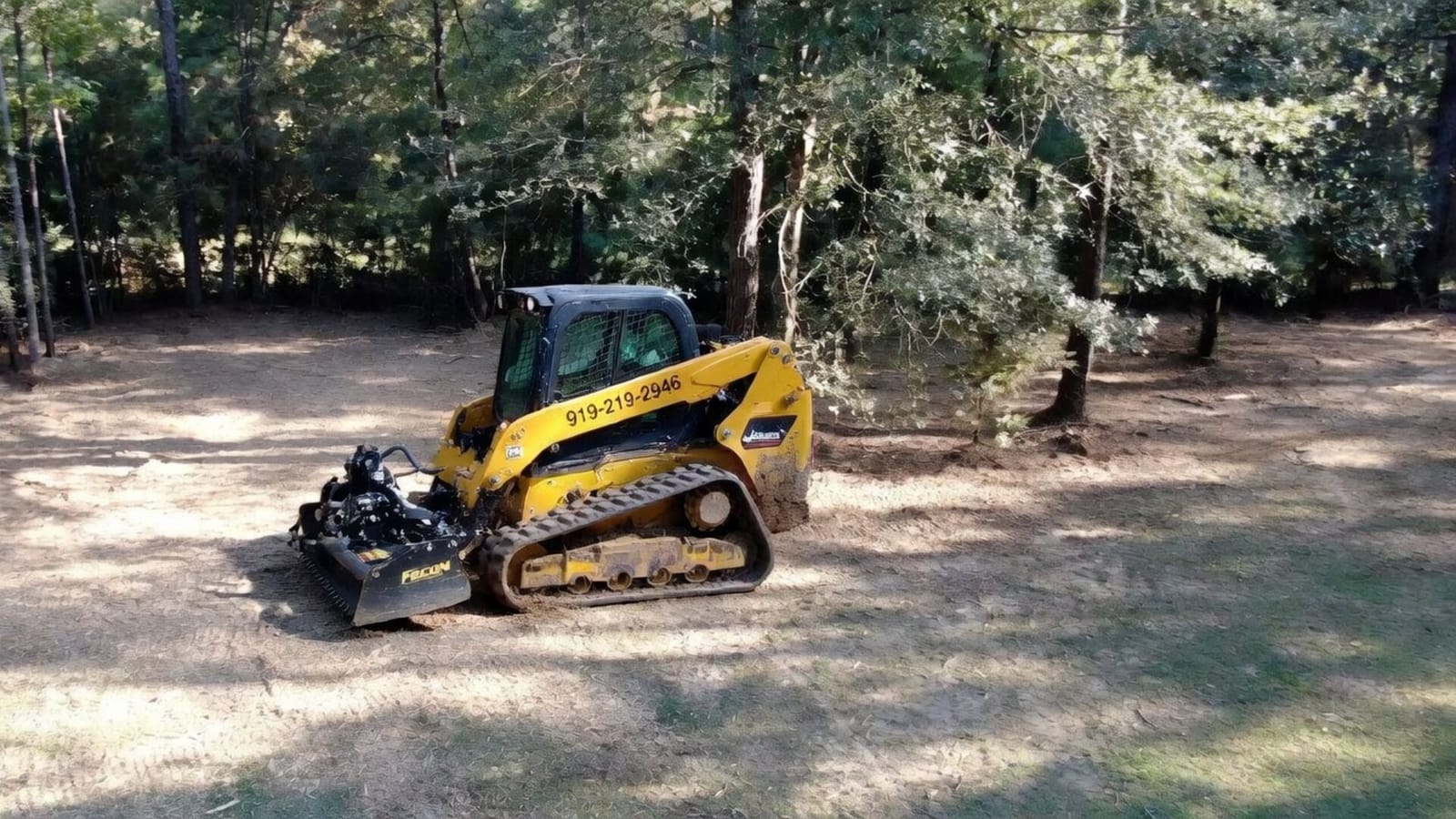
Forestry mulching is one tracked machine with a spinning drum of steel teeth that grinds cedar, brush and small trees where they stand, cuts the stumps off at ground level and leaves the wood on the ground as a layer of chips. Nothing gets piled, hauled or burned. Here is our price by what is standing.
| What is on the land | Our price per acre | What it looks like |
|---|---|---|
| Cedar seedlings and brush coming up through grass and fence rows | $1,500 – $2,500 | Cedar you can still see over, section-line brush, a pasture you can save |
| Cedar and brush under oaks you are keeping | $1,500 – $2,500 | Post oak or blackjack overhead, cedar and buckbrush packed in below |
| Cedar, scrub and small hardwoods ground to a chip mat | $1,500 – $4,000 | Young stems in grass at the bottom; a closed cedar canopy fifteen years thick at the top |
| A whole tract, with heavy timber or wood leaving the property | $1,500 – $4,500 | Land clearing rather than mulching; the finish is written into the quote |
Where these numbers come from. Every band is copied from our four Oklahoma pricing pages, which publish the same figures. The under-oak row goes by a local name on each: Regrowth & Understory Work on the Oklahoma City pricing page, Cedar & Pasture Clearing in Duncan, Redcedar & Privet Clearing in McAlester, and Redcedar & Lake Lot Clearing in Durant. If you are pricing a whole tract by vegetation rather than a mulching pass, the Oklahoma land clearing cost per acre guide breaks that down.
What Changes the Price of an Oklahoma Mulching Job
How tall the cedar is. It is the first thing we size up on a walk. OSU fact sheet NREM-5053 reports that cedar under a foot tall dies in almost any fire, while trees over six feet usually live through a prescribed burn, because grazed Oklahoma range seldom carries enough grass to burn that hot. Short cedar in open grass is fast, cheap work for the drum. A closed stand above head height takes the most hours an acre.
What sits under the chip line. In the Cross Timbers, the Darnell soil runs only 10 to 20 inches deep before it hits sandstone, under post oak, blackjack and cedar. South around the Ouachitas, the Clebit soil reaches hard sandstone tilted about 40 degrees at a similar depth, and that depth changes from one step to the next. Rock near the surface means we raise the head and make more passes. The deep red clay around the capital usually lets the drum run low and steady.
Whether cut cedar can be left lying. OSU’s cedar guidance says not to pile it after cutting, since burning piles throws firebrands hundreds of feet downwind. A newer OSU sheet on the Cross Timbers, NREM-5155, warns that felled cedar left on the ground loads fuel under the oaks you meant to keep. Grinding it into a chip mat settles both.
Privet on the eastern woodlots. The Oklahoma Department of Wildlife Conservation finds Chinese privet in counties across the eastern half of the state, forming walls along woods edges, and tells owners to treat each cut stump with herbicide right away. A mulcher takes the top off, but privet roots stay alive, so on a McAlester or Durant job we price the cedar pass and tell you plainly that privet needs a follow-up.
Canopy cover and the cost share check. The commission pays a fixed amount per acre based on how much of the ground the cedar shades, not a share of the bill. Thick canopy costs more to grind but also earns the larger payment.
Pro tip: Walk the tract before you call and split it into cedar you could reach the top of and cedar you could not. The short half may be cheaper burn ground; the tall half is your true mulching acreage. A quote divided that way is easier to compare and easier to fund.
Forestry Mulching Costs Across Oklahoma
Central Oklahoma. West of the capital toward El Reno and Chickasha, cedar stands in open grass and the price rides on height. East toward Spencer, Choctaw and Harrah, the Stephenville soil, first described in Oklahoma County, carries post oak, blackjack and hickory over sandstone 20 to 40 inches down, and the cedar grows between keeper oaks. Oklahoma, Cleveland, Logan, McClain and Grady counties are on the cost share list. The Oklahoma City mulching cost guide covers the metro in more detail.
Southwest Oklahoma. Around Duncan, Walters and Waurika, most mulching is cedar coming out of grazing land. The Foard soil, first mapped in Cotton County, is very slowly draining clay over red beds, so wet weather slows the machine more than rock does. Stephens, Comanche, Cotton and Jefferson are not on this year’s district list, so budget the full figure. See the Duncan mulching cost guide.
Southeast Oklahoma. McAlester, Krebs and Wilburton sit among ridges and valleys where the Counts soil, named for a Pittsburg County community, holds post oak, blackjack and southern red oak over heavy clay. Shallow tilted sandstone takes over toward the Ouachitas. Hughes County is on the cost share list; Pittsburg is not. On a Lake Eufaula lot, our work stops at the government line. More in the McAlester mulching cost guide.
Texoma country. Around Durant, Calera and Bennington, the Bosville soil carries water perched near the surface from fall to early spring. A summer start keeps the tracks on top of it. On a lake lot, the Corps of Engineers line decides how much of the listing is yours to mulch; the Durant mulching cost guide covers those lots.
Burning and Permit Rules for Oklahoma Mulching
A mulcher leaves no brush pile, and in Oklahoma a pile is a gamble on the calendar. County commissioners can pass a burn ban by resolution for up to 14 days and pass it again while fire danger holds, and a Governor’s ban overrides the county. When burning is open, the state rule still keeps a land clearing fire 500 feet or more upwind of any occupied home not on your property, and it cannot be lit until three hours after sunrise.
If the mulching is the first step of a building project that will disturb more than an acre, DEQ’s OKR10 construction stormwater permit comes into play, with a vegetated strip of at least 50 feet left along streams and ponds. That filing belongs to the owner or builder. We grind, leave the chip mat and go; we do not file permits, grade or build pads.
Frequently Asked Questions
How much does it cost to mulch an acre of cedar in Oklahoma?
We charge $1,500 to $4,000 an acre across all four of our Oklahoma areas. A single acre usually lands at the $1,500 minimum. Knee-high cedar scattered through grass is the low end; a closed stand taller than a man on shallow sandstone is the high end.
Is it cheaper to burn cedar than to mulch it?
For small trees, often yes. OSU finds fire kills cedar under a foot tall in nearly any burn, while trees over six feet usually survive one. A burn also needs enough grass to carry it, a county with no ban in force, and the 500-foot setback for clearing fires.
Will the state pay part of my mulching bill?
It might. The commission’s Invasive Woody Species Cost Share pays $147.21 an acre at 11 to 30 percent canopy, $233.14 at 31 to 50 percent and $419.11 above 50 percent, for mulching and other mechanical control. You need at least 20 contiguous acres in one of the 23 listed districts. Apply through your conservation district and check the current sign-up window.
Will the cedar grow back after mulching?
Not from the stump. OSU’s L-320 says redcedar cut below its lowest live branch does not sprout. Birds will plant new seedlings, so plan a prescribed burn every three to five years or a regular mowing pass afterward; the Oklahoma brush hogging cost guide prices that upkeep.
Can I build right after the land is mulched?
Not without a dirt contractor. The stumps are cut level with the ground, the chips stay as a mat, and no soil gets moved. If you only want the woods opened under the oaks, the Oklahoma underbrush removal cost guide covers that work.
Get a Forestry Mulching Quote in Oklahoma
Choose the nearest area below and request a free quote. Our crew will contact you to talk through the densest cedar and the gate a trailer would come through, how tall the tallest cedar stands, whether privet lines the woods, and the finish you want: open pasture, cleared woods under the oaks, or ground ready for your dirt contractor. If you plan to apply for cost share, mention it on that call and we will look at the canopy cover with you. Land across the state line? Our Texas forestry mulching guide and Arkansas forestry mulching guide price it.
Sources
More from the Cut Brush Blog
Keep reading for more tips and guides on land clearing.
 Cost Guide
Forestry Mulching Cost in McAlester, OK (2026)
Forestry mulching around McAlester, OK runs $1,500 to $4,000 per acre. How cedar height, privet, shallow sandstone and burn bans move a Pittsburg County quote.
 Guide
Clearing Redcedar and Privet Around McAlester, OK
Redcedar and privet fill oak woods and creek edges near McAlester. Why they spread, why cut cedar stays dead while privet returns, and a plan that holds.
 Cost Guide
Land Clearing Cost Per Acre in Oklahoma (2026 Guide)
Land clearing cost per acre in Oklahoma runs $1,500 to $4,500. See how cedar, red clay, access and county burn bans move the number. Free written quotes.
Comparing states? See land clearing costs by state.
Let's Get Started on Your Land
Request a free quote. We'll contact you to discuss your property, access, and the clearing you need.
Get a Free QuoteOr call us directly: (919) 525-3950