
Scotch Broom Removal in Oregon: Cut, Mulch and Check Back
Cut Brush Team · October 12, 2026 · 8 min read

To get rid of Scotch broom in Oregon, cut the stand before its seed pods ripen, grind or chip it where it stands, and come back for seedlings for several seasons. Cutting once does not finish the job: Oregon State University Extension says broom stems can regrow after cutting, that new seedlings come up once a stand is disturbed, and that a mature plant sets about 15,000 seeds a year that stay alive in the soil ten years or more. A forestry mulcher brings an acre of broom down in one pass and leaves the ground open and walkable. Follow-up visits are what keep it that way.
This guide covers why broom does so well in western Oregon, how to recognize it, why one cutting fails, a plan that holds, the rules that touch a broom job, and what it costs.
Why Scotch Broom Takes Over Oregon Land
The Oregon Department of Agriculture rates Scotch broom a B-listed noxious weed and calls it “one of Western Oregon’s most widespread and costliest weeds.” It was planted on purpose for decades, to hold dunes and to brighten highway corridors, and it is now, in ODA’s words, “the most extensive forest weed species” in the state. ODA puts the cost of controlling it in Oregon timberlands alone at $47 million a year.
It is at home on the coast. Lincoln County lists Scotch broom, French broom, gorse and blackberries among the noxious weeds on its vegetation page, and the county’s own crews work the road rights of way, not private land. Beside Lincoln City, volunteers at Siletz Bay National Wildlife Refuge hand-sawed and removed 10 truckloads of it from refuge ground. Inland, ODA says it grows throughout western Oregon, with the occasional population in the pine forests east of the Cascades.
Broom wins because it takes the ground nobody is using. ODA describes it as a pioneer that “readily invades disturbed sites, natural areas, dunes, and forestlands,” displacing native plants and smothering young trees. A second-home lot left alone for a few years, a pasture that is no longer grazed, or a strip along the road after the county mows is exactly the open, disturbed ground it likes.
How to Recognize Scotch Broom
Most of the year broom is a dense clump of slender, dark green stems, upright and almost leafless from a distance. ODA says it can reach 8 feet tall, and OSU gives mature shrubs as 3 to 10 feet. The stems stay green through the winter, which is why a broom stand looks alive in January when everything around it is bare.
In spring it is impossible to miss. ODA says that in May the plants carry “a profusion of yellow flowers,” each about an inch long, which ripen into flat pods holding up to a dozen seeds each. By midsummer the dry pods “crackle and pop,” throwing seed a short way from the plant. A broom stand that has been flowering for years has put seed into every bit of ground around it.
If you are not sure what you have, your county extension office can confirm it from a sample or a photo. It is worth knowing before you plan the work, because French broom and gorse, which Lincoln County lists too, need the same approach and gorse comes with spines.
Why One Cutting Fails
Picture a hillside lot cut back with a brush saw in the fall. By the next summer it is green again, with more small plants than before.
Two things are at work. The first is the cut stems: OSU notes that “broom stems will re-grow after cutting back,” so a stub left standing can put out new growth. The second, and the bigger one, is the seed bank. ODA says broom builds “persistent soil-seed banks requiring long-term commitment to exhaust,” and OSU warns that “after you disturb a stand of broom, new broom seeds will germinate.” Clearing the stand lets light reach seed that has been sitting in the soil for years.
None of that makes cutting useless. It means the first clearing is step one, and the plan has to include coming back.
A Removal Plan That Holds: Cut, Mulch, Check
Step one: cut at the right time. OSU Extension gives two windows: the dry season, July to August, or late winter through early summer, before or during flowering and before the seed pods mature. Cutting in late winter or spring, before the pods mature, keeps that year’s seed off the ground; by the July to August window many pods have already opened, so expect more seedlings after a summer cut. On the coast, the dry summer window also means firm footing for a machine.
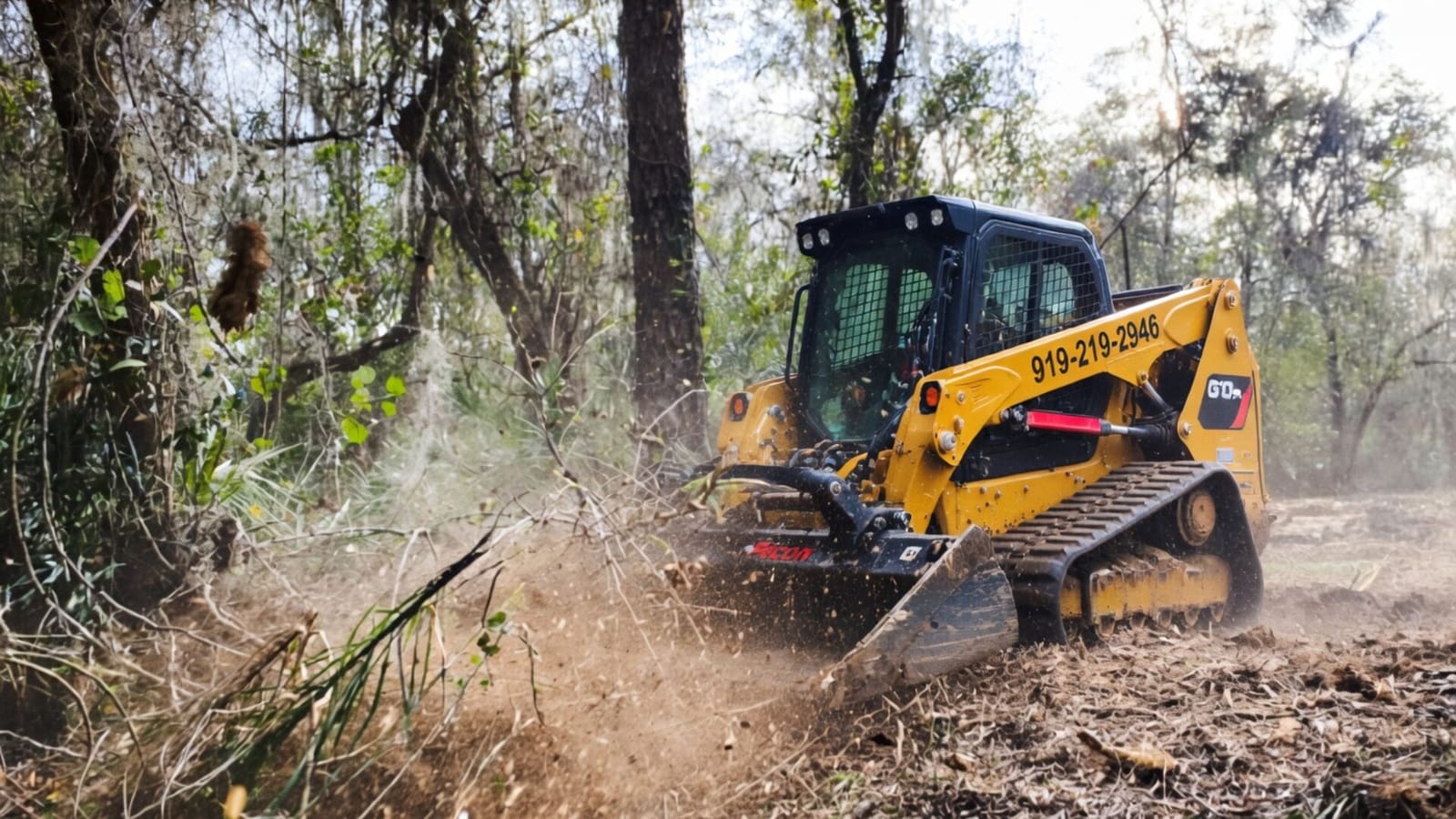
Step two: grind it where it stands. A tracked forestry mulcher feeds broom stems through a spinning drum and leaves them as a chip mat, which is OSU’s advice to chip broom or compost it in place, done at the scale of an acre. The stems are taken down to the ground rather than left as stubs, the trees you want kept are left standing, and nothing is piled or trucked away. On a wet coast lot, the chip mat also keeps bare soil covered through the winter.
Step three: come back for seedlings. Expect a flush of small plants the next season and for several seasons after. Seedlings are easy to pull while they are small; OSU says small plants can be dug out or pulled with a weed wrench. On a larger area, a light second mulching pass can be cheaper than pulling thousands of seedlings by hand. Herbicide is also an option OSU lists, used by the label; it is work for a licensed applicator, arranged by the landowner, and our crew does not apply it.
Work with your neighbours. Broom seed travels on boots, tyres and equipment, and pods throw it over fences. Clearing several lots or a whole road frontage at once spreads the trip cost and slows the reseeding.
Moving Broom, Burning It and Other Rules
Clearing broom is still clearing land, so the usual rules apply, plus one that is particular to noxious weeds.
- Moving cut broom. Oregon’s noxious weed quarantine, OAR 603-052-1200, prohibits listed weeds, Scotch broom among them, from “transport, purchase, sale or offering for sale” in the state. Ask ODA before trucking broom off a property, especially with seed pods on it. Mulching in place keeps the plants, and the seed, where they already were.
- Burning. Oregon DEQ treats brush and stumps removed to prepare a site as demolition waste. Under OAR 340-264-0100, burning that kind of debris within three miles of the city limits of Lincoln City or Newport is prohibited unless DEQ issues a letter permit, and similar control areas surround other Oregon cities. On wooded land in fire season the Oregon Department of Forestry has its own permit rules. Mulching leaves nothing to burn.
- Disturbed soil. Mulching leaves the ground in place, but a job that disturbs an acre or more of soil brings in DEQ’s 1200-C construction stormwater permit. Your city or county can tell you what else applies.
Requirements vary by parcel, scope and jurisdiction, and the governing authority makes the determination.
What Scotch Broom Removal Costs
Clearing broom from a pasture, fence row or lot edge, with the trees you are keeping left standing, falls in Cut Brush’s $1,500 to $2,500 per acre band. A dense, old stand across a whole parcel, or one mixed with young trees that also have to come down, moves into forestry mulching at up to $4,000 per acre. Where an acre lands in its band depends on how dense and how tall the stand is and how wet and steep the ground is. $1,500 is the minimum charge for a project, a floor rather than a fee added on top, because the trip costs the same whether the machine runs for two hours or eight.
The mulching price grinds the broom, small trees and stumps into mulch on site, with stumps flush with the ground and nothing hauled away. Full stump removal below grade and cut-and-haul for very large trees are discussed and priced in the quote. Follow-up seedling work is priced as its own visit when you need it, and any herbicide is a separate cost from a separate provider. Our Lincoln City forestry mulching cost guide explains where a coast job lands inside the bands, and the Oregon land clearing cost guide covers the rest of the state.
Frequently Asked Questions
When is the best time to remove Scotch broom?
OSU gives two windows: July to August, in the dry season, or late winter to early summer before the seed pods mature. Either one keeps the year’s seed off the ground.
Will Scotch broom come back after it is cleared?
Expect seedlings. The seed lasts ten years or more in the soil and sprouts once the stand is opened, so plan on checking back for several seasons.
Is Scotch broom illegal in Oregon?
It is a B-listed noxious weed, and Oregon’s quarantine prohibits its transport, purchase and sale.
Can I just pull it by hand?
Small plants, yes; OSU says they can be dug out or pulled with a weed wrench. A stand of head-high broom across an acre is a machine job.
Get Your Ground Back From Broom
If Scotch broom has taken a lot, a pasture or a road frontage around Lincoln City, Neskowin, Depoe Bay, Newport or up the valleys toward Siletz and Grand Ronde, request a free quote. We’ll contact you to discuss your property, access and the clearing you need, and our crew puts the scope on paper, including the timing and any follow-up visit.
Read more: the bands on the Lincoln City pricing guide and the local ground on our Lincoln City land clearing page.
More from the Cut Brush Blog
Keep reading for more tips and guides on land clearing.
 Cost Guide
Forestry Mulching Cost in Lincoln City, OR (2026)
Forestry mulching around Lincoln City, OR runs $1,500 to $4,000 per acre. How broom, blackberry, young trees, wet ground and burn rules move a coast quote.
 Cost Guide
Land Clearing Cost Per Acre in Oregon (2026 Guide)
Land clearing in Oregon runs $1,500 to $4,500 an acre with our crew. How blackberry, broom, juniper, wet ground and DEQ burn rules move the price on your land.
 Guide
Tree of Heaven Removal in Oregon: Plan and Cost
Tree of heaven clearing in Oregon costs $1,500 to $2,500 an acre for brush and suckers. Plan treatment, cutting and return visits. Request a free quote.
Let's Get Started on Your Land
Request a free quote. We'll contact you to discuss your property, access, and the clearing you need.
Get a Free QuoteOr call us directly: (919) 525-3950