
Tree of Heaven Removal in Oregon: Plan and Cost
Cut Brush Team · October 16, 2026 · 7 min read

For a landowner, the trouble starts when one tree becomes a grove. Removing tree of heaven in Oregon takes more than one visit, because cutting it alone makes it come back thicker. The order that works is a licensed applicator’s treatment first, cutting and mulching about a month later, and a return visit for the root suckers; clearing typically runs $1,500 to $2,500 an acre. Tree of heaven is scattered throughout western Oregon, mostly escaped from town plantings, and very abundant along the Columbia River.
Tree of Heaven in Oregon
It is a listed noxious weed. Tree of heaven is a B-rated noxious weed in Oregon and a key host of the spotted lanternfly, an insect that threatens grapevines and maple, black walnut, birch and willow trees, though it had not been found alive in Oregon as of May 2022. It is on the county lists too. Tree of heaven is on Jackson County’s noxious weed list, though it is not widespread there the way Armenian blackberry and Scotch broom are.
How to Recognize It
It is a tree 25 to 50 feet tall with leaves often mistaken for sumac and a rank odor like foul-smelling peanuts. Each leaf is pinnately compound, 1 to 3 feet long, with leaflets along a single stem, and the bark is smooth and gray at first and later looks like rough cantaloupe skin. Crush a leaf or snap a twig: a rank smell is a strong sign.
How Tree of Heaven Spreads
By seed, in large numbers. One mature female tree can produce over 300,000 seeds a year. By root, far from the trunk. A shallow but extensive root system sends up shoots as far as 50 feet from the parent tree, so it forms thickets from creeping roots and outgrows many native trees. Along water and roads. Riparian areas are especially affected, and in western Oregon it invades road rights of way, parks and private property. Under the ground you depend on. One detail matters on rural lots: its lateral roots can push up pavement and ruin septic drain fields in their search for moisture. A grove beside a drain field is worth dealing with early.
Why One Cutting Makes It Worse
Cutting a tree of heaven does not kill its roots. It wakes them up. It resprouts vigorously after cutting: mechanical methods alone do not work, because cutting or mowing answers with large numbers of stump sprouts and root suckers. So a weekend with a chainsaw, or one pass with a mulcher, can turn a handful of trunks into a yard full of sprouts. The root system is the plant, and it has to be weakened before the stems come down. That is also why herbicide is part of the plan, even though Cut Brush never applies it. Treatment is a licensed applicator’s work. Our crew does the cutting, mulching and the return visits, scheduled around the applicator’s work.
Treat, Cut, Return: The Order of Work
On a typical Oregon property the order of work runs like this.
- Map the colony. Walk the property and find every trunk, every sucker and the seed trees. Shoots can come up 50 feet from the nearest trunk, so look well past the grove. Flag the trees and shrubs you want kept.
- Treat first, in summer. July to October is the herbicide window, when the tree is moving carbohydrates down to its roots. A licensed applicator chooses the product and method. Herbicide on leafed-out trees has had minimal success, which is why the method is the applicator’s call.
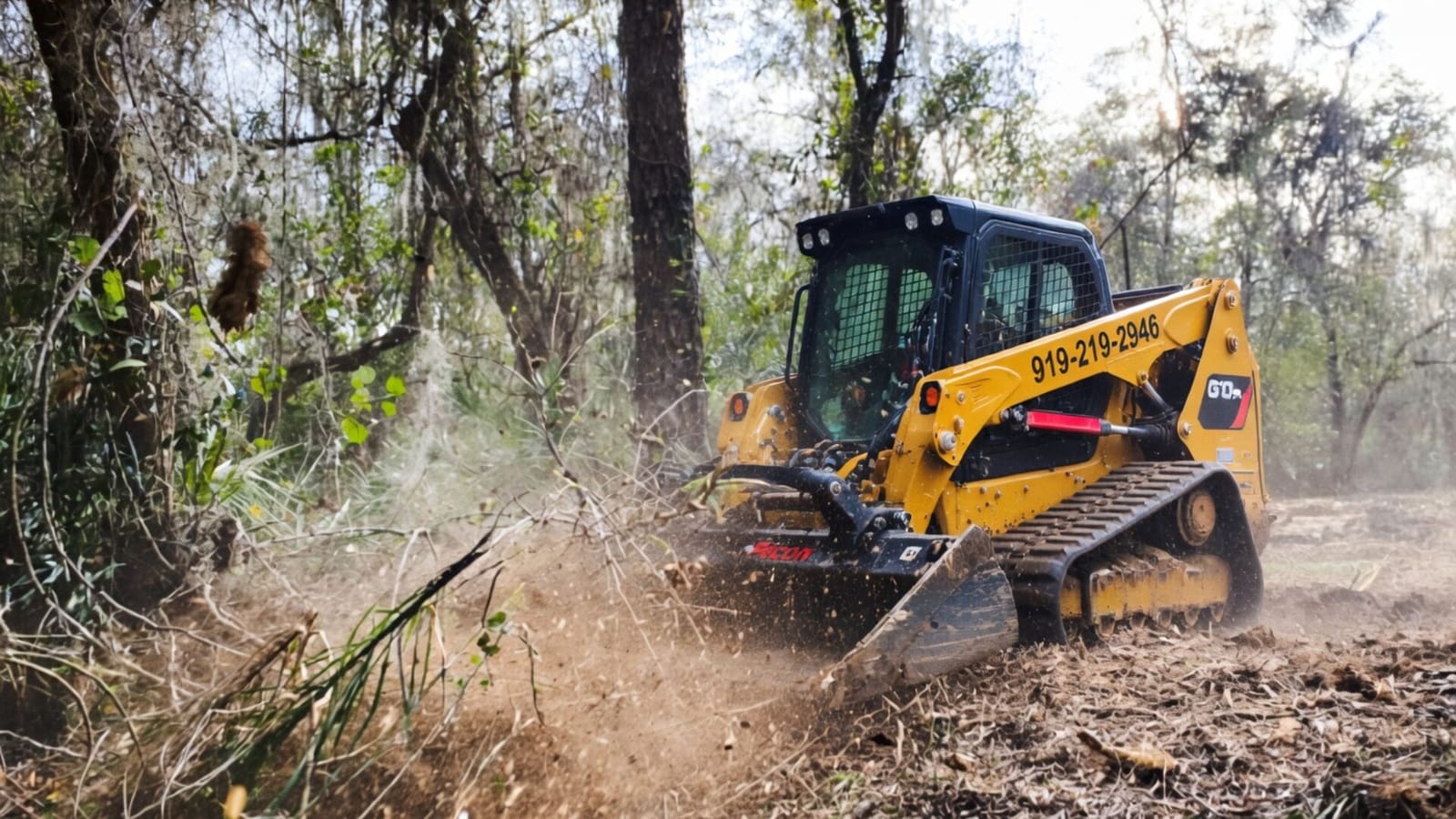
- Wait, then cut. Where trees must come down, treat first, wait about 30 days for symptoms to show, and then cut. Our crew then fells the larger stems and runs the mulcher through the thicket, grinding stems and stumps flush with the ground and leaving nothing to haul.
- Come back for the suckers. Expect new shoots the following season from roots the treatment did not reach. A return visit cuts and mulches them, with the applicator retreating where needed.
- Keep watching for a few years. Control takes persistence over several years, and a quick check each summer catches new shoots while they are small.
Pro tip: Book the applicator and the clearing together. The treat-then-wait order means the cutting usually falls in late summer or early fall, so settling both dates early keeps the job on schedule.
What Tree of Heaven Removal Costs
Clearing tree of heaven and the brush around it usually runs $1,500 to $2,500 an acre, the brush band on our Eagle Point pricing page. A dense grove of larger stems prices as forestry mulching, $1,500 to $4,000 an acre, and a whole parcel cleared to a finish runs to $4,500.
| Job | Typical range | Notes |
|---|---|---|
| Trees and suckers along a fence line or under trees you keep | $1,500 – $2,500 per acre | Narrow strips counted by their acreage equivalent |
| Dense grove with larger stems | $1,500 – $4,000 per acre | The forestry mulching band |
| A small patch beside a house or drain field | $1,500 minimum charge | Where small jobs start, not a fee on top |
| Return visits for suckers | Priced per visit | Each listed in the quote as its own line |
| Herbicide treatment | Separate trade | Quoted by a licensed applicator |
| Each pass grinds stems and stumps into mulch on site, flush with the ground, with nothing hauled away. Full stump removal below grade, and cutting and hauling a very large tree near a house, are discussed and priced in the quote. Grading is not part of our price. | ||
| What moves a job inside its band is stem count, how far the suckers have spread, the number of keeper trees the machine works around, the slope, and how wet the ground is. The Eagle Point forestry mulching cost guide explains how to compare an hourly bid with a per-acre one. |
Tree of Heaven Around the Rogue Valley and the Coast
Eagle Point and the Rogue Valley. Around Eagle Point, White City and Medford, tree of heaven is on Jackson County’s noxious weed list without the widespread mark that Armenian blackberry carries. Where both grow on one property, a single clearing visit can take both. Two local conditions shape the plan. Inside the Rogue Basin open burning control area, burning brush and stumps from a clearing job needs a DEQ letter permit, so mulching in place is the simple answer. And the flat ground north of Medford holds winter water above a shallow hardpan, which suits the treat-then-cut timing: the cutting lands in late summer or early fall, while the ground is still firm. Start at our Eagle Point land clearing page for the towns, ground and permits. Lincoln City and the central coast. The same plan applies on the coast, though there the bigger brush job is usually Scotch broom, covered in our Scotch broom removal guide. Burning clearing debris within three miles of Lincoln City needs a DEQ letter permit as well. See the Lincoln City land clearing page for that market. Elsewhere in Oregon. The tree is very abundant along the Columbia River and spreading along the Snake River reservoirs. The method does not change; the statewide picture of burning, fire season and forest conversion rules is in the Oregon land clearing cost guide.
Frequently Asked Questions
Are trees of heaven invasive in Oregon?
Yes. Tree of heaven is a B-rated noxious weed in Oregon and a key host of the spotted lanternfly. It spreads by seed and by root suckers that form thickets.
Can I just cut down a tree of heaven?
Not on its own. Cutting triggers stump sprouts and root suckers. The order that works is to treat first, wait about 30 days, then cut, and return for the suckers.
When is the best time to remove tree of heaven?
Treatment runs from July to October, when the tree moves sugars to its roots. The cutting and mulching follow about a month later, then a return visit the next season.
How much does tree of heaven removal cost in Oregon?
Clearing usually runs $1,500 to $2,500 an acre, and dense groves $1,500 to $4,000, with a minimum charge of about $1,500. Return visits are priced per visit, and herbicide is a separate trade.
Get Tree of Heaven Off Your Land
Request a free quote and we’ll contact you to discuss your property, access and the clearing you need. Our crew plans tree of heaven in the order that works: treated by a licensed applicator, cut and mulched, then checked again the next season. Read more: per-acre rates on the Eagle Point pricing page.
More from the Cut Brush Blog
Keep reading for more tips and guides on land clearing.
 Cost Guide
Forestry Mulching Cost in Eagle Point, OR (2026)
Forestry mulching in Eagle Point, OR costs $1,500 to $4,000 an acre. Compare hourly quotes, rental costs and seasonal work windows. Request a free quote.
 Cost Guide
Land Clearing Cost Per Acre in Oregon (2026 Guide)
Land clearing in Oregon runs $1,500 to $4,500 an acre with our crew. How blackberry, broom, juniper, wet ground and DEQ burn rules move the price on your land.
Let's Get Started on Your Land
Request a free quote. We'll contact you to discuss your property, access, and the clearing you need.
Get a Free QuoteOr call us directly: (919) 525-3950