
Bradford Pear Removal in Ohio: The Ban and the Cost
Cut Brush Team · October 2, 2026 · 7 min read

Every April the highway shoulders, rail lines and old fields of Northeast Ohio turn white for a week or two before anything else has leafed out. Most of that bloom is callery pear: the Bradford pears planted along streets and parking lots for decades, and the thorny wild trees they have seeded into every idle field and fence row around them. Bradford pear removal in Ohio usually starts with a question about the law and ends with a question about the back forty.
Ohio is one of the few states that has acted on this tree. This guide covers what the ban does and does not require, why the wild thickets keep spreading, why cutting alone never finishes them, what clearing costs per acre, and how the work fits Northeast Ohio’s ground and burning rules.
Are Bradford Pear Trees Illegal in Ohio?
Selling and spreading them is; owning one is not. Callery pear is on Ohio’s invasive plant list, under Ohio Administrative Code 901:5-30-01, which says “No person shall sell, offer for sale, propagate, distribute, import or intentionally cause the dissemination of any invasive plant.” Callery pear had a grace period that ended on January 7, 2023.
The Ohio State University Extension summed up the effect: “As of January 7th, 2023, Callery Pear, Pyrus calleryana and its cultivars will no longer be able to be bought or sold in Ohio.” It was just as clear about the trees already in the ground: “Existing trees do not require removal.” The rule itself allows owners to dispose of the plant and to control it.
So no one will make you cut down the pear by your driveway. The reason most Ohio owners remove them is what their offspring do to open land.
Is a Cleveland Select Pear Any Different?
Not under the law, and not much in the field. “Cleveland Select” is a callery pear cultivar, despite the local-sounding name, and Ohio’s ban covers Pyrus calleryana “and its cultivars.” Bradford, Cleveland Select, Aristocrat and the rest are the same species bred for different shapes.
That variety is also how the problem started. OSU Extension notes that “research has demonstrated that the various cultivars of P. calleryana can cross pollinate and produce viable offspring.” A street planted with one variety stayed tidy. Streets and parking lots planted with several began setting fruit, and birds carried it everywhere.
Why Do Wild Callery Pear Thickets Spread So Fast?
Because the offspring grow anywhere a bird drops a seed. OSU Extension lists the places to look: “roadsides, fence rows, disturbed sites and woodlands.” Fields that sit idle for a few seasons around Medina, Lorain or Geauga counties fill in quickly once one fruiting tree is nearby.
The wild trees are nothing like the ornamental parent. Clemson’s Home and Garden Information Center notes thorns “sometimes up to 3” long!” and reports that “many have reported the loss of tires from Callery pear thorn punctures.” A field going to callery pear is a field you cannot mow, graze or walk without gloves and patience.
Ohio is seeing the push from the other direction too. In March 2026 MetroParks of Butler County ran its “Pearmageddon” exchange, giving residents who cut down a callery pear “a replacement tree or bush of a local, native species for free,” WOSU reported. That program is in southwest Ohio; we found no similar exchange in Northeast Ohio as of October 2026.
Why Doesn’t Cutting Callery Pear Finish It?
Because it comes back from the stump and the roots. Penn State Extension puts it plainly: “Cutting or mowing effectively eliminates the low cover and provides access to overgrown sites, but plants will readily resprout.” Fire is worse; Clemson warns that “for every stem that a fire kills, four more will resprout in its place.”
Two habits make thickets worse. Mowing a stand every year keeps it short but can turn each stem into several. And leaving seed trees standing guarantees a return; Penn State notes callery pear “will likely reinvade areas where it has been removed as long as a seed source remains nearby.”
The plan that works has three parts: clear the thicket, cut the resprouts on a schedule, and remove the seed trees on your own land. Cut Brush does mechanical work only and applies no herbicide. Chemical treatment of fresh stumps is work for a licensed applicator, who can be scheduled alongside the clearing.
What Does Bradford Pear Removal Cost in Ohio?
Clearing a wild callery pear thicket typically runs $1,500 to $2,500 per acre, the brush and understory band on our Cleveland pricing page. Stands that have grown into small woods price higher, and resprout passes are priced per visit.
| Job | Typical range | Who does it |
|---|---|---|
| One ornamental pear near a house, roof or wires | Priced per tree | An insured tree service; it is climbing and rigging work |
| Ornamentals in open ground a machine can reach | Starts near the $1,500 project floor | A clearing crew |
| Wild callery thicket on a field edge or fence row | $1,500 – $2,500 per acre | Forestry mulching |
| Mature callery stand with trees to fell | $1,500 – $4,500 per acre | Land clearing |
| Resprout passes | Priced per visit | Scheduled for the next one to two growing seasons |
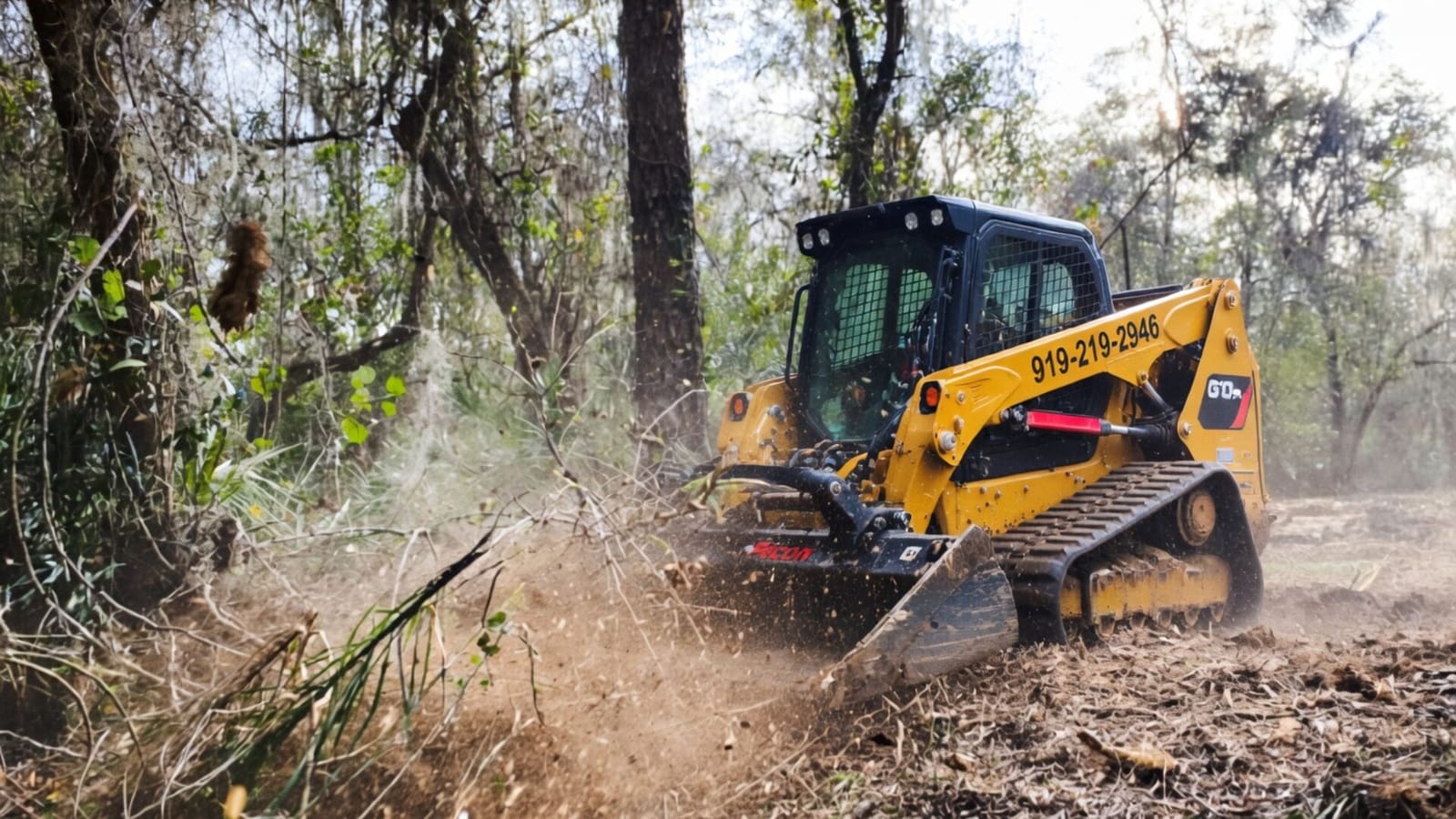
Thorns change the work. Mulching grinds the thorny branches into chips on the spot, so nothing sharp is left for tires, livestock or bare feet. For the full per-acre picture, see the Ohio land clearing cost guide.
Pro tip: Flag every callery pear on the property the week it blooms. In April they are the only white trees in the woods, which makes them easy to find. By the time you schedule clearing in late fall, the flags are your map.
Clearing Callery Pear in Northeast Ohio
Burning is restricted when most people want to do it. Under Ohio Revised Code 1503.18, burning brush in the open is banned outside municipal limits in March, April, May, October and November from 6 a.m. to 6 p.m. Those are exactly the months owners tend to clean up a field. Burning also leaves the stumps to resprout. Grinding the thorny wood in place avoids both problems.
Wet ground decides the calendar. Northeast Ohio’s heavy, wet soils can keep a machine off a field for weeks in spring. Late summer through early winter is usually the window; our guide to clearing wet ground in Northeast Ohio explains why, and our Cleveland permit guide covers the paperwork for larger clearings.
Tree of heaven often shares the ground. Old fields and rail edges that grow callery pear often grow tree of heaven too, and that one needs a different order of work, because it is the spotted lanternfly’s favorite host. Our Ohio tree of heaven removal guide covers it. Start at land clearing in Northeast Ohio.
Frequently Asked Questions
Are Bradford pear trees illegal in Ohio?
Selling, propagating and distributing callery pear, including Bradford and its other cultivars, has been illegal in Ohio since January 7, 2023. Keeping a tree that is already in the ground is legal, and OSU Extension notes that existing trees do not require removal.
Is Cleveland Select pear banned in Ohio too?
Yes. Cleveland Select is a callery pear cultivar, and Ohio’s rule covers Pyrus calleryana and its cultivars.
Is there a Bradford pear exchange in Northeast Ohio?
We found none as of October 2026. MetroParks of Butler County in southwest Ohio ran a free replacement program in spring 2026; check your local park district each spring.
How much does Bradford pear removal cost in Ohio?
A single yard tree near a house is priced per tree by a tree service. Wild callery thickets typically clear for $1,500 to $2,500 per acre, mature stands can price as land clearing at $1,500 to $4,500 per acre, and small jobs carry a practical floor near $1,500.
Will callery pear grow back after it is cut?
Yes, from the stump and roots, unless the resprouts are cut again on a schedule or treated by a licensed applicator. Removing the seed trees on your own land keeps new seedlings from coming back.
Can I burn the cut pear trees?
Outside city and village limits, not between 6 a.m. and 6 p.m. in March, April, May, October or November under Ohio law, and local rules can be stricter. Mulching the wood in place avoids the question and leaves no thorny piles.
Get Ahead of the Pears Before They Bloom
Whether it is a row of aging street pears along a drive in Strongsville, a white stripe of wild pear along a fence line outside Medina or a field going to thorns in Geauga County, every spring the thicket spreads further. Cut Brush quotes Bradford pear and callery pear removal across Northeast Ohio with the whole job in view: the thicket cleared, the thorns ground in place and the resprout passes priced up front.
More from the Cut Brush Blog
Keep reading for more tips and guides on land clearing.
 Guide
Tree of Heaven Removal in Ohio: Lanternfly and Cost
Tree of heaven removal in Ohio, now that spotted lanternfly is quarantined statewide: why cutting makes it worse, the order that works, and the cost.
 Guide
Clearing Wet Ground in Northeast Ohio: When to Book the Work
Northeast Ohio soils perch water inches under the surface from October to June. Here is how that sets the clearing calendar and what it does to your parcel.
Guide Autumn Olive Removal in Ohio: Visits, Timing and Cost
Autumn olive removal in Ohio: $1,500 to $2,500 an acre for old fields. Why cutting makes it bushier, plus the sprout visits to plan. Request a free quote.
Let's Get Started on Your Land
Request a free quote. We'll contact you to discuss your property, access, and the clearing you need.
Get a Free QuoteOr call us directly: (919) 525-3950