
Tree of Heaven Removal in Ohio: Lanternfly and Cost
Cut Brush Team · October 2, 2026 · 8 min read

It came up through a crack along the garage a few years ago, and now there is a grove of them: smooth gray trunks, long leaves like a giant fern, a smell like burnt peanut butter when you snap a twig, and every summer a few more sprouting farther out across the yard. Lately there are spotted lanternflies on the trunks too. Tree of heaven removal in Ohio has become a much more common question since 2026, and it is a job where the obvious first move, cutting the trees down, is exactly the wrong one.
This guide covers why the lanternfly made this tree a priority, how to tell it from native lookalikes, why cutting it multiplies it, the order of work that actually removes a colony, what it costs, and how the job fits Northeast Ohio.
Why Does Spotted Lanternfly Make Tree of Heaven a Priority?
Because it is the insect’s favorite host, and the insect is now quarantined across the whole state. Ohio State University Extension reported that “the Ohio Department of Agriculture (ODA) issued a statewide quarantine in Ohio for the invasive Spotted Lanternfly (SLF) effective February 17, 2026,” and that “previously, 18 Ohio counties were under quarantine.” The same report is direct about the tree: “An invasive tree known as tree of heaven is the primary host for spotted lanternfly.”
Cleveland learned this early. When state, federal, OSU and Cleveland Metroparks staff scouted the city’s east side in June 2022, they found lanternfly nymphs at Mill Creek Park, Paramelt and Saint Joseph Cemetery, and at the cemetery, “the majority were found feeding on Tree of Heaven,” OSU Extension reported.
The tree was already unwelcome. Ohio lists Ailanthus altissima first on its invasive plant rule, Ohio Administrative Code 901:5-30-01, which bans selling, propagating or distributing it. A stand of tree of heaven on your land is now a lanternfly nursery as well as a weed.
How Do You Tell Tree of Heaven From Sumac or Walnut?
Look at the edges of the leaflets, then smell a broken twig. Tree of heaven has long compound leaves that look a lot like staghorn sumac and black walnut, both natives worth keeping. Penn State Extension gives the clean test: “The leaflet edges of these native trees all have teeth, called serrations, while those of tree-of-heaven are smooth.” Tree of heaven leaflets carry one or two small bumps, glands, near the base instead.
Then the smell. “When crushed, the leaves and all plant parts give off a strong, offensive odor,” Penn State notes. Sumac and walnut do not smell like that.
Get this right before anything is cut or treated. Taking out a stand of sumac by mistake costs you a native plant and does nothing about the lanternflies.
Why Does Cutting Tree of Heaven Make It Worse?
Because the tree answers a chainsaw with dozens of new stems. Penn State is blunt: “A cut or injured tree-of-heaven may send up dozens of stump and root sprouts,” and “mechanical methods, such as cutting or mowing, are ineffective, as the tree responds by producing large numbers of stump sprouts and root suckers.”
The roots travel. Penn State notes that root suckers “may emerge as far as 50 feet from the parent tree.” The seeds travel farther; a female tree “has the potential to produce more than 300,000 seeds annually.”
Cornell’s integrated pest management program makes the same warning from the lanternfly side: “if tree of heaven is not properly removed, a single tree can turn into a grove of saplings as they can multiply via their root system,” and where removal is pursued, “a registered systemic herbicide should be used to limit regrowth,” Cornell CALS notes.
In other words: cut first, and you trade one tree for a thicket.
The Order of Work That Actually Removes a Colony
Treat the standing trees, wait, then clear the dead stand. The sequence Cut Brush quotes:
- Map the colony. Flag every stem, including the knee-high suckers well away from the big trees. They are all one root system.
- A licensed applicator treats the standing stems. Cut Brush applies no herbicide, so this step is done by a licensed applicator you hire, timed to when the tree is pulling energy down into its roots, usually summer. Treating the live tree carries the herbicide into the root system that would otherwise sprout.
- Wait for the stems to die. Cutting before then triggers the very sprouting the treatment is meant to stop.
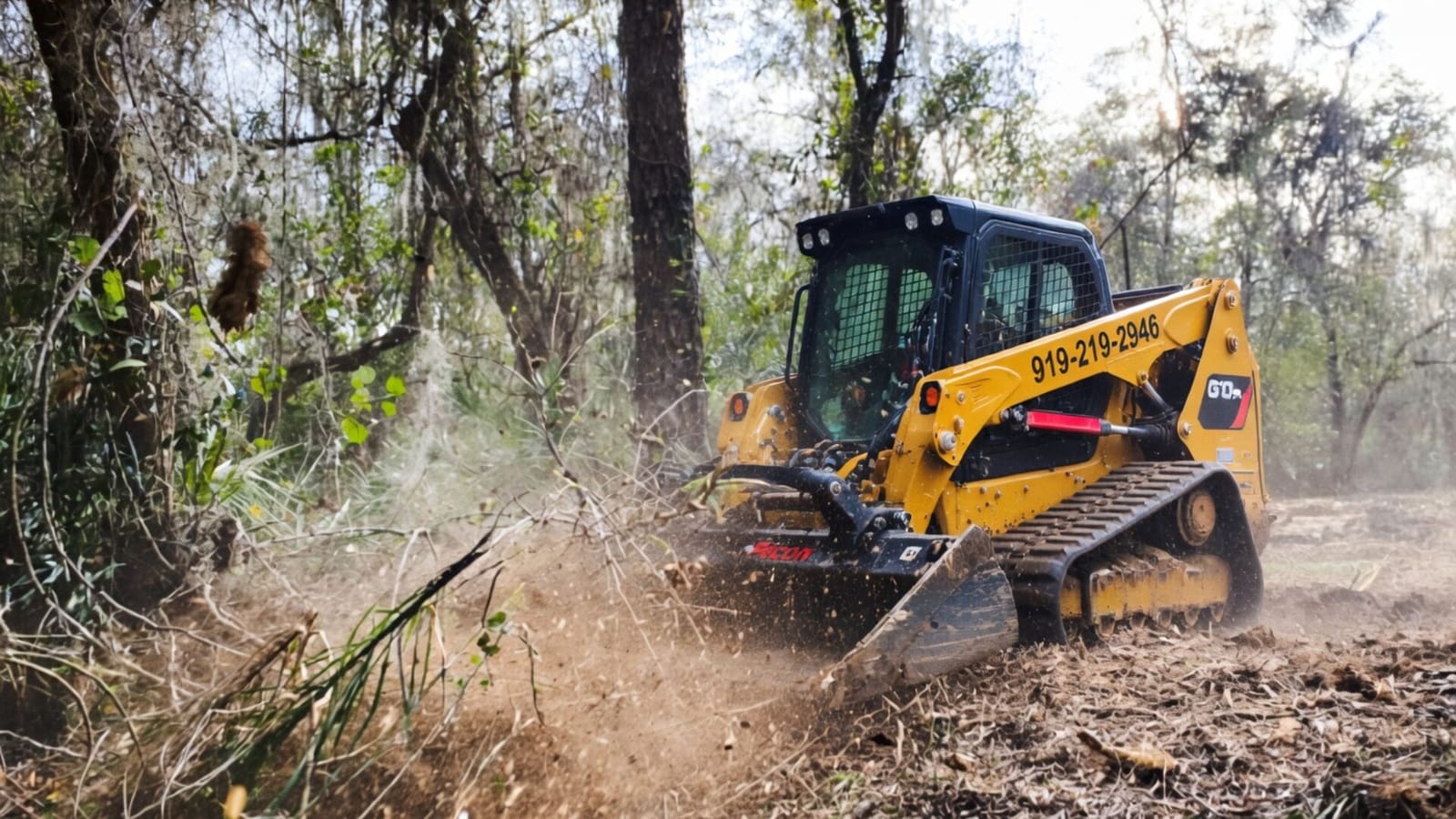
- Mulch the dead stand. A forestry mulcher drops and grinds the dead trees and the brush around them into chips, with nothing to haul and nothing to burn.
- Walk it the next season. Pull or cut any seedlings and stragglers while they are small, and have the applicator touch up any live sprouts.
If you choose not to use any treatment at all, the honest alternative is to clear the stand and then cut the sprouts back again and again for several seasons, accepting that a tree of heaven root system is very hard to exhaust that way. We will tell you which route fits your property before anything is cut.
Pro tip: Leave the big female trees, the ones hung with tan seed clusters in fall, for last in the walk-through but first in the treatment plan. Each one is a seed source for hundreds of thousands of new trees a year.
What Does Tree of Heaven Removal Cost in Ohio?
Clearing a dead or dying tree of heaven stand typically runs $1,500 to $2,500 per acre for brush and small stems, the brush and understory band on our Cleveland pricing page. Larger trees and mixed stands price as land clearing.
| Job | Typical range | Notes |
|---|---|---|
| Sucker thicket and small stems | $1,500 – $2,500 per acre | The brush and understory band |
| Colony with trees to fell and grind | $1,500 – $4,500 per acre | The land clearing band |
| Small backyard grove | Starts near the $1,500 project floor | Getting equipment to the site sets the floor |
| Herbicide treatment of standing stems | Separate trade | Quoted by a licensed applicator |
| Follow-up walk and seedling cutting | Priced per visit | The season after clearing |
Trees beside a house, garage or wires are tree service work, priced per tree. For the full per-acre picture, see our Ohio land clearing cost guide and our Cleveland forestry mulching cost breakdown.
Tree of Heaven in Northeast Ohio
It favors the same ground everywhere: rail lines, vacant lots, field edges and the cracks of old pavement. In Cuyahoga, Lorain and Lake counties that means rail corridors, the backs of industrial and commercial lots, and the edges of fields that have sat idle.
Burning is restricted. Under Ohio Revised Code 1503.18, burning brush outdoors is banned outside municipal limits from 6 a.m. to 6 p.m. in March, April, May, October and November. Burning also does nothing to the roots. Grinding the dead stand in place avoids the question.
Wet ground sets the calendar. Heavy Northeast Ohio soils can keep a machine off a site for weeks after a wet spell. Our guide to clearing wet ground in Northeast Ohio explains the timing, and our Cleveland permit guide covers larger clearings.
Callery pear often grows alongside it. The same old fields that grow tree of heaven usually have callery pear moving in, and Ohio has banned that one from sale too. Our Ohio Bradford pear removal guide covers it. Start at land clearing in Northeast Ohio.
Frequently Asked Questions
Does removing tree of heaven help with spotted lanternfly?
Tree of heaven is the insect’s primary host, according to OSU Extension, and Ohio placed the whole state under quarantine in February 2026. Removing a stand takes away the host on your land, but it has to be done properly; a tree that is just cut down sends up a grove of sprouts.
Can I just cut down a tree of heaven?
Not on its own. Penn State Extension says cutting or mowing is ineffective because the tree responds with large numbers of stump sprouts and root suckers. Treat the standing tree first, let it die, then clear it.
How do I know it is tree of heaven and not sumac?
Tree of heaven leaflets have smooth edges with a small gland near the base, and crushed leaves smell strongly unpleasant. Sumac and black walnut leaflets have toothed edges.
Is tree of heaven illegal in Ohio?
It is on Ohio’s invasive plant rule, which bans selling, propagating and distributing it. Having one on your property is not illegal, but it is a host for spotted lanternfly.
How much does tree of heaven removal cost in Ohio?
Brush and small stems typically clear for $1,500 to $2,500 per acre, colonies with trees to fell for $1,500 to $4,500 per acre, and small jobs start near $1,500. Herbicide treatment by a licensed applicator is a separate cost.
Does Cut Brush spray the trees?
No. Cut Brush does mechanical work only. A licensed applicator treats the standing trees, and Cut Brush clears the dead stand afterward.
Get the Tree of Heaven Off Your Property
Whether it is a grove along a rail line in Lorain County, a colony at the back of a commercial lot in Cleveland or a line of suckers marching across a yard in Lake County, every season it is left alone means more roots and more lanternflies. Cut Brush quotes tree of heaven removal across Northeast Ohio in the order that works: the colony mapped, treated by a licensed applicator, then cleared and walked the following season.
More from the Cut Brush Blog
Keep reading for more tips and guides on land clearing.
 Guide
Bradford Pear Removal in Ohio: The Ban and the Cost
Bradford pear removal in Ohio: what the state's callery pear ban covers, why wild thickets keep spreading, and what clearing them costs per acre.
 Guide
Clearing Wet Ground in Northeast Ohio: When to Book the Work
Northeast Ohio soils perch water inches under the surface from October to June. Here is how that sets the clearing calendar and what it does to your parcel.
Guide Autumn Olive Removal in Ohio: Visits, Timing and Cost
Autumn olive removal in Ohio: $1,500 to $2,500 an acre for old fields. Why cutting makes it bushier, plus the sprout visits to plan. Request a free quote.
Let's Get Started on Your Land
Request a free quote. We'll contact you to discuss your property, access, and the clearing you need.
Get a Free QuoteOr call us directly: (919) 525-3950