
Chinese Tallow Removal in Florida: Why Cutting It Is Not Enough
Cut Brush Team · September 3, 2026 · 4 min read

If you own land anywhere in Central Florida, you almost certainly have Chinese tallow on it. It is found in almost every county in Florida, and most owners have been looking at it for years without knowing what it is.
It is also one of the few trees where cutting it down is the beginning of the job rather than the end.
What It Is and How It Got Here
Chinese tallow (Triadica sebifera) is a small to medium tree native to China that was introduced into the United States as an ornamental in the 18th century. It grows up to about 30 feet and has invaded a wide range of natural communities, from wetland to upland habitats. Source: UF/IFAS publication AG148.
People sometimes call it the popcorn tree, for the white waxy seeds that split open on the branches in autumn. Those seeds are a large part of why it spreads so effectively: birds move them, and a single mature tree seeds a wide area around itself.
Why a Cut Alone Fails
This is the part that costs people money twice.
Cut a mature tallow at ground level and you have removed the visible tree while leaving a living stump and a seed bank in the soil around it. What comes back is not one tree but a thicket of resprouts and seedlings, often denser and harder to work than what you started with.
The UF/IFAS guidance is specific about the alternative:
- Mature trees: cut down with a chainsaw and apply herbicide to the freshly cut stump. Timing matters here; the treatment goes on the cut surface while it is fresh.
- Immature plants: remove by hand.
- Seedlings: pull by hand before they reach seed-bearing maturity, which is what stops the cycle restarting.
- Effective actives: herbicides containing triclopyr ester and triclopyr amine are the most effective.
None of that is exotic, but all of it is more than “cut the tree down,” and it is the difference between a parcel that stays clear and one that does not.
Where Mulching Fits
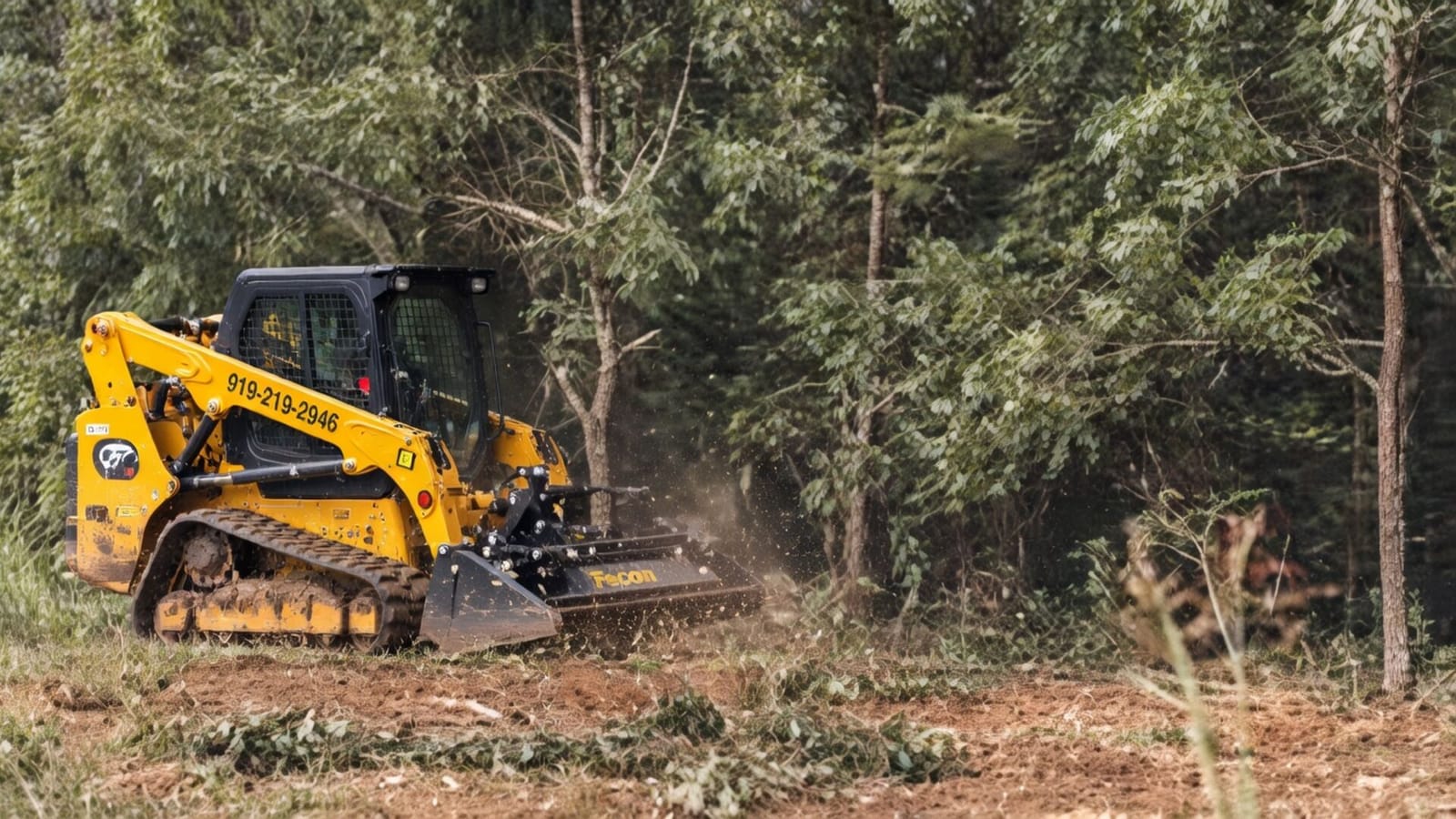
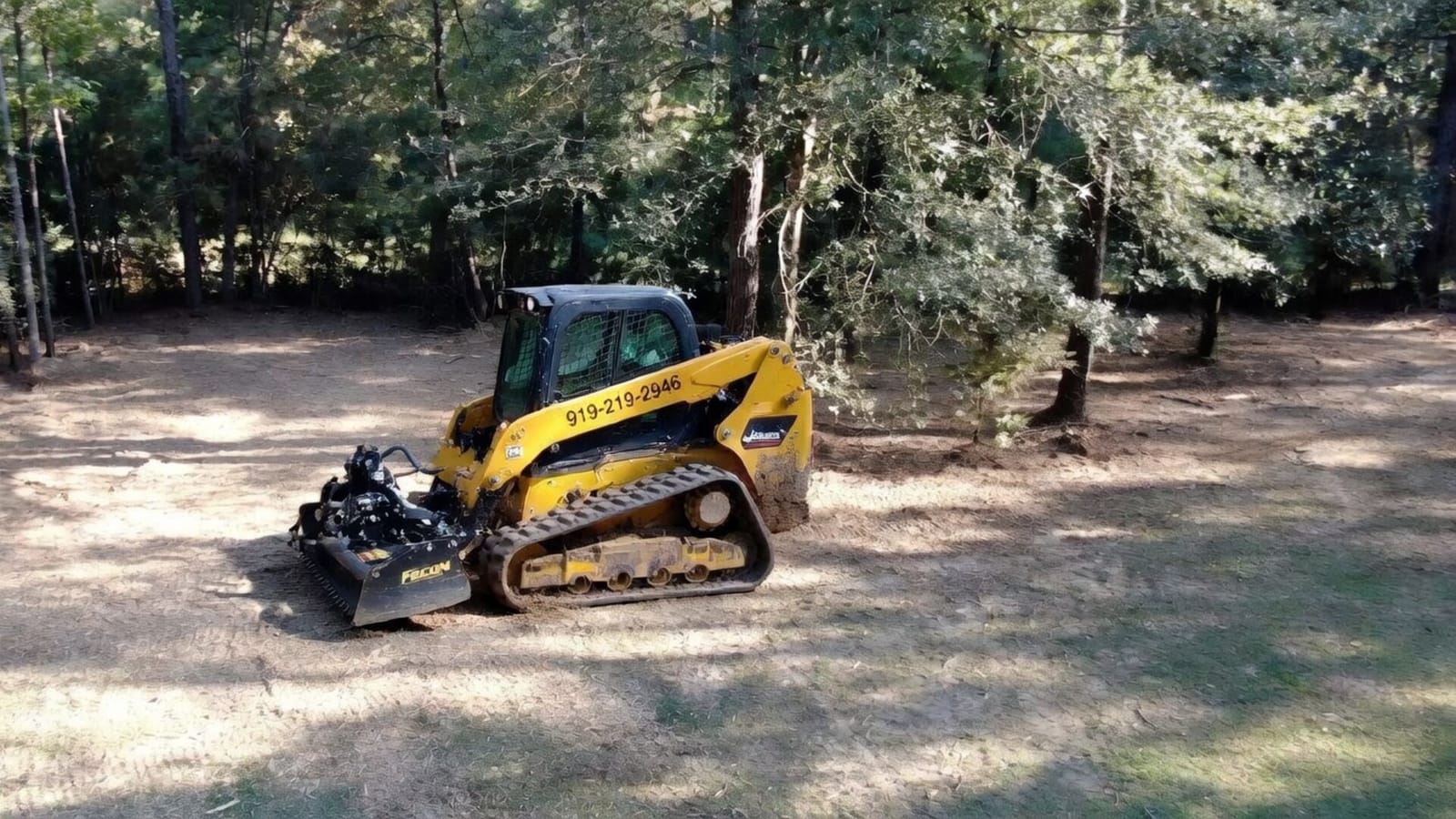
A forestry mulching pass is very good at opening a parcel that has been taken over. It processes the standing growth where it is and leaves it as a mat, which matters especially in Orange County where burning yard waste and tree-cutting debris on residential property is prohibited without an air curtain incinerator or a Florida Forest Service authorization the county will not grant.
What a mulching pass does not do is kill a tallow stand on its own, for the same reason cutting does not. So the honest sequence on an infested parcel is: open it with a machine, then treat what needs treating, then keep an eye on seedlings for a couple of seasons.
Anyone who quotes you a single pass as a permanent solution to tallow is quoting the part they can see.
What to Plant Instead
If you are taking out a stand that was providing shade or autumn color, UF/IFAS suggests the space can be used for a native or non-invasive replacement, with blackgum, maples, dogwood, and crepe myrtles offering fall color comparable to what tallow gave you.
That is worth planning at the same time as the removal rather than afterwards, because a bare spot invites the next thing.
The Other One to Watch: Camphor
While you are looking, check for camphor tree as well. It is invasive in North and Central Florida, was brought to Florida for cultivation in 1875, and is easy to identify because the shiny green leaves smell strongly of camphor when crushed. Mowing is effective on seedlings, and herbicide works on trees and stumps. Source: UF/IFAS Gardening Solutions.
UF/IFAS also publishes general guidance on removing invasive trees in Central Florida that is worth reading if you are working through a parcel yourself.
One Local Complication
Before you take anything out, remember that Orange County requires a permit to remove a tree larger than four inches in diameter at chest height on private property, with fees of $25 per acre residential and $50 per acre commercial. That threshold catches a lot of tallow, since it grows fast and reaches four inches early.
It is worth asking the county how removal of a documented invasive is handled on your parcel rather than assuming either way. Our Orange County permit guide covers the rules and the arborist contact.
What It Costs
Clearing work that includes invasive removal around Orlando generally runs within the standard bands: $1,500 to $2,500 per acre for brush and invasive passes, up to $4,500 where the work is heavy or a lot of protected canopy has to be preserved. The treatment programme is priced separately because it is separate work. Full ranges are on the Orlando pricing guide.
If you have a parcel disappearing under tallow anywhere around Orlando, Apopka, Sanford, Kissimmee, or Clermont, get a free quote from a qualified local contractor who will tell you plainly what the pass costs, what the follow-through costs, and what happens if you skip the second one.
Related Services
Learn more about the services mentioned in this article.


More from the Cut Brush Blog
Keep reading for more tips and guides on land clearing.
 Cost Guide
 Forestry Mulching Cost in Orlando (2026 Pricing)
Forestry mulching cost in Orlando runs $1,500 to $4,000 per acre. Why it beats hauling in a county where you cannot burn debris, and what drives the hours.
 Guide
Guide Orange County Tree Removal Permits: The Four-Inch Rule and the Burn Ban You Cannot Get Around
Orange County requires a permit to remove trees over four inches. Here is what that means for clearing a lot near Orlando, what it costs, and why you cannot burn the debris.
Cost Guide Land Clearing Cost Per Acre in Florida (2026 Guide)
Land clearing cost per acre in Florida runs $1,500 to $4,500. See 2026 Ocala and Marion County pricing by vegetation type, then get matched with a local pro.
Ready for a Free Quote?
Get a free, no-obligation quote from a qualified local contractor in Orlando & Central Florida. Cut Brush will connect you with the right local expert.
Get Your Free QuoteOr call us directly: (919) 525-3950