
Land Clearing and Grading Cost in Ohio (2026 Guide)
Cut Brush Team · October 9, 2026 · 8 min read

You have a wooded lot, a builder ready to start, and two questions nobody answers in one place: what it costs to get the trees off, and what the dirt work will run after that. Clearing an Ohio building site runs $1,500 to $4,500 an acre with Cut Brush, and our crews do it in Cuyahoga, Lake, Geauga, Medina and Lorain counties, from Elyria and Grafton to Mentor and Chesterland. Grading comes after us, on a separate bill from your excavating contractor.
At a glance:
- Two invoices: we bill the clearing by the acre; an excavating contractor bills the grading, compaction and stone.
- Ohio EPA stormwater coverage applies to construction that disturbs one acre or more, or less if the lot is part of a larger common plan of development. The agency’s small-site fact sheet lists a $200 fee for one to five acres and filing 21 days before ground is broken; check the current fee when you file.
- Utility locates: Ohio law has the excavator call the protection service at least two working days, and no more than 16 calendar days, before digging.
- Cleveland: the city asks for a stormwater pollution prevention plan once the disturbed area is greater than an acre.
- Licensing: Ohio’s state-licensed construction trades are HVAC, refrigeration, electrical, plumbing and hydronics. Excavation is not on that list, so ask a grading contractor for insurance and any city registration.
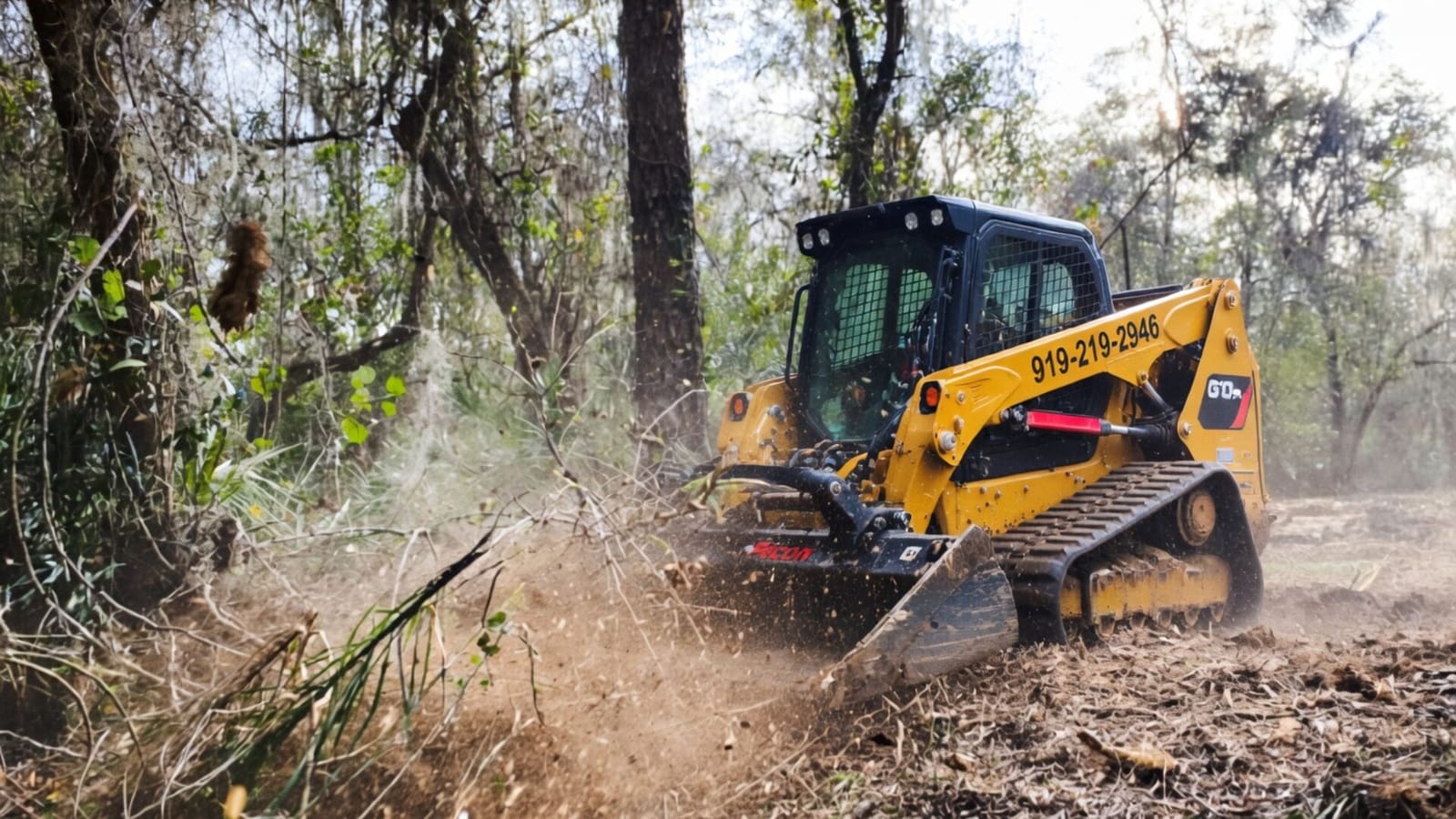
Our part ends when the footprint, drive and utility line are free of trees and stumps and the grader has clean soil to cut. We never grade, build pads, install septic or file permits. Our crew works from Cleveland: tell us where your lot is, and we will contact you about the site, the access and the clearing it needs.
What Clearing and Grading Cost in Ohio, Phase by Phase
A house lot goes through a clearing crew first and an excavating contractor second. Here is what each phase costs and who does it:
| Phase | Who does it | Price | What the lot looks like after |
|---|---|---|---|
| Trees and stumps out of the house site, drive and utility line | Cut Brush | $1,500 – $4,500 an acre equivalent | Bare footprint, ready to stake |
| Thinning or mulching the woods you keep around the yard | Cut Brush | $1,500 – $4,000 an acre | Open woods, chip mat on the floor |
| Cutting, filling and compacting the pad and drive | Your excavating contractor | Their bid, by the hour or by the job | Level pad, crowned to shed water |
| Stone and fill | Your excavating contractor and a local yard | Delivered price from the nearest yard | Base for the drive and the slab |
Where these numbers come from. Our two rows are copied from the Cleveland pricing page, which lists lot and homesite prep at $1,500 to $4,500 an acre equivalent and says plainly that grading, compaction and stone are separate line items. Every parcel also carries a practical floor near $1,500. For a sense of the second bill, Ohio State’s 2026 farm custom rate survey put bulldozer work at an average of $164.64 an hour from 14 answers; a contractor hauling a machine to a residential lot often charges more than a farm neighbour would.
If you are not building, the Ohio land clearing cost per acre guide prices clearing alone, and the Ohio forestry mulching cost guide prices woods that stay standing.
Why Ohio Grading Bids Vary So Much
Dense till under the topsoil. Across the western and central till plain, the Blount soil reaches dense till at 30 to 60 inches, with 35 to 45 percent clay above it and water perched half a foot to two feet down (USDA NRCS). A basement dug into that is slow going, the spoil is sticky when wet and makes poor fill, so it often leaves the site while better fill comes in.
Ground that holds water. The Pewamo soil, about 1.8 million acres across central and northwestern Ohio and beyond, keeps water from a foot above the surface to a foot below it from December to May. On ground like that, pads get raised and crowned rather than cut, and the money shifts from digging to fill and stone.
Old drain tile under former fields. OSU’s 2026 survey puts the typical depth of farm drainage tile at 33 inches, with laterals about 34 feet apart. A homesite carved out of a tiled field will almost certainly cross old lines, and each cut line has to be found and rerouted or repaired, or the new yard becomes the field’s outlet.
Red clay and slips in the southeast. The Upshur soil has a red clay subsoil that is very sticky, with high shrink-swell and medium to very rapid runoff, on slopes up to 70 percent. A pad cut into a hillside there may need an engineer’s look at the slope before any dozer starts.
Keeping silt fence working. Ohio EPA has permitted sites inspect their controls every seven days and within 24 hours of any storm over half an inch, with repairs inside three days. On clay that stays wet most of the year, a lot left open from autumn to spring pays for those checks week after week. When we clear close to your excavator’s start date, that bill shrinks.
Pro tip: Before we clear, ask the seller or the farmer who rented the ground for any tile map, and flag every outlet you can find plus any streak that stays green through a dry August. Hand that to your excavating contractor before grading. Finding a line on paper is cheaper than finding it crushed after the first spring rain.
Clearing and Grading Costs Across Ohio
Northeast Ohio, where our crews clear. Much of the Cleveland area sits on Mahoning, Ellsworth and Canfield till. Canfield has a fragipan 15 to 30 inches down with water perched above it from November to April, which is why footings and drives here are often wetter than buyers expect. Cuyahoga Soil and Water Conservation District reviews stormwater plans for sites disturbing an acre or more, and our Cleveland and Cuyahoga County permit guide walks through the local steps.
The northwest lake plain. On the former Black Swamp around Paulding, Napoleon and Bowling Green, the state survey maps the Paulding Clay Basin as easily ponded. Fill, crowned pads and drainage outweigh cuts on the grading bill.
The central and western till plain, and the karst belt. Blount and Pewamo ground around Lima, Marion and Findlay is dense, wet clay, usually with tile beneath it. Near Bellevue and Castalia the state maps a karst plain of rock knobs, sinkholes, caves and large springs under a thin layer of glacial drift, so a dip in the footprint there is a reason to call an engineer.
The southeast hills. Around Athens, Marietta and Gallipolis, slope and Upshur clay set the price. The state maps landslides as common on the Marietta and Little Switzerland plateaus. Flat ground is scarce, cuts run deep, and erosion control becomes a real line item.
Stormwater, Locates and Licensing in Ohio
Ohio EPA. The site operator files a notice of intent electronically and keeps a stormwater pollution prevention plan built to Ohio’s Rainwater and Land Development manual. The February 2023 fact sheet gives 21 days’ lead for the baseline permit and 45 days for watershed-specific permits, and a notice of termination is due within 45 days of final stabilization.
Counties. Ohio Revised Code 307.79 lets county commissioners require erosion, sediment and water management plans before one or more contiguous acres are disturbed for nonfarm uses. Those county rules stop at the boundary of a municipality or limited home rule township that has its own, and a smaller area is not exempt from the rest of the county’s rules.
Utility locates. Under ORC 3781.28 a homeowner digging on their own residential lot is exempt only away from easements, rights of way and the lines that serve the property. Anyone else digging makes the call inside the two working day to 16 calendar day window.
Licensing. ORC 4740.01 names Ohio’s licensed construction trades, and excavation and grading are not among them. Ask your dirt contractor for proof of insurance and any registration your city requires before you sign.
Frequently Asked Questions
How much does it cost to clear and grade an acre in Ohio?
The clearing runs $1,500 to $4,500 for that acre with us. Your excavating contractor then bills the grading by the hour or the job. A house usually needs only its pad and drive graded, so the footprint and the clay under it decide that second bill more than the acreage does.
Does Cut Brush grade or build pads in Ohio?
No. We take the trees and stumps out of the pad, drive and utility line, and either mulch or haul what comes down. Cut and fill belong to your excavating contractor, and permit filings go through you, your builder or your engineer.
Do I need an Ohio EPA permit to grade my lot?
If the project disturbs one acre or more, or is part of a larger common plan of development, Ohio EPA coverage applies. Counties and cities can add their own review at the same size, and Cleveland asks for a stormwater plan above an acre.
Why do Ohio house pads need so much fill?
Much of Ohio’s farm ground is wet clay. Pewamo and Hoytville soils hold water at or near the surface for months, so builders raise and crown pads rather than cutting into them, and the budget moves into fill and stone.
Get a Land Clearing Quote for Your Ohio Lot
Pick the nearest area below and request a free quote. Our crew will contact you to discuss the lot, the way in from the road, the house, drive and septic layout your builder has marked, and whether the land was ever a tiled field, and we will time our finish to your excavating contractor’s start. For woods you only want thinned, see the Ohio underbrush removal cost guide; for an overgrown field, the Ohio brush hogging cost guide.
Building just over the state line? See our Kentucky and West Virginia clearing and grading guides.
Sources
More from the Cut Brush Blog
Keep reading for more tips and guides on land clearing.
 Cost Guide
Underbrush Removal Cost in Ohio (2026 Guide)
Underbrush removal runs $1,500 to $2,500 an acre with Cut Brush in Ohio. Our Cleveland crews on what honeysuckle density, beech decline and wet till add to it.
 Cost Guide
Forestry Mulching Cost in Cleveland, OH (2026)
Forestry mulching around Cleveland runs $1,500 to $4,000 per acre. See what wet glacial till, stem size and resprouting shrubs do to the hours on your land.
 Guide
Autumn Olive Removal in Ohio: Visits, Timing and Cost
Autumn olive removal in Ohio: $1,500 to $2,500 an acre for old fields. Why cutting makes it bushier, plus the sprout visits to plan. Request a free quote.
Comparing states? See land clearing costs by state.
Let's Get Started on Your Land
Request a free quote. We'll contact you to discuss your property, access, and the clearing you need.
Get a Free QuoteOr call us directly: (919) 525-3950