
Land Clearing and Grading Cost in West Virginia (2026 Guide)
Cut Brush Team · October 9, 2026 · 7 min read

You have the lot and a house plan, and the trees are still standing where the foundation goes. Clearing a West Virginia building site runs $1,500 to $4,500 an acre with Cut Brush, and most complete residential lots come to $2,000 to $6,000, all before the first load of dirt moves. Our crews do that work across Berkeley, Jefferson and Morgan counties. Grading is a second bill from a second trade, and in this state it turns on how deep the rock sits.
At a glance:
- Two bills: we charge for clearing by the acre; your dirt contractor charges for grading by the hour or the job.
- DEP stormwater permit: needed at one acre of disturbance. File 30 days ahead for 1 to under 3 acres, 60 days ahead for 3 acres or more.
- Karst: where carbonate rock underlies the site, the permit needs a Karst Mitigation Plan, and stormwater cannot go into a sinkhole without a separate injection permit.
- Berkeley County reviews land disturbance over 5,000 square feet.
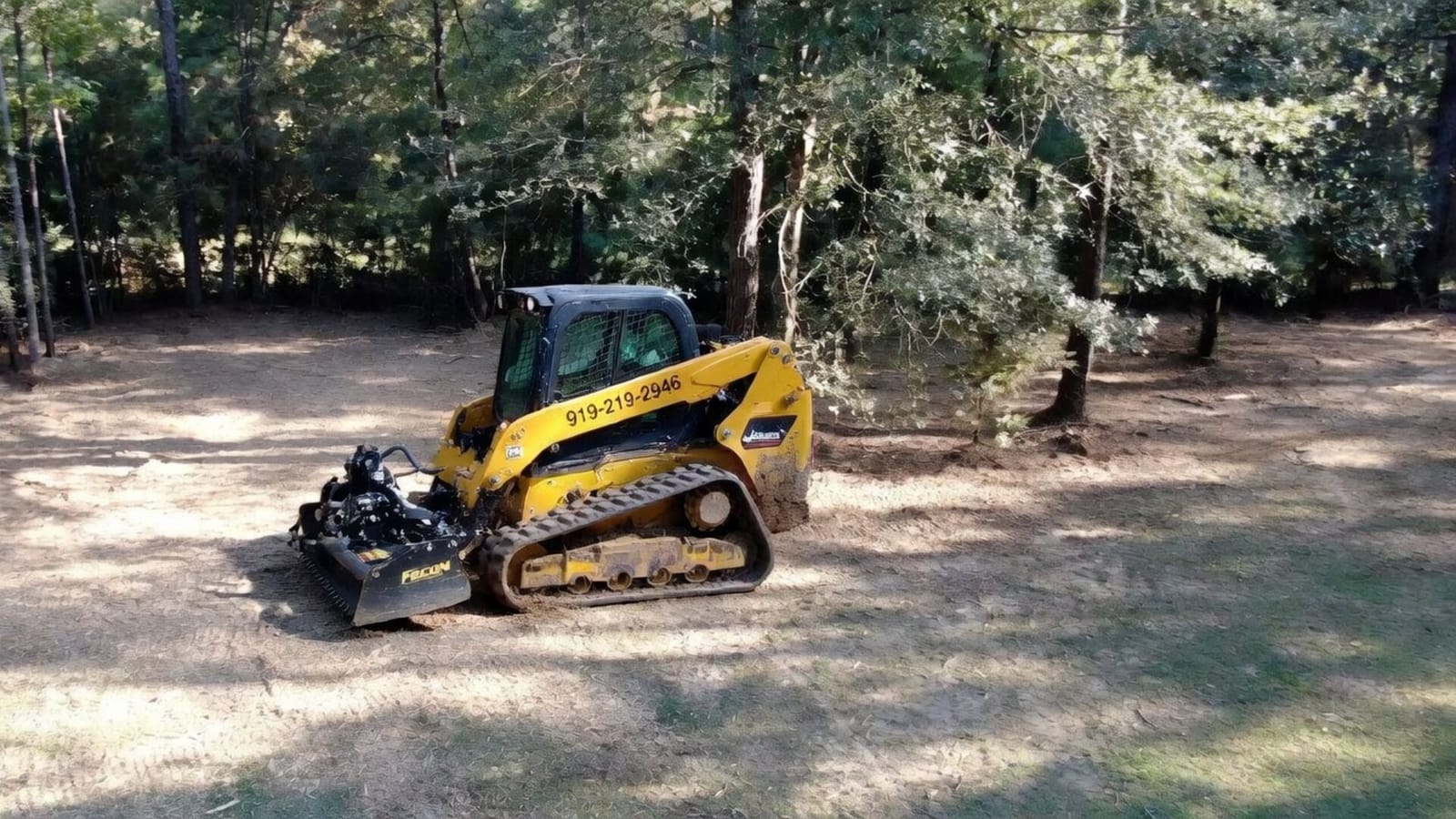
Our part of a homesite is taking it from woods to open, stump-free ground. Then it passes on: your dirt contractor grades and shapes the pad and drive, and you or your builder file the permits. We do not grade, build pads or file permits ourselves, and we plan our finish so the grader can start straight after.
How Much Does It Cost to Clear and Grade Land in West Virginia?
Site work here goes in phases, and each phase is priced by whoever does it.
| Phase | Who does it | What it costs |
|---|---|---|
| Cutting and grubbing the house site, drive and utility corridor | Cut Brush | $1,500 – $4,500 an acre; whole residential lots usually $2,000 – $6,000 |
| Mulching wooded edges kept as a screen or buffer | Cut Brush | $1,500 – $4,000 an acre |
| DEP construction stormwater coverage, one acre or more | Owner, builder or engineer | Application fee on the state schedule; filed 30 or 60 days before work |
| Cutting and filling the pad, shaping the drive | Your dirt contractor | Quoted by the hour or the job, after clearing |
Where these numbers come from. Our two rows come from the Martinsburg pricing page, the price list our Eastern Panhandle crews quote from. It lists land clearing and lot clearing at $1,500 to $4,500 an acre, notes that most complete residential lots total $2,000 to $6,000, and sets a practical floor near $1,500 a project. Your grader prices the dirt side, and so does whoever supplies the fill and stone, so get those quotes before you settle the budget. For clearing priced by what is growing on the land, see the West Virginia land clearing cost per acre guide.
What Changes the Cost of a West Virginia Building Site
How far down the rock sits. This varies more across West Virginia than almost anything else on a lot. In the Eastern Panhandle’s Hagerstown soil, hard limestone lies 40 to 84 inches or more down, though outcrops break the surface in places. Gilpin and Berks, the shale soils of the Plateau and the Valley and Ridge, reach bedrock at 20 to 40 inches. On sandstone ridges the Dekalb description rates excavation difficulty “extremely high” and says a backhoe on a 50 to 80 horsepower tractor cannot dig it in a reasonable time. A pad cut three feet into a Plateau hillside can meet rock a Panhandle pad never sees, and that is where grading bills climb.
Karst under the footprint. The state geological survey names the rocks that form karst, from the Conococheague, Elbrook and Tomstown limestones of the Panhandle to the Greenbrier Group farther west, and maps the tax districts where they reach the surface. On those sites the DEP permit requires a Karst Mitigation Plan inside the groundwater protection plan. A dip where the house will sit means a new drainage design, and a new design means a new price. When we clear karst ground we flag suspect depressions and work around them, so they show up before a dozer finds them.
Stabilization deadlines. Where a site drains to anything other than a Tier 1 water, the permit’s enhanced controls call for inspections every four days and within 24 hours of rain over a quarter inch, temporary seed and mulch within four days on ground left idle for more than 14 days, and permanent seeding within four days of final grade. A 50-foot natural buffer is required beside receiving streams, with listed exceptions. A grader who keeps moving costs less than one who leaves bare dirt sitting.
What happens to the timber. Stumps and roots come out before a blade touches the pad. Burning clearing debris needs DEP approval and is allowed only where no practical alternative exists, plus a $125 Division of Forestry permit for each site to burn by day in fire season. Valuable logs are a separate matter: state law treats cutting trees as raw material for commercial use as a timbering operation, while trees cut as part of ground-disturbing construction fall outside that rule.
Pro tip: Before you book a grader, open the state karst map and find your tax district. If it carries carbonate rock, walk the cleared footprint after the next hard rain and photograph any spot where water pools or disappears. Those photos go to your engineer for the Karst Mitigation Plan, before anyone pays to cut a pad in the wrong place.
Site Work Across West Virginia
The Eastern Panhandle. Berkeley and Jefferson counties sit on folded limestone and dolomite: deep soil, but karst and the odd outcrop. Berkeley County reviews disturbance over 5,000 square feet and handles grading permits, and the state application in these counties carries a Chesapeake Bay addendum. Our Martinsburg permit guide explains the county tier, and our lot clearing service covers the clearing side of a homesite.
The Potomac Highlands. Morgan, Hampshire, Hardy, Grant, Mineral and Pendleton counties also fall under the Bay addendum. Valleys run on shale with rock 20 to 40 inches down, ridges on sandstone, so cut depth and slope set the grading price more than the volume of soil does.
The Appalachian Plateau. The western two-thirds of the state, where all of its minable coal lies, is Gilpin and Berks hillside country. A level pad usually means cutting into the slope, and rock at two to three feet limits how deep that cut can go. Budget for fill and retaining work early.
Stormwater Permits in West Virginia
The state permit. The DEP construction stormwater general permit, in effect from April 6, 2024 through April 5, 2029, covers grubbing, grading, filling and excavation on one acre or more, or less when the site is part of a larger common plan. A single-family home on 1 to under 3 acres has a shorter path: the application form and an agreement to follow the state’s sample erosion control plan for an individual house, filed 30 days ahead. Other projects need a stormwater pollution prevention plan, a groundwater protection plan and drainage maps, plus a sign at the entrance. Sites of 100 acres or more, grading phases of a year or more on 3 acres or more, and discharges to Tier 3 streams also go to public notice in a local paper.
Frequently Asked Questions
How much does it cost to clear and grade an acre in West Virginia?
The clearing runs $1,500 to $4,500 an acre with us. Grading depends on how much soil is cut or filled and how soon the machine reaches rock, so your dirt contractor quotes it once the site is open. A typical house needs only the pad and drive graded, not the whole acre.
Does Cut Brush grade or build house pads?
No. We open the site and get the stumps out, then it passes to your dirt contractor. You, your builder or your engineer file the permits.
Do I need a DEP permit to build a house on two acres?
If the work disturbs an acre or more, yes. A single-family home on 1 to under 3 acres uses the permit’s simpler route: the application and the state’s individual house erosion control plan, filed 30 days before work starts.
What does a sinkhole on my lot do to the price?
It brings in the Karst Mitigation Plan and may move the pad or the drainage, since runoff cannot be sent into a sinkhole without a separate injection permit. Found during clearing, it costs a redesign; found by the dozer, it costs more.
Get a Land Clearing Quote for Your West Virginia Site
For a written price, pick the nearest area below and request a free quote. Our crew will contact you to discuss the site, the road access and your builder’s staked layout for the house, drive and septic, and if you have already hired a dirt contractor, we will time our finish to their start. Thinning a wooded lot you are not building on is priced in the West Virginia underbrush removal cost guide, and edges you keep in the forestry mulching cost guide. Building over the state line? See our Kentucky and Ohio guides.
Sources
Related Services
Learn more about the services mentioned in this article.

More from the Cut Brush Blog
Keep reading for more tips and guides on land clearing.
 Cost Guide
Land Clearing Cost Per Acre in WV: $1,500 to $4,500
Most West Virginia acres cost $1,500 to $4,500 to clear: brush-only work tops out near $2,500, wooded mulching near $4,000. Price table by cover and slope.
 Guide
Martinsburg Land Clearing: 5,000 Sq. Ft. Permits
How Berkeley County's 5,000-square-foot review, West Virginia's one-acre permit, city jurisdiction, and karst concerns affect clearing plans.
 Guide
Bradford Pear Removal in West Virginia: Cost and Plan
Bradford pear clearing in West Virginia costs $1,500 to $2,500 an acre for young thickets. Plan the first pass and follow-up cuts. Request a free quote.
Comparing states? See land clearing costs by state.
Let's Get Started on Your Land
Request a free quote. We'll contact you to discuss your property, access, and the clearing you need.
Get a Free QuoteOr call us directly: (919) 525-3950