
Forestry Mulching Cost in Ohio (2026 Guide)
Cut Brush Team · October 9, 2026 · 8 min read

The back few acres have filled in with honeysuckle, buckthorn and saplings so thick you cannot walk the property line, and you want them gone without dozer ruts or a burn pile. Forestry mulching runs $1,500 to $4,000 an acre with Cut Brush in Ohio. Our crews do this work across Cuyahoga, Lake, Geauga, Medina and Lorain counties, from Elyria and Grafton out to Mentor, Madison and Chesterland. Thin stems on dry late-summer ground land near the bottom of that band; a soft spring woodlot crowded with old shrub stems lands near the top.
At a glance:
- Our band: $1,500 to $4,000 an acre, with a practical floor near $1,500 on any parcel, because that is what getting a tracked machine on and off the property costs.
- Shrubs only, trees kept: clearing honeysuckle and buckthorn off a woodlot floor runs $1,500 to $2,500 an acre.
- Burning: inside any city or village, and up to a mile past a city of 10,000 or more, Ohio’s open burning rules make no allowance for land clearing waste. Outside those zones it takes written Ohio EPA permission and an air curtain destructor.
- Oaks: Ohio State University Extension says oaks should never be wounded between April 15 and July 1.
- Regrowth: tree of heaven, Callery pear, bush honeysuckle and autumn olive are all on Ohio’s invasive plant list, and every one of them sprouts back from a cut stump.
Our crew works from Cleveland. Around Columbus, Toledo, Dayton or Athens, tell us where your land is and we will contact you to discuss the property, access and the clearing you need; the rest of this guide shows where your acre would fall.
How Much Does Forestry Mulching Cost in Ohio?
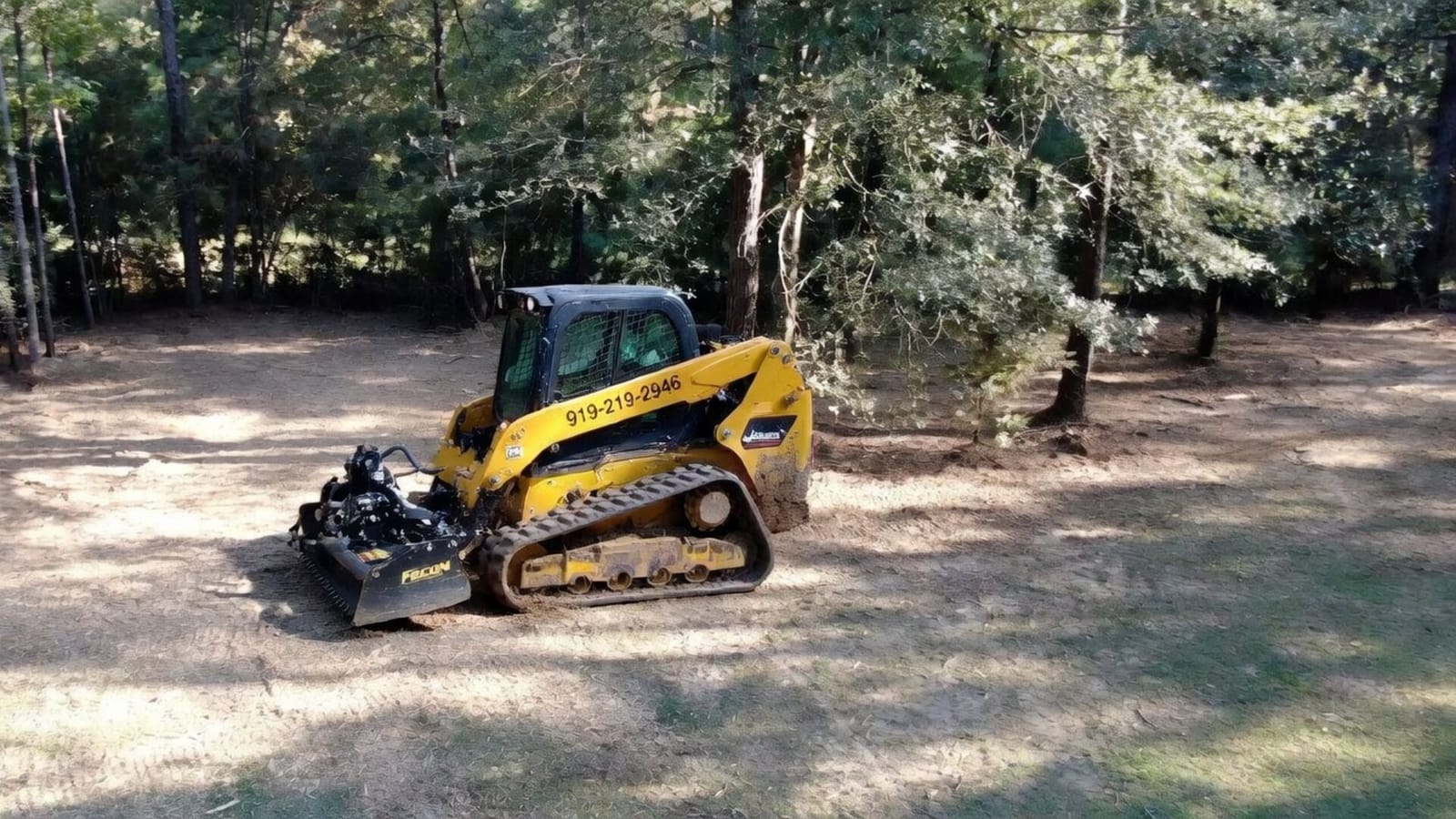
Forestry mulching is one tracked machine with a spinning toothed drum on the front. It grinds standing brush and small trees where they grow and leaves them as a layer of chips on the ground. Stumps are cut flush rather than dug out, and nothing goes on a truck. Here is what we charge, by what is standing on your land:
| What is growing there | Our price per acre | What you see when we leave |
|---|---|---|
| Honeysuckle, buckthorn and saplings under oaks and maples you keep | $1,500 – $2,500 | Woods you can see through, canopy untouched |
| Brush and small trees over the whole area | $1,500 – $4,000 | A chip mat over the soil, stumps at ground level |
| Mature woods with stumps pulled and the wood hauled off | $1,500 – $4,500 | Bare open ground, nothing left on site |
Where these numbers come from. All three rows are copied from our Cleveland pricing page, which is where we publish Ohio prices. The middle row is mulching proper. The top row is the lighter understory scope, and the bottom row is full clearing, shown so you can see what mulching saves: chipping in place takes loading, hauling and tipping fees out of the job, and those are most of the gap between the two bands. Whole-parcel clearing is priced in more detail in our Ohio land clearing cost per acre guide.
What Changes the Price of an Ohio Mulching Job
The month we can get on the ground. Northeast Ohio sits on dense glacial till. Our pricing page cites the USDA description of the Mahoning soil, which holds water 6 to 12 inches below the surface from October through June in most years. A mulcher crossing that in April moves slowly and marks the ground; in August the same acre goes quicker. If your date can move, the price usually can too.
Oaks you want to keep. Ohio State’s oak wilt fact sheet reports the disease from most of Ohio’s 88 counties. Sap beetles carry it to fresh wounds, so the rule is no wounds on oaks from April 15 to July 1, and ideally none until October 1. A drum head working close to a trunk can scrape bark or tear a surface root. On an oak-heavy lot we either book after July 1 or leave a wider ring around each keeper and finish it by hand, which adds hours. OSU also notes that about 90 percent of new infections travel between neighbouring oaks through grafted roots, so an oak that died suddenly next to one you love calls for an arborist before we come.
What grows back. OSU Extension’s tree of heaven sheet warns that cutting large stems often triggers hundreds of sprouts, and its bush honeysuckle sheet says cutting at the base produces prolific sprouting and more stems than before. Mulching knocks both flat, but neither stays down after one visit. We write the knockdown and the return pass as separate lines, and our tree of heaven and Callery pear guides explain the follow-up.
Pro tip: Walk the parcel with a roll of bright flagging tape before we visit. Tie it round every oak you want to keep, and tell us if any oak on your land or your neighbour’s browned out in midsummer. That decides whether we book before mid-April or after July, and planning around it costs nothing.
Forestry Mulching Costs Across Ohio
Northeast Ohio, where our crews work. The Ohio Division of Geological Survey describes the Grand River Low Plateau through Geauga and eastern Lake County as gently rolling ground where poorly drained areas and wetlands are relatively common. Nearer the lake, the Erie Lake Plain is close to flat, ends at shoreline cliffs and is cut by streams running in deep gorges, so a mulching line often stops at a ravine edge. Wet ground sets the calendar here; our guide to clearing wet ground in Northeast Ohio covers timing, and the Cleveland forestry mulching cost guide prices a local acre.
The northwest lake plain. Around Paulding, Napoleon and Bowling Green the land was the Great Black Swamp. The state survey calls the Paulding Clay Basin the most clayey part of the lake plain, with easily ponded soils. Its Hoytville clay holds water from a foot above the surface to a foot below it from January to April in normal years, and the woodlots left on it are swamp white oak, bur oak, pin oak and soft maple. Expect a dry-season booking and an oak wilt conversation.
The central and western till plain. Around Columbus, Dayton and Bellefontaine the woods come in scattered pieces. The questions that set a price here are how many separate patches there are, how far apart they sit, and how a trailer reaches each one, because a job split across fencerows costs more per acre than one solid block.
The southeast hills. The survey calls the Shawnee-Mississippian Plateau the most rugged area in Ohio, with 400 to 800 feet of relief, and the Marietta Plateau along the Ohio River has red shale soils and common landslides. Gilpin soil on those ridges reaches shale, siltstone or sandstone at 20 to 40 inches and holds 30 to 90 percent rock fragments below the subsoil. Flat rock near the surface chips carbide teeth, so slopes around Athens, Marietta and Ironton price toward the top of the band, and ground too steep to track safely comes out of the scope.
Burning and Permit Rules in Ohio
Mulching leaves nothing to burn, which matters more in Ohio than most owners expect.
Restricted areas. Ohio Administrative Code 3745-19-01 makes everything inside a municipal corporation a restricted area, plus 1,000 feet beyond a town of 1,000 to 10,000 people and one mile beyond a city of 10,000 or more. The exceptions in rule 3745-19-03 cover agricultural waste and recognised forestry or invasive species management burns, not land clearing waste.
Everywhere else. Rule 3745-19-04 allows land clearing waste to be burned only with written Ohio EPA permission, at least 1,000 feet from any inhabited building off the property, using an air curtain destructor or a method the agency finds as effective. An air curtain burner needs its own permit to install.
The seasonal ban. On top of that, Ohio Revised Code 1503.18 bars burning brush, wood or grass between 6 a.m. and 6 p.m. in March, April, May, October and November outside city and village limits, apart from fires in a plowed field, garden or highway at least 200 feet from woodland, brushland or dry grass.
We do not file permits or grade. If the mulching is the first step toward a house, our Ohio land clearing and grading cost guide shows who handles each later phase and which stormwater rules start at an acre.
Frequently Asked Questions
How much does it cost to mulch one acre in Ohio?
We charge $1,500 to $4,000 an acre, and on a single acre the floor near $1,500 often sets the price. Light stems on dry ground sit at the bottom; a wet spring woodlot full of mature honeysuckle, or a rocky southeastern slope, sits at the top.
Is forestry mulching cheaper than clearing land in Ohio?
Usually. Our mulching band tops out at $4,000 an acre against $4,500 for full clearing, because nothing is loaded, hauled or dumped. If you need stumps out for a foundation, clearing is the right job even at the higher price.
When is the best time to mulch land in Ohio?
Late summer. The northern clay is driest then, and oaks are past their April 15 to July 1 risk window. Ground frozen hard enough to carry a machine is the second choice on wet sites.
Will honeysuckle and tree of heaven come back after mulching?
Yes. OSU’s fact sheets say cutting either at the base sets off heavy sprouting, so plan on a follow-up pass priced on its own line. Our Ohio underbrush removal cost guide covers that return work under standing trees.
Do you mulch outside the Cleveland area?
Our crew works from Cleveland. Tell us where your land is, and we will get in touch about the ground, the oaks you are keeping and the finish you want.
Get a Forestry Mulching Quote in Ohio
Pick the nearest area below and request a free quote. Our crew will contact you to discuss the land, the gate or drive a trailer would use, and the finish you want: open woods, a field edge won back, or ground ready for an excavator. We will ask about any oaks you are keeping and any that died suddenly last summer, then turn the band into one written price.
Land over the state line? See our Indiana and Michigan mulching guides.
Sources
- Ohio Revised Code 1503.18 and Ohio Administrative Code 3745-19-04
- USDA NRCS: Mahoning soil series description
More from the Cut Brush Blog
Keep reading for more tips and guides on land clearing.
 Cost Guide
Forestry Mulching Cost in Cleveland, OH (2026)
Forestry mulching around Cleveland runs $1,500 to $4,000 per acre. See what wet glacial till, stem size and resprouting shrubs do to the hours on your land.
 Cost Guide
Land Clearing Cost Per Acre in Ohio (2026)
Land clearing cost per acre in Ohio runs $1,500 to $4,500. See how glacial till, resprouting brush and the seasonal burning ban move the number. Free quotes.
 Guide
Autumn Olive Removal in Ohio: Visits, Timing and Cost
Autumn olive removal in Ohio: $1,500 to $2,500 an acre for old fields. Why cutting makes it bushier, plus the sprout visits to plan. Request a free quote.
Comparing states? See land clearing costs by state.
Let's Get Started on Your Land
Request a free quote. We'll contact you to discuss your property, access, and the clearing you need.
Get a Free QuoteOr call us directly: (919) 525-3950