
Land Clearing in Franklin County, NC: Permits and Cost
William King · April 2, 2026 · 6 min read

Clearing more than one acre anywhere in Franklin County needs an erosion and sedimentation control plan approved by NC DEQ’s Raleigh Regional Office before work starts, and the county wants DEQ’s approval letter. Under one acre there is no state plan, but the county still requires silt fence on the low side of the lot. Forestry mulching counts as land disturbance; it is not exempt. Our land clearing starts around $1,500 an acre.
Do I Need a Permit to Clear Land in Franklin County?
Over one acre, yes, and the approval comes from the state. Under G.S. 113A-57, no one may start land-disturbing activity that disturbs more than one acre on a tract unless an erosion and sedimentation control plan was filed at least 30 days ahead and approved. The test is the disturbed area on the tract, whether or not you are building anything yet.
Franklin County does not review that plan itself. Its Unified Development Ordinance, Article 9 sends plans of one acre or more to NC DEQ and makes DEQ’s Letter of Approval a condition of county approval. Franklin County and its towns do not appear on DEQ’s list of delegated local erosion programs, the way Wake and Johnston do, so the plan goes to the DEQ Raleigh Regional Office, now at 4407 Reedy Creek Road in Raleigh. That list is not new, so confirm with Franklin County Planning and Inspections before you file.
Under one acre, the county ordinance still applies. Every disturbance under an acre must have:
- silt fence on the low side of the lot
- other erosion and sediment measures as needed to keep sediment on the property
- tree protection fence around the rest of the perimeter, if the county asks for it
Once the apparent disturbance passes half an acre, the county can also require an as-built survey of the disturbed area by a professional land surveyor.
The plan is the owner’s or the builder’s to prepare and file. We do not file permits, but we will clear to the limits your approved plan shows. Skipping the plan is costly: under G.S. 113A-64 the civil penalty runs up to $5,000 per violation, and each day a violation continues counts as a separate one.
For the statewide picture and how neighboring counties compare, see our guide to NC land clearing permit thresholds.
Does Forestry Mulching Count as Land Disturbance?
Yes. The state definition covers any development use of land that changes “the natural cover or topography,” and Franklin County’s own definition puts “substantial removal of vegetation” right beside grading, digging and fill. Mulching a lot does not move it out of either.
The exemptions are narrow: farming, and timber harvesting carried out under the state’s Forest Practice Guidelines. Clearing a homesite, a driveway route or a backlot with a mulcher is neither.
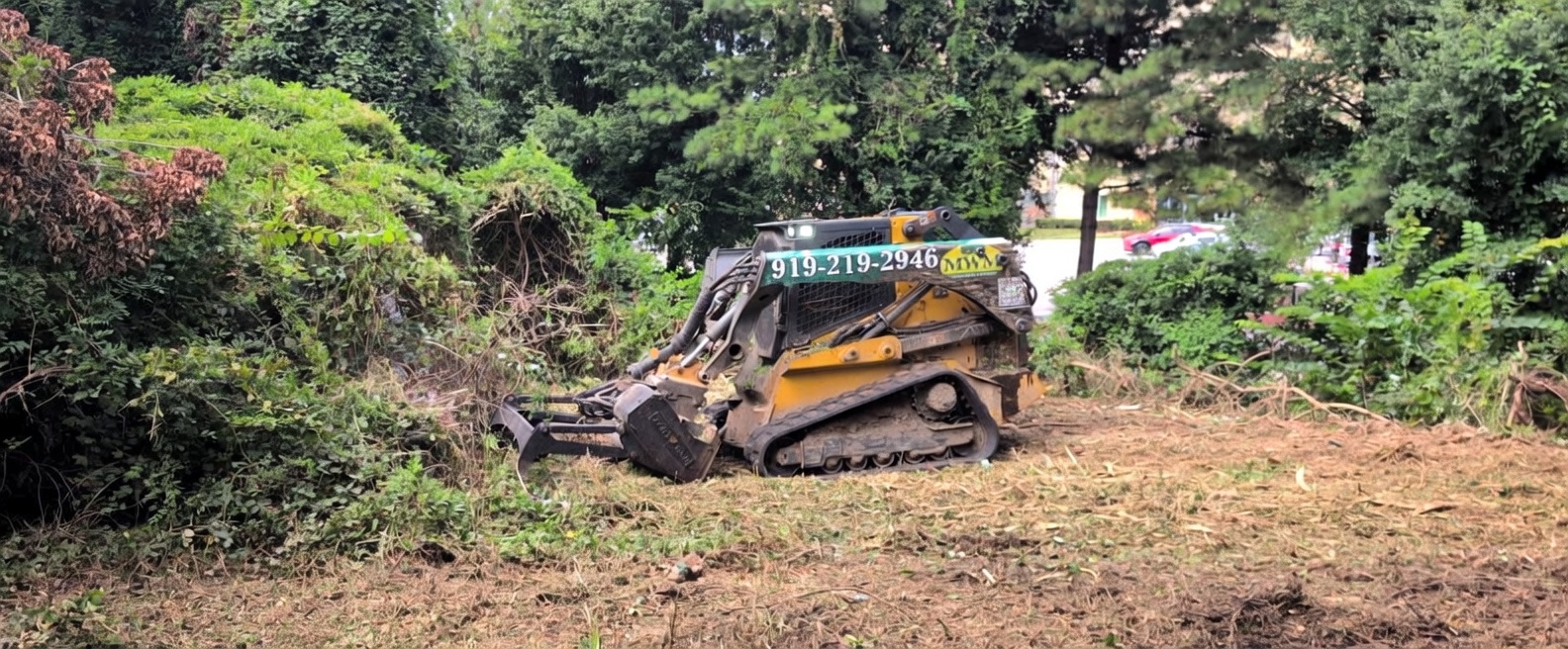
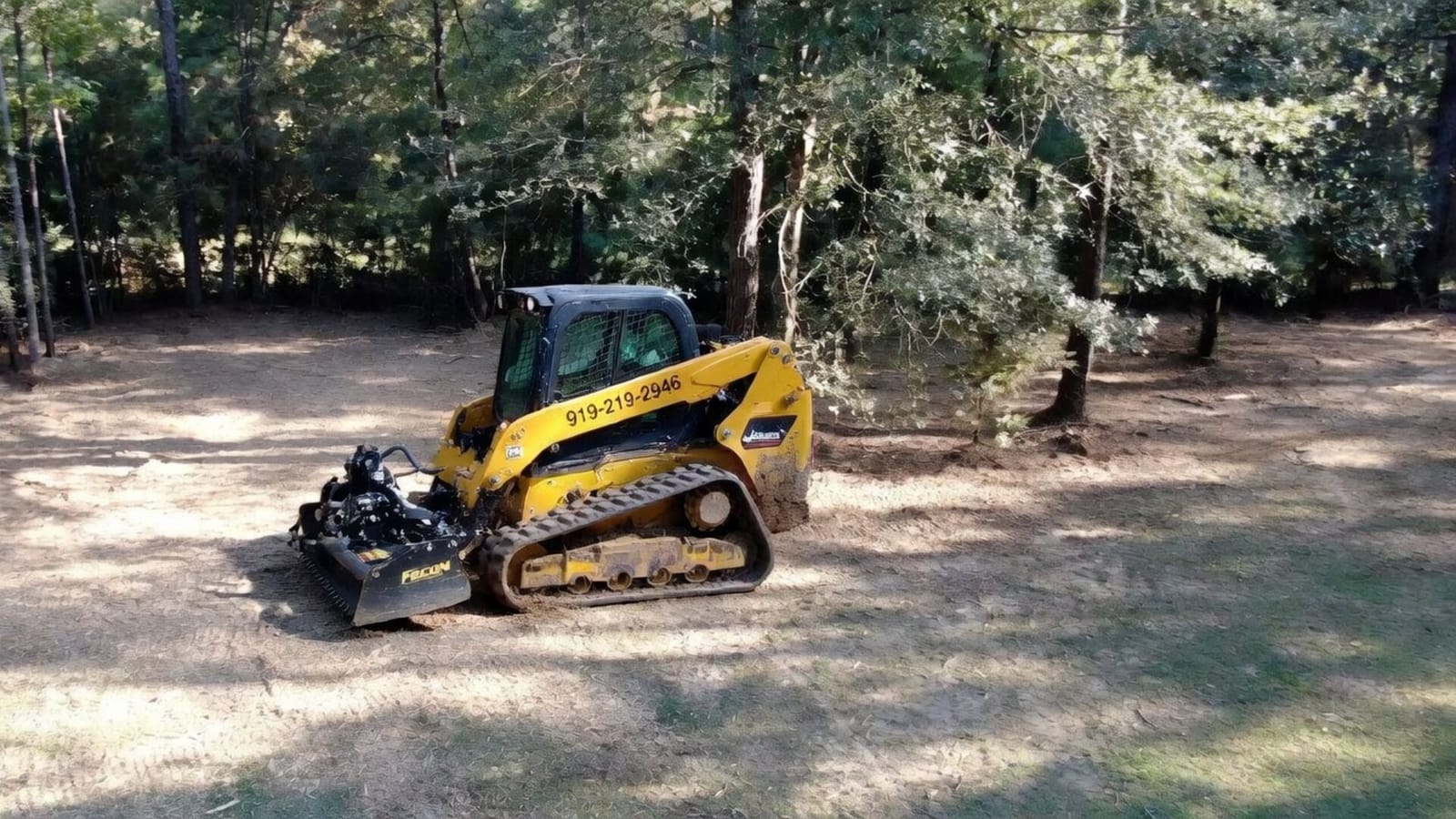
What mulching does change is what the ground looks like afterward. Our forestry mulching machine grinds standing brush and small trees where they stand and leaves the chips on the ground, with the root systems still in the soil. A dozer pushing trees out roots and all leaves bare dirt. Less bare soil makes the silt fence’s job easier. It does not change the acreage that triggers a plan.
Is There a Creek Buffer or Falls Lake Rule on My Land?
If a stream crosses or borders your parcel, check this before anyone clears. Outside town limits and their extraterritorial jurisdiction, the county ordinance requires a 50-foot riparian buffer along every perennial and intermittent stream:
- Zone 1, the first 30 feet, stays essentially undisturbed.
- Zone 2, the outer 20 feet, must stay vegetated.
We walk the creek line before we quote and keep the mulcher out of the buffer.
Franklin County spans the Neuse and Tar-Pamlico river basins, and the southern part of the county lies in the Falls Lake watershed. Which one your land sits in decides which watershed rules apply. The county’s Stormwater Jurisdiction Map and the NCDEQ Interactive Stormwater Map both show it.
If you plan to build afterward, one more threshold matters. A single-family home project of 1 acre or more in the Tar-Pamlico area also needs a county stormwater permit. The county ordinance lists 0.5 acre for the Falls Lake watershed, but since S.L. 2025-94, a single-family or duplex home disturbing less than 1 acre outside a larger common plan needs no Falls Lake stormwater plan, so confirm the current threshold with the county. That permit belongs to the building project, not to clearing on its own, so raise it with planning when you apply for the house.
Clearing Inside Louisburg, Youngsville, Franklinton or Bunn
The county buffer rule covers land outside town limits and their extraterritorial jurisdiction, and the towns set their own rules inside them. We have not verified the clearing or tree rules for Louisburg, Youngsville, Franklinton or Bunn. If your land is inside a town or its planning area, call that town’s planning office before clearing, and ask whether a town permit applies on top of the state plan.
What Does Land Clearing Cost in Franklin County?
These are our own published starting points, the same ones we use across Central North Carolina:
| Service | Starts around |
|---|---|
| Land clearing or forestry mulching | $1,500 per acre |
| Brush clearing | $1,200 per project |
| Brush hogging | $75 per acre |
Most residential clearing falls between $1,500 and $4,500 an acre. Four things move a quote inside that range:
- Acreage. Larger tracts usually earn a lower per-acre rate, because the machine is already on site.
- Density. Light brush and saplings go fast; established trees and dense hardwoods are the slowest work.
- Slope and ground. Steep hillsides, wet or soft soil and rocky ground slow the machine down.
- Access. A long run into the property or a tight gate adds time.
We also grind stumps, priced with the rest of the job. We do not grade or bulldoze: if you are building, your grading contractor takes over once we are done. Our pricing page and our NC land clearing cost guide go into more detail.
Frequently Asked Questions
How much land can I clear in Franklin County without a permit?
Under one acre on a tract, no DEQ plan is required. The county still requires silt fence on the low side and enough erosion control to keep sediment on the property, and the 50-foot stream buffer still applies outside town limits.
Will mulching tear up the soil the way a bulldozer does?
A tracked mulcher works on top of the ground. It leaves roots in the soil and a layer of chips over it, where a dozer strips the surface down to dirt. Soft, wet ground still slows any machine, so we look at drainage before we set a start date.
Can I burn the brush instead of mulching it?
Often, with an NC Forest Service burning permit. Our guide to land clearing debris in NC covers when one is needed in Franklin County. Mulched brush stays on site as chips, so there is nothing to burn or haul.
Do you work in Louisburg and the rest of Franklin County?
Yes. We clear land across Franklin County, including Louisburg, Youngsville, Franklinton, Bunn and the rural tracts between them.
Get a Free Land Clearing Quote in Franklin County
Request a free quote and our crew will contact you to talk through the property, access and the clearing you need. You can also call (919) 525-3950. If your project is over an acre, start the DEQ plan early: it has to be filed at least 30 days before the first tree comes down.
Related Services
Learn more about the services mentioned in this article.

Brush Clearing
Remove overgrown brush, shrubs, and small trees to reclaim your land.

Forestry Mulching
Single-step land clearing that mulches trees and brush in place.

Land Clearing
Full land clearing for residential and commercial development projects.

Brush Hogging
Heavy-duty mowing for overgrown fields, pastures, and large lots.
Serving These Areas
We provide land clearing services in these towns and surrounding areas.
More from the Cut Brush Blog
Keep reading for more tips and guides on land clearing.
 County Guide
Land Clearing in Granville County, NC: Permits and Cost
Clearing over an acre in Granville County, NC needs a state erosion plan, not a county permit. Which watershed you are in, the 2025 Falls Lake change and cost.
 County Guide
Land Clearing in Nash County, NC: Rules, Buffers and Cost
Clearing over an acre in Nash County, NC needs an erosion plan from NC DEQ, or from Rocky Mount inside its limits. Basins, buffers and prices from $75 an acre.
 County Guide
Land Clearing in Durham County, NC (2026 Guide)
Land clearing in Durham County, NC: permit thresholds, Falls Lake rules, costs, and methods for urban infill and wooded lots. Get a free estimate today.
Let's Get Started on Your Land
Request a free quote. We'll contact you to discuss your property, access, and the clearing you need.
Get a Free QuoteOr call us directly: (919) 525-3950