
Land Clearing for New Construction in NC: 2026 Guide
Cut Brush Team · May 17, 2026 · 10 min read

You closed on a wooded lot in Apex, your builder has a pad date 30 days out, and a framing crew already on the calendar. Now the chain of dominoes is on you: clear the lot, pass erosion control inspection, get the footing dug, pour the slab, frame. Miss one step and the whole schedule slides. The biggest cause of slipped build dates in Central North Carolina is not weather or supply chain. It is land clearing for new construction in NC that was scoped wrong, sequenced late, or handed off to a clearing crew who did not understand what the builder actually needed on day one.
This guide walks through how clearing fits into a new-home build, the difference between “cleared” and “construction-ready,” what permits and erosion controls have to be in place before a machine starts, real cost ranges, and exactly what your builder will want when the crew rolls off.
What Does Land Clearing for New Construction Actually Mean?
Land clearing for new construction is site preparation that gets a raw lot ready for a builder to dig footings, set forms, and pour foundation. It is not the same as a casual brush clear. A new-construction clear has to deliver a specific deliverable on a specific date, to a specific tolerance, with permits and erosion controls already in place.
A residential new-construction clear typically covers:
- The building envelope (the footprint plus a working perimeter, usually 10–15 feet outside the foundation line)
- Driveway and utility runs from the road to the house pad (our guide to clearing land for a driveway covers that run on its own)
- Septic and well locations (if applicable, with the perc area protected)
- Staging area for the builder’s dumpster, portable toilet, and material drops
- A tree-save area if you or the town are preserving any mature trees
Everything inside those lines comes down. Everything outside stays untouched, which protects mature trees, neighbors, and any required vegetative buffers. Clearing for a manufactured home follows much the same steps; see clearing land for a mobile home.
When Should You Schedule Clearing in Your Build Timeline?
Schedule clearing 4 to 8 weeks before the foundation date, after permits are issued and erosion controls are designed, but before the surveyor stakes the foundation corners. That window gives the soil time to settle if there are stumps to grub, lets erosion control silt fence go in immediately after the clear, and leaves a buffer if weather pushes the project.
Here is the sequence that works on most Central NC builds:
| Phase | Timing | Who’s responsible |
|---|---|---|
| Lot survey + stakeout | Week 1 | Surveyor |
| Permits + erosion plan submitted | Weeks 1–3 | Builder or owner |
| Land clearing | Weeks 4–5 | Clearing contractor |
| Silt fence + tree-protection fencing | Week 5 | Clearing or grading crew |
| Erosion control inspection | Week 5–6 | Town or county inspector |
| Rough grading + footing dig | Weeks 6–8 | Grading contractor |
| Foundation pour | Weeks 8–10 | Foundation crew |
Pro tip: Get the clearing crew on site the same week your erosion control plan is approved. Silt fence has to go up before significant disturbance under Wake County’s land disturbing rules, so a cleared lot sitting open for two weeks waiting on silt fence is a stop-work risk.
Mulching vs Grub-and-Haul: Which Method Should a Builder Use?
This is where most new-construction projects either save thousands or burn them. The right method depends on what’s going to be built on top.
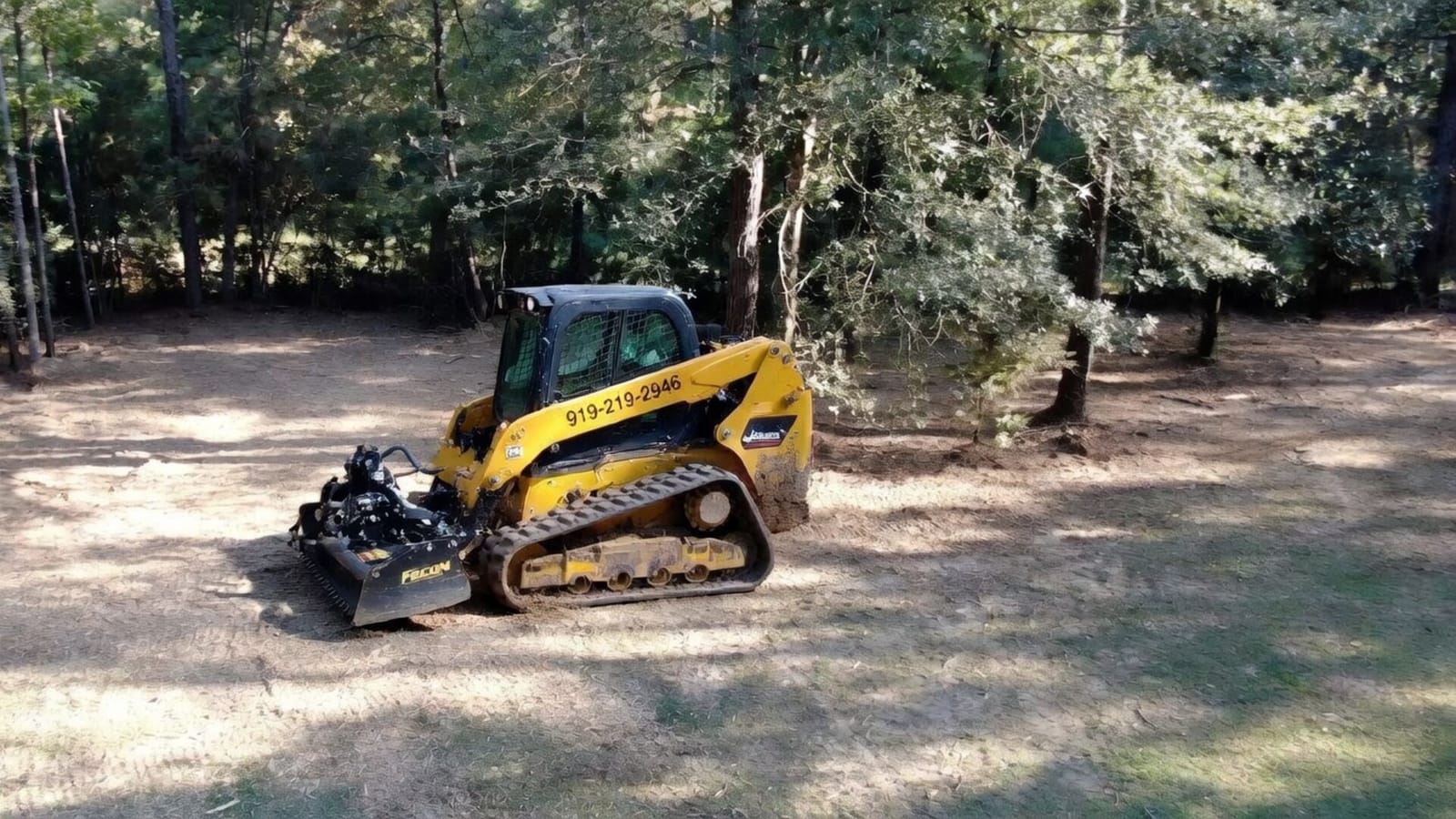
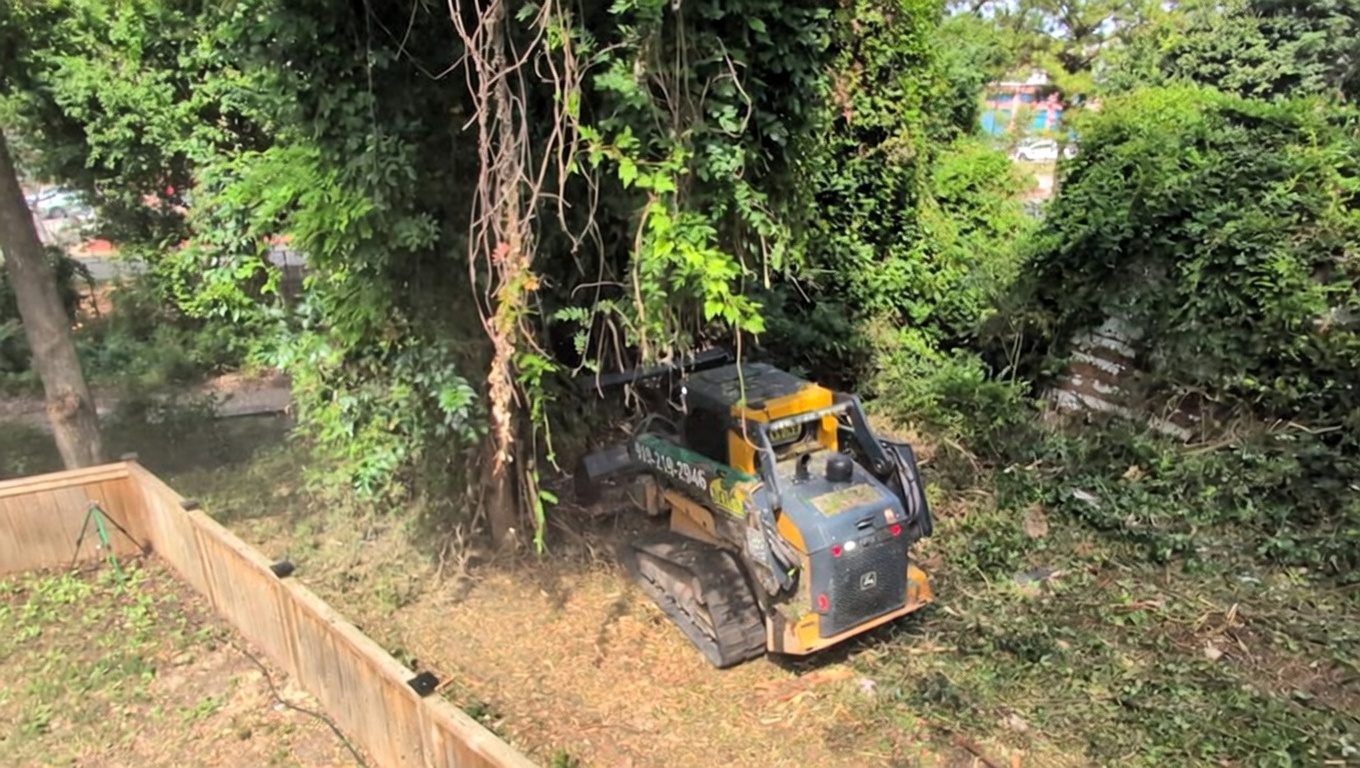
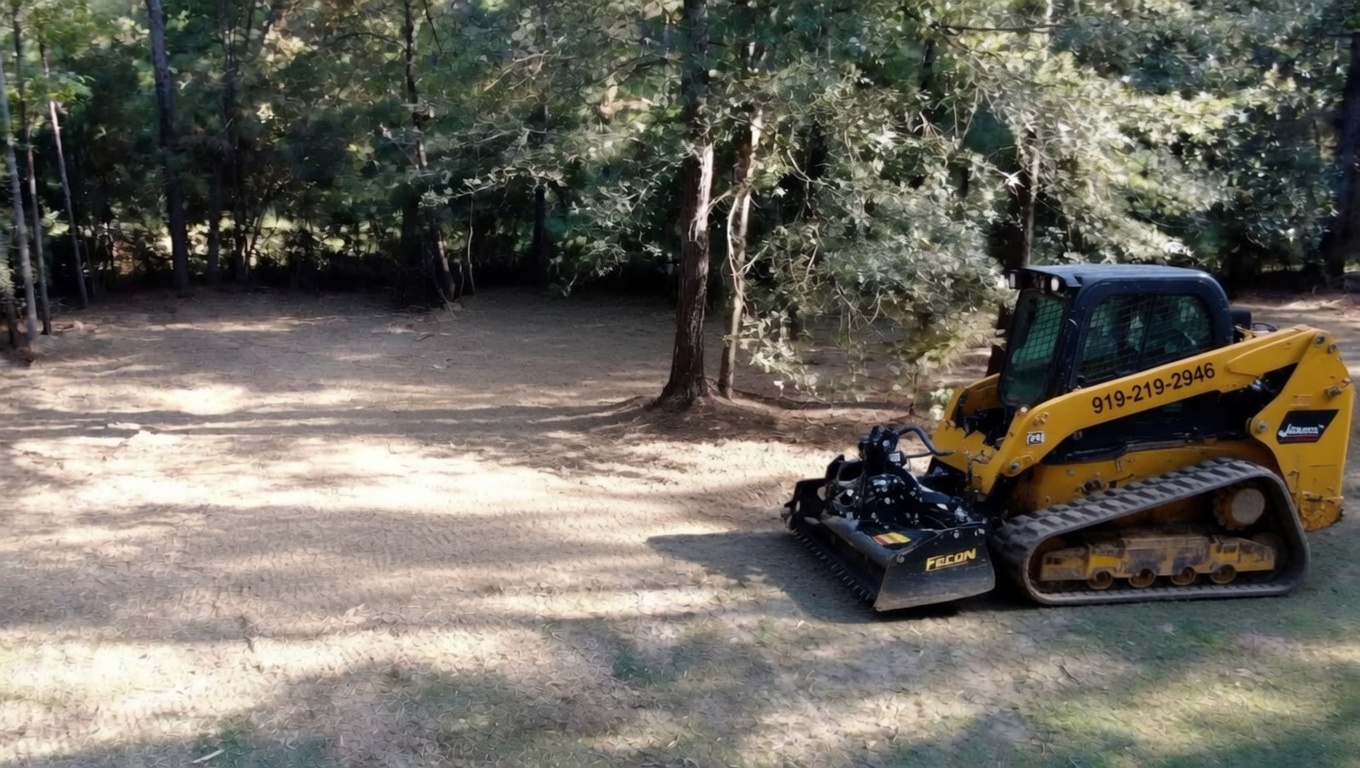
Forestry mulching (single-pass, grinds standing trees and brush into mulch on site) is the right call when:
- The pad is going on undisturbed natural grade with a slab-on-grade or crawlspace
- The builder is okay leaving root mass in the ground outside the foundation line
- You want no debris piles, no burn day, no hauling fees
- You want the lot ready in 1 to 3 days per acre
Traditional grub-and-haul (dozer, root rake, excavator, dump trucks) is the right call when:
- The build needs a full basement that requires deep excavation through tree roots
- The site needs major regrading with cut and fill across the footprint
- The lot is being mass-graded for multiple homes in a subdivision
For most residential infill, custom-home, and small-builder projects across Wake, Johnston, and Franklin counties, mulching plus targeted stump grinding inside the building envelope is faster, cheaper, and meets the builder’s needs. For deep basements, large commercial pads, or subdivision mass-grading, our commercial land clearing service handles the heavier traditional work. See our full breakdown of forestry mulching vs bulldozer land clearing in NC for the side-by-side comparison.
A common hybrid approach we run on custom-home lots in Wake Forest and North Raleigh: mulch the whole lot, then grub stumps only inside the foundation line. The builder gets a clean pad without paying to haul off the entire lot.
How Much Does New Construction Land Clearing Cost in NC?
Most new-construction land clearing in Central North Carolina runs $1,500 to $4,500 per acre for mulching with targeted stump grinding, and $3,500 to $8,000+ per acre for full grub-and-haul with stump removal across the entire pad. Pricing depends on lot density, foundation type, and how much regrading the builder needs.
Here is what we see on actual new-construction projects:
| Project type | Method | Typical cost per acre |
|---|---|---|
| Custom home, slab/crawl, wooded lot | Mulch + envelope stump grind | $1,500–$3,000 |
| Custom home, full basement, wooded lot | Mulch + grub-and-haul on pad | $3,500–$6,500 |
| Production builder, cleared subdivision lot | Brush clear + envelope grind | $800–$2,000 |
| Custom home, mature hardwoods, selective save | Selective mulch + tree-save fence | $2,500–$4,500 |
| Commercial pad or small subdivision | Full mass-grading prep | $5,000–$10,000+ |
For a deeper cost breakdown, see our full guide to land clearing cost per acre in NC. Need a quick ballpark before you call your builder back? Get a free estimate and we’ll walk the lot or quote from your site plan.
Three line items frequently missed in new-construction quotes:
- Stump grinding inside the foundation envelope (separate from the mulch price)
- Silt fence and tree-protection fencing installation (often $2–$4 per linear foot)
- Construction entrance (gravel pad at the road, required by erosion control plans)
Ask any clearing contractor whether these are included before signing.
Have a site plan and a build deadline? Our crew will contact you to go over the site plan and your foundation pour date, then work backward to give you a fixed price and a guaranteed clearing window that fits your builder’s schedule. Request a free estimate and we’ll respond within 24 hours with a working timeline.
What Permits Does New Construction Land Clearing Require in NC?
Any new-home build in a recorded subdivision in Wake County triggers the Wake County land disturbing permit regardless of lot size, because the cumulative disturbance is measured across the whole subdivision, not your single lot. On an individual lot outside a subdivision, the permit kicks in at 1 acre of cumulative disturbance.
The full permit and erosion-control picture is covered in our guide on whether you need a permit to clear land in Wake County NC, but for new construction specifically, the stack usually looks like this:
- Wake County land disturbing permit (state-delegated, enforced by Watershed Management)
- NCDEQ erosion and sediment control plan for sites at 1+ acre
- Town building permit and grading permit (Raleigh, Cary, Apex, Holly Springs, Wake Forest each have their own process)
- Watershed buffer review for properties near Falls Lake, the Neuse River, or Jordan Lake
- Tree conservation review inside Raleigh, Cary, and Chapel Hill town limits
- HOA architectural review for tree removal in planned communities
Johnston, Franklin, Durham, and Harnett counties each run their own permitting. If your build is in Clayton or Wendell Falls, the county and town processes stack differently from Wake.
What Should Be Ready Before the Clearing Crew Arrives?
A new-construction clear runs smoothly when the lot is staged before the machines roll in. Before the crew arrives, you (or your builder) should have:
- Property corners flagged or staked by a licensed surveyor
- Building envelope marked (foundation footprint plus working perimeter)
- Driveway, septic, well, and utility locations marked in spray paint or flagging
- Tree-save trees marked with bright ribbon, ideally with a tree-protection radius drawn
- Permits in hand or pending so the crew can confirm timing
- Access from the road clear of parked vehicles and dumpsters
- NC 811 utility locate complete (free, required by law before any digging)
Pro tip: Walk the lot with the crew lead on day one before any machine starts. Ten minutes of walking saves a tree you wanted kept, finds a property pin in the brush, and gets the operator’s eyes on every tree marked to stay. We do this on every new-construction job in Wake Forest, Apex, and Holly Springs.
Frequently Asked Questions
How long does land clearing for new construction take in NC?
Most residential new-construction lots clear in 1 to 3 days per acre with forestry mulching, plus another half-day for envelope stump grinding if needed. A typical quarter-acre to half-acre custom home lot in Wake Forest or Apex is a one-day job. See our full breakdown of how long land clearing takes per acre in NC for timelines by method and density.
Can you clear a lot the builder has already started staking?
Yes, as long as the corners and building envelope are clearly marked. We work around stakes, silt fence, tree-save fencing, and any flagged utilities. Most of our land clearing work in Raleigh new-construction subdivisions starts after the surveyor’s stakeout and before the foundation contractor arrives.
Do you remove stumps for new construction?
Inside the foundation envelope, yes. We grind stumps below grade so the builder can dig footings cleanly. Outside the foundation line, most builders are fine leaving stumps in place under mulch, which saves money and protects the surrounding soil from erosion. If your builder needs a fully stump-free pad (common for full basements), we grub and haul stumps inside the work area for an additional cost.
Will land clearing damage my surrounding trees?
Not when the crew uses tree-protection fencing and a marked clear line. Tracked mulching equipment runs on rubber-track or steel-track carriers that distribute weight more evenly than a wheeled dozer, which protects root zones on adjacent trees. We mark and protect every tree you want to keep before any machine moves. If you are clearing on a wooded estate lot in Holly Springs or North Raleigh, we recommend selective view clearing as a hybrid approach.
How much does it cost to clear a half-acre lot for a new home in NC?
A typical half-acre custom-home lot in Central North Carolina runs $1,000 to $2,500 for mulching with envelope stump grinding, depending on tree density and access. Production-builder subdivision lots that come pre-stripped of timber are usually $400 to $1,200 for the final clean-up clear. Want a real number for your lot? Request a free estimate and we’ll quote from the site plan or a walk-through.
Who is responsible for silt fence and erosion control on a new build?
The permit holder is legally responsible, which is usually the builder or the lot owner of record. Most clearing contractors (including Cut Brush) can install silt fence, tree-protection fencing, and a gravel construction entrance as part of the clearing scope. Get this written into the quote so it doesn’t fall between the clearing crew and the grading crew on inspection day.
Get Land Clearing for New Construction in Central NC
Land clearing for new construction in NC is the first hard deadline on a build schedule, and it sets the tone for every step that follows. Cut Brush works directly with custom-home builders, production builders, and owner-builders across Apex, Holly Springs, Wake Forest, Raleigh, Wendell, and the rest of Central North Carolina. We clear to the building envelope, protect tree-save areas, coordinate with your surveyor and grading contractor, and hand off a pad your builder can dig footings into the next morning.
We respond to every quote request within 24 hours, walk the lot with you and your builder, and give a fixed price tied to your site plan. Request a free estimate for new-construction land clearing, and our crew will contact you to go over your site plan and pad date and work backward from there.
Related Services
Learn more about the services mentioned in this article.

Brush Clearing
Remove overgrown brush, shrubs, and small trees to reclaim your land.

Forestry Mulching
Single-step land clearing that mulches trees and brush in place.

Land Clearing
Full land clearing for residential and commercial development projects.
Commercial Land Clearing
Large-scale land clearing for commercial and industrial development.
Serving These Areas
We provide land clearing services in these towns and surrounding areas.
More from the Cut Brush Blog
Keep reading for more tips and guides on land clearing.
 Guide
Guide Clearing Land for a Mobile Home in NC: Septic and Pad Rules
Clear only for access before the septic evaluation, then clear the home site with stumps and sod out of footing areas. NC order of work, rules and costs.
 Guide
Guide Best Time of Year to Clear Land in NC
When is the best time of year to clear land in NC? Compare winter, spring, summer, and fall for cost, mud, ticks, and wildlife. Get a free estimate today.
 Guide
Guide Do I Need a Permit to Clear Land in Wake County NC?
It depends where the land is. Wake County requires a permit over 1 acre, or any size in a subdivision. Raleigh, Cary and four more towns run their own rules.
Let's Get Started on Your Land
Request a free quote. We'll contact you to discuss your property, access, and the clearing you need.
Get a Free QuoteOr call us directly: (919) 525-3950