
Mesquite Removal in Lubbock, TX: Why It Resprouts and What Stops It
Cut Brush Team · October 12, 2026 · 9 min read

To remove mesquite from land around Lubbock so it stays gone, open the ground first and then deal with the crowns, because a tree cut at the surface grows back from its root. A forestry mulcher clears a pasture, a draw or an acreage lot in one pass. Taking the crowns out below grade, or a licensed applicator treating the regrowth, is what keeps it clear. Honey mesquite is a native tree on the South Plains, so the goal is to keep it off the ground you want for grass, a house or a pen, not to wipe it from the landscape.
This guide covers where mesquite grows on the plains around Lubbock, how it spreads onto pasture, why a single cutting fails, a plan that works, the local rules that touch a mesquite job and what it costs.
Where Mesquite Grows on the South Plains
Lubbock sits on the Llano Estacado, which a USDA Forest Service paper describes as “a flat, expansive plateau” bounded by escarpments on the north, west and east. A hard layer of calcrete at the top of the Ogallala Formation shapes those escarpments and helps keep the tableland flat. The same paper counts about 25,000 small lake basins, the playas, on its surface, and a network of dry valleys known locally as draws. Lubbock Lake, which holds the most complete record of the region’s valley deposits, lies in Yellowhouse Draw.
Its description of the plants is short: the modern vegetation “is a shortgrass prairie dominated by blue grama … and buffalograss … with patches of honey mesquite.” The paper’s record also places honey mesquite among the native trees of the valleys and the ground around the lake basins over thousands of years. Mesquite belongs here. What changes on a given property is how much of it there is.
In practice the trees gather in three kinds of places around Lubbock:
- Draws and canyon edges, where the soil holds more water and old trees grow in bands.
- Pasture and grazed range, where seedlings come up in the grass and a scatter of young trees thickens year by year.
- Fence lines, retired cropland and acreage lots, where nobody has mowed or plowed for a few seasons.
Most jobs here are a scatter or a patch rather than a closed wood, which shapes both the method and the price.
How Mesquite Spreads Onto Pasture
The seed travels in the beans. Texas A&M AgriLife’s Brush Busters guide says that “both livestock and wildlife spread seeds,” and that mesquite “thrives across the western two thirds of the state, both in rural pastures and on urban lots.” Cattle eat the beans and drop the seed across the pasture; wildlife do the same along fences and draws. A few mature trees in a pasture are a seed source for every acre the herd covers.
That is why the guide says “controlling mesquite is not a one-time job.” A landowner who clears a pasture and does nothing else for five years usually finds a new crop of young trees, started by seed from the next field, a fence line or the trees left standing for shade.
Three habits slow it down:
- Clear while the trees are young. A seedling or a sapling is a fraction of the work of an old tree with several trunks.
- Watch the seed trees. Shade trees you keep near a house or pen are worth keeping; a line of old mesquite along a fence is worth a second look.
- Check the ground every season. Seedlings caught early cost little; a thicket costs a full clearing.
Why One Cutting Fails
Mesquite does not die when its top comes off. Texas A&M AgriLife’s West Texas Rangelands team explains that grubbing works because it removes “the portion of the root system where new shoots develop,” and warns that “leaving any portion of the bud zone behind can allow the tree to resprout.” Mowing, shredding, a chainsaw at knee height and a mulching head at ground level all leave that bud zone in the soil.
What comes back is worse than what was cut. Instead of one trunk, the crown sends up several stems, and the Brush Busters guide notes that “multi-stemmed mesquite plants are much more difficult to control than younger trees or undisturbed plants.” A pasture shredded every few years can end up with more stems per acre than it started with, each one harder to treat.
None of this makes mulching the wrong first step. It opens the ground fast, leaves no pile and keeps the grass rooted. It means a mulching pass on its own is pruning, not removal, and the quote should say what happens to the crowns.
A Removal Plan for Lubbock Land
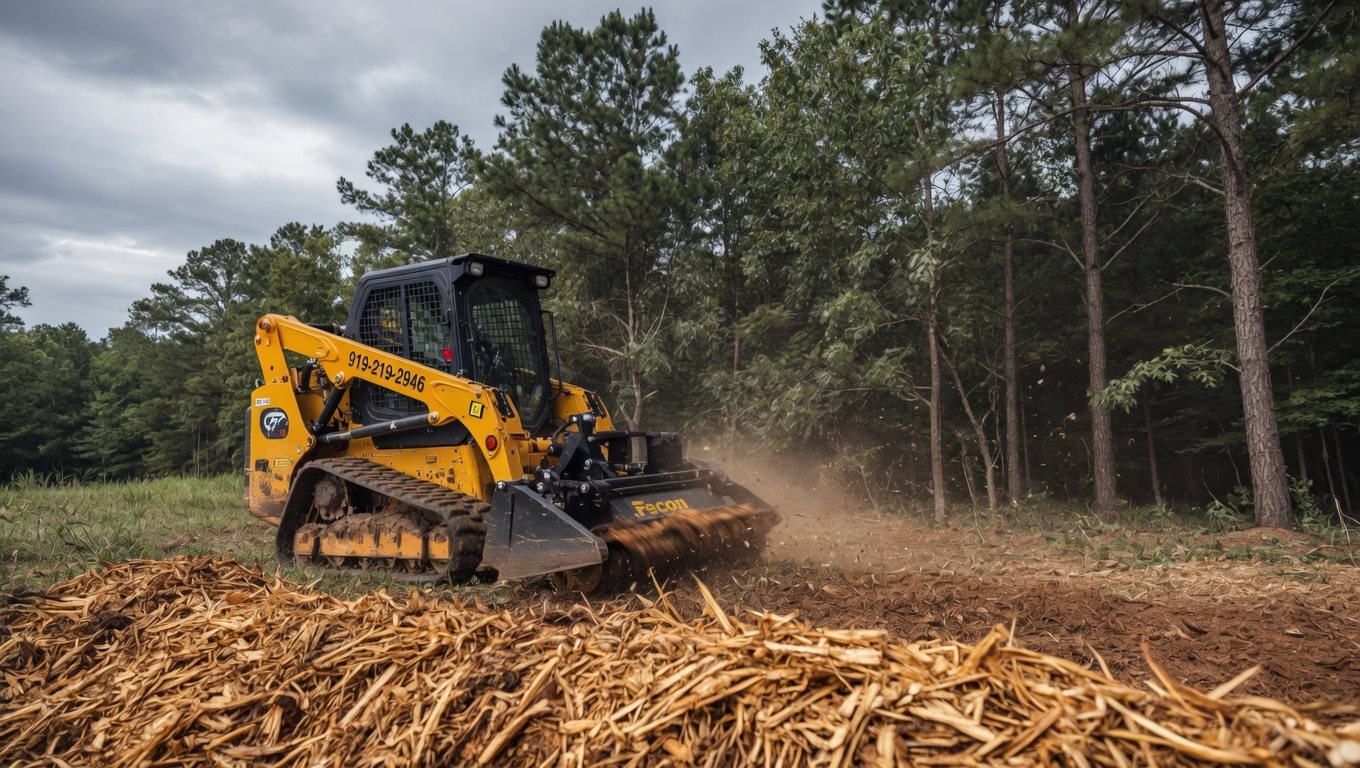
Visit one: open the ground. Our crew runs a tracked forestry mulcher through the stand and grinds the trees, trunks and all, into a chip layer where they stood. The head steers around the shade trees you flag. On flat South Plains ground most tracts are easy to reach from the road, though a playa basin holding water after a storm is left until it dries.
Then choose how the crowns are handled. There are two routes, and the right one depends on what the land is for.
- Crown removal below grade. Taking the crown out below the bud zone is full stump removal, which we discuss and price in the quote. It suits a homesite, a yard, a horse pasture or a fence line, where you want the trees gone and the ground smooth. AgriLife notes that grubbing can be done through much of the year, but “favorable soil moisture conditions make the job easier,” so a dry summer can move the date.
- Treatment of the regrowth by a licensed applicator. On larger pasture, many owners leave the crowns and treat what comes back. The Brush Busters guide says that after mesquite has been top killed by “any mechanical methods,” you should “allow two full growing seasons” before its leaf spray method, and that outside East and South Texas spraying may be able to run through September. That treatment is herbicide work, done and priced by a licensed applicator, not by us. Ask them about the product, the timing and the label.
After that: check back. Seed in the soil and beans dropped by livestock and wildlife keep new trees coming. Walk the ground every season for the first few years and deal with seedlings while they are small. On a big tract, a light return pass with the mulcher every few years is sometimes cheaper than the alternative.
Keep what earns its place. A few big mesquites near a house, barn or pen give shade on open ground. Flag them before the machine arrives, and accept that they will keep dropping beans nearby.
Rules That Touch a Mesquite Job Around Lubbock
Burning is limited. Texas allows land clearing growth to be burned on the property only outside city limits and under state conditions on distance, daylight and wind, and Lubbock County Commissioners have ordered burn bans in dry spells, including a 30-day ban in March 2025 with fines of up to $500. A pile of cut mesquite can sit on the ground until a legal burn day comes. Mulching leaves nothing to burn or haul.
An acre or more brings in stormwater rules. Inside Lubbock, the city’s stormwater regulations count clearing, grading and excavating that disturb one acre or more as construction activity. In unincorporated Lubbock County, a project of that size sends a copy of its state stormwater notice to Lubbock County Public Works. Requirements vary by parcel, scope and jurisdiction, and the governing authority makes the determination.
Herbicide is a licensed job. Anyone treating regrowth for hire should be a licensed applicator working to the product label. Our crew does the mechanical work only.
Property lines. Mesquite on a fence line often belongs to two owners. Agree with your neighbor before the machine works along the wire.
What Mesquite Removal Costs
Cutting young mesquite and brush out of pasture and fence lines falls in Cut Brush’s $1,500 to $2,500 per acre mesquite and pasture brush band. A closed stand of old, multi-stemmed trees moves into forestry mulching at up to $4,000 per acre, and a whole tract cleared for building runs up to $4,500 per acre. Jobs under about half an acre are priced at our $1,500 project minimum, which is a minimum charge for the whole job, not a fee added on top. An acre lands anywhere in its band depending on how many trunks stand on it and how big they are.
Crown removal below grade is not in the mulching price; it is discussed and priced in the quote when you want it. Treatment of the regrowth is a separate cost from a separate, licensed provider. Ask for both to be shown as their own lines so you can see the whole plan, not just the first visit. A quote that promises mesquite will not return after one mulching pass has left out the step that does the work.
Our Lubbock forestry mulching cost guide compares per-acre, hourly and day-rate quotes and shows how many acres a day different stands allow.
Frequently Asked Questions
Is honey mesquite invasive around Lubbock?
No. It is a native tree on the Llano Estacado, recorded there by the USDA Forest Service over thousands of years. What landowners deal with is its spread onto pasture and acreage where they want grass or a building site.
Will mesquite grow back after it is mulched?
Yes, from the crown, usually with several stems. Taking the crown out below the bud zone, or treatment of the regrowth by a licensed applicator, is what stops it.
When is the best time to remove mesquite?
Mulching works through most of the year. Crown removal is easier when the soil has some moisture, and a licensed applicator will wait two full growing seasons after a mechanical cut before a leaf spray.
Does Cut Brush spray the regrowth?
No. Our crew does the mulching and, when you choose it, the crown removal. Spraying is work for a licensed applicator, and it is worth planning before the first visit.
Get Your Pasture Back From Mesquite
If mesquite has taken a pasture, a draw, a fence line or an acreage lot around Lubbock, request a free quote. We’ll contact you to discuss your property, access and the clearing you need, and the scope, including what happens to the crowns, goes on paper before work starts.
Read more: the bands are on the Lubbock pricing guide, the local ground is on our Lubbock land clearing page, and owners farther east can compare notes in our North Texas mesquite guide.
More from the Cut Brush Blog
Keep reading for more tips and guides on land clearing.
 Cost Guide
Forestry Mulching Cost in Lubbock, TX (2026)
Forestry mulching around Lubbock runs $1,500 to $4,000 an acre. Day rates against per-acre quotes, acres per day in mesquite, and what keeping it gone costs.
 Cost Guide
Land Clearing Cost Per Acre in Texas (2026 Guide)
Land clearing cost per acre in Texas runs $1,500 to $4,500. See what cedar density, rock, and access do to a quote, with real Hill Country ranges by vegetation type.
Let's Get Started on Your Land
Request a free quote. We'll contact you to discuss your property, access, and the clearing you need.
Get a Free QuoteOr call us directly: (919) 525-3950