
Land Clearing Cost Per Acre in Texas (2026 Guide)
Cut Brush Team · September 3, 2026 · 11 min read
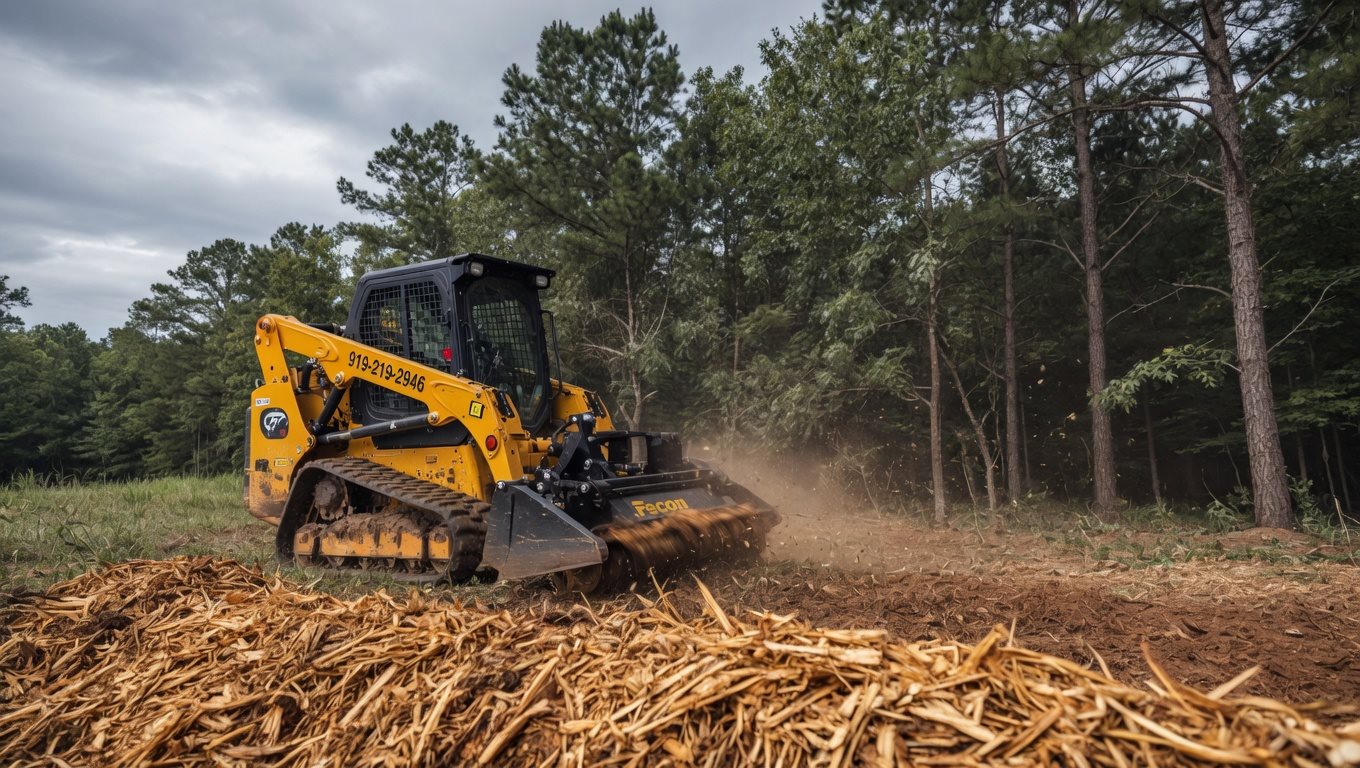
Ask three contractors what it costs to clear an acre in Texas and you will get three numbers that are all correct, because they are pricing three different acres. The state runs from Piney Woods to Hill Country limestone to South Texas brush country, and the vegetation on top of the ground moves a quote further than the acreage ever does.
Land clearing cost per acre in Texas generally runs $1,500 to $4,500. This guide explains what puts a specific parcel at the bottom or the top of that band, using the ranges we actually quote around San Antonio and the Hill Country.
The Short Answer, by What Is Growing
| What is on the acre | Per-acre range | Where you see it |
|---|---|---|
| Open pasture with scattered regrowth | $1,500 – $2,000 | Grazing ground losing its edges to young cedar and mesquite |
| Mixed brush: mesquite, huisache, prickly pear | $1,500 – $2,500 | Fence lines, ranch tracts, South Bexar and Wilson County ground |
| Moderate Ashe juniper with understory | $2,500 – $3,500 | Typical Hill Country ranchette that has not been managed in a decade |
| Closed-canopy juniper, larger stems, rock | $3,500 – $4,500 | Untouched hillsides in Comal, Kendall, and Bandera County |
These are the ranges on our San Antonio pricing guide, and they hold up reasonably well across Central Texas. A homesite pad, driveway, and utility corridor on a Hill Country lot most often totals $2,000 to $6,000 all in.
East Texas prices off a different set of variables. There is no limestone and no rock in the equation, so stem density and how much water the sandy loam is holding do the work that cedar and caliche do further west. For that side of the state see our Tyler pricing guide and the Tyler land clearing hub, which cover Smith County and the five counties around it.
There is also a practical floor of around $1,500 on very small parcels. That is not a minimum charge dressed up as pricing; it is what it costs to get equipment onto a property regardless of how little ground there is to cover.
What Actually Moves the Number
1. Cedar density, measured in stems
Ashe juniper is the single biggest variable on a Central Texas quote. A mulching head moves through ankle-high regrowth quickly and slows down sharply as trunk diameter climbs. Two adjoining acres can differ by thousands of dollars because one carries scattered stems and the other carries a canopy nobody has touched in twenty years.
This is why a per-acre rate quoted over the phone, sight unseen, is usually wrong in one direction or the other. Anyone pricing your land properly is counting stems and looking at trunk diameter, not reading canopy off a satellite image.
2. How close the limestone is
Thin soil over rock changes what equipment can do. Ledge, loose caliche, and steep faces all slow a machine and decide whether stump work makes any sense on a given parcel. Flat ground with real soil depth is the cheap end of every range in the table above.
It also changes what the right finish is. On shallow Edwards Plateau soil, scraping ground bare invites erosion on the first serious storm, which is a large part of why mulch-in-place clearing is so common here.
3. Method: mulch in place or clear and haul
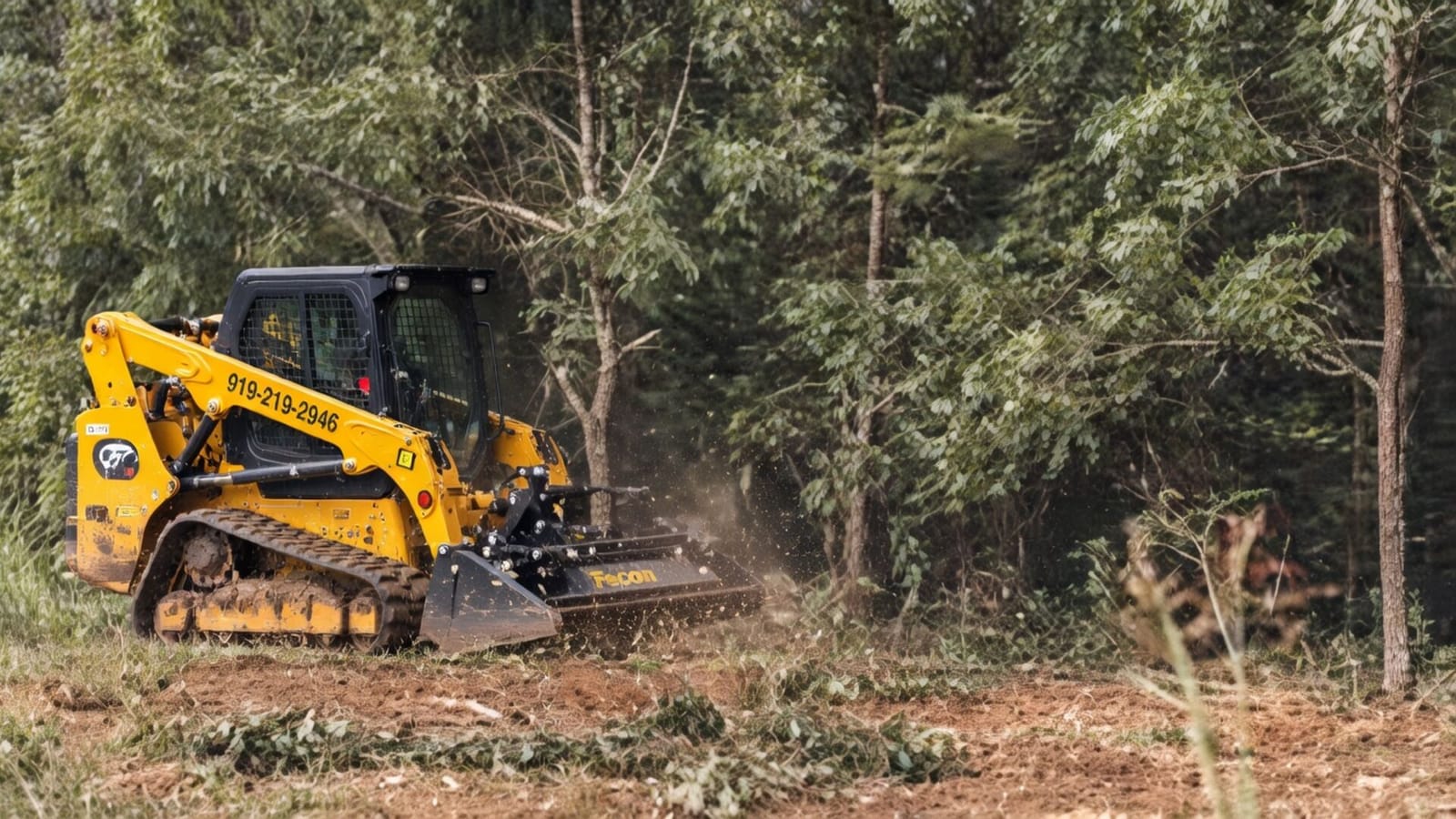
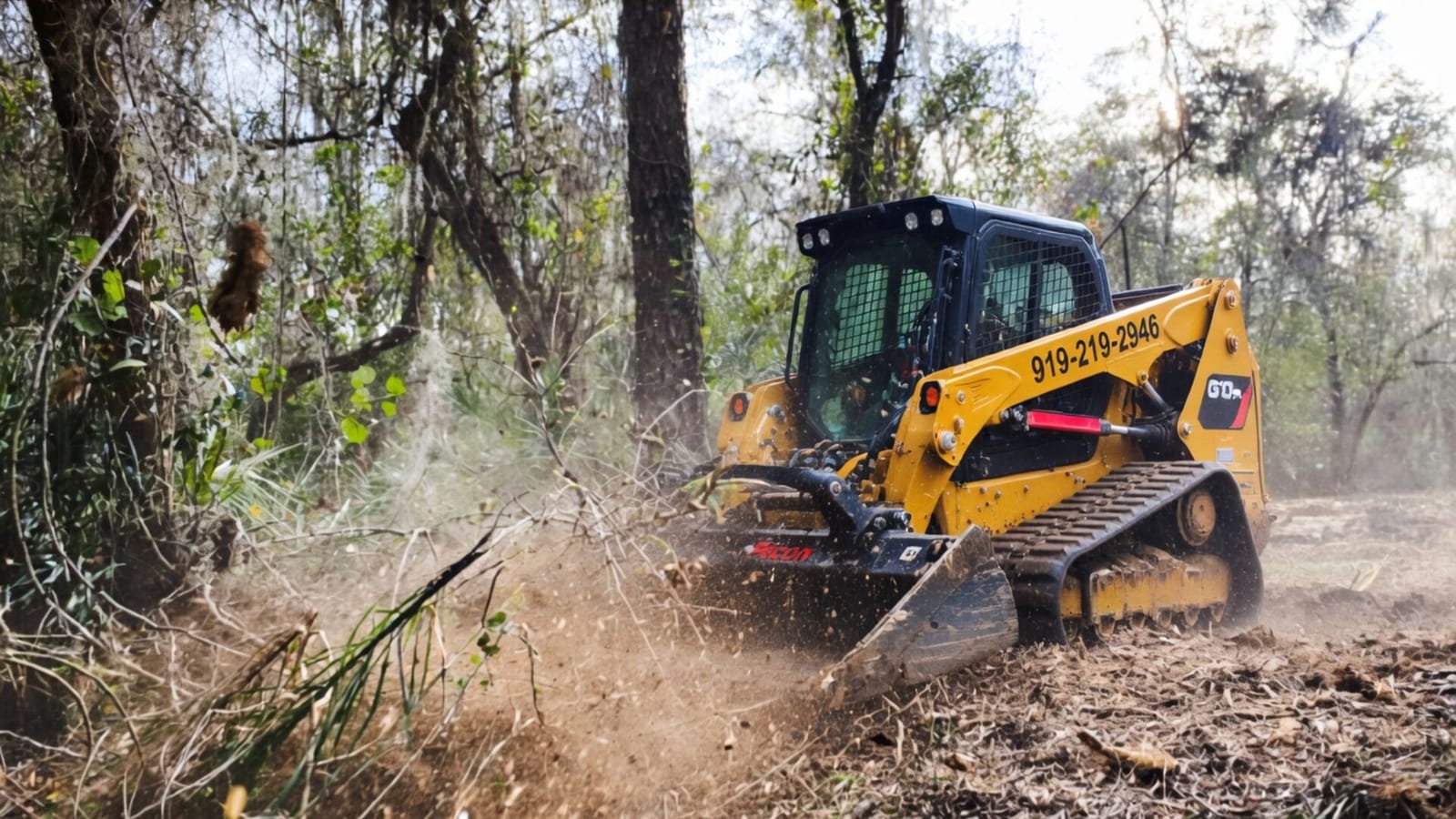
Traditional clearing has two halves: cutting, then getting rid of what you cut. Forestry mulching deletes the second half. Material is processed where it stands and left on the ground as cover, so there is no pile to build, nothing to load, no dump fees, and no waiting on a burn ban.
That last point is not theoretical in Texas. Unincorporated Bexar County extended a burn ban for 90 days in February 2026, and violating a county burn ban is a Class C misdemeanor carrying a fine up to $500. If your plan depends on burning the debris, your plan depends on the weather and the commissioners court.
Clear-and-haul still wins in specific situations: a site being cut to grade for construction, or ground where the owner wants nothing left on the surface at all. It just costs more, because you are paying for loading, trucking, and disposal on top of the clearing.
4. Access
Long caliche drives, cattle guards, narrow gates, and low branches over the approach all burn hours before any clearing happens. A parcel a trailer can reach straight off a county road prices lower than one that needs a staging plan, and it is the variable owners most often forget to mention when they call.
5. Paperwork timing
This one changes the schedule more often than the price, but a delayed project has a cost of its own.
Clearing over the Edwards Aquifer is a regulated activity under the TCEQ Edwards Aquifer Protection Program, which covers eight counties including Bexar, Comal, and Medina, and approval has to be in hand before soil is disturbed on the recharge zone. In the contributing zone the rules reach disturbances of five acres or more, or smaller pieces of a larger common plan totalling five acres. Out in unincorporated Bexar County, a Storm Water Quality Permit applies at one acre of disturbance and costs $500, and a floodplain permit runs $50 where a property is in or within 100 feet of a mapped 100-year floodplain.
Our San Antonio permits guide walks through all of it with the sources.
6. The finish you asked for
“Cleared” means at least four different things:
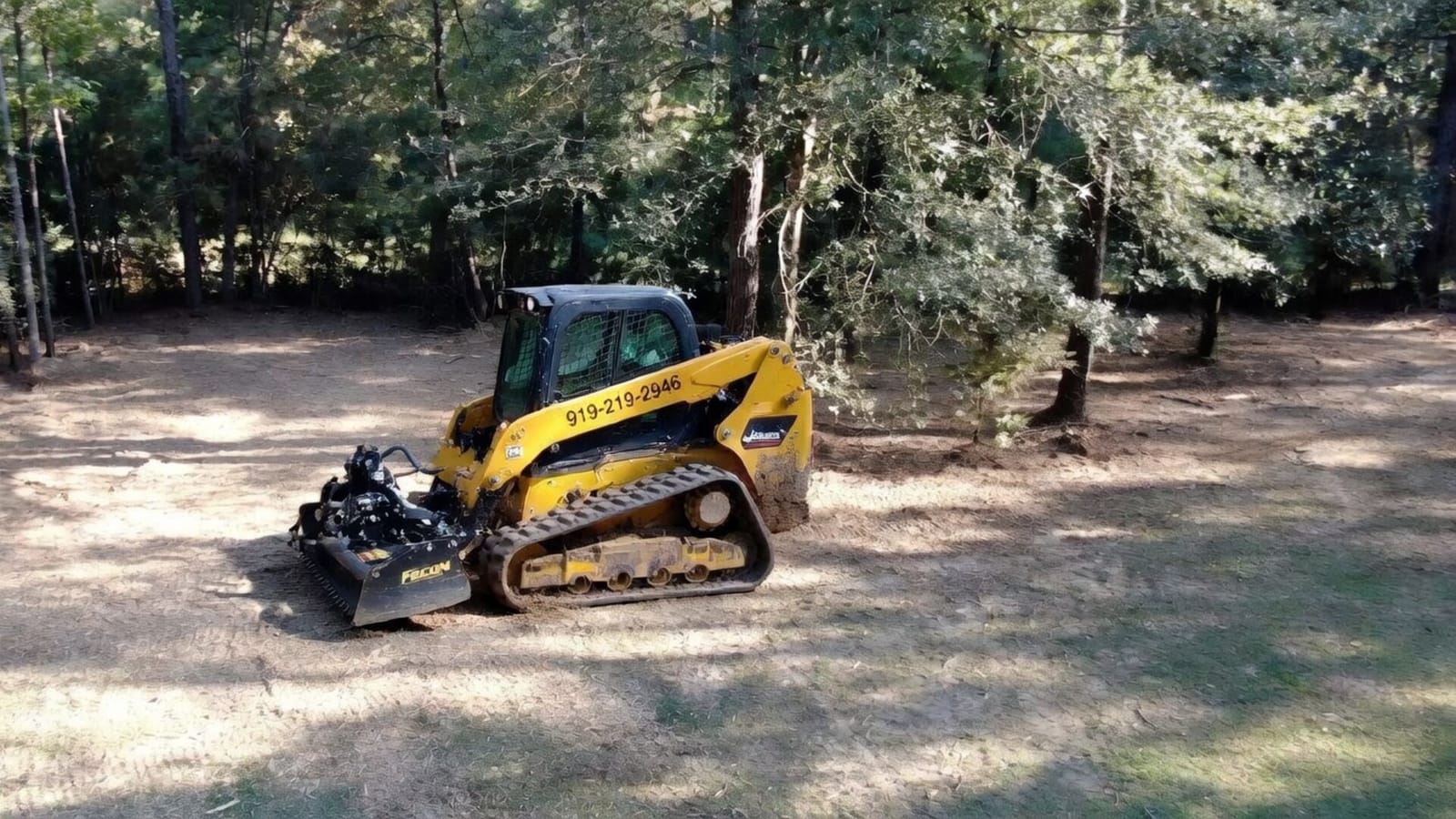
- Mulched and walkable. Understory gone, mat on the ground, keeper trees standing. The most common and least expensive outcome.
- Selective clearing. Specific trees kept, everything else removed. Slower per acre because the machine works around things.
- Cleared to bare ground. Stumps out, surface stripped. Priced highest and usually only worth it ahead of construction.
- Maintenance pass. Ground cleared within the last few years, knocked back before it gets away again. Cheapest work we do.
Naming the finish before the walk-through is the single easiest way to keep a quote accurate.
The Part Nobody Puts in a Price Table: Regrowth
Mesquite, huisache, and juniper all come back. General brush management guidance in Texas is that woody cover returns within five to ten years without follow-up, and that maintenance every three to five years is far cheaper than a full reclearing. NRCS treats this as a managed practice rather than a one-time event, funding it as conservation practice code 314 through EQIP with payment rates that vary by brush density and method.
Budget the way ranchers do: a bigger number up front, then a much smaller number every few years. An owner who mulches once and walks away for fifteen years pays the full price twice.
Is It Cheaper to Do It Yourself?
Sometimes, on small acreage, with the right equipment and time you actually have. Skid steer and mulching head rentals exist and people do use them.
The honest arithmetic: rental plus fuel plus your weekends, against a machine that does in a day what a rental does in four, operated by someone who has already learned which stems will stall a drum. On a half acre of light brush, DIY can make sense. On five acres of closed juniper over rock, it usually turns into an expensive education. And a rental does not answer the aquifer question, the tree ordinance question, or the oak wilt calendar for you.
Getting a Real Number for Your Parcel
Ranges are for budgeting. The number you pay comes from someone standing on your ground looking at stem size, rock, access, and what the land has to do next.
If your property is anywhere around San Antonio, Boerne, New Braunfels, Seguin, or the counties between them, we will walk it with you for free and put a written number in your hands, usually within a day. Start with the pricing guide if you just want to know whether your project is a $3,000 conversation or a $30,000 one.
Down on the Rio Grande the deciding variable is stem count rather than tree size. Around Laredo the brush is thorny mesquite, huisache and blackbrush. Texas A&M AgriLife warns that multi-stemmed mesquite is much harder to kill than an undisturbed tree, and Laredo’s stormwater permit reaches into the extraterritorial jurisdiction from one acre. If your ground is in Webb, Zapata, Jim Hogg, Duval or La Salle County, start with land clearing in Laredo and the Laredo pricing guide.
Toward the coast, Victoria trades thorn for rose. Texas A&M AgriLife puts Macartney rose, brought in as hedge fencing in the late 1800s, on more than 500,000 acres of Texas rangeland, and on the clay prairie of the Golden Crescent the height of that hedge sets the pace of a job more than tree size does, while along the Guadalupe bottoms the floodplain map decides the paperwork. Owners in Victoria, Calhoun, Jackson, DeWitt or Goliad County can read about the ground on the Victoria land clearing page and price it against the Victoria pricing guide.
What makes a Killeen acre expensive is the age of the brush, not its species. On the limestone hills around Fort Cavazos the brush owners pay to remove is mostly cedar and mesquite, and because the USDA Forest Service finds that Ashe juniper does not resprout from the stump, young cedar is a one-time job while a closed stand of old juniper on rock runs slower and may first need a warbler-habitat question answered. Owners in Bell, Coryell, Lampasas or Burnet County can read about that ground on the Killeen land clearing page and set their acreage against the Killeen pricing guide.
The cedar on the northern rim of the Edwards Plateau is a harder customer. Around San Angelo much of it is redberry juniper, which Texas A&M research finds resprouting from buds at its base when only the top is cut, so young plants ground out at the surface are a one-pass job while older ones are quoted with a return visit, and Tom Green County’s repeated burn bans make a brush pile a gamble. If your land is in Tom Green, Runnels, Coke, Concho, Irion or Schleicher County, see land clearing in San Angelo and price it on the San Angelo pricing guide.
Up on the Llano Estacado the ground flattens out, and the question changes from how big the trees are to how many there are. The USDA Forest Service describes the plateau around Lubbock as shortgrass prairie with patches of honey mesquite, and Texas A&M AgriLife explains that a mesquite cut at the surface resprouts from the bud zone on its root crown, so a South Plains quote turns on stem count and on whether the crowns come out below grade, which is priced in the quote. If your land is in Lubbock, Hockley, Hale, Lynn, Crosby or Terry County, see land clearing in Lubbock and price it on the Lubbock pricing guide.
Ask what slows a Beaumont job down and it is usually water rather than wood. Texas Parks and Wildlife maps the pine-hardwood flatwoods north and east of the city as low ridges and shallow swales over a perched water table, so the swales holding the biggest water oaks and blackgums are also the last ground to dry, and a stand that has taken storm damage adds leaning trees to the count. Owners in Jefferson, Orange, Hardin or Jasper County can see how that ground is handled on the Beaumont land clearing page and price their acreage on the Beaumont pricing guide.
Uvalde is where a single ranch can straddle two kinds of brush: cedar on the shallow limestone hills of the Edwards Plateau and blackbrush on the plains below them. Texas A&M AgriLife notes that redberry cedar resprouts after its top is cut while blueberry cedar is controlled by cutting at the ground line, and over the Edwards Aquifer recharge zone in Uvalde and Kinney counties TCEQ’s rules treat clearing without soil disturbance differently from work that moves dirt. For land in Uvalde, Real, Zavala, Dimmit, Maverick or Kinney County, the Uvalde land clearing page explains that ground and the Uvalde pricing guide prices it.
Palestine is a case of two soils on one deed. Texas Parks and Wildlife describes the Post Oak Savannah around it as sandy uplands, where decades without fire have packed a thick understory of yaupon under the post oaks, falling away to clay creek and river bottoms that drain to the Trinity and the Neches and stay soft long after the hill has dried, so the share of bottomland and the age of the yaupon set the figure more than the acreage does. If your tract is in Anderson, Freestone, Houston or Leon County, read how that ground is handled on the Palestine land clearing page and set your acres against the Palestine pricing guide.
Further up Interstate 35, the Austin metro runs on a calendar of its own: a golden-cheeked warbler habitat blackout from March through August, stacked on the February to June oak wilt window, plus a Travis County permit whose trigger is machinery rather than acreage. If your ground is in Travis, Williamson, Hays, Bastrop or Caldwell County, start with land clearing in Austin and the Austin pricing guide.
North of Dallas the deciding variable is not rock at all, it is clay. The Blackland Prairie runs from Collin County south through Ellis on Houston Black, a Vertisol with 40 to 60 percent clay that swells, shrinks and cracks open every year, and in a metro inside an ozone nonattainment area burning what you clear is not a plan you can schedule around. If your ground is in Dallas, Collin, Rockwall, Kaufman or Ellis County, start with land clearing in Dallas and the Dallas pricing guide.
On the Gulf Coast the deciding variable changes again. The ground is a nearly level, slowly drained plain rather than rock or slope, Harris County requires a permit for all development with no acreage floor written under it, and a clearing burn for commercial or subdivision development does not normally meet a TCEQ exception, so what it costs to get the cut material off the property does the work that cedar density does further west. If your property is in Harris, Fort Bend, Brazoria, Waller, Chambers or Galveston County, start with land clearing in Houston and the Houston pricing guide.
Related Services
Learn more about the services mentioned in this article.


More from the Cut Brush Blog
Keep reading for more tips and guides on land clearing.
 Cost Guide
 Forestry Mulching Cost in Texas (2026 Per-Acre Guide)
Forestry mulching in Texas runs $1,500 to $4,000 an acre. See why cedar and rock, Blackland clay, yaupon and burn rules move a quote in each part of the state.
 Guide
Guide San Antonio Land Clearing Permits: Trees, the Aquifer, and County Rules
What San Antonio land clearing permits actually require in 2026: city tree thresholds, Edwards Aquifer plans, and Bexar County storm water rules, explained plainly.
 Cost Guide
 Underbrush Removal Cost in Texas (2026 Pricing)
Underbrush removal in Texas runs $1,500 to $2,500 an acre, up to $3,500 in East Texas. See what yaupon, privet, keeper trees and cost-share programs change.
Comparing states? See land clearing costs by state.
Let's Get Started on Your Land
Request a free quote. We'll contact you to discuss your property, access, and the clearing you need.
Get a Free QuoteOr call us directly: (919) 525-3950