
Russian Olive Removal in Utah: Cut, Treat and Check Back
Cut Brush Team · October 11, 2026 · 8 min read

To get rid of Russian olive in Utah, cut the trees down and then treat the stumps, and plan to check back for a few seasons. Cutting on its own does not work: Utah State University Extension says Russian olive sprouts from the root crown and sends up root suckers, and that the most effective control has been cutting the trees followed by spraying or burning the stumps. A forestry mulcher brings a ditch-bank stand down in one pass and leaves the bank open and walkable. A stump treatment by a licensed applicator, arranged by the landowner, is what makes the clearing last.
This guide covers why Russian olive does so well along Utah water, how to recognize it, why one cutting fails, a plan that holds, the rules that touch a Russian olive job, and what it costs.
Why Russian Olive Takes Over Utah Ditches and Creeks
The Utah Department of Agriculture and Food lists it as a Class 4 prohibited noxious weed, the class for plants that “pose a threat to the state through the retail sale or propagation in the nursery and greenhouse industry.” In plain terms, it can no longer be sold or propagated in Utah. Tamarisk, also called saltcedar, is listed separately as Class 3, a weed to be contained.
The places it chooses are the places landowners care about most. USU Extension says it is “commonly found growing along floodplains, riverbanks, stream courses, marshes, and irrigation ditches in the West at elevations from 4500 to 6000 feet.” On a Utah property that means the ditch that carries water to a pasture, the creek bottom below a homesite or the wet corner of a horse paddock.
It is widespread here. The EDDMapS county map, run by the University of Georgia’s invasive species center, held 198 Russian olive reports in Tooele County, 179 in Salt Lake County and 428 in Utah County as of October 2026. Reports only count where someone recorded a tree, so a county with fewer reports is not necessarily a county with fewer trees.
It also spreads fast. USU says it can grow up to 6 feet a year and reaches 12 to 45 feet, and that “more than 50 species of birds and mammals eat the fruit.” Every bird that feeds on a tree along one ditch carries seed to the next one. A single untreated stand upstream keeps reseeding everything below it.
How to Recognize Russian Olive
Russian olive is easiest to spot by its colour. USU describes leaves 1.7 to 3.5 inches long, narrow, light green above and gray below, covered in tiny scales that give the whole tree a silvery look. Against the darker green of cottonwood or willow on the same bank, a Russian olive stand looks almost gray from a distance.
Up close, look at the twigs. They are flexible, coated with a gray, scaly fuzz, and end in a thorn. Those thorns are why a ditch lined with Russian olive is hard to walk, hard to clean and hard on anyone who tries to cut it by hand.
If you are not sure what you have, your county extension office can confirm it from a sample or a photo. It is worth knowing before you plan the work, because a cottonwood or willow you want to keep can be standing in the middle of the stand.
Why One Cutting Fails
Picture a ditch bank cut back with a chainsaw in the fall. By the next summer it is green again, and often with more stems than before.
Each of those stems has a source you cannot see from the bank. USU says Russian olive “reproduces from seed and by root sprouting,” and that it “sprouts from the root crown and sends up root suckers.” Cut the trunk and leave the stump untreated, and the root crown pushes up a cluster of new stems where one used to be. Root suckers come up away from the stump, along the line of the roots. Seed already in the soil keeps germinating too.
That is why USU’s own summary is blunt: once established, Russian olive “is difficult to control and nearly impossible to eradicate.” A contractor who promises it will never come back after one visit has left out the part that does the work.
None of that makes mechanical work useless. It means the machine is step one, not the whole job.
A Removal Plan That Holds: Cut, Treat, Check
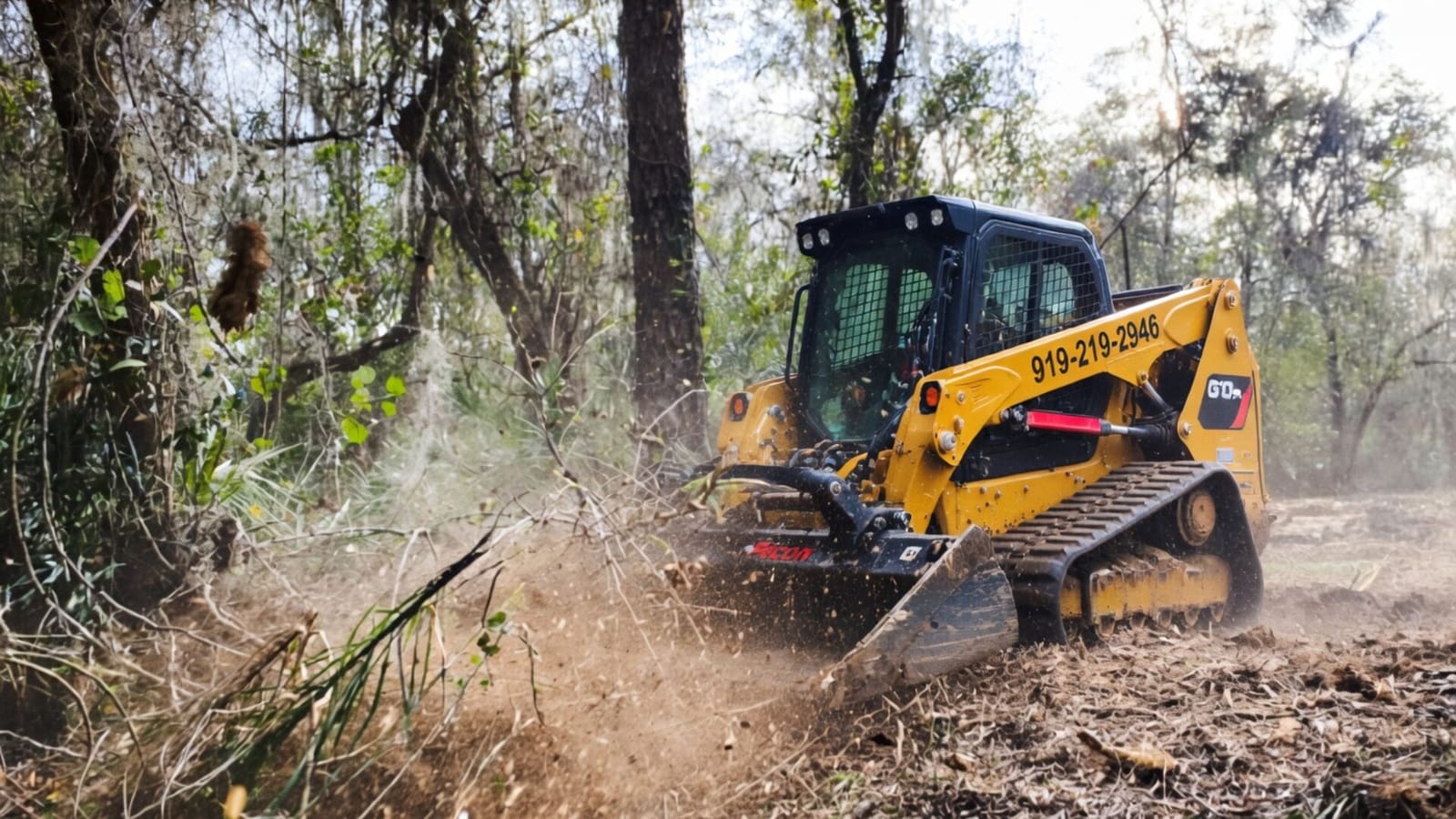
Step one: bring the stand down. A tracked forestry mulcher grinds Russian olive, thorns and all, into a chip layer where it stood. It steers between the cottonwoods, willows and fruit trees you want kept, which a dozer working a ditch bank cannot do gently. Nothing is piled, so there is no burn question and no thorny brush to drag out. The bank is left walkable, and the stumps are left low and easy to reach. Narrow ditches are worked from the bank, and wet ground is worked when it is firm enough to carry the machine.
Step two: treat the stumps. USU names cutting followed by spraying or burning the stumps as the most effective combination. The herbicide part is a job for a licensed pesticide applicator, arranged by the landowner, following the product label; our crew does not apply herbicide. Ask the applicator how to time the treatment to the cutting, and to quote it as its own line so you can see the whole plan.
Step three: check back. Sprouts from the root crown and root suckers can appear as soon as the next growing season, and seed in the soil keeps coming. A walk along the bank each season for the first few years, with spot treatment on anything green, is what turns a cleared ditch into a ditch that stays clear. On a long run of bank, a light second mulching pass can be cheaper than treating hundreds of sprouts by hand; on most properties spot treatment is enough.
Work with your neighbours. Because birds carry the seed, a cleared bank below an untreated stand will keep seeing seedlings. If a ditch runs through several properties, clearing the whole run at once spreads the trip cost and slows the reseeding.
Ditches, Burning and Other Rules
Clearing Russian olive is still clearing land, so the usual rules apply.
- Burning. Utah Code 65A-8-211 makes June 1 to October 31 a closed fire season statewide, when burning brush or a debris pile needs a written permit from the state forester and a call to dispatch first. The same law lets you burn within 10 feet of the bank of a canal or irrigation ditch without that permit, outside a Red Flag Warning, provided you still notify dispatch and the fire threatens no forest, range or watershed land. Utah’s open burning rule adds a permit and a clearing index of 500 or more for most other burning. Mulching leaves nothing to burn.
- Ditch and canal banks. A ditch may be shared or belong to an irrigation company. Before work starts on a bank, confirm who owns it and whether the company has its own rules for work along it.
- Disturbed soil. Mulching leaves the ground in place, but a job that disturbs an acre or more of soil brings in Utah’s construction storm water permit. Your city or county can tell you what applies.
Requirements vary by parcel, scope and jurisdiction, and the governing authority makes the determination.
What Russian Olive Removal Costs
Clearing Russian olive from a ditch bank, fence line or creek bottom, with the trees you are keeping left standing, falls in Cut Brush’s $1,500 to $2,500 per acre band. Ditch work is narrow, so it is priced by the acreage equivalent of the strip. A dense, old stand across a wide creek bottom, or one mixed with large trees that also have to come down, moves into forestry mulching at up to $4,000 per acre. Where an acre lands in its band depends on how dense and how big the stand is. $1,500 is the minimum charge for a project, a floor rather than a fee added on top, because the trip costs the same whether the machine runs for two hours or eight.
The mulching price grinds the trees and stumps into mulch on site, with stumps flush with the ground and nothing hauled away. Full stump removal below grade and cut-and-haul for very large trees are discussed and priced in the quote. The stump treatment is a separate cost and a separate provider, and it is not something our crew prices. Ask for it to be quoted as its own line so you see the whole plan, not just the first visit. Our Tooele forestry mulching cost guide explains where a job lands inside the bands.
Frequently Asked Questions
How do I get rid of Russian olive trees and keep them from coming back?
Cut or mulch them, have a licensed applicator treat the stumps, and check the bank each season for a few years. Cutting alone lets them sprout back from the root crown and roots.
Is pulling Russian olive seedlings enough?
It may take out a few small seedlings. Once a tree has a root crown and suckers, roots left in the ground can resprout, and the thorns make hand work slow. Treat anything past seedling size as a cut and treat job.
Is Russian olive illegal in Utah?
It is a Class 4 prohibited noxious weed, which means it cannot be sold or propagated in Utah.
Can I burn the Russian olive I cut?
Within 10 feet of a canal or irrigation ditch bank you can burn without a state forester’s permit outside a Red Flag Warning, but you must notify dispatch. Mulching leaves nothing to burn.
Get Your Ditch Bank Back
If Russian olive has taken a ditch, a fence line or a creek bottom around Tooele, Grantsville, Erda or across the Oquirrhs in Herriman and Eagle Mountain, request a free quote. We’ll contact you to discuss your property, access and the clearing you need, and our crew puts the scope on paper, including what is and is not treated.
Read more: the bands on the Tooele pricing guide, the local ground on our Tooele land clearing page, and statewide figures in our Utah land clearing cost guide.
More from the Cut Brush Blog
Keep reading for more tips and guides on land clearing.
 Cost Guide
Forestry Mulching Cost in Tooele, UT (2026)
Forestry mulching around Tooele, UT runs $1,500 to $4,000 per acre. How juniper size, the trees you keep, sagebrush, rock and slope move a Tooele quote.
 Cost Guide
Land Clearing Cost Per Acre in Utah (2026 Guide)
Land clearing in Utah runs $1,500 to $4,500 an acre with our crew. How Gambel oak, juniper, rock and the state's burn rules move the price on your land.
Guide Juniper Removal in Utah: How It Returns and the Plan
Juniper removal in Utah: $1,500 to $2,500 per acre for understory clearing. Plan the first pass and follow-up visits. Request a free quote today.
Let's Get Started on Your Land
Request a free quote. We'll contact you to discuss your property, access, and the clearing you need.
Get a Free QuoteOr call us directly: (919) 525-3950