
Land Clearing Cost Per Acre in Utah (2026 Guide)
Cut Brush Team · October 9, 2026 · 9 min read

Scrub oak has closed in on the slope above your bench lot, or juniper has crept across the ranch ground until the cows cannot find the grass. Our crew clears Utah land for $1,500 to $4,500 an acre. Sagebrush on a lot edge prices near the bottom; a closed oak thicket on a grade, with large trees cut and hauled off, prices near the top.
Our Utah work runs through three markets: Tooele and the Oquirrh Valleys, Tremonton and the Bear River Valley, and Nephi and Central Utah. Land elsewhere in the state is still worth asking about.
At a glance:
- Sagebrush, rabbitbrush or Russian olive along a fence, ditch or lot line: $1,500 to $2,500 an acre
- A closed Gambel oak or pinyon-juniper stand mulched in place: $1,500 to $4,000 an acre
- A whole parcel cleared to a finish agreed in the quote: up to $4,500 an acre
- Closed fire season: from June 1 to October 31, burning a brush or debris pile needs a written permit from the state forester and a call to dispatch first.
- Stormwater: disturbing an acre or more of soil needs Utah DEQ’s UPDES construction permit coverage.
Request a free quote and we’ll contact you to discuss your property, access and the clearing you need.
How Much Does Land Clearing Cost Per Acre in Utah?
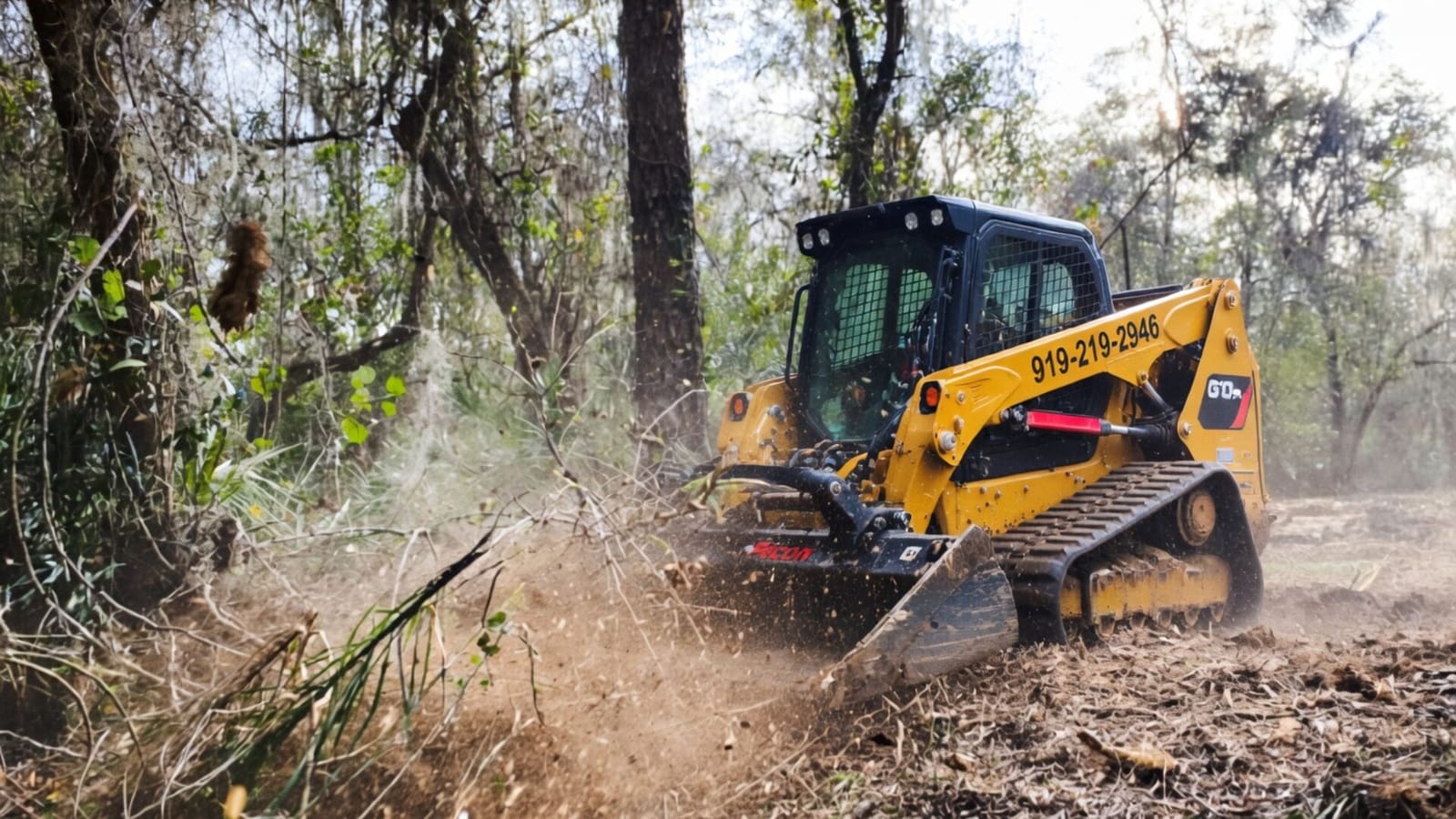
Clearing, for us, means one of two things: grinding brush and trees into a chip mat where they stand, or taking a whole parcel to a finish agreed in the quote. The first is cheaper. What is standing on the land decides which band you are in.
| What is on the land | Price per acre | What it looks like in Utah |
|---|---|---|
| Sagebrush, rabbitbrush and young juniper along a lot edge or fence | $1,500 – $2,500 | Tooele and Juab valley ranchettes, west desert acreage |
| Russian olive or tamarisk cut back from a ditch, pond or creek | $1,500 – $2,500 | Irrigation ditches and river bottoms such as the Escalante |
| Closed Gambel oak or pinyon-juniper, mulched in place | $1,500 – $4,000 | Wasatch bench lots, Sanpete and Sevier foothills |
| Whole parcel cleared to an agreed finish | $1,500 – $4,500 | Ground opened for a barn, a hay field or a shop |
| Cabin or house site, drive and utility path | $1,500 – $4,500 per acre equivalent | Mountain lots in Summit, Wasatch and Iron counties |
Where your land is and what grows on it set the quote.
What the price includes. Forestry mulching grinds brush, small trees and stumps into mulch on site, with stumps flush with the ground and nothing hauled away. Full stump removal below grade and cut-and-haul for very large trees are discussed and priced in the quote. Grading and build pads are not part of our price: we clear to the ground so a builder can grade.
Where these numbers come from. They are the bands our crew works to, the same ones on the Tooele pricing guide. An acre can land anywhere in its band, depending on what grows there. $1,500 is the minimum charge for a project, a floor rather than a fee added on top, because moving a tracked machine costs the same whether it works one afternoon or a full week. Bigger acreage, or two neighbours on one trip, spreads that cost thinner.
What Changes the Price of a Utah Clearing Job
Gambel oak does not stay cut. The oak’s lignotuber, a woody mass below ground, drives “rapid and extensive” sprouting once the top is removed. It grows from 4,000 to 8,000 feet across central and southern Utah and as far north as Sardine Canyon in Box Elder County. One pass knocks a thicket down; a second visit a season or two later is what keeps it down, and we say so before the first invoice.
Pro tip: Before anyone quotes a Wasatch slope, walk it and tie flagging on the bigtooth maples you want left. Oak favours south-facing ground while maple holds the north and east faces, so the trees worth keeping often sit on one side of the draw.
The size of the juniper. Utah has about 8 million acres of pinyon-juniper, nearly 60 percent of its forest cover, and the stands have thickened over the last century as fire was kept out. Treated ground is worth a return visit five to ten years later, because taking the trees while small costs less. A private acre works the same way: knee-high juniper is quick, trunks you need a saw for are not. Our Utah juniper removal guide sets out the clearing plan.
Hardpan and rock. The Borvant soils of Sanpete Valley and west-central Utah, where Utah juniper and pinyon grow, hold a cemented layer 10 to 20 inches down and 35 to 60 percent rock fragments. A mulching head working at the surface never meets it. Stump removal below grade in it pushes a job toward the top of its band.
Russian olive and tamarisk. Utah lists tamarisk as a Class 3 noxious weed, widespread and to be contained, and Russian olive as Class 4, banned from sale. Cut Russian olive needs retreating the year after cutting and then every three to five years. Our crew cuts and grinds; the herbicide follow-up is a licensed applicator’s work, arranged by you. Our Russian olive removal guide and tamarisk removal guide set out the cut, treat and check plan.
What becomes of the brush. A pile only saves money if you are allowed to light it, and along the Wasatch Front the burn windows are short. Brush mulched where it stands needs no permit and no burn day.
Land Clearing Costs Across Utah
The Wasatch Front, Brigham City to Provo. Ogden, Layton, Salt Lake City, Draper, Lehi and Orem sit on old Lake Bonneville terraces. The Parleys soils climb those terraces into the foothills on slopes up to 40 percent under big sagebrush and oakbrush. Bench lots here are oak on a grade, so slope and access set the price.
The Wasatch Back and the Uintas. Park City, Heber City, Kamas, Vernal and Roosevelt. Much of the work is fuel cleared around a cabin. Fire zones around a cabin run from an Immediate Zone to 5 feet, an Intermediate Zone to 30 feet and an Extended Zone to 100 feet, pushed to 200 feet on steep ground below the home. Thinning to those zones usually lands in our understory band.
Central Utah. Manti, Richfield and Delta, through Sanpete, Sevier and Millard counties, with Nephi, Ephraim and Juab County covered below. Pinyon-juniper on rocky Borvant benches is the standard job, and the WRI lesson holds: take the young trees before they become big ones.
Southeastern Utah. Moab, Monticello, Blanding and Green River. The Mivida soils of San Juan County are wind-blown sand over sandstone on 8 to 13 inches of rain a year. Upland brush is thin here; Russian olive and tamarisk in the river bottoms are the dense work.
The west desert and the southwest. Tooele, Milford, Beaver, Cedar City and St. George. Hiko Peak soils, mapped across about 450,000 acres, carry Wyoming big sagebrush over subsoil that is 35 to 70 percent rock fragments. Sagebrush clears fast; toward Cedar City and St. George, distance weighs on the quote as much as the brush does.
Tooele and the Oquirrh Valleys. One of our three Utah markets: Tooele County, the west side of Salt Lake County and northwest Utah County, from Grantsville and Erda to Herriman, Eagle Mountain and Lehi. The Tooele land clearing page covers the juniper, sagebrush and Russian olive our crew clears there, and the Tooele pricing guide lists the per-acre bands.
Tremonton and the Bear River Valley. Our northern Utah market: Box Elder County from Tremonton, Garland and Corinne to Brigham City, Cache County from Wellsville to Logan and Richmond, and Plain City at the north end of Weber County. The dense work here is tamarisk and Russian olive on irrigation ditches, canal banks and Bear River bottoms. The Tremonton land clearing page covers what our crew clears there, and the Tremonton pricing guide lists the same per-acre bands.
Nephi and Central Utah. Our third Utah market: Juab County from Nephi, Mona and Rocky Ridge, the north end of Sanpete County from Fountain Green and Moroni to Mount Pleasant and Ephraim, and south Utah County from Santaquin and Payson to Spanish Fork. On the east bench of Nephi, pinyon-juniper grows over a dense Gambel oak understory on soils that erode easily, so the oak’s return visit and the grade shape the quote here. The Nephi land clearing page covers what our crew clears there, and the Nephi pricing guide lists the same per-acre bands.
Permits and Burning Rules in Utah
The closed fire season. Utah Code 65A-8-211 makes June 1 to October 31 a closed season statewide. In those months, burning brush, range, a field or a debris pile without a written permit from the state forester or a deputy is a class C misdemeanor, and so is skipping the call to dispatch with the burn time. The exception: burning within 10 feet of a fence line on cultivated land, or on a canal or ditch bank, needs no permit, still needs the call, and is barred during a Red Flag Warning.
The air quality permit. Under Utah’s open burning rule, R307-202, every burn needs a permit from the county or city fire authority and is allowed only on days when the clearing index is 500 or more. In nonattainment and maintenance areas, which take in the Wasatch Front cities and Cache Valley, the windows are April 1 to May 31 and September 15 to October 31; elsewhere a November 1 to March 31 window also opens at a clearing index of 250. Utah DEQ has a locator that tells you which area you are in.
Stormwater. Disturbing an acre or more, or less as part of a larger plan, needs UPDES construction storm water coverage: a site plan (SWPPP) first, then a Notice of Intent. We never file permits, and grading is not part of our price: we clear to the ground so your dirt contractor can grade.
Frequently Asked Questions
How much does Gambel oak removal cost per acre in Utah?
Scattered oak along a lot line falls in our $1,500 to $2,500 band; a closed thicket mulched in place runs up to $4,000. Budget for a return visit, because the oak sprouts back from its root mass.
Can I burn brush piles on my land in Utah?
Usually, with two permissions. Your local fire authority issues the air quality permit for an open window on a day with a clearing index of 500 or more, and from June 1 to October 31 you also need the state forester’s written permit and a call to dispatch. Wasatch Front windows are the shortest.
Do I need a permit to clear land in Utah?
The state rules attach to what the job disturbs or burns, not to the cutting itself: an acre or more of disturbed soil needs UPDES coverage, and burning the debris needs the permits above. Your city or county may add its own grading or tree rules.
Get a Land Clearing Quote in Utah
Request a free quote and we’ll contact you to discuss your property, access and the clearing you need, whether that is a fuel zone around a cabin, open pasture, or a site cleared for your dirt contractor.
Sources
- Utah Code, 65A-8-211 closed fire season and burning permits
- Utah Department of Agriculture and Food, State of Utah noxious weed list
More from the Cut Brush Blog
Keep reading for more tips and guides on land clearing.
 Cost Guide
Forestry Mulching Cost in Tooele, UT (2026)
Forestry mulching around Tooele, UT runs $1,500 to $4,000 per acre. How juniper size, the trees you keep, sagebrush, rock and slope move a Tooele quote.
 Guide
Russian Olive Removal in Utah: Cut, Treat and Check Back
Why Russian olive takes over Utah ditches and creek banks, why one cutting brings it back, and the cut, treat and check plan that keeps a bank open over time.
 Guide
Juniper Removal in Utah: How It Returns and the Plan
Juniper removal in Utah: $1,500 to $2,500 per acre for understory clearing. Plan the first pass and follow-up visits. Request a free quote today.
Comparing states? See land clearing costs by state.
Let's Get Started on Your Land
Request a free quote. We'll contact you to discuss your property, access, and the clearing you need.
Get a Free QuoteOr call us directly: (919) 525-3950