
Juniper Removal in Utah: How It Returns and the Plan
Cut Brush Team · October 17, 2026 · 7 min read

To clear Utah juniper for good, grind every tree you are not keeping down to its base, including the knee-high ones, and walk the ground again every few years for seedlings. Utah juniper reproduces only from seed, so a tree ground out at the base does not sprout back from its stump and needs no stump treatment. Cleared ground fills in again for two reasons only: small trees the first pass missed, and seed already on the site or carried in by birds and jackrabbits. A plan that deals with both keeps the ground open.
Utah juniper is also called cedar, so a cedar on a Utah bench lot is usually this tree.
Where Utah Juniper Is Taking Ground
Utah juniper is everywhere in this state. It is the most widespread tree in Utah by cover, on nearly a fifth of the state, from about 4,000 to 7,500 feet on dry plains, plateaus and the lower slopes of the mountains.
It is a native tree, and much of it belongs where it stands. The problem is where it has moved. Since settlement it has spread into sagebrush-grass ground, helped by overgrazing, fire suppression and a changing climate, and without fire or other disturbance the trees take over and crowd out the grass and shrubs. On a ranch or foothill lot, that is the pasture thinning out between the trees.
How Juniper Spreads Into Open Ground
Everything about juniper spread comes back to the berry. The reddish-brown “berries,” dusted with a whitish bloom, are small cones that usually hold one seed each, and animals move them. Animals carry much of the seed, especially jackrabbits; foxes and coyotes eat the cones too, and that many birds depend on them for fall and winter food. Seed that has passed through an animal germinates faster than seed that has not.
Three things explain why a cleared lot does not stay clear by accident:
- The seed keeps. Utah juniper seeds usually germinate the second season after they ripen, and some stay alive in the soil for decades. Ground that grew junipers holds seed for a long time.
- Young trees are slow and easy to miss. Utah juniper adds about a twentieth of an inch of trunk diameter a year. A six-inch tree may be over 50 years old, and trees that size are easy to drive past.
- A tree seeds late, then for centuries. Utah junipers begin bearing seed at about 30 years old, and a tree can live as long as 650 years. One mature tree left uphill keeps feeding the lot below it.
After a fire, new trees come up beside or under the burned ones from seed already on the site. Mechanical clearing works the same way: the seed is in the ground before the machine arrives.
Why Cleared Juniper Ground Fills In Again
The tree you grind out is finished. Utah juniper has no root sprouts to fall back on, which makes it unlike Gambel oak growing under it on many Utah foothills, and unlike Russian olive and tamarisk along the water. What returns is new trees.
Juniper can return from missed seedlings and seed already in the soil or carried in. Going back early pays: the trees are still small, less fuel is left on the site and the work costs less.
So a juniper job fails in two ways. The first pass skips the small trees because they look like nothing, and in ten years they are the next stand. Or the first pass is thorough, nobody looks again, and seed in the soil produces a new crop that is left to grow until it is expensive. Both are cheap to prevent.
A Juniper Clearing Plan Over Several Years
- Decide what stays. Many owners keep a few large junipers for shade, wind or looks. Flag the keepers before anyone quotes the job. Keep in mind that every mature tree you leave is a seed source.
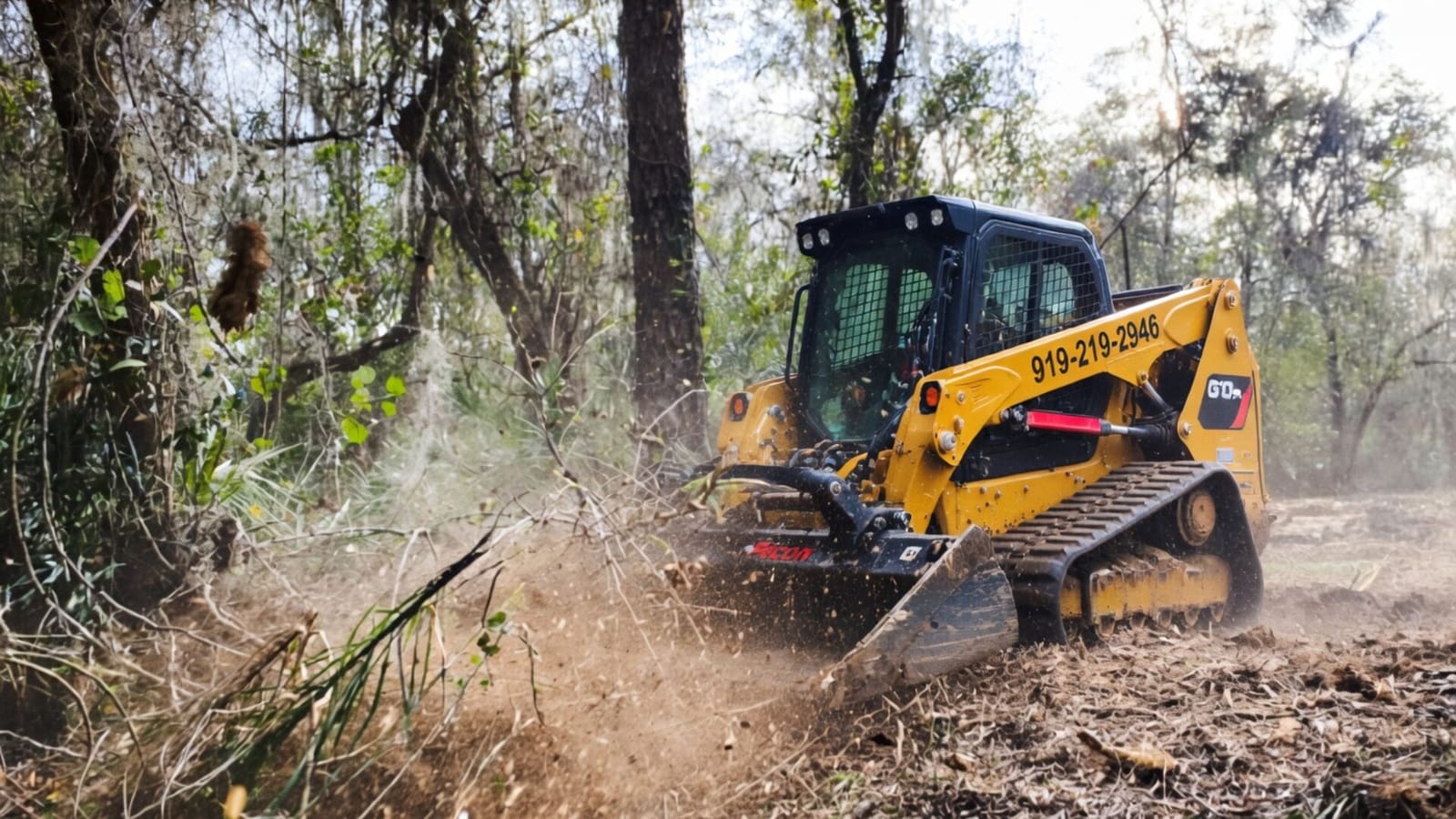
- Clear the stand, small trees included. A forestry mulcher grinds each juniper from the top down to its base and leaves the chips on the ground, where they cover the soil and leave the sagebrush and grass roots in it. The seedlings and saplings matter as much as the big trees, so the pass covers the whole area, not just the obvious trunks.
- Deal with the oak separately. Where Gambel oak grows under the juniper, as on the Nebo bench, it sprouts back from its roots and needs a return cut a season or two later. That is the one part of the job that does come back from the stump, and the quote should list it on its own line.
- Walk the ground after two seasons. Seed that was ripe at clearing time tends to come up the second season. Seedlings are easy to cut or pull while small.
- Look again every few years. Walk the cleared ground every few years and remove young trees while they are small. The timing depends on missed seedlings and seed already on the site or carried in.
- Talk to the neighbors. Birds and jackrabbits do not stop at a fence. Clearing two properties on one trip slows the reseeding and spreads the trip cost.
No herbicide step is part of this plan. Juniper does not need one. Where an owner wants chemical control of something else on the property, that is a licensed applicator’s work.
Mulching also settles the debris question. Under Utah Code 65A-8-211, June 1 to October 31 is a closed fire season statewide, when burning a brush pile needs a written permit from the state forester and a call to dispatch first. Ground-up juniper leaves no pile to burn. Disturbing an acre or more of soil brings in Utah DEQ’s construction storm water coverage; requirements vary by parcel, scope and jurisdiction, and the governing authority makes the determination.
Juniper Clearing Around Our Utah Markets
Nephi and Central Utah. The pattern here is pinyon-juniper over a dense Gambel oak understory, on foothills where the soils around Salt Creek Canyon erode easily. Expect the oak to need a return visit and the steepest faces to be left out. Our Nephi land clearing page covers the towns from Spanish Fork and Payson to Moroni and Ephraim, and the Nephi forestry mulching cost guide shows how the oak follow-up is priced.
Tooele and the Oquirrh Valleys. Our Tooele land clearing page covers juniper, sagebrush and the Russian olive along Tooele County ditches.
Tremonton and the Bear River Valley. Down in the valley the dense work is usually tamarisk and Russian olive on ditches and river bottoms. Juniper sits higher up: in the canyons east of Logan and Providence it has moved into the sagebrush, mountain shrub and aspen. Our Tremonton land clearing page covers Box Elder and Cache County ground.
Along water anywhere in the state, the trees crowding a ditch are more likely Russian olive than juniper, and they do sprout back; our Russian olive removal guide covers that plan.
What Juniper Clearing Costs
Young juniper cut out of sagebrush or pasture, worked around the trees you keep, falls in our $1,500 to $2,500 per acre band, the juniper and oak brush row on the Nephi pricing page; our other Utah markets price their brush row at the same band. A closed stand of mature juniper, or juniper over thick oak, is forestry mulching at $1,500 to $4,000 an acre, and taking a whole parcel to an agreed finish can run to $4,500. Where an acre lands depends on how big and how close the trees are, how many stay, the slope and the access. Small jobs start at a minimum charge of about $1,500, billed in place of an acre rate, never stacked on one.
The mulching price grinds the trees, brush and stumps into mulch on site, with stumps flush with the ground and nothing hauled away. Full stump removal below grade and cut-and-haul for very large trees are discussed and priced in the quote. Grading and build pads are not part of our price. Statewide figures and burn rules are in our Utah land clearing cost guide.
Frequently Asked Questions
Will juniper grow back after it is cut?
Not from the stump. Utah juniper reproduces only from seed, so a tree ground out at the base is gone. New trees come from seedlings that were missed or from seed in the soil, which is why the plan includes later walks over the ground.
Do I need to treat juniper stumps with herbicide?
No. That step matters for plants that sprout from their roots, such as Russian olive and tamarisk. Juniper does not, so there is nothing to treat.
Should I keep some of the big junipers?
Often, yes. A few large trees give shade and wind shelter. Every mature tree left standing does keep producing seed, so plan on checking the ground around it.
Get Juniper Off Your Land
Request a free quote and we’ll contact you to discuss your property, access and the clearing you need. The quote sets out the clearing pass, any oak return cut and the trees you are keeping, in writing.
More from the Cut Brush Blog
Keep reading for more tips and guides on land clearing.
 Cost Guide
Forestry Mulching Cost in Nephi, UT (2026)
Forestry mulching around Nephi, UT: $1,500 to $4,000 an acre. Why oak ground needs a second visit and how benches move a quote. Request a free quote.
 Cost Guide
Land Clearing Cost Per Acre in Utah (2026 Guide)
Land clearing in Utah runs $1,500 to $4,500 an acre with our crew. How Gambel oak, juniper, rock and the state's burn rules move the price on your land.
Let's Get Started on Your Land
Request a free quote. We'll contact you to discuss your property, access, and the clearing you need.
Get a Free QuoteOr call us directly: (919) 525-3950