
Tamarisk (Saltcedar) Removal in Utah: A Plan That Lasts
Cut Brush Team · October 12, 2026 · 8 min read

Tamarisk, also called saltcedar, is removed in Utah by cutting or mulching the stand and then having the stumps treated, with checks for regrowth over the next few seasons. Cutting alone does not kill it. Utah State University Extension says saltcedar is “difficult or impossible to kill by burning, drought, freezing, hypersalinity, prolonged submersion, or repeated cutting at ground level,” and that control usually combines methods, with herbicide as one of them. A forestry mulcher brings a ditch-bank or river-bottom stand down and leaves the ground covered in chips. A stump treatment by a licensed applicator, arranged by the landowner, is what stops the sprouting.
This guide covers why tamarisk does so well along Utah water, how to recognize it, why one cutting fails, a removal plan that holds, the rules that touch the job, and what it costs.
Why Tamarisk Takes Over Utah Ditches and River Bottoms
The Utah Department of Agriculture and Food lists tamarisk as a Class 3 noxious weed, the class for weeds that are already widespread and are to be contained. Its neighbour on the same banks, Russian olive, is listed separately as Class 4.
It grows where water is. USU Extension says saltcedar “commonly occurs along floodplains, riverbanks, stream courses, salt flats, marshes, and irrigation ditches in arid regions of Utah at elevations from 4,200 to 7,000 feet.” On a farm or acreage property that means the ditch that carries water to a field, the canal bank along a lane, or the wet bottom ground below a homesite.
In the Bear River Valley it is a live problem. The state’s Watershed Restoration Initiative runs a tamarisk and phragmites project in Box Elder County around the Bear River Migratory Bird Refuge and Willard Spur, noting that “the expanding stands of phragmites and tamarisk are reducing nesting/foraging habitat for migrating waterfowl.” Upstream, on the lower Bear River in Cache County, a restoration project found the river bottoms “largely overrun” by tamarisk and Russian olive.
It spreads two ways. USU says “a mature saltcedar can produce 600,000 seeds annually,” and that it also comes back from root sprouts. One seeding stand can keep restocking the banks around it for years.
Why a Stand Is Worth Clearing
Tamarisk is more than an eyesore on a bank.
- Salt. USU says its leaf drop “increases the salinity of the surface soil,” which is where the name saltcedar comes from. The Bear River project above notes the same thing along the river. Saltier ground is harder to bring back to grass or pasture.
- Water. USU counts water loss among saltcedar’s effects. On a ditch, a solid wall of it also makes the bank hard to walk, clean and maintain.
- Fire. A state project record for a Uintah County creek describes tamarisk as “more likely to burn than native riparian vegetation”. A dense stand near a barn or house is fuel.
How to Recognize Tamarisk
From a distance, tamarisk looks like a feathery shrub or small tree, often in thick clumps. USU describes it at 6 to 26 feet tall, with scale-like, bluish-green leaves about 1/16 of an inch long, so the branches look more like a juniper’s or a cedar’s than a broadleaf tree’s. In spring and summer it carries white to pink flowers in narrow, drooping clusters an inch or two long, and a stand in bloom shows a pink haze along the bank.
Russian olive often grows beside it on the same ditch. The difference is easy once you look: Russian olive has narrow, silvery leaves and thorns at its twig tips; tamarisk has no thorns and scale-like leaves. If you are not sure what you have, your county extension office can confirm it from a sample or a photo.
Why One Cutting Fails
Imagine a canal bank cut back with a chainsaw in the fall. By the next summer it is feathery and green again, often with more stems than before.
Cutting removes the top, but the root crown and roots are untouched, and saltcedar comes back from root sprouts. Seed already on the bank keeps germinating too. That is why USU lists repeated cutting at ground level alongside burning and drought as things that rarely kill it, and why state crews do not rely on the cut. On the Bear River project, trees were felled with saws, piled by heavy equipment, and “immediately after cutting all trees will be sprayed so that all herbicide can work its way into the lower roots.” On a Uintah County project, herbicide went on each stump within 15 minutes of the cut, with the expectation that “eradication will take many years to complete.”
Even pulling the whole plant out does not end it. The Box Elder County project found that pulling tamarisk out with heavy equipment “will reduce the new shoots to approximately 25%,” and it follows up on the new shoots for 2 to 3 seasons.
None of that makes machine work pointless. It means the machine is the first step, not the whole job, and any contractor who promises one visit will finish it has left out the part that does the work.
A Removal Plan That Holds: Cut, Treat, Check
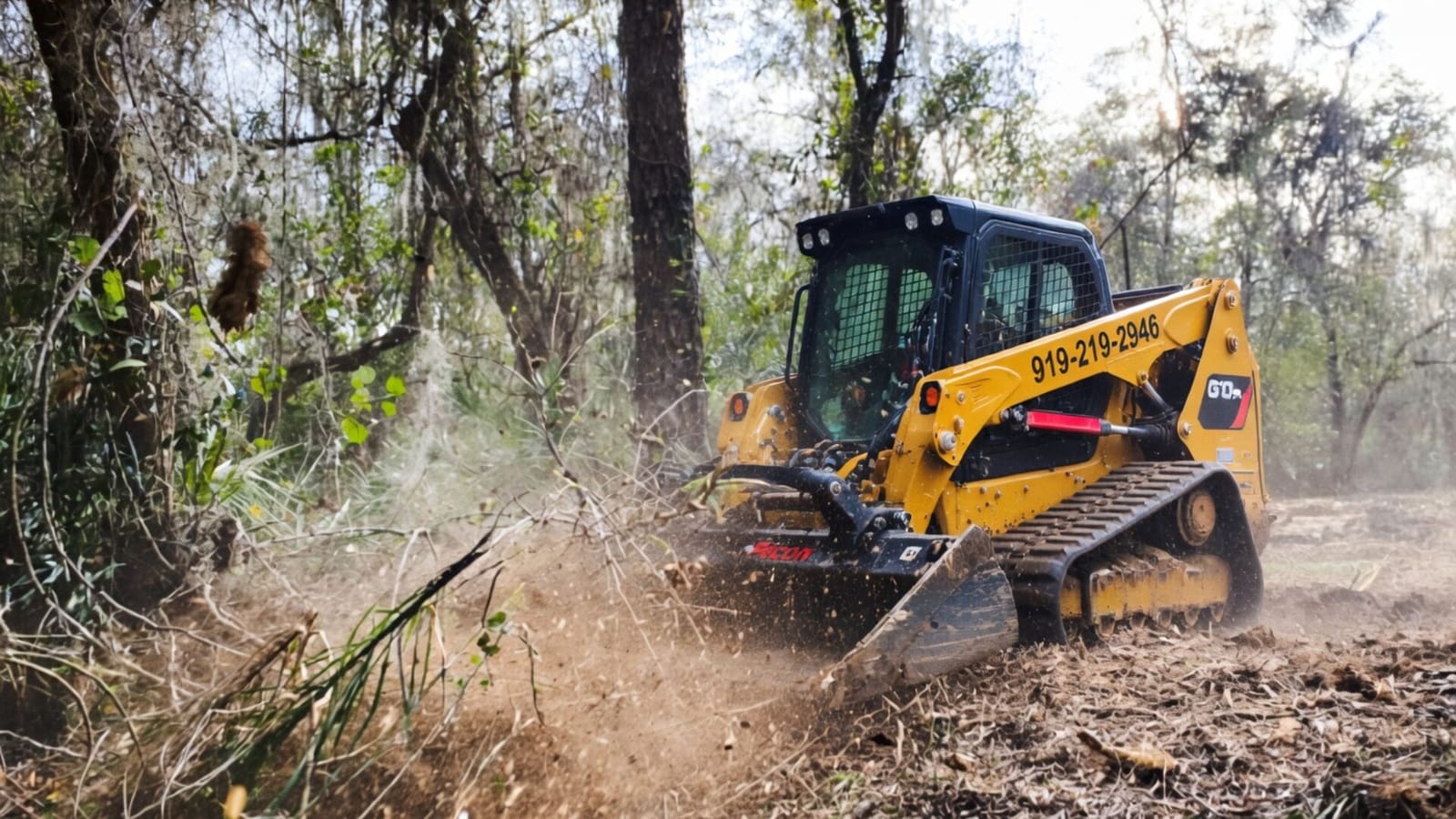
Step one: bring the stand down. A tracked forestry mulcher grinds tamarisk into a chip layer where it stood. It steers between the cottonwoods, willows and fruit trees you want kept, and it leaves the stumps low and easy to reach. Nothing is piled, so there is no burn question. Narrow ditches are worked from the bank, and wet ground is worked when it is firm enough to carry the machine.
Step two: treat the stumps. The state’s own projects pair the cut with a stump treatment, applied right after cutting. That is work for a licensed pesticide applicator, arranged by the landowner and following the product label; our crew does not apply herbicide. Line the applicator up before the cut, so the stumps are treated while they are fresh, and ask for the treatment quoted as its own line so you see the whole plan.
Step three: check back. Root sprouts can show the next growing season, and seed keeps arriving from upstream. A walk along the bank each season for the first few years, with spot treatment on anything green, is what turns a cleared ditch into a ditch that stays clear. On a long run of bank, a light second mulching pass can cost less than treating hundreds of sprouts by hand.
Work with your neighbours. Because a seeding stand nearby keeps supplying new plants, a cleared bank below an untreated stand will keep seeing seedlings. If a ditch runs through several properties, clearing the whole run at once spreads the trip cost and slows the reseeding.
Ditches, Rivers, Burning and Other Rules
Tamarisk removal is still land clearing, so the usual rules apply, plus one that matters more along rivers.
- Natural streams. Utah’s Division of Water Rights says altering “the bed or banks of a natural stream” needs a Stream Alteration Permit from the State Engineer. “Canals, ditches, or other man-made channels are not considered natural streams.” Before machines work at the edge of the Bear or Malad River, ask.
- Ditch and canal banks. A ditch may be shared or belong to an irrigation company. Confirm who owns the bank and whether the company has its own rules for work along it.
- Burning. Utah Code 65A-8-211 makes June 1 to October 31 a closed fire season, when burning brush needs a written permit from the state forester and a call to dispatch. Burning within 10 feet of a canal or ditch bank needs no permit, still needs the call and is barred during a Red Flag Warning. Mulching leaves nothing to burn.
Requirements vary by parcel, scope and jurisdiction, and the governing authority makes the determination.
What Tamarisk Removal Costs
Clearing tamarisk from a ditch bank, fence line or field edge, with the trees you are keeping left standing, falls in Cut Brush’s $1,500 to $2,500 per acre band. Ditch work is narrow, so it is priced by the acreage equivalent of the strip; a bank 20 feet wide and about 2,200 feet long is roughly an acre. An old, dense stand across a wide river bottom moves into forestry mulching at up to $4,000 per acre. Where an acre lands depends on how dense and how big the stand is. $1,500 is the minimum charge for a project, a floor rather than a fee added on top.
The mulching price grinds the trees and stumps into mulch on site, with stumps flush with the ground and nothing hauled away. Full stump removal below grade and cut-and-haul for very large trees are discussed and priced in the quote. The stump treatment is a separate cost from a separate provider, and our crew does not price it. Our Tremonton forestry mulching cost guide explains where a ditch-bank job lands inside the bands.
Frequently Asked Questions
How do I get rid of tamarisk for good?
Cut or mulch the stand, have a licensed applicator treat the stumps right after, and check the bank each season for a few years. Cutting alone lets it sprout back.
Is tamarisk illegal in Utah?
It is a Class 3 noxious weed, a widespread weed the state aims to contain.
Is tamarisk the same as Russian olive?
No. They often share a ditch, but Russian olive has silvery leaves and thorns; tamarisk has scale-like leaves and pink flower clusters. Our Russian olive removal guide covers that tree.
Can I burn the tamarisk I cut?
Within 10 feet of a ditch bank, outside a Red Flag Warning, with a call to dispatch. Mulching leaves nothing to burn.
Get Your Ditch Bank Back
If tamarisk has taken a ditch, a canal bank or a river bottom around Tremonton, Garland, Corinne or Brigham City, request a free quote. We’ll contact you to discuss your property, access and the clearing you need, and our crew puts the scope on paper, including what is and is not treated.
Read more: the bands on the Tremonton pricing guide, the local ground on our Tremonton land clearing page, and statewide figures in our Utah land clearing cost guide.
More from the Cut Brush Blog
Keep reading for more tips and guides on land clearing.
 Cost Guide
Forestry Mulching Cost in Tremonton, UT (2026)
Forestry mulching around Tremonton, UT runs $1,500 to $4,000 an acre. Why it is priced by the acre, not the yard, and what ditch-bank work costs here.
 Guide
Juniper Removal in Utah: How It Returns and the Plan
Juniper removal in Utah: $1,500 to $2,500 per acre for understory clearing. Plan the first pass and follow-up visits. Request a free quote today.
Let's Get Started on Your Land
Request a free quote. We'll contact you to discuss your property, access, and the clearing you need.
Get a Free QuoteOr call us directly: (919) 525-3950