
Tree of Heaven Removal in the Hudson Valley, NY
Cut Brush Team · October 2, 2026 · 7 min read

The first one was a volunteer along the stone wall. Ten years later there is a grove: fast, straight trunks, big feathery leaves, and a ring of new shoots popping up in the lawn every June. Since spotted lanternflies arrived, the trunks are crawling with them by late summer. Tree of heaven removal in the Hudson Valley has moved from a someday job to a this-year job for a lot of owners in Orange, Dutchess, Ulster and Sullivan counties, and the way most people start, by cutting the trees down, is the way that makes it worse.
This guide covers why lanternflies and this tree go together, what the extension experts actually recommend, how to be sure of what you are looking at, the order of work that removes a colony instead of multiplying it, what it costs, and the burning and calendar rules that shape the job here.
What Does Spotted Lanternfly Have to Do With Tree of Heaven?
Everything: it is the insect’s preferred tree. Cornell Cooperative Extension Dutchess County says “adults prefer to feed and lay eggs on tree of heaven (A. altissima),” and that the pest “targets ailanthus trees, in particular.”
Lanternfly is no longer a rare find here. CCE Dutchess notes that residents of Dutchess, Orange, Putnam, Rockland, Sullivan, Ulster, Westchester, Nassau and Suffolk counties, along with New York City, no longer need to report sightings, because the insect is so widely established.
CCE Dutchess also names one of the ways to slow it: “limit the spread of Tree of Heaven which is also an invasive species.”
Should You Remove Tree of Heaven at All?
Yes, if it is done properly, and that qualifier matters. Cornell’s statewide integrated pest management program has urged caution. As of April 2019 it was “not recommending the removal of tree of heaven as a management tool” for lanternfly alone, for reasons including the most practical one: “if tree of heaven is not properly removed, a single tree can turn into a grove of saplings as they can multiply via their root system,” Cornell CALS notes. Where removal is done, it advises that “a registered systemic herbicide should be used to limit regrowth.”
Read together, the advice is consistent. Tree of heaven is an invasive tree worth getting off your land, the lanternfly makes it more urgent, and the removal has to kill the roots, not just drop the trunks. Done halfway, you get more trees, not fewer.
Is It Tree of Heaven, Sumac or Walnut?
Check the leaflet edges and smell a twig. Staghorn sumac and black walnut both have long compound leaves and both belong here. Penn State Extension gives the test: “The leaflet edges of these native trees all have teeth, called serrations, while those of tree-of-heaven are smooth.” Tree of heaven leaflets have a small gland or two near the base instead of teeth.
The smell settles it. Penn State notes that “when crushed, the leaves and all plant parts give off a strong, offensive odor.” Neither native smells like that.
In late summer, the lanternflies themselves are a clue: clusters of them on the trunks usually mean you are looking at ailanthus.
Why Does Cutting It Down Backfire?
The tree treats a cut as a signal to multiply. Penn State says “a cut or injured tree-of-heaven may send up dozens of stump and root sprouts,” and that “mechanical methods, such as cutting or mowing, are ineffective, as the tree responds by producing large numbers of stump sprouts and root suckers.”
Those suckers can come up “as far as 50 feet from the parent tree,” Penn State notes, which is why one tree by a stone wall turns into a grove across the lawn. Seed adds to it: a female tree “has the potential to produce more than 300,000 seeds annually.”
The Order of Work That Removes a Colony
Treat the live trees first, wait for them to die, then clear what is left. The sequence Cut Brush quotes:
- Find every stem. Walk the colony and flag the big trees, the young ones and the knee-high suckers in the lawn. They are one connected root system.
- Have a licensed applicator treat the standing trees. Cut Brush does mechanical work only and applies no herbicide, so this step is done by a licensed applicator you hire, typically in summer when the tree is moving energy down to its roots.
- Give it time. Cutting a treated tree too early wakes up the very sprouting the treatment is meant to stop.
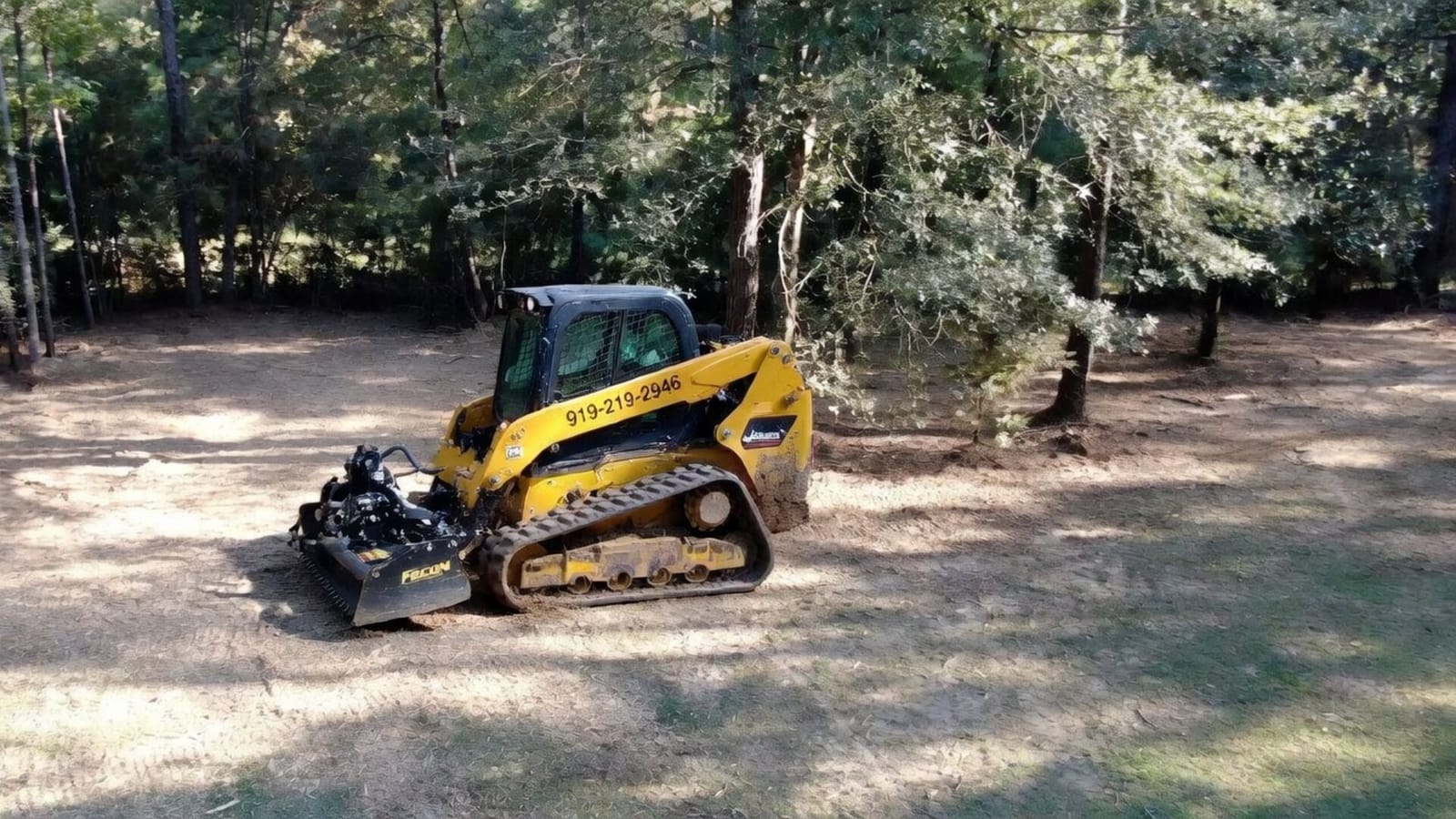
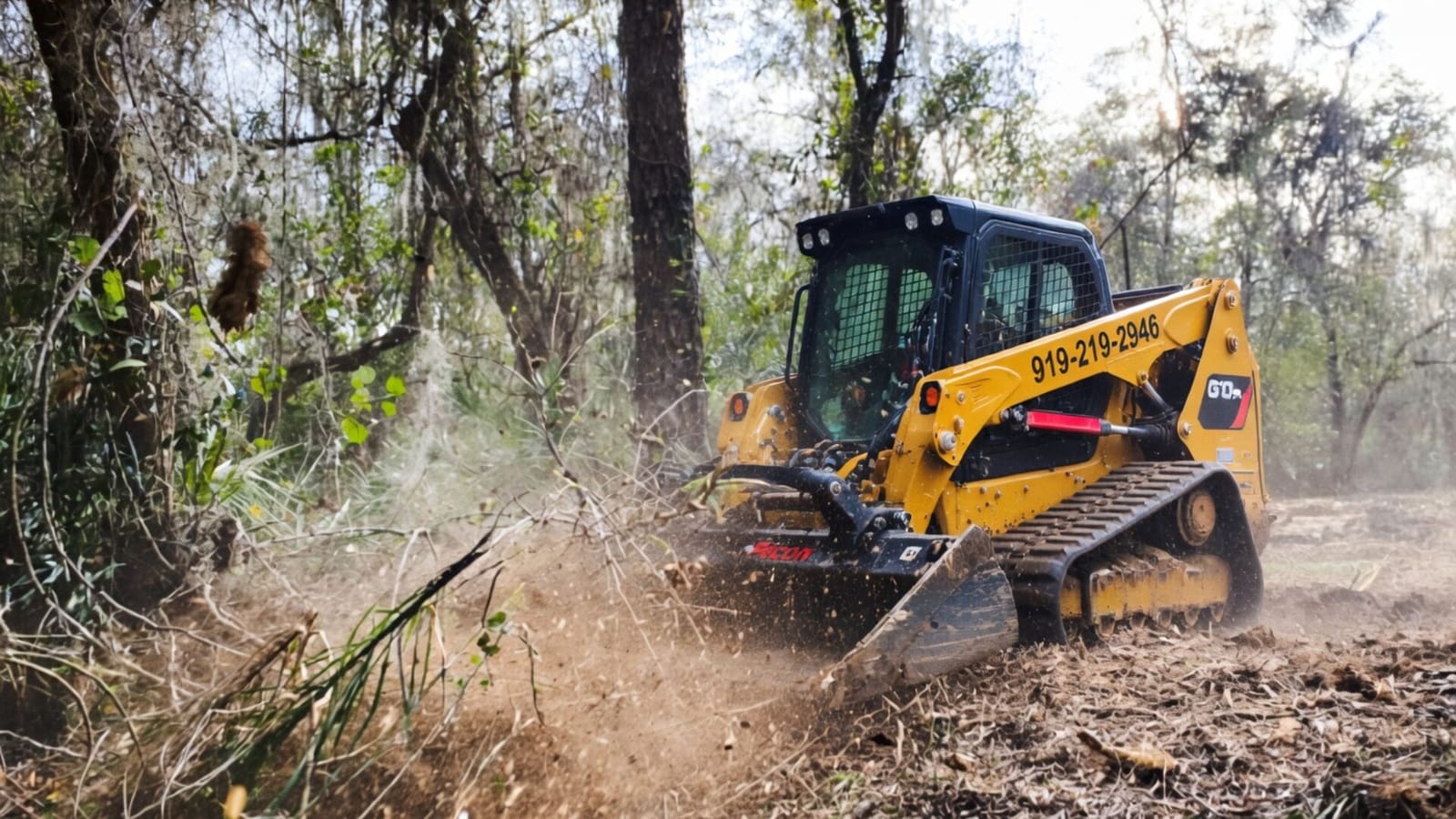
- Mulch the dead stand. A forestry mulcher drops and grinds the dead trees and the brush around them in place, with no piles to haul or burn.
- Check the next season. Cut or pull any seedlings while they are small, and have the applicator spot-treat any live sprouts.
If you would rather use no treatment at all, the honest alternative is clearing the stand and then cutting every sprout, repeatedly, for several seasons, knowing that ailanthus roots are very slow to give up that way. We will say plainly which route fits your land.
Pro tip: In October, the female trees are hung with tan clusters of winged seeds. Mark them. They are the ones seeding the next generation, and they should be at the top of the treatment list.
What Does Tree of Heaven Removal Cost in the Hudson Valley?
Clearing a dead or dying tree of heaven stand typically runs $1,500 to $2,500 per acre for brush and small stems, the brush and understory band on our Hudson Valley pricing page. Stands with larger trees price as land clearing.
| Job | Typical range | Notes |
|---|---|---|
| Sucker thicket and small stems | $1,500 – $2,500 per acre | The brush and understory band |
| Colony with trees to fell and grind | $1,500 – $4,500 per acre | The land clearing band |
| Small backyard grove | Starts near the $1,500 project floor | Getting equipment to the site sets the floor |
| Treatment of standing stems | Separate trade | Quoted by a licensed applicator |
| Follow-up walk and seedling cutting | Priced per visit | The season after clearing |
Trees beside a house, barn or power line are tree service work, priced per tree. For the full picture, see the New York land clearing cost guide and our Hudson Valley forestry mulching cost breakdown.
Burning, Timing and the Rest of the Hudson Valley Job
Spring burning is off the table statewide. New York’s open burning rule bans brush burning across the state from March 16 to May 14, and outside that window on-site burning is allowed only in towns under 20,000 residents and only for small branches. Burning also does nothing to the roots. Grinding the dead stand in place avoids the question entirely.
Wetlands and permits. Old fields and wooded edges in Orange and Dutchess counties often run into wet ground, where state and town rules apply. Our Hudson Valley permit guide walks through who to ask before a machine goes in.
It rarely grows alone. The same overgrown edges that grow tree of heaven often carry Japanese barberry, which brings its own problem: ticks. Our barberry and ticks guide covers that clearing. Start at land clearing in the Hudson Valley.
Frequently Asked Questions
Does removing tree of heaven stop spotted lanternfly?
Not on its own. Lanternfly is widely established in the Hudson Valley and feeds on other plants too. Tree of heaven is its preferred host, though, and CCE Dutchess recommends limiting the tree’s spread. Removing a stand properly takes that host off your land.
Can I just cut the trees down?
Not on their own. Penn State Extension says cutting or mowing is ineffective, because the tree responds with large numbers of stump sprouts and root suckers. Treat the standing trees first, let them die, then clear them.
How do I tell tree of heaven from sumac?
Tree of heaven leaflets have smooth edges with a small gland near the base and smell strongly unpleasant when crushed. Sumac and black walnut leaflets have toothed edges.
How much does tree of heaven removal cost in the Hudson Valley?
Brush and small stems typically clear for $1,500 to $2,500 per acre, colonies with trees to fell for $1,500 to $4,500 per acre, and small jobs start near $1,500. Treatment by a licensed applicator is a separate cost.
Can I burn the cut trees?
Not from March 16 to May 14 anywhere in New York, and outside that window only small branches in towns under 20,000 people. Mulching in place is the simpler route.
Does Cut Brush spray the trees?
No. Cut Brush does mechanical work only. A licensed applicator treats the standing trees, and Cut Brush clears the dead stand afterward.
Get Tree of Heaven Off Your Land the Right Way
Whether it is a grove along a stone wall in Dutchess County, a colony at the edge of an old orchard in Ulster or a line of suckers creeping across a lawn in Orange County, every season left alone means more roots, more seed and more lanternflies. Cut Brush quotes tree of heaven removal across the Hudson Valley in the order that works: mapped, treated by a licensed applicator, cleared, and checked the season after.
More from the Cut Brush Blog
Keep reading for more tips and guides on land clearing.
 Guide
Land Clearing Permits in the Hudson Valley, NY
New York has no county land disturbance permit. Your town holds it, the state starts at one acre, and wetlands are no longer settled by a map. Sources here.
 Cost Guide
Land Clearing Cost Per Acre in New York (2026 Guide)
Land clearing cost per acre in New York runs $1,500 to $4,500. What glacial stone, a short working season and a town-by-town permit map do to the number.
 Guide
Japanese Barberry, Ticks and Overgrown Hudson Valley Land
Barberry thickets hold far more blacklegged ticks. Clearing it once cut tick numbers for six years. What that means for overgrown Hudson Valley property.
Let's Get Started on Your Land
Request a free quote. We'll contact you to discuss your property, access, and the clearing you need.
Get a Free QuoteOr call us directly: (919) 525-3950