
Underbrush Removal Cost in Mississippi (2026 Guide)
Cut Brush Team · October 9, 2026 · 8 min read

The big oaks and pines are why you bought the place, but you cannot see thirty feet into the woods. Privet, vine and young cedar have filled every gap, and walking it means pushing through. Clearing that underbrush and keeping your trees runs $1,500 to $2,500 an acre with Cut Brush. Our crews do this work from Starkville, Jackson, Hattiesburg, Gautier, Corinth and Indianola, and a small job rarely prices under about $1,500.
At a glance:
- Our price: $1,500 to $2,500 an acre for the brush, vine and small trees under the trees you keep.
- What grows back: Chinese privet resprouts from roots and stumps. Eastern redcedar does not sprout once it is cut.
- Fire spacing: the Mississippi Forestry Commission asks for at least 30 feet of defensible space around a home, with low limbs pruned six to 10 feet off the ground.
- A rule to know: inside the Ross Barnett Reservoir project area, a tree removal and preservation plan is due before any clearing of underbrush.
- Cost share: the state’s FY 2027 rates pay $76 an acre for mid-rotation vegetation management in planted pine, on 10 acres or more of forestland.
We have crews in the Golden Triangle, the capital region, the Pine Belt, the Gulf Coast, the northeast hills and the Delta. Choose the nearest one below this guide and we will walk the woods with you before we price them.
How Much Does Underbrush Removal Cost in Mississippi?
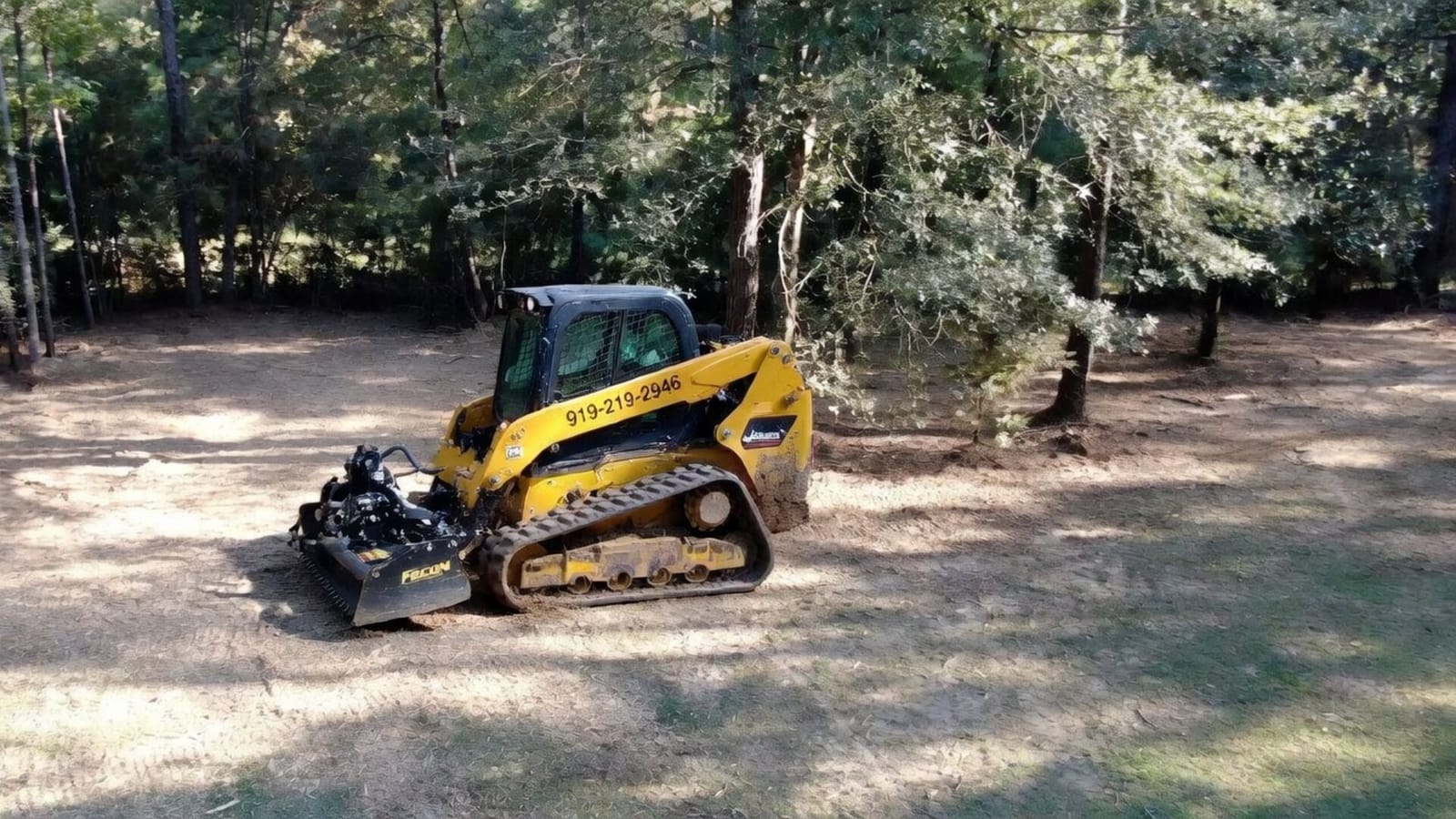
Underbrush removal is a tracked mulcher working the shrub and vine layer between the trunks you keep. It grinds privet, briars, vine and saplings where they stand and leaves the chips over the roots. The canopy stays. What you get back is woods you can walk, see into and mow under.
| What is standing under your trees | Our price per acre | What it looks like |
|---|---|---|
| Shrubs, vine and saplings under trees you keep | $1,500 – $2,500 | Privet hedges under hardwoods, young cedar among post oaks, tallow beneath pines |
| Fence rows and field edges, counted by acreage equivalent | $1,500 – $2,500 | A strip of privet and vine along a fence you want to keep standing |
| Understory plus some of the trees coming out | $1,500 – $4,000 | Thinning a crowded stand as well as clearing the floor; priced as forestry mulching |
| The whole stand taken down to a finish you name | $1,500 – $4,500 | Every tree felled and ground; priced as land clearing |
Where these numbers come from. Each of our six Mississippi pricing pages prints the same $1,500 to $2,500 row, named after the brush that market sees most: Redcedar & Prairie Pasture Clearing on the Starkville pricing page, Privet & Understory Clearing on the Jackson pricing page, and Fence Row & Bottomland Clearing in the Delta. The two lower rows are the forestry mulching and land clearing bands from the same pages, explained in our Mississippi forestry mulching cost guide.
What Changes the Price of Clearing Mississippi Underbrush
Privet or cedar. These two decide whether you are buying one visit or two. Mississippi State Extension describes privet thickets with little or no other understory under them, in bottomland woods, along fence rows and where field meets forest, and says privet comes back from roots and stumps unless the cut stems are treated. Redcedar is the opposite: cut completely, it does not sprout. A Starkville woodlot of young cedar is done in one pass. A Jackson creek bottom full of privet gets a second line on the quote for a licensed applicator’s herbicide visit.
Which keeper trees you have. MSU’s 2025 tree preservation guide sorts Mississippi trees by how well they take work nearby. White oaks, water and willow oaks, bald cypress and loblolly, longleaf and slash pine are rated resistant; sweetgum, most magnolias and shortleaf pine moderate; beech, yellow poplar, black walnut and hackberry susceptible. The same guide warns that even slight soil compaction can cut root growth by 90 percent. Under resistant pines we work close and steady. Around old beech by a creek we go slow and keep the tracks back, and that slower acre costs more.
How much fire fuel comes out. MSU Extension reports 2,502 wildfires on 52,982 acres in the Forestry Commission’s 2024 report, most often in February, March and April. Extension forester Butch Bailey points out that nearly all Mississippi uplands are fire-maintained ground that once burned every year or two. A thick understory is ladder fuel, and MSU suggests breaking it up 50 to 100 feet from a house, out to 200 feet on a slope. The farther out you want it cleared, the more acres we price.
Wet prairie clay. Around Starkville, Oktibbeha clay drains very slowly. We schedule those woods for a dry month, because a mulcher on soft clay is also packing soil over the roots of the trees you are paying to keep.
Whether the state shares the cost. On 10 acres or more of forestland, the Forestry Commission’s FY 2027 rates pay flat amounts: $76 an acre for mid-rotation vegetation management in planted pine, $262 for hack and squirt stand improvement and $26 for a silvicultural burn. Your Area Forester writes the prescription before work starts, and the land is then managed for timber for ten years.
Pro tip: The day before we visit, tie a ribbon on every tree you want kept and take a photo of each. Note the beech and poplar. Those are the trees MSU rates most easily hurt, and knowing where they stand lets us plan a route around them instead of pricing caution into the whole acre.
Underbrush Removal Costs Across Mississippi
The Golden Triangle around Starkville. From Maben to Macon and Louisville, cedar crowds the post oaks and other hardwoods owners keep for shade and pasture. Starkville’s own code strongly encourages clearing that keeps natural vegetation and drainage, which is exactly what underbrushing does.
The capital region around Jackson. Madison, Ridgeland and Brandon lots carry privet under hardwoods and pine. Near the reservoir the paperwork comes before the machine; see the rules below and our Jackson permit guide.
The Pine Belt and the coast. Around Hattiesburg the job is vine and small hardwoods under pines you are keeping, in country where prescribed fire is common. Around Gautier, tallow and soft ground set the pace, and live oaks and magnolias are protected trees under city rules.
The northeast hills and the Delta. Near Corinth, kudzu has to come down off the keeper trees before we can work the floor. Around Indianola, the bottomland timber that remains is scarce, and owners want the privet out from under it without a scratch on the trunks.
Tree Rules and Permits in Mississippi
Ross Barnett Reservoir. The Pearl River Valley Water Supply District’s regulations make it unlawful to cut any tree in the Reservoir Project Area without following them. A tree removal and preservation plan, prepared by a Registered Forester or Certified Landscape Architect, goes to the District Building Inspector before tree removal, dirt work or clearing of underbrush. Each kept tree’s protected zone runs at least to its farthest dripline.
Starkville. The city’s Land Disturbance Application applies when clearing over 1,000 square feet is part of, or leads up to, construction. Logging, timber harvest and farm work are exempt. Streams keep a 15-foot buffer from the top of the bank, the residential fee is $50, and after notice each day of a violation is a separate offense carrying a $500 to $1,000 fine.
Gautier. Removing a protected live oak, magnolia or other significant tree takes its own $50 permit plus a $1 filing fee, apart from any land disturbance permit.
Prescribed burning instead. Burning under pines is legal in Mississippi, and the Prescribed Burning Act adds liability protection when the burn has a Forestry Commission permit, a notarized plan, a Certified Prescribed Burn Manager in charge and a public interest purpose. Mulching needs no permit or weather window. We do not file permits; the district, city or county office makes the call.
Frequently Asked Questions
How much does it cost to clear underbrush per acre in Mississippi?
With us, $1,500 to $2,500 an acre. A one-acre house lot usually lands at the $1,500 project floor. Dense privet between closely spaced keepers, or soft prairie clay, pushes an acre toward $2,500.
Will privet grow back after the underbrush is cleared?
Yes, if the cut stems go untreated, because privet regrows from both roots and stumps. Budget a separate herbicide pass by a licensed applicator the next growing season.
Do I need a plan to clear brush near the Ross Barnett Reservoir?
Inside the Reservoir Project Area, yes. A tree removal and preservation plan from a Registered Forester or Certified Landscape Architect goes to the District before any clearing of underbrush. Check with the District before you book us.
Is there cost share for clearing underbrush in Mississippi?
On 10 or more acres of forestland, often. The Forest Resource Development Program pays flat per-acre rates, such as $76 for mid-rotation vegetation management in planted pine. Approval comes first, so call your Area Forester before work starts.
How far from my house should underbrush be cleared?
The Forestry Commission asks for at least 30 feet of defensible space, with low limbs pruned six to 10 feet up. MSU suggests breaking up ladder fuels out to 100 feet, and to 200 feet on a slope.
Get an Underbrush Removal Quote in Mississippi
Choose your nearest area below and request a free quote. Our crew will contact you to discuss the thickest brush, the entrance a trailer would use, the trees you are keeping, whether the land is near the reservoir or inside Starkville or Gautier, and the finish you want: woods you can walk, ground you will mow under the trees, or a stand ready for a prescribed burn. If the ground is open field rather than woods, the Mississippi brush hogging cost guide fits better.
Woods across the state line? See our Alabama and Tennessee underbrush removal guides.
Sources
- Mississippi Forestry Commission: FY 2027 cost share rates
- Pearl River Valley Water Supply District: regulations, Part 211 tree preservation
More from the Cut Brush Blog
Keep reading for more tips and guides on land clearing.
 Cost Guide
Forestry Mulching Cost in Starkville, MS (2026)
Forestry mulching around Starkville, MS runs $1,500 to $4,000 per acre. How cedar age, wet prairie clay, trees you keep and field access move a quote.
 Guide
Clearing Redcedar From Pasture Around Starkville, MS
Why eastern redcedar fills old fields and pasture around Starkville, why a mulched cedar does not sprout back, and how to keep the cleared ground open.
Cost Guide Forestry Mulching Cost in Mississippi (2026 Guide)
We charge $1,500 to $4,000 an acre to forestry mulch Mississippi land. How Pine Belt sand, Delta clay, tallow, kudzu and state cost share move your price.
Comparing states? See land clearing costs by state.
Let's Get Started on Your Land
Request a free quote. We'll contact you to discuss your property, access, and the clearing you need.
Get a Free QuoteOr call us directly: (919) 525-3950