
Forestry Mulching Cost in New York (2026 Guide)
Cut Brush Team · October 9, 2026 · 9 min read

The field your family stopped haying has gone to brush and saplings, and you want it open again without a burn pile or a line of log trucks. Forestry mulching runs $1,500 to $4,000 an acre with Cut Brush in New York, across Orange, Dutchess, Ulster and Sullivan counties in the Hudson Valley. Where your acre lands in that band comes down to stone, oak, and what the state lets you do with wood.
At a glance:
- Our price: $1,500 to $4,000 an acre to mulch, $1,500 to $2,500 when the trees overhead stay, and a practical floor near $1,500 for any single visit.
- Spring burn ban: brush burning is closed statewide from March 16 to May 14. Farms over 5 acres in active agricultural use are the exception and may burn organic farm waste through it.
- Oak wilt: DEC asks owners not to wound oaks from March through September. Inside a quarantine district, oak may leave only once chipped below one inch in two dimensions.
- Firewood: the state firewood regulation caps how far firewood may travel at 50 miles.
- Adirondack Park: clearcutting more than three acres of a wetland needs a Park Agency permit.
Our New York crews work the Hudson Valley: Warwick and Goshen in the south, Poughkeepsie and Red Hook on the east bank, Kingston and Saugerties across the river, and Monticello and Liberty out west. Outside those four counties we have no New York crew. Pick the area nearest you at the foot of this page and we will come and walk the ground.
What Is Forestry Mulching?
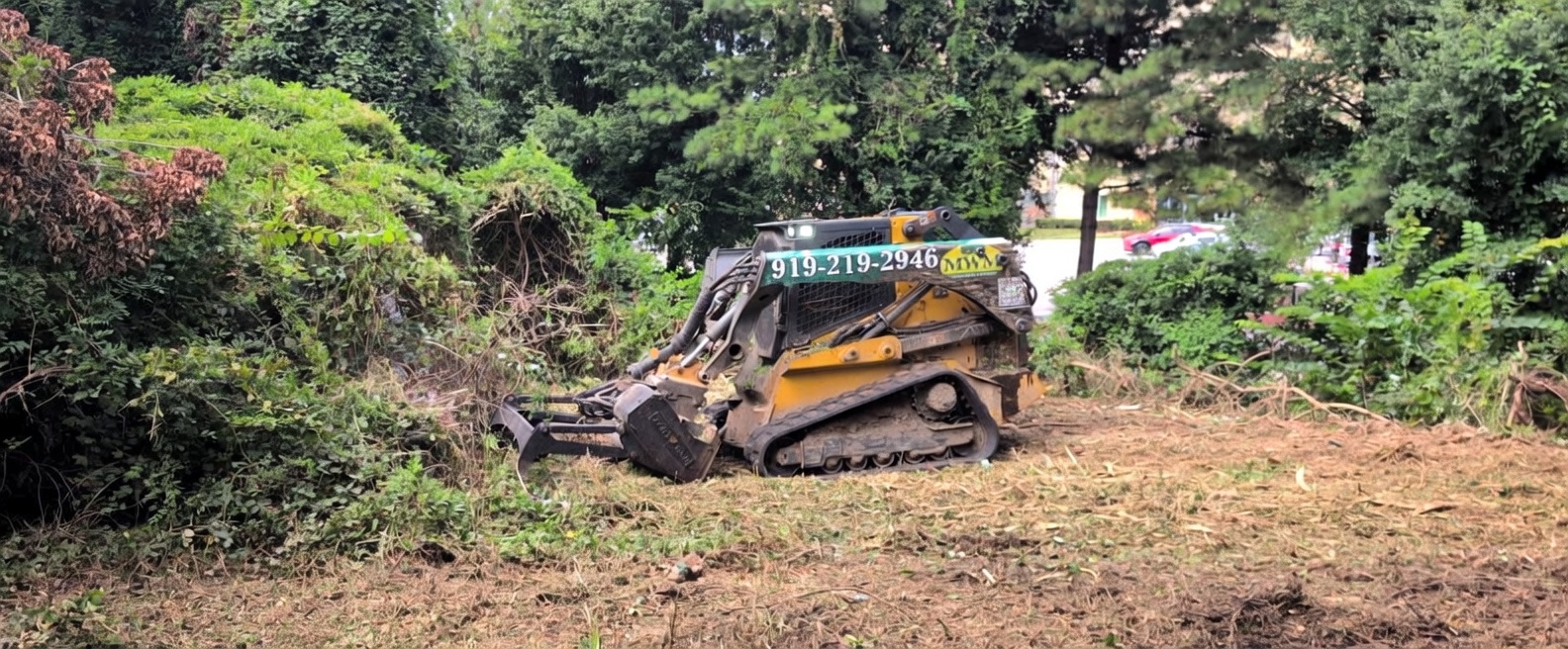
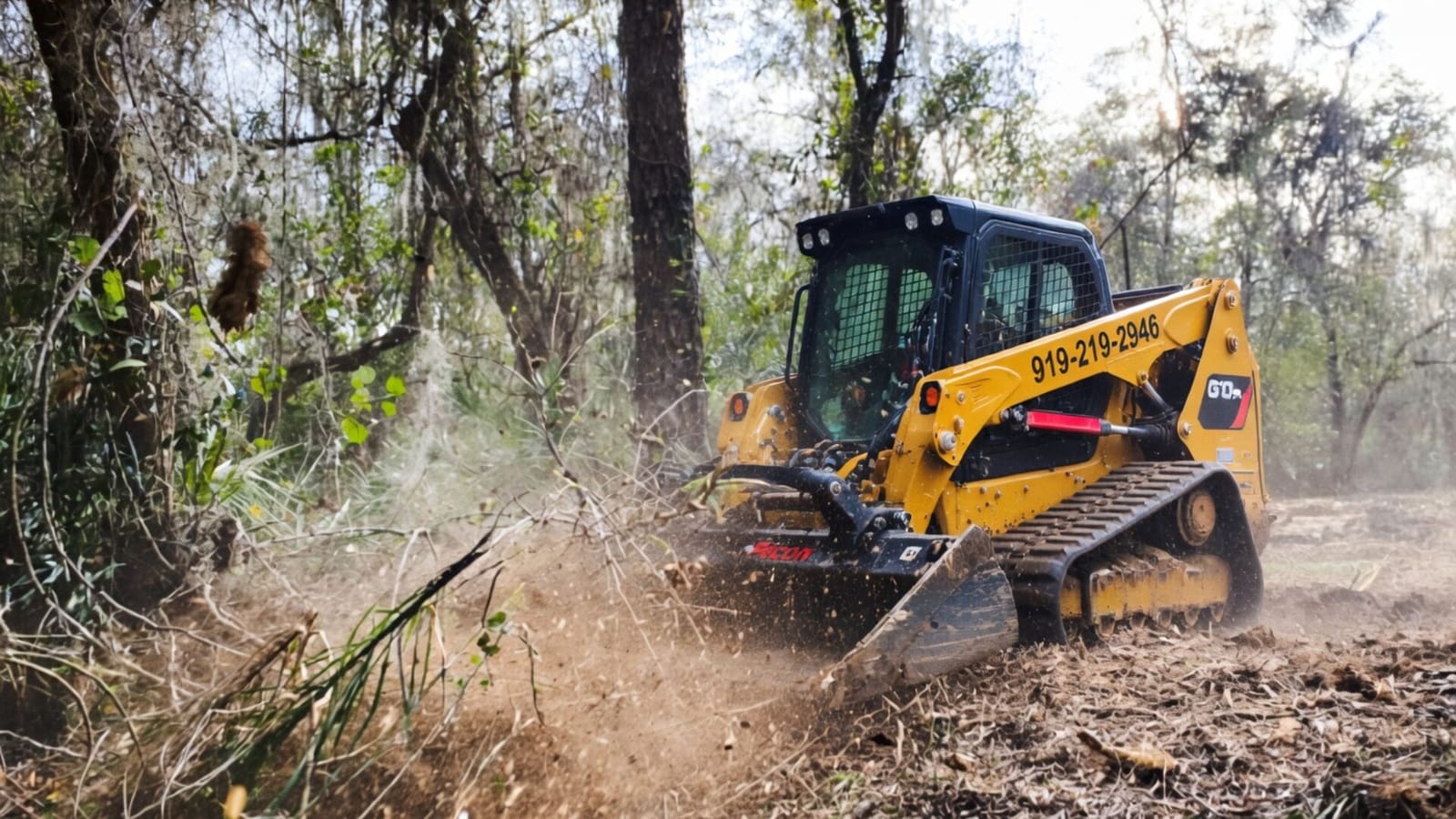
One tracked machine with a spinning drum head grinds standing brush and small trees where they grow and leaves the chip spread across the soil. Stumps are cut flush with the ground, not pulled. Nothing gets piled, burned or loaded onto a truck, and in New York that last part decides more of the bill than the brush does.
If the trees overhead are staying and only the shrub layer beneath them goes, that is a lighter job, priced in our New York underbrush removal cost guide.
How Much Does Forestry Mulching Cost in New York?
We price by what is standing on the land and what is under it.
| What is on the land | Our price per acre | What it looks like in New York |
|---|---|---|
| Brush beneath trees you keep | $1,500 – $2,500 | A woodlot floor filled in under maple and oak, or a hedgerow swallowing a stone wall |
| Old hayfield or pasture gone to brush | $1,500 – $4,000 | A few years idle sits low; twenty years of saplings sits high |
| Brush and small trees on flagstone or slope | $1,500 – $4,000 | Sullivan County till or ground climbing toward the Shawangunk ridge; expect the upper half |
| Whole parcel, larger timber, cleared to a finish | $1,500 – $4,500 | Ground opened edge to edge for a build rather than mulched in place |
Where these numbers come from. Every figure in the table is copied from our Hudson Valley pricing page, the prices our New York crews work to. A single visit has a floor near $1,500 because hauling a tracked machine up a valley drive costs the same for one hour of work as for eight. If you want clearing priced by tree size rather than mulching, the New York land clearing cost per acre guide lays that out.
What Changes the Price of a New York Mulching Job
Flagstone in the top foot of soil. Most of the Catskill side and the Southern Tier is glacial till packed with flat stone. The Volusia soil carries channers and flagstones above a dense pan only 10 to 22 inches down. The Lordstown soil, first described near Ithaca, hits bedrock at 20 to 40 inches, with flagstones making up 20 to 60 percent of its lower layers. When our drum keeps striking slabs, the operator raises the head and slows the pass. That lost time moves an acre toward the top of the band, and it is the first thing we look for on a walk-through.
How many years the field has sat. The federal soil descriptions say it plainly: much cleared Lordstown ground is now “idle or reverted to woodland or brush,” and some Volusia fields are “growing up with a cover of brush.” A field let go five years ago is mostly forbs, grass and thin stems, and the machine moves through it at walking pace. One let go twenty years ago has trunks the head has to work down one at a time.
Oaks you want to keep. Oak wilt is the reason we schedule oak ground with care. DEC says to avoid wounding oaks from March to September, when the fungus forms spore mats and the beetles that carry it are active. Red oaks standing close together graft their roots, and the disease travels through those grafts, so one scarred keeper can cost a stand. We book oak woods for late fall or winter. The price per acre is the same; the risk to your trees is not.
Wet ground over the pan. Volusia is somewhat poorly drained, and water sits on that dense layer through a wet spring. Tracks on soft ground leave ruts and take longer. Frozen ground or a dry late summer carries the machine and finishes cleaner, so a flexible start date is often the cheapest thing you can offer us.
Where the wood would otherwise go. Mulching leaves the material on the parcel, which keeps you clear of three state rules at once: the burn limits, the 50-mile firewood cap, and the oak quarantine. Clear-and-haul has to answer all three, and that is why it costs more here.
Pro tip: If your land is near Canandaigua, Naples or the Town of Greece, ask DEC whether the parcel sits in an oak wilt quarantine district before you plan to sell or truck any oak off it. Oak mulched where it falls never leaves, so the question never comes up.
Forestry Mulching Costs Across New York
The Hudson Valley. This is our ground, and every band above applies here. Along the river in Dutchess, the Hudson soil formed in lake clay and silt, and its steeper slopes are pastured or “reverting to brushy woodland,” in the USDA’s words. Orange County’s farm belt is cut up by hedgerows and stone wall lines that stopped being trimmed. Ulster climbs toward the Shawangunk ridge and the Catskill front, and Sullivan sits on stony, wet upland. Local detail is on our Hudson Valley land clearing page and in the Hudson Valley forestry mulching cost guide.
The Catskills. A town wholly or partly inside the Catskill Park that DEC lists as a Fire Town needs a DEC burning permit before anyone burns brush there, on top of the statewide ban. Mulching needs no such permit. The watershed rules west of the river are in our Hudson Valley permit guide.
The Adirondacks. The Park Agency counts a wetland as one acre or more, or any size where it connects to a stream or lake. Clearcutting more than three acres of one needs its permit, and where any permit is needed, clearing a building site waits until it is issued.
The Finger Lakes and Western New York. Oak wilt is active in the Town of Greece in Monroe County, in Bristol, South Bristol, Naples and Canandaigua in Ontario County, and in Italy and Middlesex in Yates County. The Honeoye soil common here can have stones over 10 inches across covering up to a fifth of the surface, which slows a mulcher as surely as flagstone does.
Long Island. Deep, excessively drained Plymouth sand carries white and black oak, pitch pine and scrub oak. No rock to fight, but Suffolk County has an inactive oak wilt center.
Permits and Burning Rules in New York
Outside the spring ban, brush under 6 inches across and 8 feet long may be burned only in towns with fewer than 20,000 residents. The exceptions cut both ways. Contiguous farmland larger than 5 acres, actively used for agriculture or horticulture, may burn organic agricultural waste and is not bound by the March to May ban. Fire Towns in the Adirondack and Catskill parks need a DEC permit to burn brush at all. Towns, villages, cities and counties may set stricter rules than the state, so call your town hall before you strike a match.
A mulched acre raises none of those questions. Mulching can still sit inside a bigger project with a permit attached. We clear and mulch; we do not grade, build pads or file permits. Who does each phase after the mulcher leaves is in the New York land clearing and grading cost guide, and if the field only needs mowing, the New York brush hogging cost guide has our rates.
Frequently Asked Questions
How much does it cost to mulch one acre in New York?
With Cut Brush, $1,500 to $4,000 an acre. A single acre usually lands near the $1,500 floor, because the trailer trip costs the same for one acre as for three. Flagstone till, a steep Shawangunk slope or twenty years of regrowth push it toward the top.
Can I mulch around oak trees in the summer?
DEC advises against pruning or wounding oaks from March through September, when oak wilt spreads most easily. Brush can still come out in summer if the machine stays well away from trunks and roots, but for an oak woodlot we recommend a late fall or winter date.
Can I just burn the brush instead?
Only in some places and some months. Brush burning is banned statewide from March 16 to May 14, and outside that window it is allowed only in towns under 20,000 people, unless you farm more than 5 acres. Many valley owners have no legal fire at any point in the year.
Can I sell or give away the logs?
Within limits. The firewood regulation stops firewood moving more than 50 miles, and in an oak wilt quarantine district oak cannot leave unless chipped below an inch. Mulched material stays on your property, so neither rule touches it.
Get a Forestry Mulching Quote in New York
Pick your nearest area below and request a free quote for a walk-through and a written figure from our Hudson Valley pricing. Our crew will contact you to talk through the thickest stand of brush, the gate or drive a trailer would come up, any oaks you want kept, how long the ground has been idle and what you want at the end, whether that is open woods, a field you can mow again, or a site handed to your excavator.
Sources
More from the Cut Brush Blog
Keep reading for more tips and guides on land clearing.
 Cost Guide
Brush Hogging Cost Per Acre in New York (2026 Guide)
Brush hogging runs $75 to $400 an acre with Cut Brush in New York's Hudson Valley, by how long the field went uncut. Stone, birds and hogweed explained.
 Cost Guide
Forestry Mulching Cost in the Hudson Valley, NY (2026)
Forestry mulching in the Hudson Valley runs $1,500 to $4,000 per acre. What the working season, glacial stone and New York's burn rules do to your quote.
 Cost Guide
Land Clearing Cost Per Acre in New York (2026 Guide)
Land clearing cost per acre in New York runs $1,500 to $4,500. What glacial stone, a short working season and a town-by-town permit map do to the number.
Comparing states? See land clearing costs by state.
Let's Get Started on Your Land
Request a free quote. We'll contact you to discuss your property, access, and the clearing you need.
Get a Free QuoteOr call us directly: (919) 525-3950