
Land Clearing and Grading Cost in Indiana (2026 Guide)
Cut Brush Team · October 9, 2026 · 9 min read

You have the lot, a house plan and a builder lined up, and now you need two numbers: what it costs to get the trees off, and what it costs to shape the ground for a pad. Clearing an Indiana building site runs $1,500 to $4,500 an acre with Cut Brush; grading is a second bill from your dirt contractor. We clear building sites in central Indiana from our Indianapolis market and in Clark and Floyd counties from Louisville.
At a glance:
- Our clearing price is $1,500 to $4,500 an acre, figured per acre equivalent when the job is a house envelope, a lane and a utility corridor.
- We hand off a cleared footprint. Grading, pad building, tile and septic belong to other trades, and they start after we leave.
- IDEM’s construction stormwater permit applies from one acre of disturbance, or less on a lot inside a larger plan of development, with a $175 notice of intent fee.
- Floodways: the Indiana DNR must approve fill, grading or excavation in the floodway of a stream draining one square mile or more.
- Burning stumps from clearing for a housing development needs IDEM approval first.
Around Indianapolis we clear in Marion, Hamilton, Boone, Hendricks, Johnson and Hancock counties; our Louisville crews cover Jeffersonville, New Albany, Charlestown and the rest of Clark and Floyd. If your lot is elsewhere in Indiana, send the location and we will tell you whether a crew can reach it.
How Much Does Land Clearing and Grading Cost in Indiana?
Site prep is two jobs done by two crews. We take the timber, brush and stumps off the ground that will carry the house, drive and utility lines; then your dirt contractor cuts, fills and compacts it to the grades your engineer set.
| Phase | Who does it | Price | What it covers |
|---|---|---|---|
| 1. Clear the house envelope, lane and utility corridor | Cut Brush | $1,500 – $4,500 per acre equivalent | Trees down, stumps out of the footprint, debris ground on site or hauled |
| 2. Open the wooded border you are keeping | Cut Brush | $1,500 – $4,000 an acre | Brush and small stems mulched in place; stumps cut flush |
| 3. Stormwater plan and notice of intent | You, your builder or engineer | $175 IDEM fee at one acre or more | A plan the review authority signs off before work starts |
| 4. Rough grade and pad | Your dirt contractor | Their quote | Cut, fill and compaction for the house and drive |
| 5. Tile, footing drains and septic | Drainage and septic contractors | Their quotes | Getting water away from the pad and the field ready |
Where these numbers come from. Our two rows are copied from the Indianapolis pricing page: Lot and Homesite Prep at $1,500 to $4,500 per acre equivalent, and Forestry Mulching at $1,500 to $4,000. Small jobs have a practical floor near $1,500. The Louisville pricing page that covers Clark and Floyd counties lists the same bands. Clearing with no building plan, priced by what is standing, is in our Indiana land clearing cost per acre guide.
What Changes the Price of an Indiana Site Prep Job
Water sitting on dense till. Across central Indiana the Miami soil, described near Danville in Hendricks County, hits a dense till layer 24 to 40 inches below the surface, with water perched on it 2 to 3 feet down from December to April (USDA NRCS, Miami). That is why so many central Indiana pads end up with footing drains or tile, and why a lot we clear in March takes longer, and costs more, than the same lot in August.
A fragipan in the south. South of the old glacial boundary, Bedford soil on the limestone hills has a fragipan 20 to 38 inches down, and Cincinnati soil on the older till plains reaches one at 22 to 36 inches. Avonburg soil in Scott and Switzerland counties holds water only half a foot to a foot and a half down in undisturbed ground (USDA NRCS, Avonburg). On ground that wet, many builders raise the pad with fill rather than cut it in, and the grading bill shifts from machine hours to material.
Sinkholes in the footprint. The Indiana Geological and Water Survey maps karst in the Mitchell Plateau, the Muscatatuck Plateau, the Charlestown Hills, the eastern edge of the Crawford Upland and the western edge of the Norman Upland. It warns that new roofs and pavement send more water to a sinkhole than it can take, and that soil moved during construction can plug one (IGWS karst overview). A depression inside the house envelope can move the pad, so we flag every one we find while clearing.
Slides and old mines. The same survey names the Dearborn Upland, the Crawford Upland and the Charlestown Hills as where Indiana landslides happen most, on clay-rich soil and weathered shale at steep angles. It lists fourteen west and southwest counties, from Fountain and Vigo to Posey and Vanderburgh, as holding the most underground coal mines, where subsidence can damage buildings (IGWS geologic hazards). Either one calls for an engineer before the grading quote.
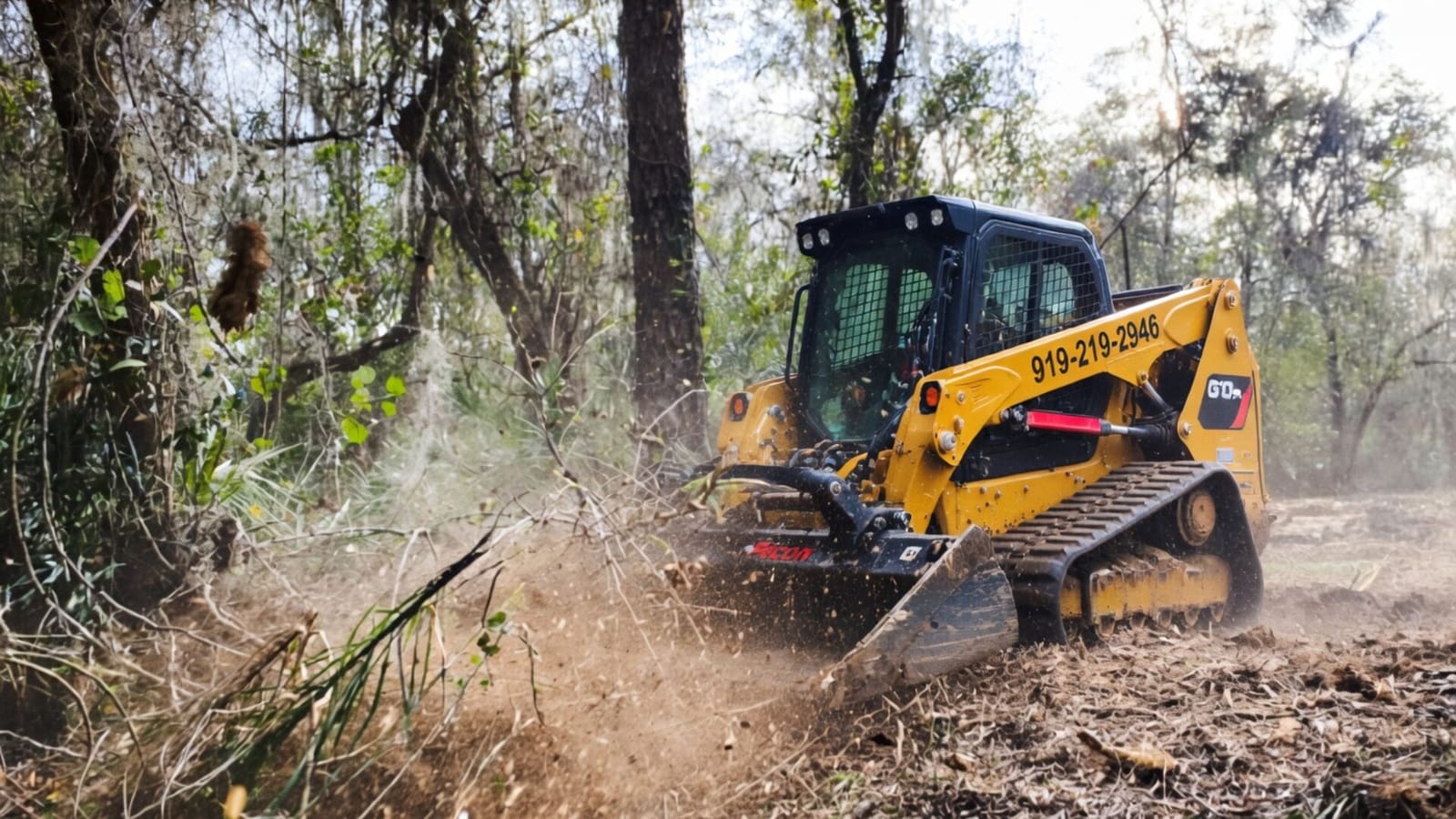
What happens to the stumps. Roots have to leave the pad before it is graded. IDEM names clearing for a housing development as a burn that needs its approval, and an approved fire must sit 100 feet from any structure or power line and 300 feet from a frequently traveled road (326 IAC 4-1-4.1). On a tight lot those distances rule a fire out, so grinding or hauling the stumps belongs in our clearing price.
Pro tip: Old Indiana farm ground is full of buried tile. Between our last day and the grader’s first, walk the cleared footprint and look for a cracked tile outlet in the ditch, a wet streak across the pad, or a round dip. Photos of each, sent to your dirt contractor and engineer, can move the pad while moving it still costs nothing.
Site Prep Costs Across Indiana
Central Indiana around Indianapolis. The Central Till Plain is the largest of the state’s physiographic regions and home ground for our Indianapolis crews. Pads here price on water, not rock: dense till, a winter water table and tile everywhere. Marion County adds a drainage permit for most land altering work even under an acre, and regulated drains carry their own easements; our Indianapolis permit guide covers both.
Clark and Floyd counties. Our Louisville crews clear here. The Charlestown Hills appear on the IGWS lists for both karst and landslides, so a hillside lot near Floyds Knobs or Charlestown can need a sinkhole check and a slope check. The state burn rule also asks that a clearing burn site not be in Clark or Floyd County, though IDEM may still allow one under conditions it sets.
South-central karst: Bloomington, Bedford, Mitchell. The IGWS records a known maximum of 1,023 sinkholes in one square mile near Mitchell, and Bedford soil on the uplands adds the fragipan. Have your engineer look at every depression before the pad is staked.
The river hills and the southeast. In Perry County the Markland soil sits on slopes commonly 12 to 50 percent with slow permeability. The flat Avonburg ground of Scott and Switzerland counties is the opposite problem: water close to the surface.
The north. In the Northern Moraine and Lake region, up to 450 feet of glacial sediment covers the bedrock. Wet depressions shape a pad there more than rock does: Maumee soil near Kouts in Porter County can hold water two feet above the surface for part of a normal year.
Permits for Clearing and Grading in Indiana
IDEM stormwater. IDEM’s Construction Stormwater General Permit, in effect since 18 December 2021, replaced the old Rule 5. It covers clearing, grading, excavation and other land disturbance of one acre or more, or less on a lot inside a larger common plan of development or sale. The notice of intent is filed online with the $175 fee and a review authority’s verification that the stormwater plan meets the permit (IDEM).
Floodways. Under the Flood Control Act the DNR approves structures, deposits and excavation in the floodway of any stream draining a square mile or more. Its guidance says lawns and pastures can be kept up without approval, but land converted to another use, or any fill or grading, should get approval first (Indiana DNR).
Classified Forest. Houses and sheds are not allowed on land in the DNR’s Classified Forest and Wildlands program, and taking land out to build means paying back taxes with interest.
You, your builder or your engineer files the permits; we will tell you which office to call.
Frequently Asked Questions
How much does it cost to clear and grade a lot in Indiana?
Our clearing runs $1,500 to $4,500 per acre equivalent. Your dirt contractor quotes the grading, which depends on how much ground moves for the pad, drive and yard.
How much does a dozer cost per hour in Indiana?
Purdue’s 2025 Indiana Farm Custom Rates averaged $129 an hour for a dozer with a blade 9 feet wide or less, from 9 responses, and $165 for a larger blade, from 4. Farmers often do that work for each other below full machine cost, so a grading contractor may charge more.
Does Cut Brush grade or build pads in Indiana?
No. We take the trees, brush and stumps off the footprint, lane and utility corridor and leave bare ground ready for the grader. Grading, tile and septic belong to other trades.
Do I need a permit to grade a lot in Indiana?
At one acre of disturbance, or inside a platted subdivision, IDEM’s stormwater permit applies. In a floodway, the DNR approves fill and grading. In Marion County a drainage permit is needed for most land altering work even under an acre.
Can I build on land enrolled in Classified Forest?
Not while it is classified. The land has to be withdrawn first, with the back taxes, interest and withdrawal penalty paid.
Get a Land Clearing Quote for Your Indiana Building Site
Pick the nearest area below and request a free quote. Our crew will contact you to go over the lot, the road access, the house, lane and septic layout your builder staked, and any dip, tile outlet or creek, so our crew and your dirt contractor can meet the same week.
Wooded edges you only want opened up are priced in our Indiana underbrush removal cost guide, and full mulching in the Indiana forestry mulching cost guide. Lots across the state line are covered in our Ohio and Kentucky clearing and grading guides.
Sources
More from the Cut Brush Blog
Keep reading for more tips and guides on land clearing.
 Cost Guide
Forestry Mulching Cost in Indianapolis, IN (2026)
Forestry mulching around Indianapolis runs $1,500 to $4,000 per acre. What wet till plain ground and Indiana disposal rules do to the hours on your tract.
 Cost Guide
Underbrush Removal Cost in Indiana (2026 Guide)
Underbrush removal runs $1,500 to $2,500 an acre with Cut Brush in Indiana. How honeysuckle, ash loss and Classified Forest rules change what you pay.
 Guide
Buckthorn Removal in Indiana: Cost and Plan
Buckthorn removal in Indiana: why one cutting fails, the state transport ban, a follow-up plan for fence rows and wet ground near Lowell, and what it costs.
Comparing states? See land clearing costs by state.
Let's Get Started on Your Land
Request a free quote. We'll contact you to discuss your property, access, and the clearing you need.
Get a Free QuoteOr call us directly: (919) 525-3950