
Forestry Mulching Cost in Michigan (2026 Guide)
Cut Brush Team · October 9, 2026 · 8 min read

The old hayfield went quiet ten years ago, and now autumn olive and buckthorn stand shoulder high across it, with young trees coming up through the middle. You want it open again without a burn pile or a line of trucks. Forestry mulching runs $1,500 to $4,000 an acre with Cut Brush, and that is what our West Michigan crews charge across Kent, Ottawa, Allegan, Barry, Ionia and Montcalm counties.
At a glance:
- Our mulching price: $1,500 to $4,000 an acre. Grinding only the shrubs under trees you keep runs $1,500 to $2,500.
- Smallest job: close to $1,500, because trailering a tracked machine out and back costs the same for a quarter acre as for ten.
- Oak wilt calendar: the state’s invasive species program says not to prune oaks from April 15 to July 15. A mulcher scraping a red oak you mean to keep opens the same kind of wound.
- Burning instead: brush, logs and stumps may not be burned within 1,400 feet of an incorporated city or village limit.
- Spring roads: from March through May, posted Michigan roads carry 25 to 35 percent less weight per axle.
Our Michigan crews work out of Grand Rapids, from Rockford and Hudsonville out to Hastings, Belding and Greenville. If your land sits elsewhere in the state, the same band is the right budget, and we will tell you plainly whether the ground is in reach.
How Much Does Forestry Mulching Cost in Michigan?
We price by what is standing on the land and the finish you want.
| What is on the land | Our price | What it looks like after |
|---|---|---|
| Autumn olive, buckthorn and saplings under trees you keep | $1,500 – $2,500 / acre | Woods you can see through, canopy untouched |
| Brush and small trees, from open pasture grass to a closed thicket | $1,500 – $4,000 / acre | Everything ground to a chip mat, stumps flush, nothing piled |
| A whole parcel cleared to a finish you name | $1,500 – $4,500 / acre | Pasture, a homesite footprint or ground handed to a grader |
| A small job of an acre or less | Near $1,500 per project | The floor that covers bringing the machine in |
Where these numbers come from. Every band is copied from our Grand Rapids pricing page, the price list our Michigan crews quote from. Open pasture grass sits at the bottom of the mulching band. A reverted field closed in with autumn olive and glossy buckthorn sits at the top, and so does slow work around oaks you want kept. For whole-parcel clearing priced by what is growing, see the Michigan land clearing cost per acre guide.
What Is Forestry Mulching?
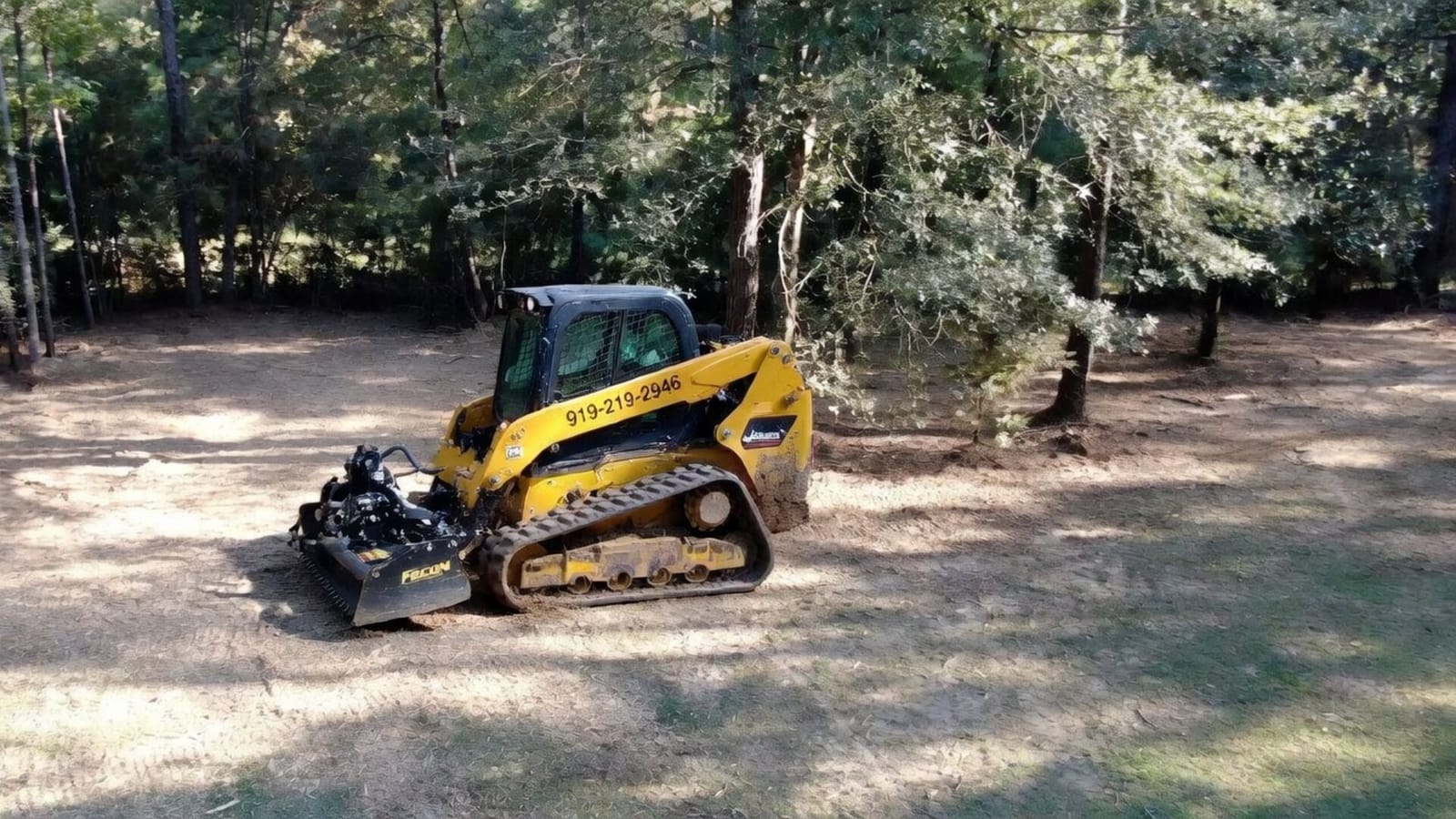
One tracked machine with a spinning toothed drum walks into the brush and grinds it where it stands. Shrubs and small trees become a mat of chips on the ground, and stumps are cut flush rather than pulled. There is no pile to burn and nothing to haul.
It does not leave ground ready to build on. We do not grade, build pads or file permits. If a house is coming, your excavator takes over after us, and the Michigan land clearing and grading cost guide shows that handoff.
What Changes the Price of a Michigan Mulching Job
Red oaks you want to keep. Oak wilt kills an infected red oak, with no treatment that saves it, and spreads through roots to the oaks beside it. Beetles carry the spores to freshly pruned or injured trees, which is why the state asks for no oak pruning from April 15 to July 15. On a wooded lot with keeper red oaks, we either work those edges after mid-July or slow right down around every trunk. Slow work near keepers is what pushes an acre toward $4,000.
Shrubs that answer the machine. Michigan Natural Features Inventory, which writes control guides for the state, says cutting mature glossy or common buckthorn makes it resprout unless the stump is treated. Autumn olive sprouts hard from the root crown. Common buckthorn can also leave 500 to 1,000 seeds per meter in the top few inches of soil. So a buckthorn acre gets two lines on our quote: the knockdown, then a lighter return visit. We do not spray; a licensed applicator handles that step.
Hedges next door. MNFI notes glossy buckthorn was long planted as a hedge and for wildlife cover. If a fruiting hedge runs along your line, birds will keep seeding the ground we just opened. From January 1, 2028, an MDARD order makes it unlawful to sell, import or propagate glossy buckthorn, common buckthorn and Japanese barberry. Autumn olive is already restricted. Removing them from your own land is not on that list.
Frost laws on the road in. Under MCL 257.722, axle loads drop 25 percent on concrete roads and 35 percent on other roads through March, April and May, and each road agency posts its own dates. A loaded mulcher trailer on a posted gravel road can wait until late May. A summer or fall start costs the same and avoids the wait.
Pro tip: If your woods hold red oaks, ask us to split the quote into the oak edges and the open interior. The interior can be mulched any month. The edges wait until after July 15, and seeing the two apart tells you which acres carry the slower rate.
Forestry Mulching Costs Across Michigan
West Michigan, around Grand Rapids. This is where our crews work. Old farms around Ada, Caledonia, Allendale and Middleville have gone back to autumn olive and buckthorn, which is why a quote there usually carries a return visit. Our reverted field guide explains why one pass rarely finishes those fields, and the Grand Rapids mulching cost guide breaks the band down for the six counties.
The southern farm belt. The Kalamazoo soil series covers much of southern Michigan: well drained loam over sand and gravel, mostly farmed, with idle cropland near the bigger cities. Its native forest is red, white and black oak, so the oak wilt calendar touches nearly every wooded edge. Dry ground lets the machine run fast.
The southeast lake plain. Blount soils, a heavy till on till plains and old shore zones, hold a perched water table 6 to 24 inches down. A tracked machine waits for that ground to firm up instead of rutting it. Booking a dry month there saves hours.
The northern Lower Peninsula. Around Grayling in Crawford County, the Grayling series is deep sand that drains fast, under jack pine and scrub oak. Wet ground almost never holds us up. Debris burning was the top cause of the 231 fires the DNR fought in 2022, which is a good reason to grind the brush instead of piling it.
The Upper Peninsula. Kalkaska sand, the state soil, is mapped on about 982,000 acres across the north under maple, beech, pine and aspen. Its frost-free season runs only 90 to 160 days, so mulching up there is a summer and fall job.
Permits and Burning Rules in Michigan
Burn permits split by region. In the Upper Peninsula and the northern Lower Peninsula, the DNR burn permit map shows each county’s status for the day, and a “yes” is your permit. In the southern Lower Peninsula, the local fire department or township decides. Where local law allows burning, the DNR needs no permit over continuous snow cover, and burning to clear land for construction needs a permit from a local DNR fire manager.
Soil erosion. Part 91 calls for a soil erosion permit for an earth change of one acre or more, or any earth change within 500 feet of a lake or stream. Whether a mulching pass that leaves the root mat in place counts is up to the local agency, so ask before the machine arrives. Our Grand Rapids permit guide sets out who issues it in Kent County.
Frequently Asked Questions
How much does it cost to mulch one acre in Michigan?
With us, $1,500 to $4,000, and on a single acre the floor near $1,500 often sets the number. Thin regrowth on dry sand sits low. A closed buckthorn thicket with red oaks to work around sits near the top.
When is the best time to mulch wooded land in Michigan?
After July 15 if red oaks are staying, so no wound opens during the oak wilt window. Late summer and fall also miss the spring road limits and soft lake plain ground. In the Upper Peninsula, plan around the short frost-free season.
Will buckthorn grow back after mulching?
Yes, from the stump and from seed in the soil. Plan on a return visit the next growing season, priced as its own line, and a herbicide step by a licensed applicator if you want it gone for good.
Can I just burn the brush instead?
Sometimes. Check the DNR map in the north or your fire department in the south, stay 1,400 feet from any city or village limit, and get a DNR fire manager’s permit for construction clearing. Mulching skips all of that.
Do you mulch outside the Grand Rapids area?
Our crews work Kent, Ottawa, Allegan, Barry, Ionia and Montcalm counties. Further out, use this band to budget and ask us whether your land is in reach before you plan around a date.
Get a Forestry Mulching Quote in Michigan
Pick the nearest area below and request a free quote for a walk-through. Our crew will contact you to discuss the land and the drive or gate a trailer would use, what is growing if you know it (buckthorn, autumn olive, young pine), whether red oaks are staying, and what you want at the end: open woods, a cleared field edge, or ground ready for your grader. A field that only needs cutting back is cheaper as mowing; see the Michigan brush hogging cost guide.
Land across the state line? See our Ohio and Indiana mulching guides.
Sources
More from the Cut Brush Blog
Keep reading for more tips and guides on land clearing.
 Cost Guide
Land Clearing Cost Per Acre in Michigan (2026 Guide)
Land clearing cost per acre in Michigan runs $1,500 to $4,500. See how old-field reversion, water proximity and disposal move the number statewide.
 Cost Guide
Forestry Mulching Cost in Grand Rapids, MI (2026)
Forestry mulching around Grand Rapids runs $1,500 to $4,000 per acre. See what a reverted field, water proximity and access do to the hours on your land.
 Guide
Japanese Barberry Removal in Michigan: The 2028 Rule, Regrowth and Cost
Japanese barberry removal in Michigan costs $1,500 to $2,500 an acre. Know the 2028 restricted listing and plan for regrowth. Request a free quote.
Comparing states? See land clearing costs by state.
Let's Get Started on Your Land
Request a free quote. We'll contact you to discuss your property, access, and the clearing you need.
Get a Free QuoteOr call us directly: (919) 525-3950