
Land Clearing and Grading Cost in Georgia (2026 Guide)
Cut Brush Team · October 9, 2026 · 9 min read

On a sloped Piedmont lot of red clay, the pad is a cut and a fill, and on a flat Coastal Plain lot it is mostly leveling, but either way the trees come off the footprint first. That is two jobs with two bills. Clearing a Georgia homesite runs $1,500 to $4,500 an acre with Cut Brush, and the grading that follows is your dirt contractor’s work. Our crews clear lots around Columbus, Atlanta, Augusta, Savannah, Albany and Valdosta.
Site prep in Georgia is a short chain: paperwork, clearing, then cutting and filling the pad. We do the clearing and hand you ground a grader can start on the morning the dozer unloads. We do not grade, build pads, install septic or file permits, so this guide shows what each link costs and who carries it.
At a glance:
- Clearing: $1,500 to $4,500 an acre in all six of our Georgia markets. On our Atlanta pricing page, most complete residential lots total $2,000 to $6,000.
- The 1-acre line: disturb 1 acre or more and Georgia’s construction stormwater permit applies, with a Notice of Intent filed at least 14 days ahead and an $80 fee per disturbed acre.
- Buffers: a 25-foot undisturbed strip along state waters, 50 feet on trout streams, whatever the size of the job.
- Near a creek, small lots count too: within 200 feet of state waters, the under-one-acre exemption from Georgia’s erosion rules does not apply.
- Certified crews: anyone doing land-disturbing work in Georgia has to be certified through the state’s soil and water commission.
How Much Do Land Clearing and Grading Cost in Georgia?
Five phases, and only one of them is ours.
| Phase | Who does it | What it costs you |
|---|---|---|
| Erosion plan, Notice of Intent and local land disturbance permit | You, your builder or a design professional | $80 per disturbed acre in state fees from 1 acre up, plus the local permit |
| Clearing the pad, drive, septic area and utility run | Cut Brush | $1,500 – $4,500 per acre equivalent |
| Cutting, filling and compacting the house pad | Your dirt contractor | Their bid, driven by slope and how much dirt moves |
| Fill dirt for a low pad | A supplier, plus delivery | Priced by the yard, delivery by distance |
| Stone base for the driveway | A supplier, plus delivery | Priced by the ton |
Where these numbers come from. Our clearing band is the Lot & Homesite Prep row on the Columbus pricing page, and every one of our Georgia markets publishes the same figure. For the dirt half, a Middle Georgia grading contractor publishes a couple thousand to ten-plus thousand dollars for most residential house pads, and a Marietta supplier posts fill dirt at $28 a yard before delivery. Raising a 3,000-square-foot pad by a foot takes about 111 cubic yards of loose fill, or roughly $3,100 at that price before trucking and compaction.
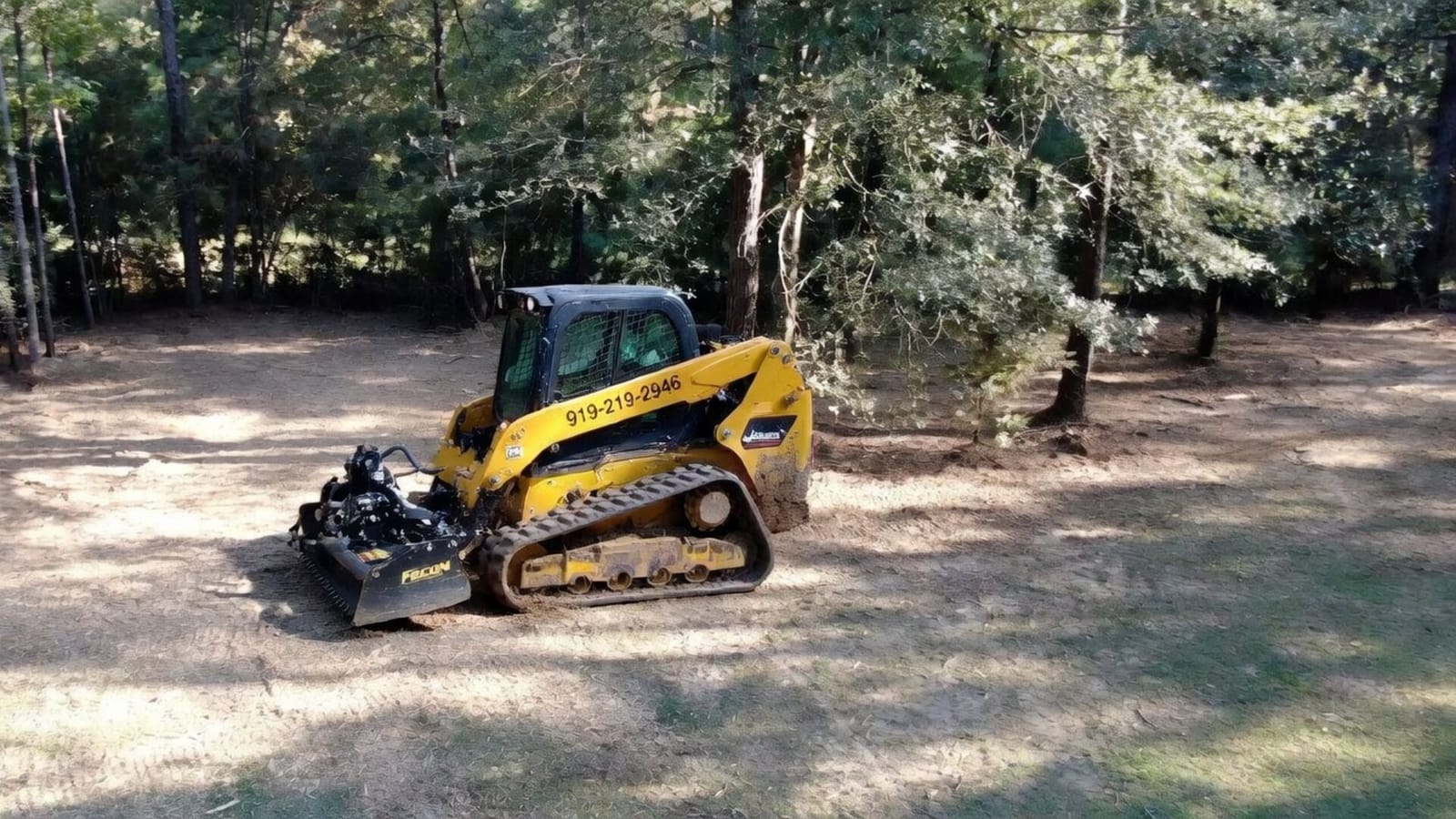
What grader-ready means. Trees and brush are off the footprint, stumps are pulled from the pad and drive, and the wood is hauled or ground where it will not end up under the slab. Outside the footprint, we mulch in place and leave the mat. On a sloped Georgia lot, that mat is the only cover between our handoff and the grader’s first cut. The clearing price by what is growing is in our Georgia land clearing cost per acre guide; a mulch-only job is in our Georgia forestry mulching cost guide.
Pro tip: Have your grader or designer mark the limits of disturbance before we arrive, and we clear to that line and no further. Georgia’s erosion law counts grubbing as land disturbance, so every acre where stumps come out moves you toward the 1-acre line and adds $80 to the state fee.
What Changes the Grading Bill in Georgia
Slope. A level pad on a hillside means a cut, a fill and compaction in lifts. That is the single biggest swing in a pad bid, and it is why Piedmont lots cost more to grade than Coastal Plain ones.
The state-water buffer. A branch or creek where flowing water has stripped the bank carries a 25-foot buffer under state rule 391-3-7-.05, and a designated trout stream 50 feet. Nothing gets graded inside it without a variance, which can push the pad or the drive somewhere more expensive to build.
The 200-foot line. Georgia law, O.C.G.A. 12-7-17, exempts most projects under one acre from its erosion rules, but not within 200 feet of the bank of any state water, and not inside a larger common plan of development of an acre or more. A small lot by a creek gets permitted like a big one.
How the timber came off. If a timber harvest disturbed a buffer, the same statute bars any other land disturbance on the whole property for three years. Ask before you schedule a grader on a lot that was logged recently.
How far the fill travels. Supplier delivery is priced by zone, so a lot near the yard pays the low fee and a lot on the edge pays the high one, per truck. On low ground that needs a raised pad, trucking can rival the dirt itself.
A certified crew. The Georgia Soil and Water Conservation Commission requires anyone involved in land-disturbing activity in the state to be certified, and its Level IA course is the one for grading contractors and site superintendents. Ask your grader for the card before you sign.
Land Clearing and Grading Costs Across Georgia
Soil decides how much dirt moves, and Georgia has four very different kinds. Our Fall Line clearing guide shows two of them meeting in one county.
The Piedmont: metro Atlanta, Athens and Harris County. Soils like the Pacolet series carry a subsoil of 35 to 65 percent clay on slopes that commonly run 15 to 25 percent. That slope is the bill: Piedmont pads sit toward the top of a grader’s range. Cherokee County and City of Atlanta rules are in our Atlanta permit guide.
The Fall Line sand: south of Columbus and around Augusta. The Fall Line runs about twenty miles wide from Columbus to Augusta. South of it, sandhill soils such as Lakeland hold sand deeper than 80 inches on slopes mostly under 12 percent. The ground drains fast, so a grader loses fewer days to rain than on clay, but a cut face in loose sand needs cover quickly.
South Georgia uplands: Albany, Tifton and Valdosta. Soils such as the Tifton series sit on slopes of 0 to 8 percent, so shaping a pad takes little cutting. The catch is below: ironstone nodules make up 5 to 25 percent of the top layers, and a dense plinthite layer appears 30 to 50 inches down. Ask your grader how deep the footings and septic lines go.
The coastal flatwoods: Savannah, Pooler and Richmond Hill. Flatwoods soils like Leon hold a water table 6 to 18 inches down for one to four months of most years. Pads here go up rather than down, so the fill and delivery rows of the table become the big line. Inside Savannah, the city clearing permit comes first; see our Savannah permit guide.
Permits Before the First Cut in Georgia
At 1 acre, the state permit applies. Georgia’s construction stormwater permits cover disturbance of 1 acre or more, or less inside a larger common plan, according to EPD’s March 2023 fact sheet. New sites file the Notice of Intent online at least 14 days before work starts.
The fee is split. State rule 391-3-6-.22 sets it at $80 per disturbed acre, measured to the tenth of an acre and paid before disturbance. Where a city or county is the certified local issuing authority, $40 goes to the state and $40 to the local office.
The county or city issues the land disturbance permit. In Columbus, the consolidated government’s Engineering Department reviews a full site permit in 15 business days once the package is complete, and its NPDES fee form starts at 0.95 of a disturbed acre. Clearing under an acre on a residential lot can go through a $75 minor permit instead. Our Columbus permit guide has both.
Pasture is treated differently. The erosion act exempts agricultural operations, including preparing and planting pasture. Clearing for grazing and grading for a house are separate questions for the issuing office.
Your builder or grader usually carries the erosion plan and the Notice of Intent. We clear inside whatever limits that plan sets.
Frequently Asked Questions
How much does it cost to clear and grade a one-acre lot in Georgia?
Clearing the acre runs $1,500 to $4,500 with us. A Middle Georgia grading contractor publishes a couple thousand to ten-plus thousand dollars for most house pads, and the state stormwater fee adds $80 once disturbance reaches a full acre. Fill, driveway stone and the local permit come on top.
Does Cut Brush grade house pads in Georgia?
No. We clear to grader-ready ground, pull stumps from the pad and drive, and hand the site to your dirt contractor. We do not grade, build pads, install septic or file permits, in Georgia or anywhere else.
Do I need a permit to grade a lot in Georgia?
Usually, yes. At 1 acre of disturbance the state stormwater permit applies, and under an acre you still need the local permit if the work is within 200 feet of a creek or inside a larger development. Your county or city land disturbance office makes the call.
Why does grading cost more around Atlanta than around Valdosta?
Slope. Piedmont lots on clay soils like Pacolet often sit on 15 to 25 percent grades, so the pad needs a cut and a fill. Coastal Plain uplands around Valdosta run 0 to 8 percent, and the shaping is lighter.
Should I clear the whole lot before grading?
No. Clear the pad, drive, septic area and utility run, and mulch or keep the rest. Fewer grubbed acres means a smaller state fee, less bare clay and less for the grader to stabilize. Our Georgia underbrush removal cost guide covers opening up the woods you keep.
Get a Clearing Price Your Georgia Grader Can Build On
Pick your nearest Georgia area below and request a free quote. Our crew will contact you to discuss where you plan to build, the way in from the road, any creek or branch within 200 feet and your dirt contractor’s timing, then walk the lot, mark the limits with you and put a written clearing price in your hands.
Building across the state line? Our Alabama land clearing and grading cost guide and South Carolina land clearing and grading cost guide cover those states.
Sources
More from the Cut Brush Blog
Keep reading for more tips and guides on land clearing.
 Cost Guide
Forestry Mulching Cost in Columbus, GA (2026)
Forestry mulching around Columbus, GA runs $1,500 to $4,000 per acre. See what Piedmont clay, Fall Line sand, scrub oak and creeks do to the price.
 County Guide
Land Clearing Permits in Columbus & Muscogee County, GA
Columbus issues a minor land disturbance permit for small clearing and a full site permit for the rest. The size tests, the 200 foot rule and burn rules.
Cost Guide Forestry Mulching Cost in Georgia (2026 Guide)
Forestry mulching in Georgia runs $1,500 to $4,000 an acre with Cut Brush. See what palmetto, privet, wet flatwoods and the summer burn ban do to your price.
Comparing states? See land clearing costs by state.
Let's Get Started on Your Land
Request a free quote. We'll contact you to discuss your property, access, and the clearing you need.
Get a Free QuoteOr call us directly: (919) 525-3950