
Land Clearing & Grading Cost in South Carolina (2026 Guide)
Cut Brush Team · October 9, 2026 · 7 min read

You have a wooded lot, a house plan and two crews to pay before the foundation goes in: one to take the trees off and one to cut and pack the pad. Clearing a South Carolina homesite runs $1,500 to $4,500 an acre with Cut Brush around Charleston, Columbia and Greenville. Grading is a separate contract with your dirt contractor, and we hand the lot over ready for that machine.
At a glance:
- $1,500 to $4,500 an acre to clear, and the same per acre equivalent for a pad, drive and utility run. Our Columbia pricing page puts most complete residential lots at $2,000 to $6,000.
- We do not grade. No pads, no septic, no permits: we clear to grader-ready ground and stop.
- 1 acre of disturbance means state Construction General Permit coverage, SCR100000, in place before clearing starts.
- 2 acres means a stormwater plan from a professional engineer, landscape architect or Tier B land surveyor.
Our crews clear homesites from Columbia across the Midlands, from Charleston across the Lowcountry and from Greenville across the Upstate. The Columbia land clearing service page shows what our handoff to the grader covers.
How Much Does It Cost to Clear and Grade a Lot in South Carolina?
A South Carolina homesite moves through five phases, and two of them are ours. This is who does each one and what we charge for our part.
| Phase of the job | Who does it | What it costs |
|---|---|---|
| Clearing the lot, trees and brush off | Cut Brush | $1,500 – $4,500 / acre |
| Pad, drive and utility run cleared, stumps out of the footprint | Cut Brush | $1,500 – $4,500 / acre equivalent |
| Stormwater coverage and the county permit | Owner, builder or design professional | Fees set by SCDES and the county |
| Cutting, filling and compacting the pad | Grading contractor | Your grader’s quote |
| Fill dirt and driveway stone | Grader or supplier | By the ton or the yard, delivery extra |
Where these numbers come from. Our two rows are copied from the Columbia pricing page, and the Charleston and Greenville pages publish the same bands, each noting that grading is billed separately. The grading half has no published South Carolina rate, so the grader prices it after seeing your plan. For materials, an Upstate sand and gravel yard posts fill dirt at $22.50 a ton, about $450 for a 20-ton truckload, and a Johns Island yard sells it at $28 a cubic yard.
Grader-Ready: Where Our Work Stops
Grader-ready means your dirt contractor can start cutting the morning the machine comes off the trailer. Trees and brush are off the footprint, stumps are out of the pad and the drive, and the wood has gone somewhere it will never end up under a slab.
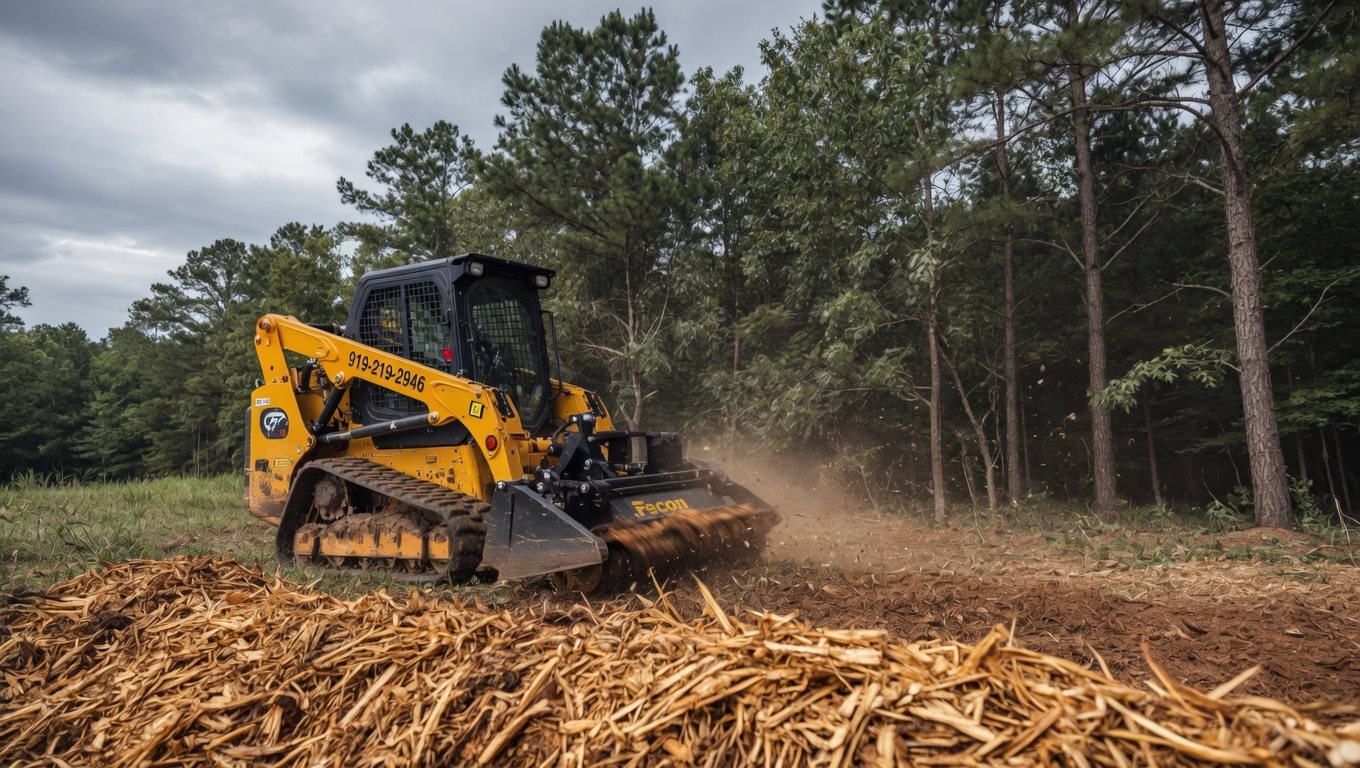
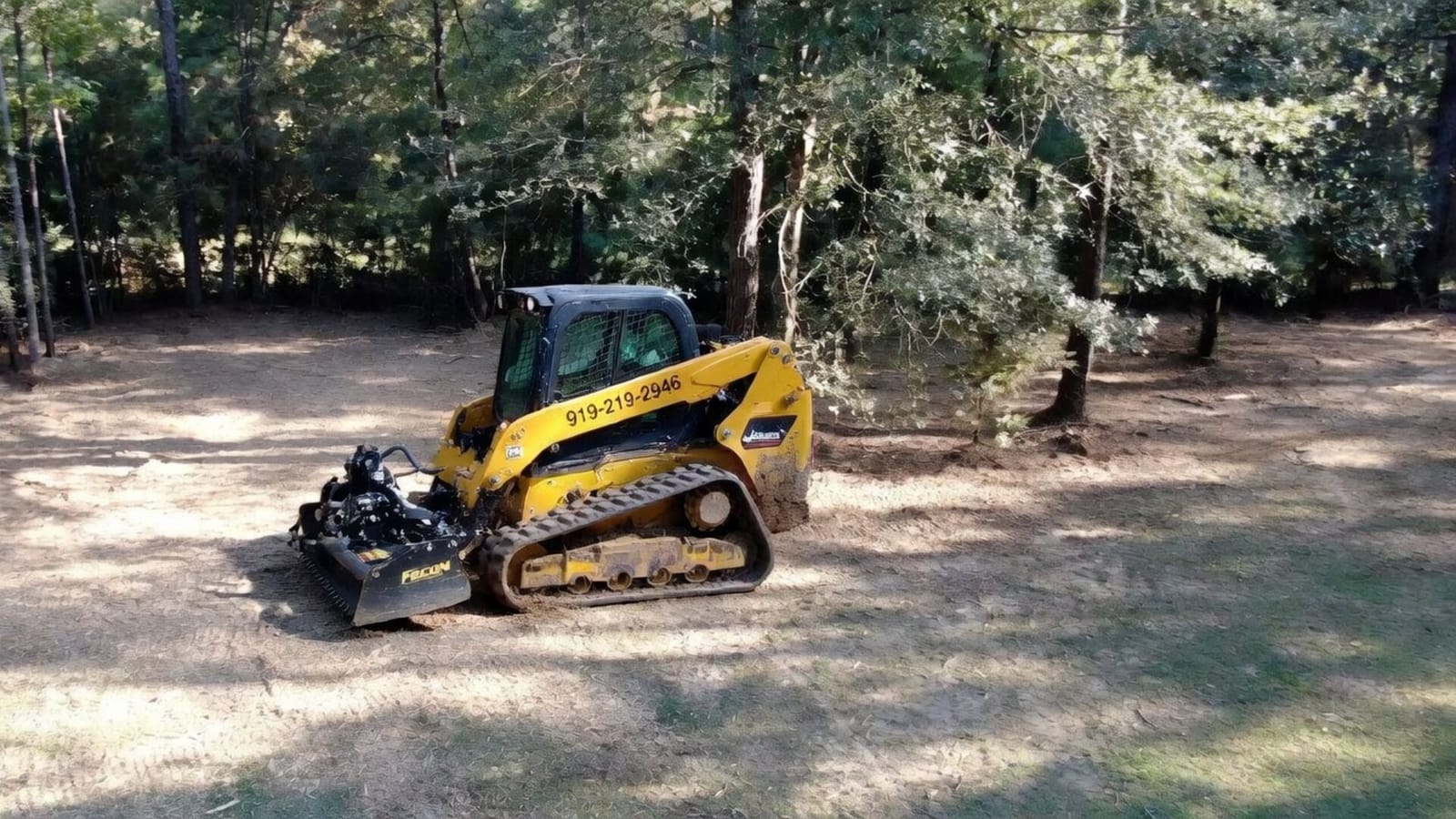
Outside the footprint we mulch in place and leave the chips down, which on Upstate clay is the cover between our exit and the grader’s arrival. The per-acre picture by what is growing is in our South Carolina land clearing cost per acre guide, and the mulch-only job in our South Carolina forestry mulching cost guide.
SCDES lists clearing, grading, excavating and filling of low areas together as construction activity, so every grubbed acre counts toward the 1-acre line. Whether a mulched strip that keeps its roots counts too is a question for the issuing office.
Pro tip: Have your designer or grader stake the limits of disturbance before we arrive, and we clear to that line and stop. On a lot that would otherwise pass 2 acres, keeping the cleared footprint under that line is what spares you the engineered stormwater plan.
What Changes the Grading Bill in South Carolina
The 2-acre engineering line. From 2 acres of disturbance, or less inside a larger common plan, SCDES wants a Comprehensive Stormwater Pollution Prevention Plan prepared by a South Carolina professional engineer, landscape architect or Tier B land surveyor. Between 1 and 2 acres a simplified plan on the state template will do. Inside one of the state’s 75 MS4 programs you apply through the local government, and what reaches SCDES is the notice of intent, the $125 federal fee and the local approval letter, with a state fee by acreage on top.
Being part of a larger common plan. SCDES reads this broadly: a sign, a sales pitch, an advertisement, a zoning request, lot stakes or surveyor marks can all show more construction is planned. A half-acre lot in a subdivision is permitted as part of the whole.
Taking land out of farm use. If the parcel has been taxed at agricultural use value, building on it is a change of use, and South Carolina charges rollback taxes for the current year and the three before it. Ask the county assessor for the figure before you commit to the plan.
Rock in the Piedmont. SCDOT’s geotechnical manual describes 5 to 70 feet of weathered soil over granite, schist and gneiss across the Piedmont, with boulders and partly decomposed rock inside it and a profile that changes over short distances. Ask your grader how rock is priced before the first cut.
Scraps once the frame goes up. State rules allow construction waste from one and two family houses to be burned on site only at least 500 feet from occupied buildings off the property, between 9 a.m. and 3 p.m., and never from April 1 to October 30. A summer build hauls its scraps.
Clearing and Grading Across South Carolina
The Upstate: Greenville, Simpsonville, Greer and Anderson. Cecil clay carries a subsoil 24 to 50 inches thick, with bedrock and the water table both deeper than 60 inches, so drainage seldom sets the pad. Slope does: Pacolet ground commonly runs 15 to 25 percent, and a level pad on a hillside means a cut, a fill and compaction in lifts. In Greenville County, an individual lot outside a permitted subdivision that disturbs between 5,000 square feet and an acre can let the building permit stand in for a separate grading permit if erosion controls go in and are kept up; a habitual offender faces fines up to $7,500 a violation a day. Our Greenville permit guide has the rest.
The Midlands and Sandhills: Columbia, Lexington, Irmo and Camden. Lakeland sand runs deeper than 80 inches, drains very fast and lies mostly on slopes under 12 percent, so a grader loses fewer days to rain than on clay. A cut face in loose sand still needs cover quickly. The state acreage tiers are laid out in our Columbia permit guide.
The Lowcountry: Summerville, Goose Creek, Johns Island and Moncks Corner. On Yonges soils the water table sits within 10 inches of the surface for about six months of most years, on ground with under 2 percent slope. Pads here go up, not down, so fill and delivery become the biggest lines after clearing. In unincorporated Charleston County, a stormwater permit is required above 5,000 square feet of disturbance and before a building permit is issued. In Beaufort, Berkeley, Charleston, Colleton, Dorchester, Georgetown, Horry and Jasper counties, a Coastal Zone Consistency determination must be issued before the state stormwater permit. Our Charleston permit guide covers the county and city rules.
Frequently Asked Questions
How much does it cost to clear and grade a one-acre lot in South Carolina?
Clearing the acre runs $1,500 to $4,500 with Cut Brush, and our Columbia pricing page puts most complete residential lots at $2,000 to $6,000. Grading is quoted by your dirt contractor, and fill, driveway stone, the stormwater fees and the local permit come on top.
Does Cut Brush grade house pads in South Carolina?
No. We clear to grader-ready ground, pull stumps from the pad and the drive, and hand over to your dirt contractor. We do not grade, build pads, install septic or pull permits.
Do I need a stormwater permit for a lot under an acre?
Often a lighter step instead. Outside the coastal counties you file Form 2628 and receive a letter of exemption. In a coastal county, a lot under an acre outside any larger plan that drains within half a mile of a coastal receiving water is covered automatically unless SCDES asks for more. A lot inside a larger common plan needs a full notice of intent whatever its size.
Will building on farmland raise my property tax?
It can. A change from agricultural use triggers rollback taxes for the current year and the three before it. Ask your county assessor before clearing starts.
Get a Clearing Quote Your Grader Can Build On
Pick your nearest area below and request a free quote. Our crew will contact you to discuss the footprint you plan to build on, the way in from the road, your dirt contractor’s timing, and whether the lot is in a subdivision, near tidal water or taxed as farmland. Then we will walk the lot, mark the limits with you and put a written clearing price in your hands.
Building across the state line? See our Georgia land clearing and grading cost guide.
Sources
Related Services
Learn more about the services mentioned in this article.

More from the Cut Brush Blog
Keep reading for more tips and guides on land clearing.
 Cost Guide
Land Clearing Cost Per Acre in South Carolina (2026 Guide)
Land clearing cost per acre in South Carolina runs $1,500 to $4,500. What sandhill ground, pine stands and the state's acreage permit tiers do to a quote.
 Guide
South Carolina Land Disturbance Permits: The Acreage Tiers Explained
South Carolina gates land clearing by acreage, and the first tier starts under one acre. Here is what applies at each level around Columbia, and the rule that catches subdivisions.
 Cost Guide
Forestry Mulching Cost in South Carolina (2026 Guide)
Forestry mulching in South Carolina runs $1,500 to $4,000 an acre with Cut Brush crews in Charleston, Columbia and Greenville. Here is what moves your price.
Comparing states? See land clearing costs by state.
Let's Get Started on Your Land
Request a free quote. We'll contact you to discuss your property, access, and the clearing you need.
Get a Free QuoteOr call us directly: (919) 525-3950