Land Clearing Cost Per Acre in Colorado (2026 Guide)
Cut Brush Team · September 12, 2026 · 7 min read
Land clearing cost per acre in Colorado generally runs $1,500 to $4,500. Where a particular tract lands inside that band has less to do with acreage than most people expect, and more to do with three things this state raises that flatter states do not: how far the parcel sits above the valley floor, whether the brush is Gambel oak that comes back from the root, and how far a crew has to travel to reach it.
This guide covers per-acre pricing by vegetation and terrain, the Colorado-specific factors that move a number, and how the state’s own geography splits into different jobs depending on where you are standing.
The Short Answer, by What Is Standing
Most land clearing in Colorado costs $1,500 to $4,500 per acre in 2026. Vegetation and terrain set the baseline together, because machine hours per acre are most of the price, and both heavy growth and difficult access add hours.
| What is on the acre | Per-acre range | Where you see it |
|---|---|---|
| Open field brush on flat, accessible ground | $1,500 – $2,000 | High plains and suburban lots on easy grade |
| Light regrowth and field edges | $1,500 – $2,500 | Fence lines and pasture margins left a season too long |
| Gambel oak or mixed brush, foothills grade | $2,500 – $4,000 | Wildland urban interface ground west of the Front Range |
| Whole-tract clearing or a lot prepared for building | $1,500 – $4,500 | Anything cut for a house, a barn, a drive or open field |
There is also a practical floor near $1,500 on small jobs, which is what it costs to get a tracked machine onto a property regardless of how little ground there is to cover. Lot and homesite preparation is quoted on the same $1,500 to $4,500 basis, per acre equivalent, because the work is measured by the building envelope rather than by the parcel.
What Actually Moves the Number
1. Elevation and slope decide access before vegetation does
Colorado is the only state in this company’s service area where the same acreage can sit at a mile of elevation gain from one parcel to the next. A foothills lot above Denver, reached by a climbing gravel drive, takes a tracked machine longer to work than the same brush density on a suburban lot or a flat eastern-plains parcel. Long, tight or steep approaches add hours before a single stem is cut, and that is true in both directions: an easy plains parcel can still cost more to reach than it does to clear, simply because the drive to it is long.
2. Gambel oak resprouts from the root, not the stump
Gambel oak is the vegetation story that makes Front Range foothills clearing different from clearing almost anywhere else this company works. Colorado State Forest Service management guidance states that the species resprouts aggressively after being cut, mowed, or burned, because it reproduces mainly through an extensive root system rather than from acorns (Colorado State Forest Service). A single pass through an oak thicket opens the ground; it does not end the plant’s involvement, so an honest quote separates the knockdown from a return visit instead of implying one visit settles it.
3. Front Range, high plains or Western Slope
Colorado’s terrain does not behave the same way twice. The Front Range foothills carry Gambel oak, ponderosa pine and steep, often narrow access. The high plains east of the mountains are flatter and more open, with lighter native brush and grass, but longer distances between parcels. The Western Slope, on the far side of the Continental Divide, sits in a drier climate with its own pinyon-juniper and sagebrush country, a different vegetation profile from the Front Range entirely. A quote written for one of these without knowing which applies is a guess dressed up as a number.
4. Method, and what happens to the material
Traditional clearing has two halves: cutting and disposal. Forestry mulching removes the second. The material is processed where it stands and left across the soil as a chip mat, so there is no pile, nothing to load, and no burn permit to arrange. Clear and haul still wins where a site needs to be cut to grade or an owner wants nothing left on top, and it typically costs more, especially where the haul route runs down a foothills grade.
Three Rules That Apply Anywhere in Colorado
One acre is a common state permit trigger. Beyond whatever a city or county requires, construction work that disturbs one acre or more, including demolition, or that is part of a larger common plan of development or sale, may also need a state Stormwater Discharge Permit Associated with Construction Activities (City and County of Denver). Local jurisdictions can, and often do, add their own permitting on top of that state floor; Denver’s own city permit and Jefferson County’s half-acre grading line are two examples covered in our Denver and Jefferson County permit guide.
Open burning needs local permission, not just a match. Colorado Regulation No. 9 (5 CCR 1001-11) governs open burning statewide through CDPHE, and counties and fire districts issue their own burn permits and day-of conditions on top of that framework. Specific seasonal dates and fees are set locally and are not the same everywhere in the state.
Russian olive and tamarisk are regulated wherever they grow in Colorado. Both are Colorado List B noxious weeds, meaning management is mandated statewide even though the exact approach is set county by county, because both species take over streambanks and outcompete native riparian growth (Colorado Department of Agriculture). Gambel oak, by contrast, is native and carries no such listing; it is a resprout problem, not a regulatory one.
Requirements vary by parcel, scope and jurisdiction, and the governing authority makes the determination.
Where in Colorado Is Your Land?
The bands above hold statewide. What moves inside them, and which office has to say yes first, changes by region.
Denver and the Front Range. Metro Denver, the Jefferson County foothills around Golden, Evergreen, Conifer and Morrison, and the suburban and plains counties of Douglas, Elbert, Adams and Arapahoe are covered by our dedicated Denver market. Start with land clearing in Denver, see current ranges on the Denver pricing guide, and read what each method actually covers on the Denver services page. If the ground is in the foothills wildland urban interface, our defensible space and home ignition zone guide covers the fuel-reduction side of that work.
The high plains and the Western Slope. Ground further east on the plains or west across the Continental Divide is not yet covered by a dedicated Cut Brush hub. Call and we will tell you plainly whether your property falls inside our current service area before anyone quotes it.
When to Book
Spring mud season is the one predictable window to plan around on foothills and mountain-adjacent ground: as snow melts and dirt access roads saturate, a loaded trailer can rut a drive that carries weight easily the rest of the year. Outside that window, most Front Range ground is workable across the year, with heavy snow at higher elevations the other practical limit. Flexible timing on foothills work is worth mentioning when you request a quote.
Frequently Asked Questions
How much does it cost to clear one acre of land in Colorado?
Plan on $1,500 to $4,500 for full clearing, or $1,500 to $4,000 if mulching gets you the finish you need. A flat, accessible acre of light brush sits near the bottom; a foothills acre of Gambel oak on a steep access road sits near the top. Elevation, vegetation and access decide it, not the acre count alone.
Do small jobs really cost $1,500?
Yes, as a practical floor. Mobilisation costs the same whatever the size, so bundling a fence line, a field edge and a brush patch into one visit is the easiest way to get full value from it.
Is there a cheap season to clear land in Colorado?
No published seasonal discount, but spring mud season on foothills access roads is the one stretch worth avoiding if your timeline allows it. Most other Front Range ground works year-round outside heavy snow at elevation.
Can I get a number without a site visit?
You can get a rough range from acreage and photos. A firm written quote takes a walk-through, because elevation, access and vegetation are the three things aerial views hide and the three most likely to move the price.
Get a Real Number for Your Colorado Property
Understanding the land clearing cost per acre in Colorado starts with your own ground: what is growing on it, how it sits on the slope, and what the land has to do next.
Compare your project against the ranges on our Denver pricing guide, then request a free estimate. We respond within 24 hours, walk the parcel with you, and put every line item in writing so the quote you approve is the price you pay.
More from the Cut Brush Blog
Keep reading for more tips and guides on land clearing.
 Cost Guide
 Forestry Mulching Cost in Denver, CO (2026)
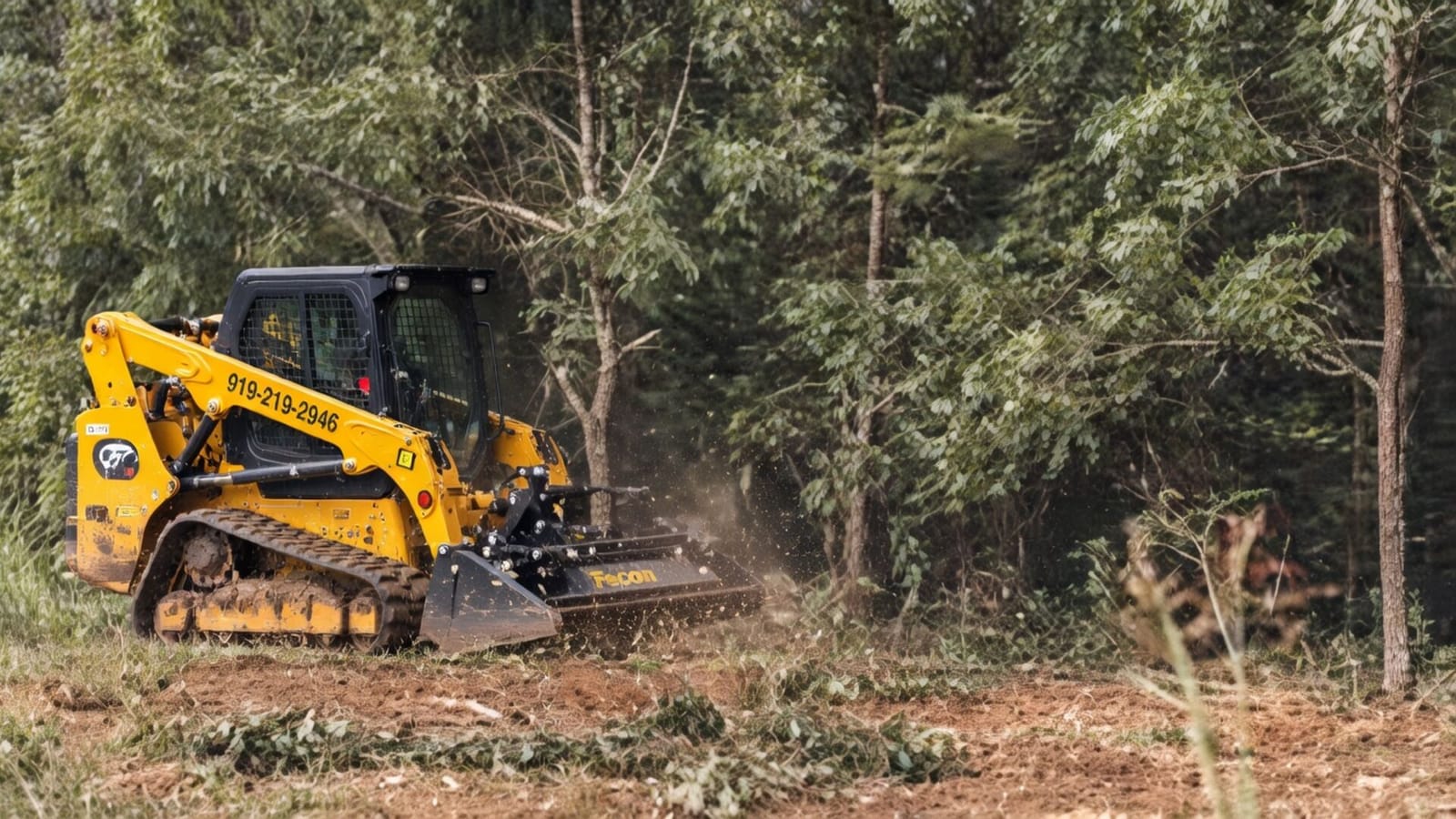
Forestry mulching around Denver runs $1,500 to $4,000 per acre. See what elevation, foothills access and resprouting Gambel oak do to the hours on your land.
County Guide Land Clearing Permits in Denver & Jefferson County (2026)
Do you need a permit to clear land in Denver? The rules split by jurisdiction: Denver's own trigger, its tree license, and Jefferson County's line.
Guide Defensible Space & the Home Ignition Zone in the Denver Foothills
Defensible space around a Denver foothills home follows three zones out from the structure. Here is what each zone actually calls for, with distances.
Ready to Get Started on Your Land?
Get a free, no-obligation estimate for property in Denver & the Front Range.
Get Your Free QuoteOr call us directly: (919) 525-3950