
Multiflora Rose Removal in West Virginia Pastures
Cut Brush Team · August 26, 2026 · 8 min read

Walk any farm road in Berkeley or Jefferson County and you will find a fence line that is not a fence anymore, just a wall of arching thorn canes ten feet tall. That wall has a history. West Virginia planted more than 14 million multiflora rose plants between the 1940s and 1960s, on purpose, as living fence and wildlife cover, and Panhandle farm country has been fighting the gift ever since. Multiflora rose removal in West Virginia is less about killing a bush and more about reclaiming ground: pasture corners the cattle stopped using, fence wire nobody has seen in a decade, field edges that shrink a little more each summer.
The plant now claims tens of millions of acres across the eastern United States, and it did not manage that by dying when cut. This guide covers why the rose took over here, the grind-treat-mow sequence that actually gets rid of it, the fall timing that fits Panhandle ground, and what reclaiming a pasture costs.
The Living Fence That Outlived the Farm Plan
In the 1940s and 1950s, conservation programs promoted multiflora rose across the eastern states as a self-maintaining hedge: plant a row, get a stock-proof fence plus quail cover for free. West Virginia took the pitch harder than most, with those 14 million plants going into farm ground statewide. The trouble is that the sales pitch worked too well. The plant does not stay in a row.
Every arching cane that touches soil roots at the tip and starts a new crown. Birds eat the red hips and reseed fence rows and cedar edges for miles around. Seeds wait in the soil for up to 20 years before sprouting.
States across the region now list the plant as a noxious weed, and whatever the current legal label, the working reality in the pasture country across our Eastern Panhandle service area is the same: the living fence went feral, and it is winning corners of farms from Hedgesville to Charles Town.
How Do You Get Rid of Multiflora Rose for Good?
Grind the thickets down to the crowns, treat the regrowth while it is young and soft, then mow the reclaimed ground once a year so the seedbank never rebuilds. Skip any of the three steps and the rose comes back; run all three and it stays gone.
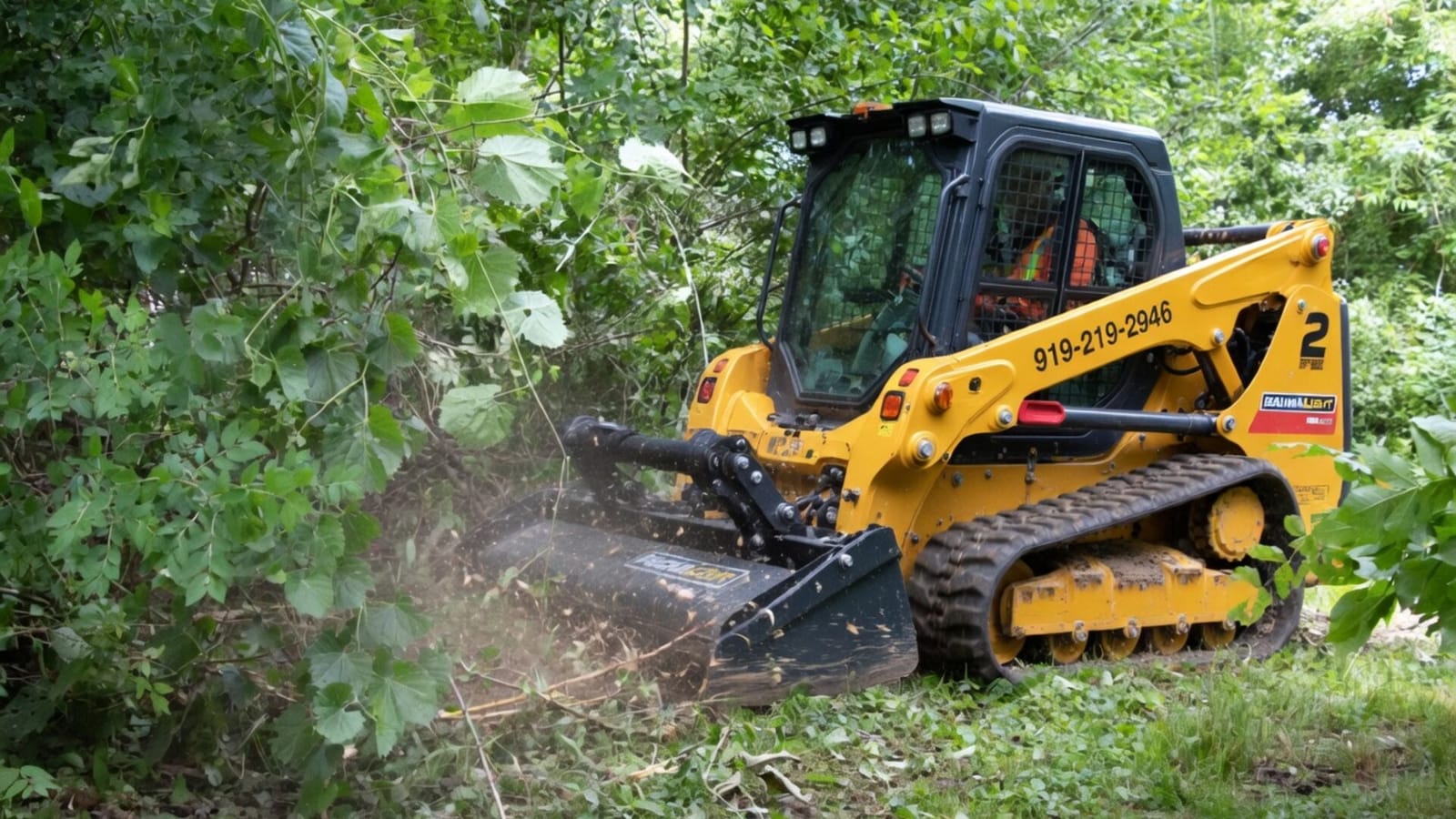
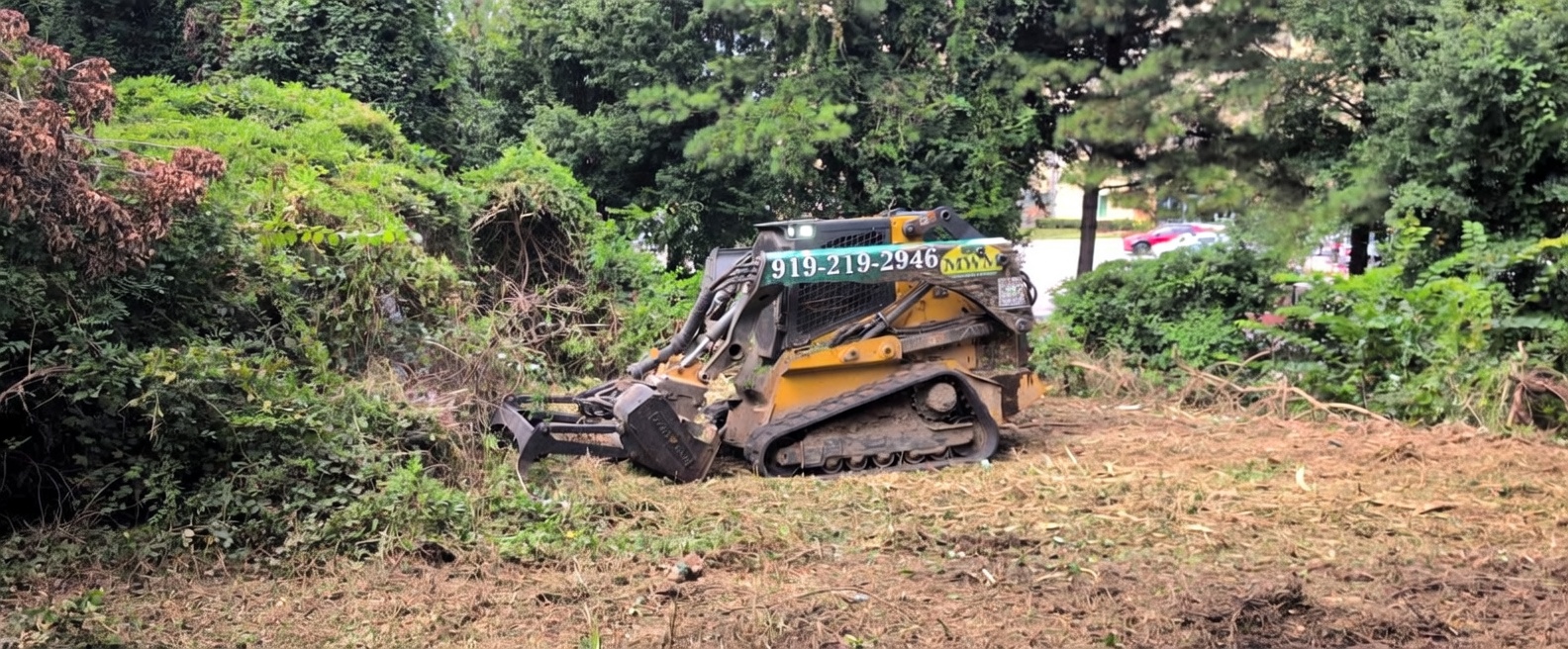
Step one is the knockdown. A forestry mulching machine grinds canes, crowns, and hips into mulch in place. Nobody wades into thorns with hand tools, nothing gets piled or burned, and a thicket that took a decade to build comes out in hours.
Step two is the kill. Cut crowns resprout within weeks, and that regrowth is the target. WVU Extension’s approach to invasive brush pairs mechanical and chemical control across multiple seasons, with herbicide timed to late summer and fall, when plants carry treatment down into their roots.
Step three is the insurance. One inexpensive mowing pass a year clips seedlings from the long-lived seedbank before they turn woody. Mowing is the step that converts a clearing job into a permanent result.
Why not just cut once and be done? Because a mature crown answers a single cut with more canes than it had, and extension research puts the mowing-only cure at several cuts per season sustained for years, a schedule almost nobody keeps in a thorn patch.
When Is the Best Time to Clear Multiflora Rose in West Virginia?
Late summer through fall is the working window: the ground is firm, the herbicide timing is right, and the regrowth schedule lines up. Spring has its uses, but they are for scouting, not clearing.
In May and June the rose blooms in clusters of small white flowers for about two weeks, and for that window every plant on the farm announces its position. Fall is when the machine work pays best: firm ground protects pasture sod, and mulching then puts regrowth on schedule for treatment.
There is a debris angle too. West Virginia’s fall fire season bans daytime open burning from October 1 through December 31, which complicates any plan built on burn piles. Mulching in place never creates the pile, a point our tree of heaven removal guide makes about that species for the same reason.
A Season-by-Season Pasture Reclamation Plan
Reclaiming rose-choked ground is a calendar, not a single visit. Here is the schedule that fits Panhandle farms:
| Timing | The work | Why then |
|---|---|---|
| May – June | Walk the farm during bloom and map every thicket | Two weeks of white flowers gives you a complete target list |
| August – October | Mulch thickets, corners, and fence rows | Firm ground, and regrowth emerges in time to treat |
| 4 – 8 weeks later, or the next season | Treat the resprouting crowns | Young regrowth carries treatment down to the roots |
| Every year after | One mowing pass over reclaimed ground | Seeds stay viable up to 20 years; mowing beats the seedbank |
The payoff shows up fast. Livestock get their corners and shade lines back, the wire becomes visible and fixable, and the brushy cover that shelters ticks and groundhogs is gone. Per-acre numbers for this kind of work sit in the brush-clearing band of our published ranges, and our land clearing cost per acre in West Virginia guide breaks down every figure by vegetation density.
Fence Lines: Taking the Living Fence Back Out
Fence rows are where the rose digs in hardest, because the original plantings followed the wire. Brush clearing along a line is slower, more careful work than open-field mulching: the machine works one side at a time, hand tools finish around posts, and the goal is a clean line you can restring, not just a mowed strip.
Pro tip: Before machines touch a Panhandle fence row, walk it and flag every post you can find. Rows planted as living fence in the 1950s often still hide rusted wire deep inside the canes, and wire found with flagging tape costs nothing, while wire found with a mulcher head costs repair time on somebody’s bill.
Expect company in the canes. Autumn olive, one of the most common invasive brush plants in West Virginia, and tree of heaven both share Panhandle fence rows with the rose, and clearing all of them in one mobilization prices better than three separate visits. Farms around Gerrardstown, Bunker Hill, and out toward Berkeley Springs rarely have a single-species fence line.
Frequently Asked Questions
Why does West Virginia have so much multiflora rose?
Because the state planted it: more than 14 million multiflora rose plants went into West Virginia ground between the 1940s and 1960s as living fence and wildlife cover. The plantings spread by tip-rooting canes and bird-carried seed, and the descendants of those hedges now hold fence lines and pasture corners across Berkeley, Jefferson, and Morgan counties.
Will mowing alone kill an established rose thicket?
No. Mature crowns treat an occasional mowing as a pruning and come back thicker, and extension trials put the mowing-only cure at several cuts per season, kept up for two or more years. Mowing is the right maintenance tool for ground already cleared and the wrong assault tool for a standing thicket.
What does it cost to clear multiflora rose from a pasture in WV?
Brush-dominated ground runs $1,500 to $2,500 per acre, with a practical project minimum near $1,500 for trailering. Thickets mixed with cedar and saplings price as mulching work, up to about $4,000 per acre at the dense end. The full ranges are published on our Martinsburg pricing page.
Can livestock go back on the field right away?
The mulched ground itself is usable immediately, and the mat breaks down into the pasture. The caution window comes with the follow-up treatment: keep stock off treated regrowth for whatever interval the product label and your applicator specify. Most Panhandle cattle operations time the treatment for a paddock they can rest anyway.
Does multiflora rose come back after clearing?
Untreated crowns will resprout, and the seedbank keeps trying for up to 20 years, which is why the sequence includes treatment and an annual mow instead of ending at the knockdown. A cleared field with a yearly pass stays a field; a cleared field left alone starts over. Request a free quote and the knockdown and the follow-up get priced together, up front.
Should tree of heaven come out in the same project?
Usually, yes. It shares the same fence rows, Berkeley and Jefferson counties sit inside the state’s spotted lanternfly quarantine, and the insect prefers tree of heaven over every other host. Our guide to tree of heaven removal in West Virginia explains why that species needs a treat-first sequence instead of a straight grind.
Multiflora Rose Removal Across West Virginia’s Panhandle
The living fence had an eighty-year head start, and it still loses to a mulching head and a follow-up calendar. Cut Brush handles multiflora rose removal across West Virginia’s Eastern Panhandle, reclaiming pastures and fence lines around Martinsburg, Hedgesville, Bunker Hill, Charles Town, and Berkeley Springs.
Get your free estimate and we will respond within 24 hours. You can sanity-check any number against the published bands on our Eastern Panhandle pricing overview, and if a fall clearing slot is what your farm needs, late summer is the time to book it.
Related Services
Learn more about the services mentioned in this article.


More from the Cut Brush Blog
Keep reading for more tips and guides on land clearing.
 Guide
Guide Tree of Heaven Removal in West Virginia's Panhandle
Tree of heaven removal in West Virginia: how to ID the lanternfly's host tree, why cutting backfires, and the fall window that works. Get a free estimate.
 Cost Guide
 Brush Hogging Cost Per Acre in West Virginia (2026 Guide)
Brush hogging a West Virginia field runs $75 to $400 an acre with Cut Brush, set by how overgrown it is. See what autumn olive, shale and July 15 do to a job.
Guide Bradford Pear Removal in West Virginia: Cost and Plan
Bradford pear clearing in West Virginia costs $1,500 to $2,500 an acre for young thickets. Plan the first pass and follow-up cuts. Request a free quote.
Let's Get Started on Your Land
Request a free quote. We'll contact you to discuss your property, access, and the clearing you need.
Get a Free QuoteOr call us directly: (919) 525-3950