
Underbrush Removal Cost in Arkansas (2026 Guide)
Cut Brush Team · October 9, 2026 · 8 min read

The oaks and pines are the reason you bought the place. Underneath them, privet, honeysuckle and a carpet of pine saplings have filled every gap, and you can no longer see the creek from the porch. Underbrush removal in Arkansas runs $1,500 to $2,500 an acre with Cut Brush, and that is what we charge around Bryant, Bella Vista and Batesville. A small job has a floor near $1,500 a project.
At a glance:
- Our price: $1,500 to $2,500 an acre to clear under the trees you keep. If the whole stand comes down instead, our mulching band of $1,500 to $4,000 applies.
- Regrowth is the real cost: in a University of Arkansas privet trial in Little Rock, every control method worked and every one needed follow-up.
- Fire spacing: the Forestry Division’s Firewise guidance treats the 30 to 300 feet around a home as defensible space, with limbs trimmed six feet off the ground.
- Bella Vista: tree removal that disturbs the ground needs a city permit; grinding a stump without disturbing the ground does not.
- Burning the pile: the state’s open burning rule exempts on-site land clearing fires, but county judges issue burn bans on top of it, and on September 4, 2026 more than 65 counties had one.
We clear understory around Bryant in Saline County, Bella Vista in Benton County and Batesville in Independence County, and every quote follows a walk through the woods with you.
What Is Underbrush Removal?
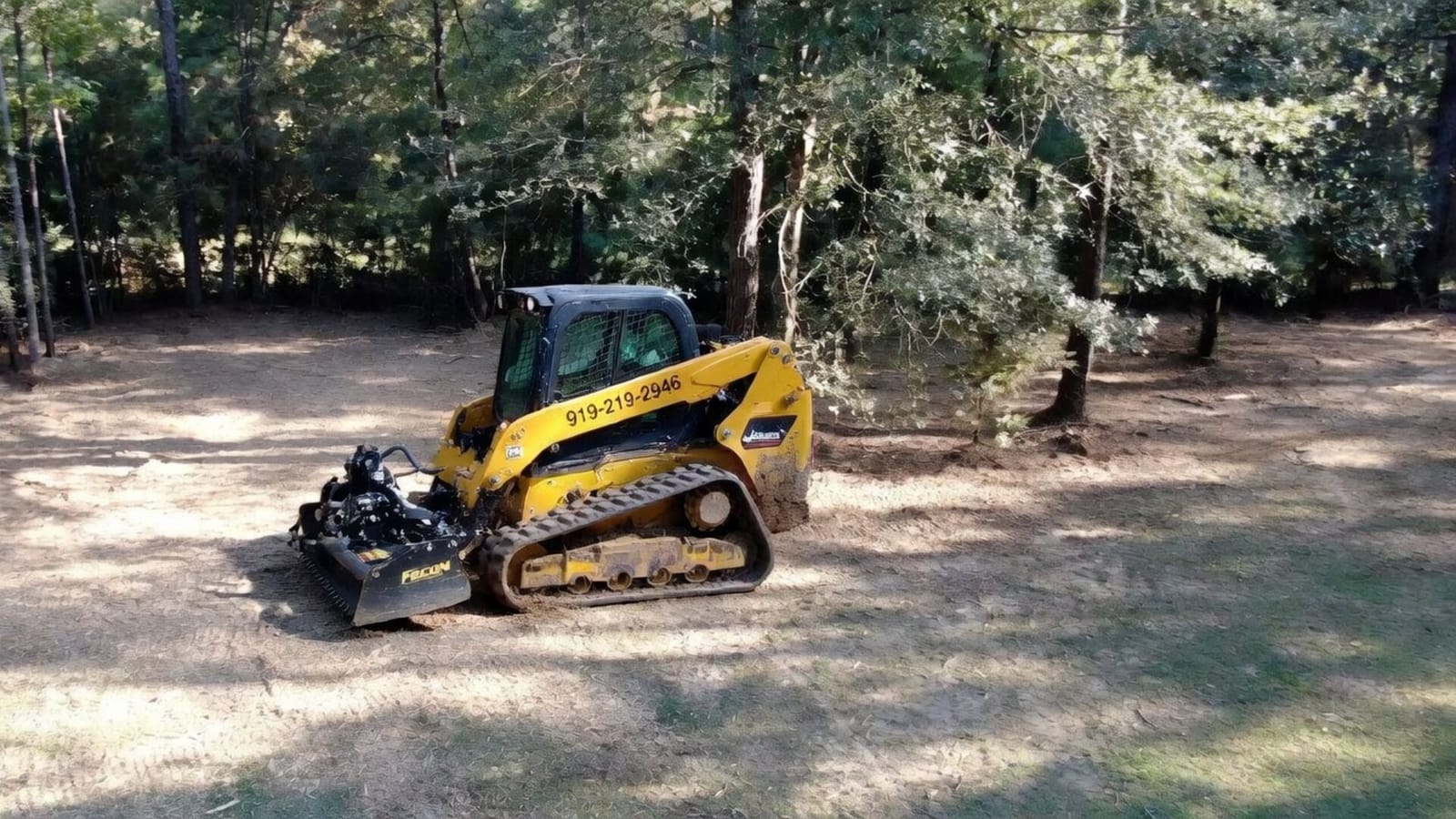
It is clearing the floor of a wood without touching the canopy. A tracked mulcher works between the trunks you are keeping and chews the brush, vines and young trees into chips, which settle over the roots as a protective layer. The big trees stay, the shade stays, and you can walk, see and mow under them again. It is not brush hogging, which needs open ground for a rotary cutter, and it is not land clearing, which takes the trees too.
How Much Does Underbrush Removal Cost in Arkansas?
What is growing under your trees sets the row. These are our rates in all three Arkansas areas.
| What is under your trees | Our price per acre | What it looks like |
|---|---|---|
| Brush, vines and small trees under oaks and hickories | $1,500 – $2,500 / acre | A lot or back acre of open woods choked with undergrowth |
| Young pine, hardwood sprouts and briar under oaks and big pines | $1,500 – $2,500 / acre | A woodlot, fence row or lot edge filling in |
| Redcedar in glade openings, fence rows and pasture edges | $1,500 – $2,500 / acre | Ozark ground that is mostly grass with cedar moving in |
| Understory too thick to save the stand | $1,500 – $4,000 / acre | Nothing kept; everything ground into chips |
Where these numbers come from. Each of the first three rows sits on one of our pricing pages under its local name: Pine & Oak Woodlot Clearing in Bryant, Wooded Lot Understory Clearing in Bella Vista and Ozark Cedar Glade Clearing in Batesville. The band is the same in all three, with a floor near $1,500 a project, since hauling the machine to the woods is one trip whether they cover half an acre or two. The last row is our forestry mulching rate, explained in the Arkansas forestry mulching cost guide. Whole tracts are priced by their cover in our guide to clearing cost per acre in Arkansas.
What Changes the Price Under Arkansas Trees
Privet that comes back. In February 2020 the Division of Agriculture set up a demonstration behind its extension headquarters in Little Rock, aimed mainly at Chinese privet. It tested pulling, cut stump treatments with glyphosate and triclopyr, and foliar sprays of both. Extension educator John Pennington reported no significant difference between them: “they all seem to be effective and require follow up treatment.” Early results put mechanical pulling as the least effective method. So a privet understory is a grinding pass plus a treatment visit, and we price the two as separate lines.
Honeysuckle in the mix. The Division’s pasture weed guide, MP522, lists fall applications of glyphosate or triclopyr for honeysuckle and says follow-up treatments will be needed. Vines rarely change our first-pass rate much, but they are one reason a mulched floor turns green again inside a year.
How many trees stay. Working around a row of oaks or a stand of big pines on a small lot takes slow, careful passes, and that time is in the figure. Walk the lot with us and point out every keeper before we price it.
Red pines among the keepers. The Forestry Division says a dying, red-colored pine in Arkansas is a sign of Ips engraver beetles, which periodically kill pines, typically after drought. After a dry summer, walk the stand before the quote. Red-topped pines usually come down in the same visit, and each one is a felled tree, not understory.
Rock under the leaf litter. In the Ouachita foothills and the Arkansas Valley, the Carnasaw soil forms in shale on slopes up to 60 percent, and its surface comes in stony and bouldery forms. In the pine country of the south, the Smithdale soil is very deep and loamy. The same privet costs more to clear on a stony Ouachita slope than on deep Smithdale ground, because our operator slows for rock.
Pro tip: If the woods sit within 300 feet of your house, ask us to price the Firewise zone as its own line: a clean floor and limbs lifted six feet nearest the house, lighter work farther out. The Forestry Division’s guidance draws exactly that zone, and splitting it out shows you which acres you are paying for safety and which for looks.
Underbrush Removal Costs Across Arkansas
Bryant and Saline County. Woodlots here carry young pine and sprouts beneath oaks and big pines worth keeping. The cost sits in stem count and in how many keepers the machine works around. Our Bryant wooded lot guide covers choosing which trees stay.
Bella Vista and Benton County. Oak and hickory lots on cherty limestone, often in a subdivision. Chert slows the head, and the city’s rules shape where the machine may disturb soil. The Bella Vista karst lot guide covers that ground.
Batesville and the Ozark hills. The understory here is often redcedar invading glades and woodland edges beneath oak and hickory. Cedar cut below its lowest green branch does not resprout, so these acres are usually a single visit with no spraying behind it.
South Arkansas pine country. The Arkansas Game and Fish Commission records that more than 75 percent of the South Central Plains is still wooded, with large commercial loblolly and shortleaf pine plantations. Deep, loamy ground lets a machine move freely under pine that stays. It lies outside our three Arkansas areas.
River bottoms. Along the Arkansas and Red Rivers, the Perry clay carries hardwoods such as cherrybark, Nuttall, water and willow oak, and floods for short periods nearly every year unless a levee protects it. Underbrushing there waits for dry ground.
Firewise Spacing, Permits and Burning in Arkansas
Firewise defensible space. The Forestry Division’s Firewise program describes the 30 to 300 feet around a home as “lean, clean, and green”: mowed short grass and trees trimmed of branches six feet up, a space clear of stored debris, and a floor free of dead leaves, pine needles, sticks and twigs. The Division has worked with more than 300 Arkansas communities and every state park on it. A wooded homesite in Saline County is often exactly the job it describes.
Bella Vista’s line between clearing and grinding. The city’s planning FAQ requires a grading permit for clearing or excavating of any size, and for tree removal that disturbs the ground, such as pushing stumps over or ripping roots out. It says stump grinding needs no permit “so long as the ground is not disturbed.” Mulching leaves the roots in place, but ask the city which side of that line your job falls on before we start.
Burning. The state’s open burning rule exempts controlled fires for on-site land clearing, but county judges issue burn bans that come first. On September 4, 2026 the Department of Agriculture counted more than 65 counties under a ban and asked residents to avoid outdoor burning. A mulched floor leaves nothing to burn.
We clear and mulch; we do not grade, build pads or file permits.
Frequently Asked Questions
What does underbrush removal cost per acre in Arkansas?
With Cut Brush, $1,500 to $2,500 an acre in all three of our Arkansas areas. A single-acre homesite usually just meets the $1,500 floor. Privet under closely spaced keeper oaks, or brush on a stony Ouachita slope, pushes it toward the top.
Will privet grow back after the underbrush is cleared?
Yes, unless the stumps and sprouts are treated. The Little Rock trial found every method effective but every one needing follow-up. Budget for a lighter return trip the following summer, quoted separately.
How far from the house should I clear brush in Arkansas?
The Forestry Division’s Firewise guidance treats the 30 to 300 feet around a home as defensible space: short grass, limbs trimmed six feet up, and no dead leaves, needles or twigs on the ground. Most owners have us clear the nearest band hardest.
Do I need a permit to clear underbrush in Bella Vista?
Possibly. The city requires a grading permit for clearing of any size and for tree removal that disturbs the ground, while stump grinding that leaves the ground undisturbed needs none. Ask the planning office before work begins.
Is underbrushing the same as brush hogging?
No. Brush hogging is field mowing with a rotary cutter, which has no room to work among standing trunks. For open pasture, see the Arkansas brush hogging cost guide.
Get an Underbrush Removal Quote in Arkansas
Pick the nearest Arkansas area below and request a free quote. Our crew will contact you to talk through the densest brush, the entrance a trailer would use, the trees that must stay untouched, the growth if you know it (privet, honeysuckle and cedar each price their own way), and the floor you want when we leave. Then we will set up the walk-through.
Woods across the state line? See our Oklahoma and Tennessee underbrush removal guides.
Sources
- University of Arkansas Division of Agriculture: invasive plant removal demonstration
- City of Bella Vista: planning FAQs
More from the Cut Brush Blog
Keep reading for more tips and guides on land clearing.
 Cost Guide
Land Clearing and Grading Cost in Arkansas (2026 Guide)
Clearing an Arkansas homesite runs $1,500 to $4,500 an acre with Cut Brush before your dirt contractor grades. See ADEQ stormwater tiers, Delta clay and karst.
 Cost Guide
Forestry Mulching Cost in Bryant, AR (2026)
Forestry mulching around Bryant, AR runs $1,500 to $4,000 per acre. How stem count, trees you keep, slope and the way in move a quote on Saline County lots.
Cost Guide Land Clearing Cost Per Acre in Arkansas (2026 Guide)
Land clearing cost per acre in Arkansas runs $1,500 to $4,500. How Ozark chert, Delta clay, cedar and county burn bans move the number on your tract.
Comparing states? See land clearing costs by state.
Let's Get Started on Your Land
Request a free quote. We'll contact you to discuss your property, access, and the clearing you need.
Get a Free QuoteOr call us directly: (919) 525-3950