
Opening Up Pine Ground in the Midlands Sandhills
Cut Brush Team · September 3, 2026 · 5 min read

There is a very common shape to Midlands property. Pine overhead, planted or naturally regenerated, and beneath it fifteen years of understory that quietly closed the ground in. The owner does not want the pines gone. They want to walk the place again.
That is a specific job with a specific answer, and it is worth understanding before you collect quotes.
What the Sandhills Actually Are
Columbia sits on the Fall Line, where the Piedmont hands off to the Coastal Plain. The Sandhills ecoregion running along it is a nearly continuous belt of broad rolling hills with sandy soils derived from coarse Cretaceous and Tertiary marine sediments, predominantly vegetated by pine forest interspersed with agricultural land, with hardwood forests on narrow floodplains along medium-gradient streams. Source: SC DNR.
These are ancient coastal dunes that now lie far inland, running from the Georgia line near Aiken northeast past Columbia and Camden toward Florence. The slightly higher sandy soils and longleaf pine give the Sandhills a different look from the surrounding farmland. Source: University of South Carolina.
Longleaf restoration across this belt is an active research area, including Clemson work on habitat suitability modelling for restoration across the region, and USDA Forest Service documentation of the Atlantic Coastal Plain Fall-line Sandhills longleaf pine woodland covers the ecology in depth.
Practically, that history is why so much private ground here sits somewhere between plantation and woodland, and why so much of it wants the same treatment.
Why the Floor Closed In
Pine overstory plus time equals understory. Without fire, grazing, or periodic mechanical work, the layer beneath the canopy fills with woody growth until the ground stops being usable for anything, and the change is slow enough that owners often do not register it until it is complete.
The fix is not complicated. It just needs the right machine and a plan for what happens next.
What Opening It Involves
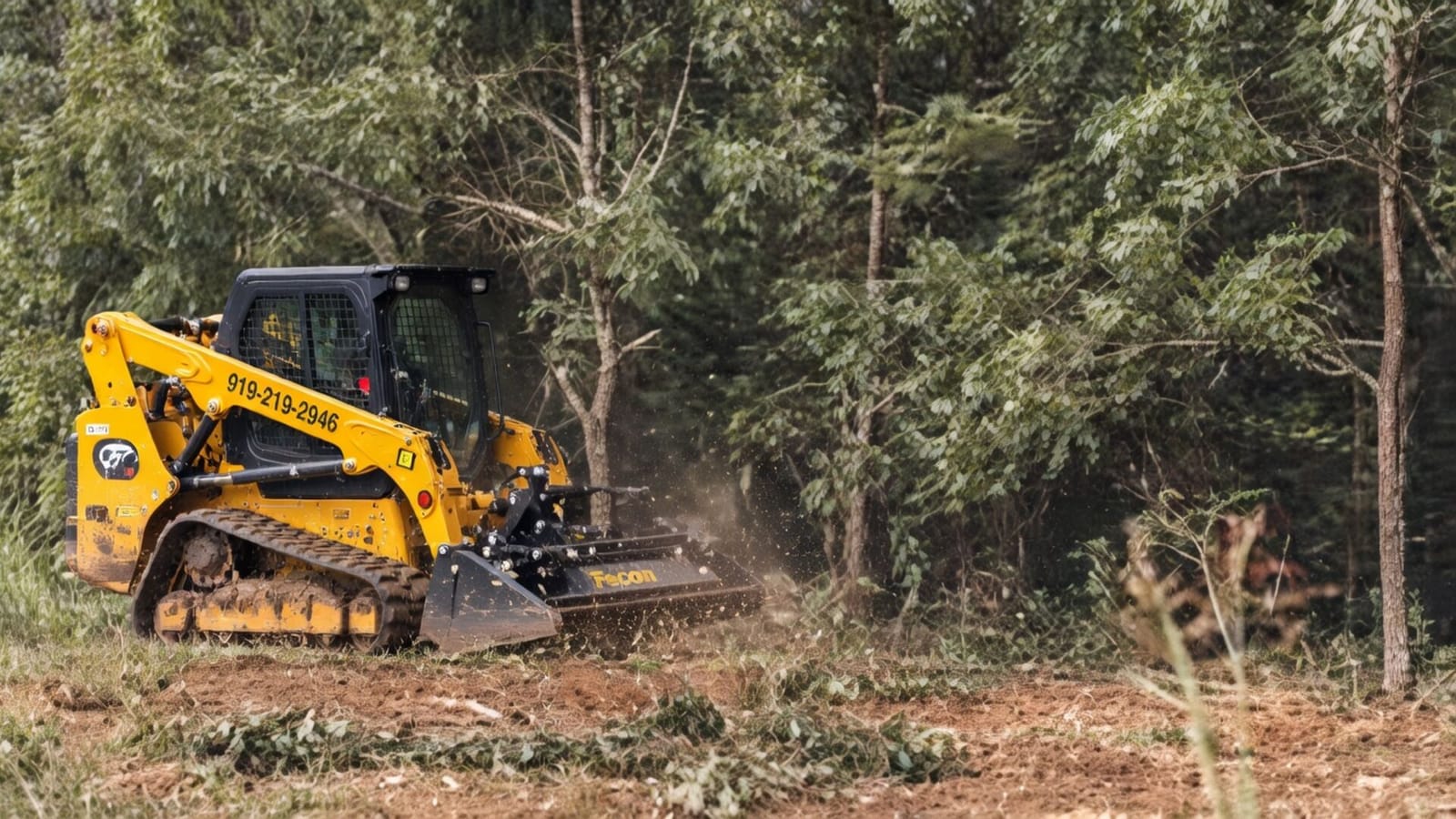
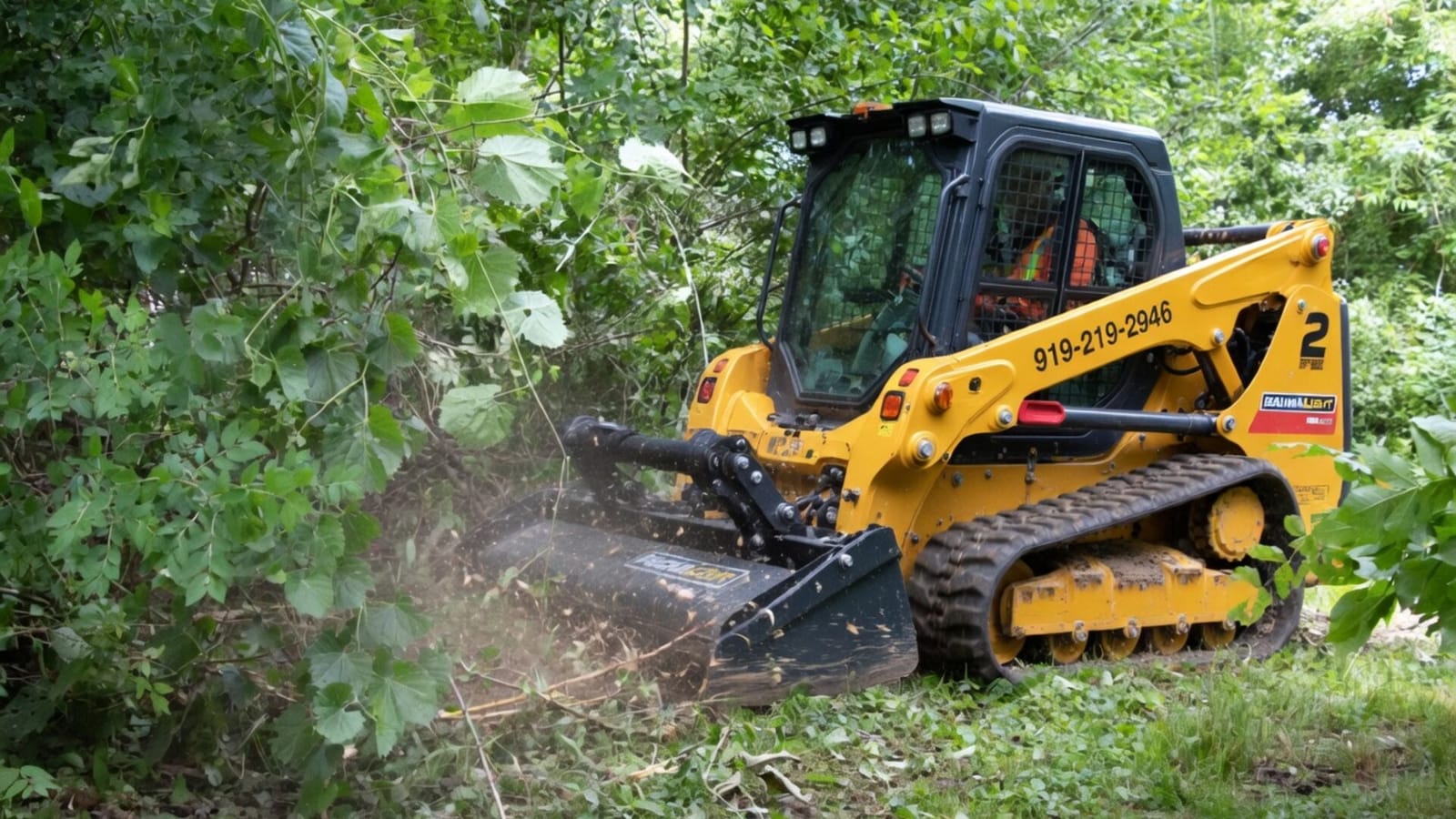
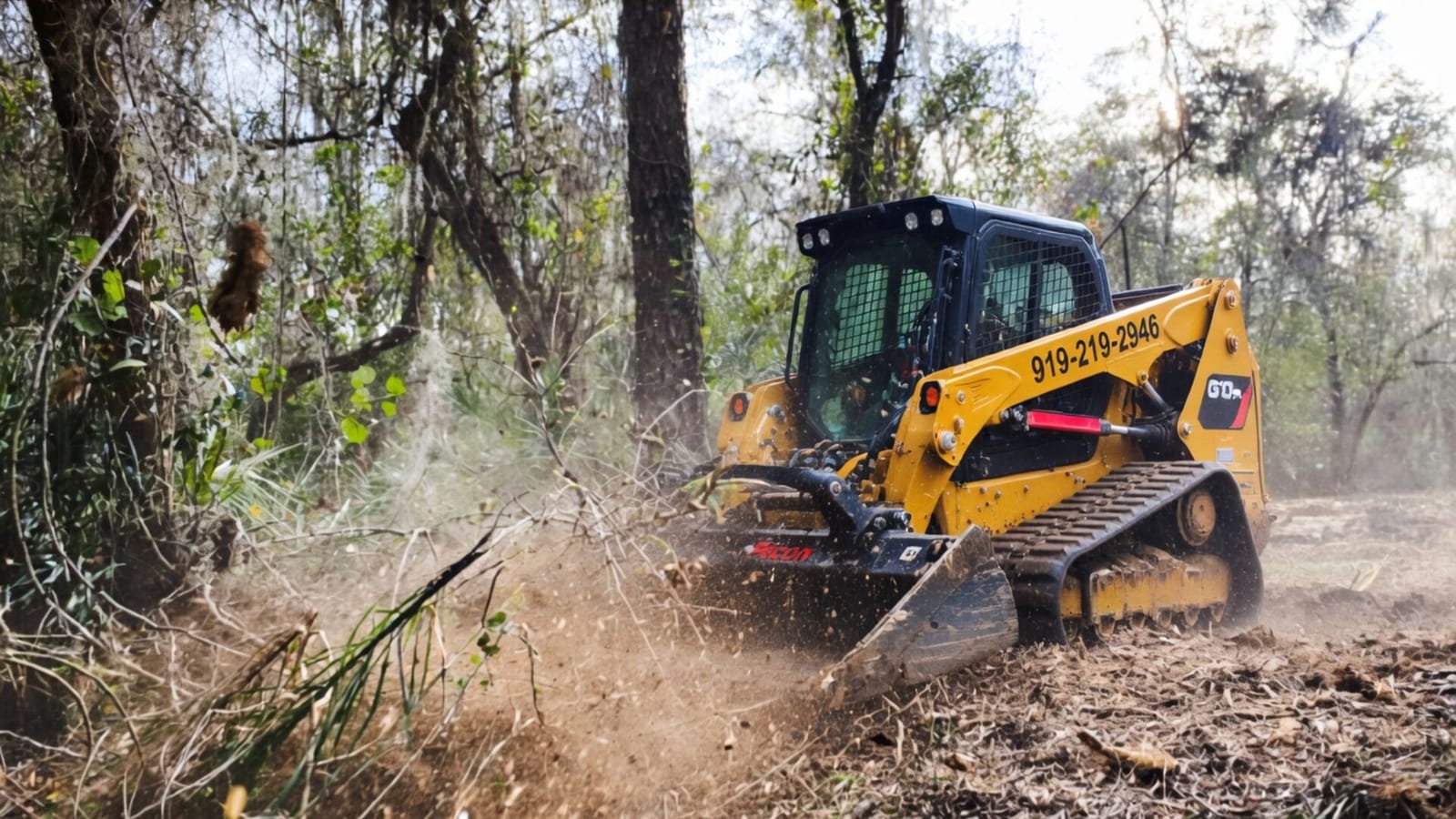
A forestry mulching head takes the understory and smaller regrowth in a single pass and leaves it on the ground as a mat, while the overstory stays untouched. Three reasons that is the right tool here:
It is sized for the material. Understory beneath a canopy is small stuff. The drum handles it efficiently rather than fighting trunks, which is why this work prices toward the bottom of the band at $1,500 to $2,500 per acre rather than the $3,500-plus of clearing a tract to open ground.
It leaves the cover where sandy soil wants it. Sandhill ground stripped bare does not hold well and is not rich to begin with. The mat keeps the surface covered and returns organic matter as it breaks down.
There is no disposal problem. Nothing is stacked, nothing is trucked, no dump fee appears on the invoice.
What You Get Back
Pine ground you can walk, hunt, run a fence through, graze around, or put a building somewhere on. Light reaching the forest floor again, which is generally the point. And a property that looks like managed land rather than a wall of growth, which matters if you ever sell it.
What It Does Not Do
It does not remove stumps or set grade. A building pad cut to grade needs clearing plus dirt work.
It does not stop the understory returning. It will come back, and how fast depends on what is growing and how much light now reaches the floor. A maintenance pass in a few years costs a fraction of the first one. Where the goal is permanently open ground rather than periodically opened ground, that takes a programme rather than a pass, and it is worth saying so up front.
The Bottom Is a Different Job
If your tract runs down to a creek, the hardwood floodplain there is not the same work as the sandy upland. Those bottoms hold water, slow a tracked machine considerably, and want better timing rather than a heavier pass. On a tract spanning both, we treat them separately and say plainly which parts are worth waiting for a drier window.
Do Not Forget the Acreage Tiers
Method does not change what the state asks. South Carolina gates land disturbance by acreage: under an acre in a non-coastal county is a notification form and an exemption letter; one to two acres requires Construction General Permit coverage before any land disturbing activity begins, plus a simplified plan and a SWPPP; above two acres is another tier. Anything inside a larger common plan of development or sale needs the full notice of intent regardless of size.
Our South Carolina land disturbance guide covers the detail, and the statewide cost guide covers pricing across the state.
Why Now
South Carolina’s population grew faster than any other state in 2025, as it did in 2024. Richland County sits near 434,956 residents, and Lexington County added roughly 3,500 people between 2024 and 2025 to reach about 317,588. North of the city, the Scout Motors plant at Blythewood represents a $2 billion investment with the potential for 4,000 or more permanent jobs, and development interest has followed it.
Ground that sat unmanaged for two decades is suddenly worth looking at again.
If you have pine ground closing in anywhere around Columbia, Blythewood, Lexington, Chapin, or Camden, the walk-through is free and we will tell you what opening it costs and how often it will want doing again.
Related Services
Learn more about the services mentioned in this article.


More from the Cut Brush Blog
Keep reading for more tips and guides on land clearing.
 Cost Guide
 Forestry Mulching Cost in Columbia, SC (2026 Pricing)
Forestry mulching cost in Columbia runs $1,500 to $4,000 per acre, with understory work under pine at the lower end. What drives the hours in the Midlands.
 Guide
Guide Bamboo Removal in Columbia, SC: Stop Running Bamboo
Bamboo removal in Columbia, SC fails when only the canes come down. Learn how rhizomes spread, the order of work that stops a grove, and what it costs.
 Cost Guide
 Underbrush Removal Cost in South Carolina (2026 Guide)
Underbrush removal in South Carolina runs $1,500 to $2,500 an acre with Cut Brush, and the trees you pick stay. See how privet, grand trees and pine move it.
Let's Get Started on Your Land
Request a free quote. We'll contact you to discuss your property, access, and the clearing you need.
Get a Free QuoteOr call us directly: (919) 525-3950