
Underbrush Removal Cost in South Carolina (2026 Guide)
Cut Brush Team · October 9, 2026 · 8 min read

You like your trees. It is everything under them you are tired of: privet you cannot see past, sweetgum whips, vine climbing the pines, a yard that ends in a green wall. Underbrush removal runs $1,500 to $2,500 an acre with Cut Brush in South Carolina, the same band from our Greenville, Columbia and Charleston crews, and every tree you mark for keeping stays standing.
At a glance:
- $1,500 to $2,500 an acre at all three markets, with a floor near $1,500 on a small lot.
- Taking the small trees as well turns the job into forestry mulching, $1,500 to $4,000 an acre.
- Charleston County grand trees are any tree 24 inches across at 4.5 feet, pine and sweetgum excepted, and taking three or more limbs of 6 inches or more off one needs a Zoning Permit.
- 100 feet around the house is where the SC Forestry Commission’s home checklist says to remove dense vegetation.
- Pine thinning cost share under the Southern Pine Beetle program pays 60 percent of a qualifying pre-commercial thinning, up to $127 an acre.
Our Greenville crew works the Upstate, Columbia the Midlands and Charleston the Lowcountry. Every quote starts with a free walk through the woods, where we flag your keepers with you before a machine is booked.
How Much Does Underbrush Removal Cost in South Carolina?
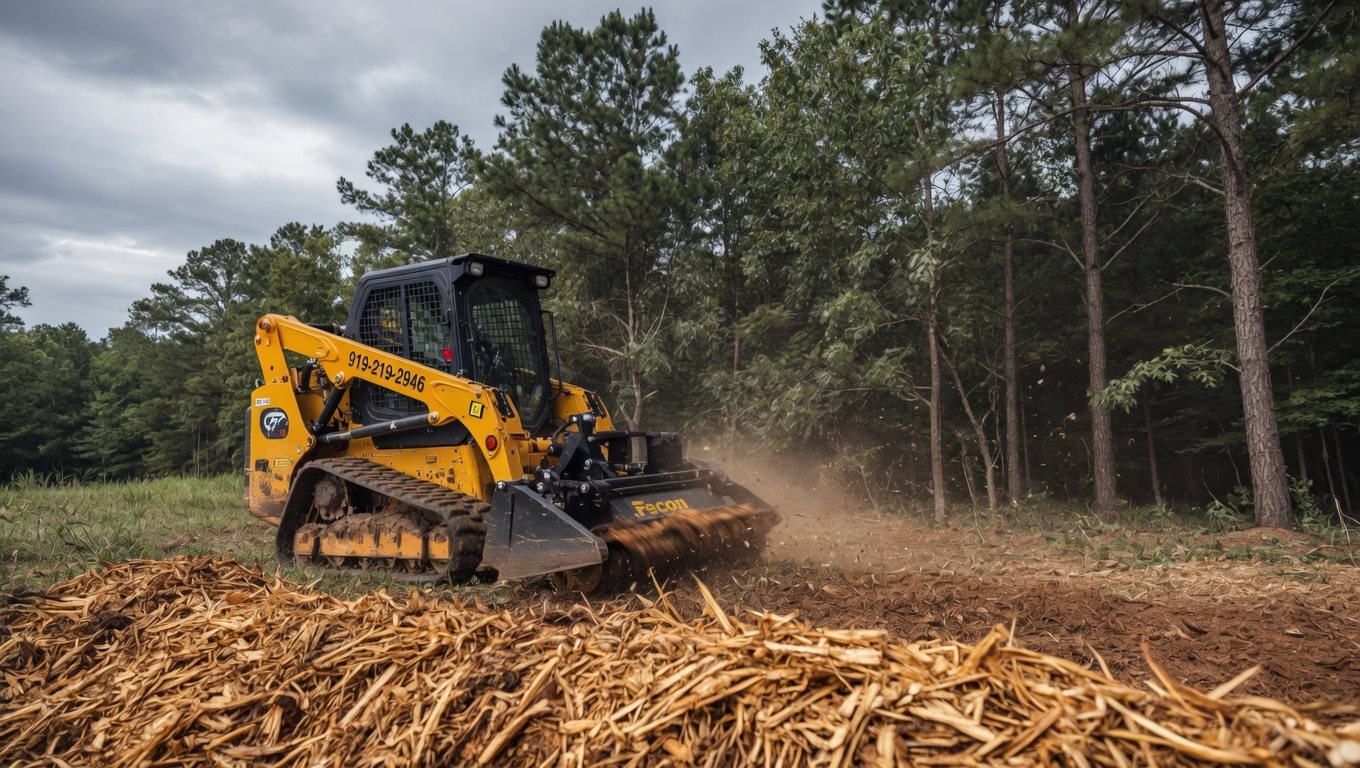
Underbrushing means our tracked mulcher works beneath standing trees and grinds the shrub layer, vines and saplings into chips that stay on the floor. The trunks you keep are never touched. What sets the price is how thick that layer is and how many keepers the machine has to steer around.
| Under your trees today | What we charge per acre | What you see when we finish |
|---|---|---|
| Privet, vine and sweetgum whips beneath pine or hardwood | $1,500 – $2,500 | Clear sight lines through the woods, a layer of chips on the ground |
| Planted pine that has closed in underneath | $1,500 – $2,500 | Rows you can walk again, thinned where you and your forester want |
| A half acre of brush behind the house | Near the $1,500 floor | The same trip for the machine as a full acre |
| The shrub layer plus small trees you do not want | $1,500 – $4,000 | Only the trees you flagged left standing |
Where these numbers come from. The bands are the published rows on our Greenville, Columbia and Charleston pricing pages. Columbia calls the understory row Underbrush & Pine Thinning; Greenville and Charleston call it Regrowth & Understory Work. Same work, same $1,500 to $2,500. Clearing a tract outright, trees and all, is a different job on its own row at $1,500 to $4,500 an acre.
What Changes the Price Under South Carolina Trees
Privet that comes back from its roots. Clemson’s Home and Garden Information Center calls Chinese privet an aggressive and troublesome shrub that spreads by root sprouts from rhizomes as well as by seed, and the SC Exotic Pest Plant Council lists it as a severe threat that forms thickets dense enough to choke out native plants. A privet floor prices toward the top of the band, and we will tell you plainly that it will try to come back. Spraying the sprouts is a licensed applicator’s job on a separate bill; our crews use machines only.
How many keepers, and how big. Every tree that stays is a trunk the head works around. Charleston County warns that roots suffer from compaction, digging and fill, and a hurt tree may not die at once but decline over several years. Inside the City of Charleston a 24-inch tree keeps 12 feet clear of land disturbance, plus a foot for every 3 inches beyond, so a 36-inch live oak gets 16 feet. A lot with a keeper every few yards prices above an open pine stand because the work inside those circles is slower.
Low limbs as well as low brush. Owners often want the canopy lifted while the floor is opened. On a Charleston County grand tree, removing three or more limbs of 6 inches or more, or thinning over a quarter of the leaf surface, needs a Zoning Permit. We open the floor; pruning a protected tree is work for a qualified tree service.
Pine density. Much Midlands woodland is planted loblolly that has closed in, which is why Columbia’s row names pine thinning. The Forestry Commission’s Southern Pine Beetle program cost-shares pre-commercial thinning in stands at least four years old with 700 or more pine stems an acre, thinned to about 545, roughly a 9-by-9-foot spacing. It pays 60 percent of cost up to $127 an acre for a heavy thinning and $30 for a light one.
Fire risk around the house. The Forestry Commission has assessed more than 1,300 South Carolina communities for wildfire and rated almost 642 at high to extreme risk. Its checklist asks owners to clear dense vegetation within 100 feet of the house and to strip vines and low branches. That ring is exactly the ground an understory pass opens.
Pro tip: If you own a pine stand of a few acres or more, call your county Forestry Commission project forester before you call us. The beetle program will not pay for work started before your application is approved, and the forester’s stem count tells you whether you need a thinning, an understory pass or both.
Underbrush Removal Across South Carolina
The Upstate: Greenville, Travelers Rest, Easley and Spartanburg. Pine and mixed hardwood on Pacolet slopes of 15 to 25 percent, where the Foothills take 60 inches of rain or more a year. On a grade we leave the chips down as cover, and wet weeks slow us. Paris Mountain, just north of Greenville, has its own Community Wildfire Protection Plan. Our Upstate steep ground guide covers working on a hillside.
The Midlands and Sandhills: Columbia, Lexington, Chapin and Camden. Planted pine with a decade of brush beneath it, and on deep Lakeland sand the native turkey, blackjack and post oak coming back under scattered longleaf. Firm sand lets the machine keep moving, so stem count, not weather, decides the bill. Our Midlands pine understory guide goes through a typical job.
The Lowcountry: Mount Pleasant, Summerville, Johns Island and Moncks Corner. On the drier Wando terraces, the layer under loblolly, longleaf and live oak is yaupon, wax myrtle, American beautyberry, redbay and young red maple. On wet Yonges flats it is sweetgum, water oak and a tangle of shrubs and vines. Grand trees and marsh buffers decide where the machine may go, and our Charleston permit guide sets them out.
Tree Rules and Wildfire Help in South Carolina
Charleston County. A grand tree cannot come down without a Grand Tree Removal Permit, granted when the tree is dead, diseased, dying or a hazard, or otherwise by the Board of Zoning Appeals on hardship. On uses other than single-family homes every tree of 8 inches or more is protected, and the county wants a Zoning Permit before any property is cleared for development.
City of Charleston. On single-family and duplex lots, trees under 24 inches need no removal permit. Commercial lots, buildings of three or more units and residential lots of an acre or more must keep 15 protected trees per acre, and no tree in an OCRM critical line buffer may come out. On a development site, grand trees sit behind a barrier at least 4 feet high.
The Upstate and the Midlands. We do not list city or county tree rules for Greenville, Spartanburg, Columbia or Lexington here. Check with your city or county before any tree larger than understory comes down.
Wildfire grants and cost share. The Forestry Commission’s Community WUI Mitigation Grants fund fuels reduction for neighborhoods working with it, so an HOA with a shared wooded buffer should ask before paying for the work itself. Beetle program money goes to you after the forester checks the work, and you pay the contractor.
Frequently Asked Questions
How much does it cost to clear underbrush on one acre in South Carolina?
With Cut Brush, $1,500 to $2,500, though one acre on its own usually lands near the $1,500 floor. Dense privet around many trees you are keeping pushes it up the band.
Do I need a permit to clear underbrush around Charleston?
Usually not for the brush itself, but the trees around it are another matter. A grand tree cannot come down without a permit, heavy pruning of one needs a county Zoning Permit, and clearing for development starts with a Zoning Permit. Inside the city, stay out of the critical line buffer.
Will underbrushing hurt my live oaks?
Not if the crew respects the root zone. We flag keepers with you, keep tracks out of the clearance circle where we can, and leave the chips as a cushion over the roots.
Does South Carolina pay for thinning pine?
Sometimes. The Southern Pine Beetle program pays 60 percent of a qualifying pre-commercial thinning, up to $127 an acre, on stands at least four years old. Apply through your county project forester and wait for approval before any work starts.
Is underbrushing the same as brush hogging?
No. Brush hogging is mowing open ground with a rotary cutter that rides up over anything woody. Underbrushing works beneath standing trees and grinds the shrubs and saplings there. Open pasture is priced in our South Carolina brush hogging cost guide.
Get an Underbrush Removal Quote in South Carolina
Pick your nearest South Carolina area below and request a free quote. Our crew will contact you to talk through the thickest brush, the way a trailer would come in, the trees you want to keep, whether the land is inside Charleston city or county limits, and how open you want the floor, from park-like to a light pass. Then we will set up the walk-through. Taking the small trees too? Our South Carolina forestry mulching cost guide prices that.
Woods across the state line? See our Georgia underbrush removal cost guide.
Sources
More from the Cut Brush Blog
Keep reading for more tips and guides on land clearing.
 Cost Guide
Forestry Mulching Cost in Greenville, SC (2026)
Forestry mulching around Greenville runs $1,500 to $4,000 per acre. Here is what grade, stem size and Upstate rainfall do to the hours on your tract.
 Guide
Kudzu Removal in South Carolina: Cost and Control Plan
Kudzu removal in South Carolina needs a plan, not one mowing. See how the vine regrows, the multi-visit plan that kills the crowns, and the cost per acre.
 Cost Guide
Land Clearing Cost Per Acre in South Carolina (2026 Guide)
Land clearing cost per acre in South Carolina runs $1,500 to $4,500. What sandhill ground, pine stands and the state's acreage permit tiers do to a quote.
Comparing states? See land clearing costs by state.
Let's Get Started on Your Land
Request a free quote. We'll contact you to discuss your property, access, and the clearing you need.
Get a Free QuoteOr call us directly: (919) 525-3950