
Bamboo Removal in Columbia, SC: Stop Running Bamboo
Cut Brush Team · October 1, 2026 · 8 min read

Someone planted it as a screen along the back line, back when the street was new. Now the grove is thirty feet tall, the shoots are coming up in the middle of the lawn and under the deck, and the neighbor has started asking pointed questions about the canes in their flower bed. Bamboo removal in Columbia, SC is one of the most misunderstood jobs in land clearing, because what you can see is not what is spreading.
Columbia’s older neighborhoods and first-ring suburbs are full of groves like this, and every sale, teardown and lot split turns one up. This guide explains why running bamboo is so hard to stop, the order of work that does stop it, how property lines and creeks change the job, and what removal costs in the Midlands.
Why Is Running Bamboo So Hard to Get Rid Of?
Because it is officially one of South Carolina’s worst invaders, and it earned the title. Clemson’s Home and Garden Information Center reports that “the South Carolina Exotic Plant Pest Council lists golden or fishpole bamboo (Phyllostachys aurea) as a severe environmental threat.” Clemson also tells homeowners to expect a long fight: “Homeowners with bamboo infestations must be patient, as this weed requires an intensive control program over several years.”
Running bamboos spread by underground stems called rhizomes. UGA Extension in neighboring Georgia notes that “rhizomes grow up to 5 feet a year and groves can double in size every year.” The Midlands’ long, hot growing season gives a grove the whole of spring and summer to run.
The Rhizome Problem: Why Cutting Canes Changes Nothing
Every cane is a shoot off an underground stem. Cutting canes is like mowing a lawn and expecting the grass to die. The rhizomes hold the energy, push sideways under fences, walks and slabs, and send up new shoots wherever they find light.
They also travel farther than anyone expects. Clemson warns that rhizomes “can spread more than 100 feet from the mother plant.” The shoots in the middle of the lawn are fed by the grove at the back.
The weak point is depth. Clemson says the rhizomes are “shallow, growing less than one foot deep in the soil,” and UGA puts nearly all of them within 6 to 18 inches of the surface. Everything that matters is within reach of a machine, and of a determined mowing schedule.
What Is the Right Order for Running Bamboo Removal?
Clear the grove, then starve what is left underground. Skip the second step and the grove comes back. The sequence Cut Brush quotes:
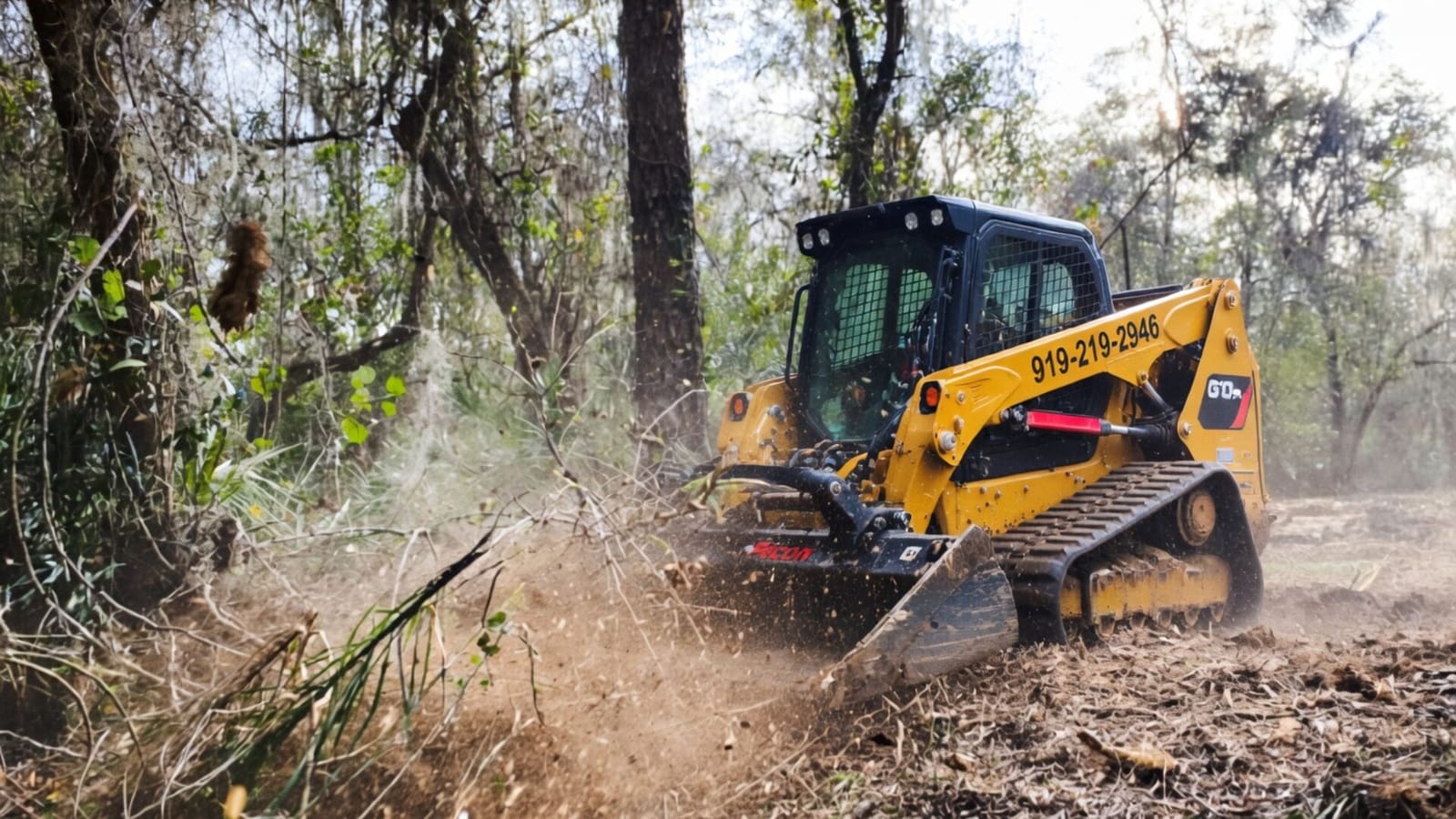
- Mulch the grove to the ground. A forestry mulching machine grinds mature canes, leaf litter and the brush that grew up inside the stand into a chip layer in a few hours. Nothing has to be hauled, and nothing is left piled for the canes to root through.
- Map the spread. With the canes gone, the first new shoots show the true edge of the rhizome mat, which is usually well past the old screen.
- Cut every new shoot, every time. Shoots that are cut at the soil line before they leaf out drain the rhizomes; shoots left standing feed them. Clemson notes that “two to three years of regular mowing are often needed to see results.”
- Decide on containment. If part of the grove is on a neighbor’s side and staying there, a barrier along the line keeps it from coming back.
The knockdown makes the yard usable. The follow-up visits are what keep it that way, so they are scheduled in the quote from the start.
Cut Brush does mechanical work only and applies no herbicide. If you want chemical treatment of the regrowth, a licensed applicator can be scheduled between visits.
Pro tip: Before anyone quotes the job, flag the farthest shoot you can find in every direction. The flags show the real size of the grove, and they keep a quote from covering only the part you can see.
Property Lines, Creeks and the Neighbor’s Grove
Most Midlands bamboo jobs end at a fence, a creek or both.
When the grove is next door. You can clear and control your side, but rhizomes will keep crossing from an untreated grove. The lasting answer is a shared plan with the neighbor or a barrier along the line. Clemson’s guidance is that a barrier of concrete, metal, high density polyethylene or pressure-treated wood “installed about 18 inches deep has proven to be effective”; UGA recommends a trench “approximately 36 inches deep” with the barrier left “about 2 inches” above the soil. On a property line, the deeper figure is the safer one.
When the grove runs to a creek. Clearing near water is where rules start to apply, and they vary by city, county and parcel. Check with the local office before any machine works a creek bank, and expect a lighter touch at the water’s edge than on the open lot above it.
When the cleared area is large. South Carolina regulates land disturbance by acreage, and the tiers start lower than most people expect. Under an acre, SCDES asks for a notification form and issues a letter of exemption. Our Midlands acreage tier guide covers the rest.
What Does Bamboo Removal Cost in Columbia, SC?
Most Columbia bamboo knockdowns start near $1,500, the practical project floor for getting equipment to the site, and larger stands price by the acre. These figures come from our Columbia pricing page:
| Job | Typical Columbia range | Notes |
|---|---|---|
| Backyard grove, under a quarter acre | Starts near $1,500 | The project floor applies to small stands |
| Larger stand mixed with brush | $1,500 – $2,500 per acre | The brush and understory band |
| Dense, mature grove on acreage | $1,500 – $4,000 per acre | The forestry mulching band; heavy canes price toward the top |
| Follow-up shoot cutting | Priced per visit | Scheduled over two to three seasons |
| Rhizome barrier or excavation | Separate trade | Quoted by an excavation or landscape contractor |
Access moves the price more than square footage. A grove behind an open gate on a Lexington County lot clears in a morning; the same grove wedged between a shed, a fence and a drainage ditch on a tight in-town lot takes longer. For mulching prices in general, see our Columbia forestry mulching cost breakdown.
When Excavation Beats Starving It Out
Draining the rhizomes works, but it takes seasons. Two cases call for digging instead.
Re-landscaping this year. If the ground is getting a new lawn, patio or garden right away, lifting the rhizome mat is faster than waiting it out. With the mat in the top foot or so, a small excavator can reach it, though the soil and rhizomes have to go somewhere.
Holding a line you do not control. If the grove is the neighbor’s and will stay, a barrier is the only lasting fix on your side.
For most Midlands yards, the order stays the same: clear the canes, drain the rhizomes, and add a barrier only where a grove you do not control will keep pushing. If your property also has a white stripe of wild pear along the back fence every March, our South Carolina Bradford pear guide covers that job.
Frequently Asked Questions
Will bamboo die if I keep mowing it?
It can be brought under control that way, if every new shoot is cut before it leafs out, for two to three seasons, with no shoots left standing anywhere in the network. Mowing the lawn edge while the grove stays up does nothing.
How far do bamboo rhizomes spread?
Clemson says more than 100 feet from the original plant, and UGA says up to five feet a year. The shoots in the middle of the lawn are almost always connected to the grove.
How much does bamboo removal cost in Columbia, SC?
Small backyard groves start near the $1,500 project floor. Larger stands price at $1,500 to $2,500 per acre with brush, or $1,500 to $4,000 per acre for dense mature canes, with follow-up visits priced separately.
Does forestry mulching kill bamboo?
Not on its own. It removes every cane and makes the ground workable, but the rhizomes survive. The follow-up shoot cutting is what depletes the rhizomes and brings the grove under control, so the two are quoted together.
How deep should a bamboo barrier be?
Clemson cites about 18 inches as effective; UGA recommends a trench of about 36 inches with the barrier sticking up about 2 inches. On a property line, go deeper.
Is bamboo invasive in South Carolina?
Yes. The state’s exotic plant council lists golden bamboo as a severe environmental threat, according to Clemson.
Get Your Midlands Yard Back From Bamboo
Whether the grove is crowding a back fence in Irmo, swallowing the edge of a lot in Lexington or creeping toward the house in Blythewood, it gets bigger every season. Cut Brush quotes bamboo removal across the Columbia area the way the plant requires: a mulching knockdown, a map of the spread, and a written schedule of follow-up visits, priced together before any work starts.
Compare the ranges on the Columbia pricing page, read about our work on the Columbia land clearing page, then request a free estimate. If what you need is excavation or a barrier rather than clearing, we will say so.
Related Services
Learn more about the services mentioned in this article.


More from the Cut Brush Blog
Keep reading for more tips and guides on land clearing.
 Guide
Opening Up Pine Ground in the Midlands Sandhills
Most Midlands acreage is pine with an understory closed in beneath it. What it takes to open the floor without touching the stand, and what it costs per acre.
 Guide
Bradford Pear Removal in South Carolina: Bounty and Costs
Bradford pear removal in South Carolina: how the bounty exchange works, why wild callery pear thickets spread, and what clearing them costs per acre.
Guide Kudzu Removal in South Carolina: Cost and Control Plan
Kudzu removal in South Carolina needs a plan, not one mowing. See how the vine regrows, the multi-visit plan that kills the crowns, and the cost per acre.
Let's Get Started on Your Land
Request a free quote. We'll contact you to discuss your property, access, and the clearing you need.
Get a Free QuoteOr call us directly: (919) 525-3950