
Forestry Mulching Cost in South Carolina (2026 Guide)
Cut Brush Team · October 9, 2026 · 9 min read

Your South Carolina land has closed in: wax myrtle and tallow on a Lowcountry lot, oak sprouts under the Midlands pines, or an Upstate hillside you can no longer walk across. You want it open without a burn pile or a convoy of dump trucks. Forestry mulching runs $1,500 to $4,000 an acre with Cut Brush, and that is the band our crews in Charleston, Columbia and Greenville quote across the state.
At a glance:
- $1,500 to $4,000 an acre at all three of our South Carolina markets, with a working floor near $1,500 on a small job.
- Keeping the trees? Clearing only the layer under them is a lighter row at $1,500 to $2,500 an acre.
- A burn pile is not free. Under SCDES Regulation 61-62.2, a land clearing fire is allowed only outside predominantly residential areas and at least 1,000 feet from public roads and from homes and businesses off your property.
- Outside town and city limits, the SC Forestry Commission must hear from you before every day you burn.
- Replanting pine? The Forest Renewal Program repays 40 percent of mechanical site prep, up to $67 an acre for light work and $143 for medium or heavy.
Our crews cover the Lowcountry from Charleston, the Midlands from Columbia and the Upstate from Greenville. Pick the nearest of the three at the bottom of this page and we will walk your land for free and hand you one written price.
How Much Does Forestry Mulching Cost in South Carolina?
We price a mulching job on two things: what is growing on the acre now, and how open you want it when our machine leaves.
| What is growing on the acre | Cut Brush price per acre | How the ground looks afterward |
|---|---|---|
| Shrubs and vine beneath pine or oak that stays | $1,500 – $2,500 | Trunks left alone, the floor opened up, chips underfoot |
| A recently thinned pine flat or a few years of light regrowth | $1,500 – $4,000, near the floor | One quick pass, a thin mat of chips |
| A dozen years of tallow and wax myrtle over the ground | $1,500 – $4,000, toward the ceiling | Every stem ground, stumps flush, a thick mat left as cover |
| Real timber on a tract you want fully opened | $1,500 – $4,500 | Finished to whatever ending the written quote names |
Where these numbers come from. Every band is copied from our own pricing pages for Charleston, Columbia and Greenville, and all three publish identical rows, so a Sandhills acre and a coastal acre start from the same range. Half an acre does not cost half as much: the tracked machine rides the same trailer to your gate either way, which is why a small job settles near $1,500. Whole-tract clearing has its own guide, our South Carolina land clearing cost per acre guide.
What Is Forestry Mulching?
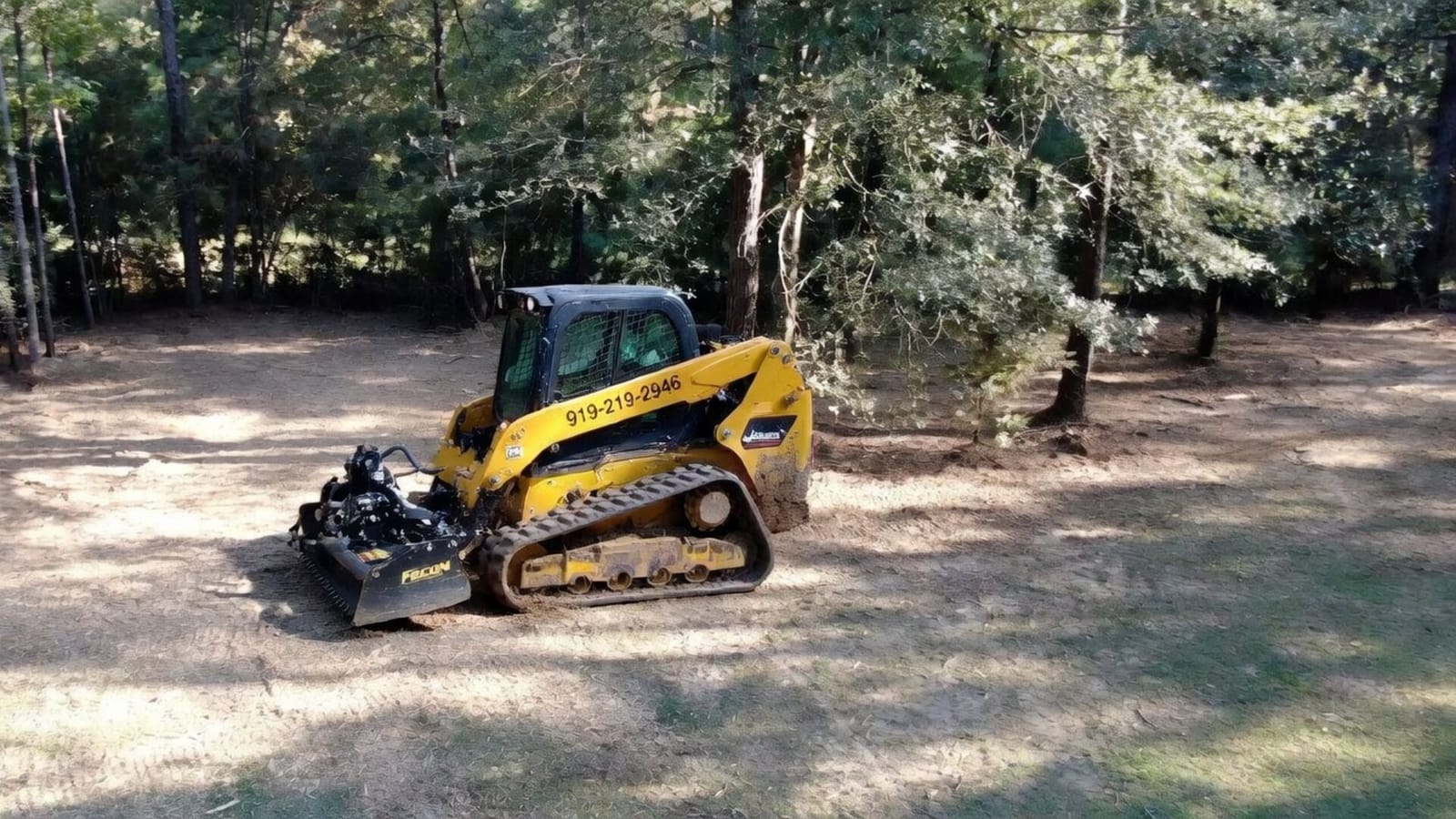
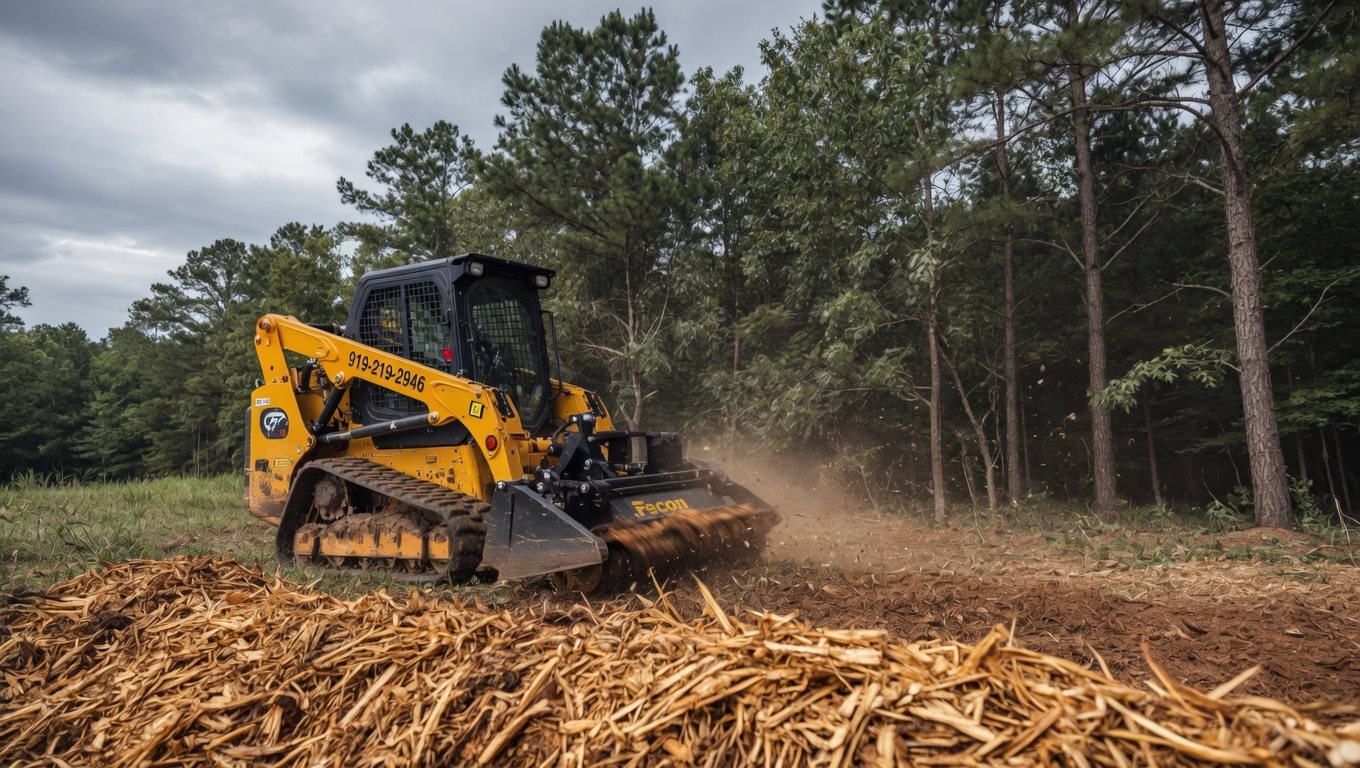
It is one tracked machine with a spinning drum head. It walks into the brush and turns standing stems, vines and small trees into chips right where they grew. Nothing gets pushed into windrows, loaded or trucked away. Stumps are cut flush and stay in the ground, and the chips stay down as a mat.
On an Upstate slope that mat is the cover between our exit and the first green-up. What mulching does not do is grade: you get open, walkable ground, not a building pad.
What Changes the Price of a South Carolina Mulching Job
How long the land has been let go. The first question we ask on the phone is what year the mowing or the last cut stopped. Four or five years of light stems lets the machine travel. Twelve years, especially with Chinese tallow in the ditches, puts wrist-thick and arm-thick wood in front of the drum and slows every acre.
Tallow that sprouts back. Clemson’s Home and Garden Information Center says a young Chinese tallow can grow 13 feet in a year, a mature tree sets up to 100,000 seeds, and a cut stump throws up sprouts, so one tree becomes several. We grind tallow down, but that is the first pass, not the cure. Clemson names chemical control as the most reliable route, which is a licensed applicator’s job on a separate bill; our crews do not spray.
How wet the ground is, and in which months. Two Lowcountry soils can sit a short walk apart and behave like different jobs. Yonges soils, first described near Hollywood in Charleston County, hold the water table within 10 inches of the surface for about six months of most years. Wando sand on the terraces keeps it 48 to 72 inches down, and only from January to March. Our rate is the same on both, but a soft flat means fewer acres a day, which pushes a tract up its band, so we would rather book wet ground in its dry season.
Slope and rainfall in the Upstate. Pacolet ground, typed in Chester County, commonly runs 15 to 25 percent and can reach 60. The Foothills take 60 to more than 70 inches of rain a year. On a side slope our carrier works shorter lines and turns more often, so an Upstate hillside costs more than the same brush on a creek bottom.
Whether burning was ever on the table. On a five-acre parcel between a county road and a neighbor’s house, the state’s 1,000-foot setback usually rules the pile out, and then the real choice is grinding or hauling. Hauling is the line owners underestimate most.
Pro tip: Before you collect a pile-and-burn quote, open a satellite map and draw a 1,000-foot circle around the spot where the pile would go. If that circle takes in a public road or the house next door, the pile fails the state rule, and the price you need is a mulching price.
Forestry Mulching Costs Across South Carolina
The Fall Line splits the state: about a third is Piedmont above it and two thirds Coastal Plain below.
The Upstate: Greenville, Spartanburg, Anderson and Easley. Pine and mixed hardwood on red clay hillsides. Up here winter is wetter than summer, and wet clay on a grade marks under tracks, so November, one of the state’s two driest months, is often our best month. Slope moves Upstate jobs up the band more than brush does. Our Upstate steep ground guide shows what grade does to the finish.
The Midlands and Sandhills: Columbia, Lexington, Camden and Aiken. The Sandhills follow the Fall Line from near the Edgefield-Aiken line northeast through Lancaster County. Lakeland sand runs past 80 inches deep and drains fast, under blackjack, turkey and post oak with scattered longleaf. Because the sand rarely bogs a carrier, Midlands prices are set by how many stems stand per acre, and planted pine closed in underneath is among our quickest work. Our Midlands pine understory guide walks through a typical job.
The Lowcountry: Charleston, Summerville, Moncks Corner and Walterboro. The Coastal Plain falls toward the ocean only 2 to 3 feet a mile, so rain has nowhere quick to go. Wax myrtle, yaupon and beautyberry fill the drier terraces, tallow takes the ditch banks, and the wet flats decide the calendar. Our wet Lowcountry ground guide goes through the soils parcel by parcel.
Burning Rules and Cost Share in South Carolina
The burn rule and its exception. Regulation 61-62.2 bans open burning except where it lists an exception, and land clearing is one of them. Outside predominantly residential areas, plant material cut on the property may burn if the pile sits at least 1,000 feet from public roads and from homes and businesses off the property, the wind carries smoke away from them, the fire is lit between 9 a.m. and 3 p.m. with nothing added overnight, and no more than two 30-by-30-foot piles burn per six acres at once. Salvageable timber and pulpwood come off first.
Telling the Forestry Commission. Outside town and city limits, next to woods, brush or grassland, state law requires notice to the Forestry Commission before every day you burn land clearing debris, and debris burning is the state’s leading cause of wildfire. Inside town limits that notice does not apply and the local ordinance decides.
The coastal counties. In Beaufort, Berkeley, Charleston, Colleton, Dorchester, Georgetown, Horry and Jasper counties, a job that needs state stormwater coverage also needs a Coastal Zone Consistency determination first, and altering tidelands or other critical areas takes its own permit.
Cost share. Forestry Commission money goes to the landowner after a forester checks the finished work, and nothing may start before the application is approved. If you are replanting pine, call your county project forester before you call us.
Frequently Asked Questions
How much does it cost to mulch one acre in South Carolina?
With Cut Brush, $1,500 to $4,000 an acre, and on a single acre the floor near $1,500 usually sets the price. Light regrowth on Sandhills sand sits low; a decade of tallow on a wet Lowcountry flat sits near the top.
Is mulching cheaper than clearing and burning in South Carolina?
On most homesites, yes, mainly because burning is often not allowed there. The 1,000-foot setback from roads and neighbors rules out a pile on smaller parcels, and trucking brush away costs more than grinding it where it stands.
Will the Forestry Commission pay for part of my mulching?
Only as part of an approved forestry practice. Mechanical site prep for replanting can qualify under the Forest Renewal Program at 40 percent of cost, up to $67 or $143 an acre depending on how heavy the work is. Get approval before any machine arrives.
Does mulching kill Chinese tallow or privet?
No. Both sprout back from roots left in the ground. Mulching opens the stand so a herbicide follow-up from a licensed applicator can reach the sprouts while they are small.
Can I build on mulched ground?
Not as we leave it. Stumps are flush, chips are down and nothing is graded. The pad is your dirt contractor’s work after we hand over, laid out in our South Carolina land clearing and grading cost guide.
Get a Forestry Mulching Quote in South Carolina
Pick the nearest of our three South Carolina areas below and request a free quote. Our crew will contact you to talk through the land, the way in from the road and what you want the ground to look like when we leave, along with roughly when it was last mowed or cut, whether it sits inside town limits, and whether it runs down to marsh. Then we will set up the walk-through.
Land across the state line? See our Georgia forestry mulching cost guide.
Sources
More from the Cut Brush Blog
Keep reading for more tips and guides on land clearing.
 Cost Guide
Forestry Mulching Cost in Charleston, SC (2026)
Forestry mulching around Charleston runs $1,500 to $4,000 per acre. Here is what sets your number, and why the water table matters more than the timber.
 Guide
Clearing Wet Lowcountry Ground Around Charleston
Charleston parcels can differ by four feet of water table across one line. Here is how that changes the season, the machine and the finish on a clearing job.
 Cost Guide
Land Clearing Cost Per Acre in South Carolina (2026 Guide)
Land clearing cost per acre in South Carolina runs $1,500 to $4,500. What sandhill ground, pine stands and the state's acreage permit tiers do to a quote.
Comparing states? See land clearing costs by state.
Let's Get Started on Your Land
Request a free quote. We'll contact you to discuss your property, access, and the clearing you need.
Get a Free QuoteOr call us directly: (919) 525-3950