
Clearing Wet Land in NC: Wetland Rules and Soggy Ground
Cut Brush Team · July 17, 2026 · 8 min read

Under federal rules, cutting vegetation above the ground (mowing, rotary cutting, chainsawing) is not a “discharge” when it neither substantially disturbs the root system nor pushes or drags soil around. Pulling stumps, grubbing or moving soil in a wetland is different: it needs a Corps permit application. Soggy ground is not automatically a wetland, and neither we nor a map decide that. The U.S. Army Corps of Engineers does.
So the order on a wet tract is: find out whether any of it is a jurisdictional wetland, then plan the clearing around the answer.
Can I Clear Underbrush in a Wetland With a Forestry Mulcher?
It is a fair question, and the rule gives a narrower answer than “yes” or “no.”
33 CFR 323.2 carves out activities “that involve only the cutting or removing of vegetation above the ground (e.g., mowing, rotary cutting, and chainsawing) where the activity neither substantially disturbs the root system nor involves mechanized pushing, dragging, or other similar activities that redeposit excavated soil material.” Work that fits that description is not a regulated discharge.
The same section then limits the carve-out. It does not apply to anyone “preparing to undertake mechanized landclearing” in a water of the United States that would redeposit soil, unless that person shows the Corps the work “would not have the effect of destroying or degrading” any area of those waters. The burden sits with whoever runs the machine and whoever hired them.
Three practical points follow for a mulcher:
- A forestry mulcher is not named in the list. Mowing, rotary cutting and chainsawing are. Whether mulching a particular wet area stays inside the carve-out depends on how the work is done and what it does to roots and soil, and the Corps is the one that judges it.
- Wood chips are named as an example of fill material in the same section. Whether chips left on the ground in a wetland count as fill on your site is a question for the Corps before the work, not after.
- Stumps are the line to watch. Pulling stumps or grinding them below ground works the root system, which is the part the carve-out leaves out.
For the permit picture on dry ground, our guide to land clearing permits in Johnston County covers the county side.
Is Every Soggy Spot a Wetland? Who Decides?
No, and the Corps decides. Under 33 CFR 328.3, wetlands are areas “inundated or saturated by surface or ground water at a frequency and duration sufficient to support” a prevalence of plants adapted to saturated soil. Delineators look at three things together: soils, vegetation and hydrology. For federal jurisdiction, a wetland generally has to be adjacent to a covered water, which the rule defines as “having a continuous surface connection.”
So a low spot that holds water after rain may or may not be regulated. The only way to know for sure is a professional wetland determination, and the Corps makes the final call. In North Carolina that is the Corps’ Wilmington District, which works through five field offices.
What North Carolina adds:
- Soil disturbance needs a federal permit application. Any disturbance to the soil or flow of water in a wetland requires an application for a Section 404 permit with the Corps.
- State permits follow the federal answer. Where an Approved Jurisdictional Determination confirms the wetlands on a property are not federal, the state’s isolated and non-jurisdictional wetland permits are not needed.
- Maps screen; they do not decide. The National Wetlands Inventory mapper is not meant to show the presence, absence or extent of wetlands covered by any law.
Pro tip: If a determination comes back, ask for it in writing as an Approved Jurisdictional Determination. That is the document that settles whether the state’s own wetland permits apply.
One more trap: clearing for pasture, timber or crops does not make it exempt. Under 33 CFR 323.4, activities “which bring an area into farming, silviculture, or ranching use are not part of an established operation.” Opening a grown-up bottom for a new use is that kind of activity.
What the Rules Cover, Side by Side
| Work on wet ground | What the rule text covers |
|---|---|
| Mowing, rotary cutting, chainsawing above ground | Not a discharge if roots are not substantially disturbed and soil is not pushed or dragged (33 CFR 323.2) |
| Mechanized landclearing that redeposits soil in a wetland | Carve-out does not apply unless you show the Corps no wetland is destroyed or degraded |
| Any soil disturbance in a wetland | Section 404 permit application with the Corps |
| Neuse buffer, Zone 2 (outer 20 feet) | Periodic mowing and harvesting of plant products is deemed allowable, in Zone 2 only |
| Neuse buffer, Zone 1 (first 30 feet) | Removing woody vegetation is allowable with mitigation upon authorization |
Can I Clear All the Way to the Creek?
In the Neuse basin, usually not without more paperwork. The 50 feet beside a mapped stream is a protected riparian buffer in two zones, and wetlands inside that strip fall under a separate state rule. Johnston County administers the buffer only in unincorporated areas outside towns and their ETJs, so inside Smithfield, Selma, Four Oaks or Princeton the county is not the office to ask. Our Neuse River buffer guide walks through both zones, the authorization process and what counts as an existing lawn.
When we quote a creek bottom, we leave the buffer strip out of the scope until the buffer question has an answer, and we will not clear inside a buffer without the authorization the rule requires.
When Is a Creek Bottom Firm Enough to Clear?
For most land, the best time of year to clear in NC is November through March: firm upland, dormant growth and leafless brush. Creek bottoms are the exception, because those same months are when their water table is highest.
Two flood plain soils found in North Carolina show it. The Chewacla series, somewhat poorly drained, has its seasonal high water table 6 to 24 inches below the surface from November to April. Wehadkee, poorly and very poorly drained and first described in Johnston County, carries a seasonal high water table within a foot of the surface from November to May.
So a bottom can stay soft long after the ridge above it has firmed up. Late summer is no sure thing either: the Atlantic hurricane season peaks on September 10, with most activity between mid-August and mid-October, and one tropical system can put the water right back.
That is why we schedule bottom work by the ground, not the calendar. Before we quote, we walk the low ground and look at where water stands and how the soil takes a boot. On the job, we stop when the tracks start to rut. Poorly planned forest work damages soil mainly through rutting, and fine-textured, wet soil under frequent heavy traffic is the most susceptible.
Why Tracks Matter on Soft Ground
Wheeled machines typically put more pressure on the ground than tracked ones, and some rubber-tracked machines run around 2 to 3 psi. Ground pressure alone does not tell you how much a soil will compact, though, so the machine is only half of it; timing and the number of passes are the other half.
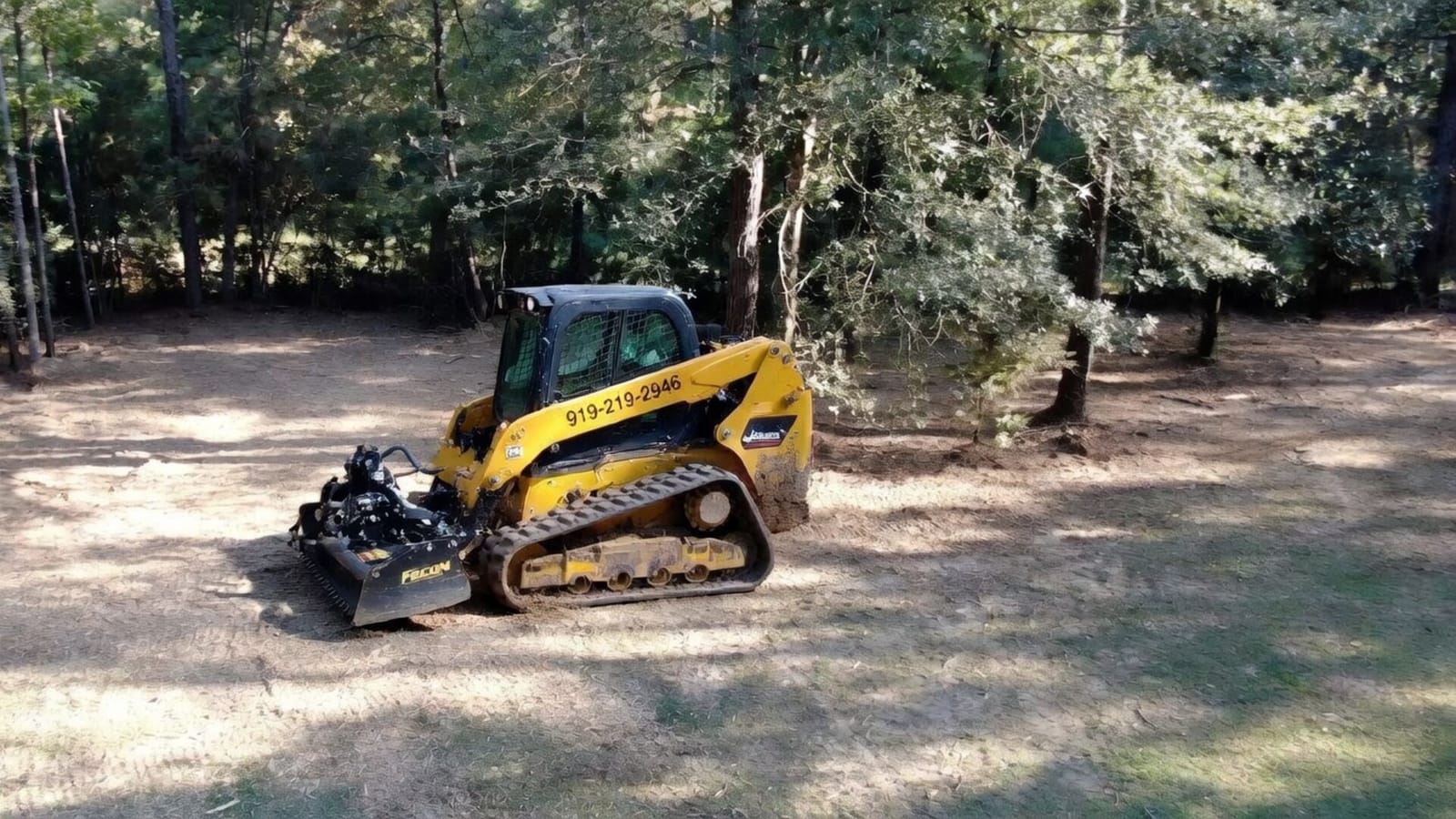
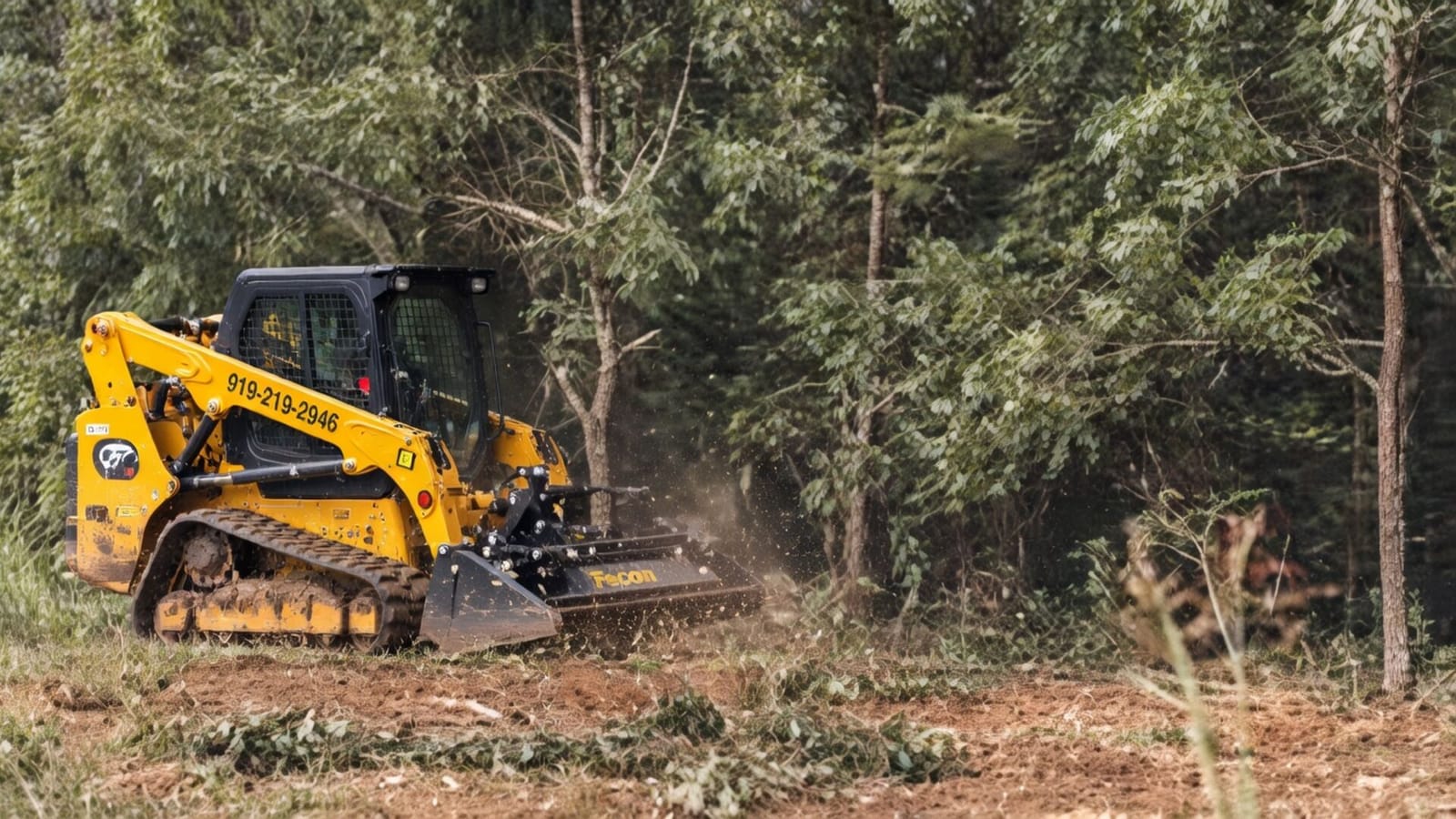
Our forestry mulching is done with a rubber-tracked machine that grinds brush where it stands. There are no burn piles to build and no trucks hauling debris across soft ground, which keeps the passes down. Our mulching vs bulldozer comparison covers why a dozer and haul trucks are harder on a wet site.
What We Do Not Do on Wet Ground
- We do not decide whether ground is a wetland, and we do not file Corps or DWR permits. You or your environmental consultant handle the determination and any application.
- We do not grade, regrade, cut swales or dig ditches. Fixing ruts, crowning a path or improving drainage is work for your grading contractor, and in a wetland any soil disturbance goes to the Corps first.
- We do not guess. If part of the tract might be a wetland, we quote the parts that are settled and wait for the Corps on the rest.
If a low spot holds water most of the year and you are thinking about a pond instead, our guide to clearing land for a pond in NC covers that route.
How Much Does Clearing Wet Ground Cost?
Forestry mulching starts around $1,500 an acre, and most residential clearing in Central North Carolina falls between $1,500 and $4,500 an acre. Wet or soft soil slows the equipment and pushes a job toward the higher end of a range. Our pricing page lists starting prices by service, and the land clearing cost per acre guide explains what moves the number.
Frequently Asked Questions
How do I know if I need a permit just to cut trees and mow a wet area?
Start with whether any of it is a wetland, which takes a professional determination and the Corps’ final call. If it is, the federal rule treats above-ground cutting that leaves roots and soil alone differently from work that disturbs them. We will not tell you which side your job falls on; the Corps will.
How much standing water can a machine handle?
There is no set depth. We judge it on the ground, and we stop when the machine starts to rut, because ruts on wet, fine soil are what damage a bottom.
Get a Free Quote for Your Wet Ground
Request a free quote and our crew will contact you to talk through the property, the access and the clearing you need, including which parts are ready to clear and which wait on the Corps or DWR. You can also call us at (919) 525-3950.
Related Services
Learn more about the services mentioned in this article.


Serving These Areas
We provide land clearing services in these towns and surrounding areas.
More from the Cut Brush Blog
Keep reading for more tips and guides on land clearing.
 Guide
Guide Clearing Land for a Mobile Home in NC: Septic and Pad Rules
Clear only for access before the septic evaluation, then clear the home site with stumps and sod out of footing areas. NC order of work, rules and costs.
 Guide
Guide Selling Timber Before Land Clearing in NC: Bids & Cleanup
Sell timber before clearing only if the stand is merchantable and big enough for a logger. What to put in the contract on stumps and tops, plus the permit trap.
Guide Permit to Clear Land in Johnston County NC: Offices, Fees
An acre or more of clearing in Johnston County NC needs an approved erosion plan first. Which office reviews your address, the fees, and the 30-day clock.
Let's Get Started on Your Land
Request a free quote. We'll contact you to discuss your property, access, and the clearing you need.
Get a Free QuoteOr call us directly: (919) 525-3950