
Selling Timber Before Land Clearing in NC: Bids & Cleanup
Cut Brush Team · July 13, 2026 · 8 min read

Sell the timber first only if the stand is worth a logger’s trip: merchantable pine or hardwood, usually on 10 acres or more. The sale pays for the wood, not the cleanup. Loggers take what a mill buys and leave the stumps, tops, limbs and brush, so your clearing bill shrinks but rarely disappears. Get three or more bids, sign a written contract that sets stump height and where the tops go, and if you plan to build, check the permit rule below first.
We clear land. We do not buy timber, log it, or grade sites. Our part comes after the loggers leave, when we mulch what they left behind, and on tracts with nothing a mill wants, when we clear the whole thing.
What Is Left After the Loggers Go?
A logging crew cuts what a mill pays for. Everything with no mill value stays on the ground:
- Stumps, at whatever height the contract allowed.
- Tops and limbs (slash), scattered where trees were limbed or pushed into rows.
- Understory: sweetgum, briars, small pine and vines no mill wants.
- Cull trees: crooked, hollow or undersized stems the buyer skipped.
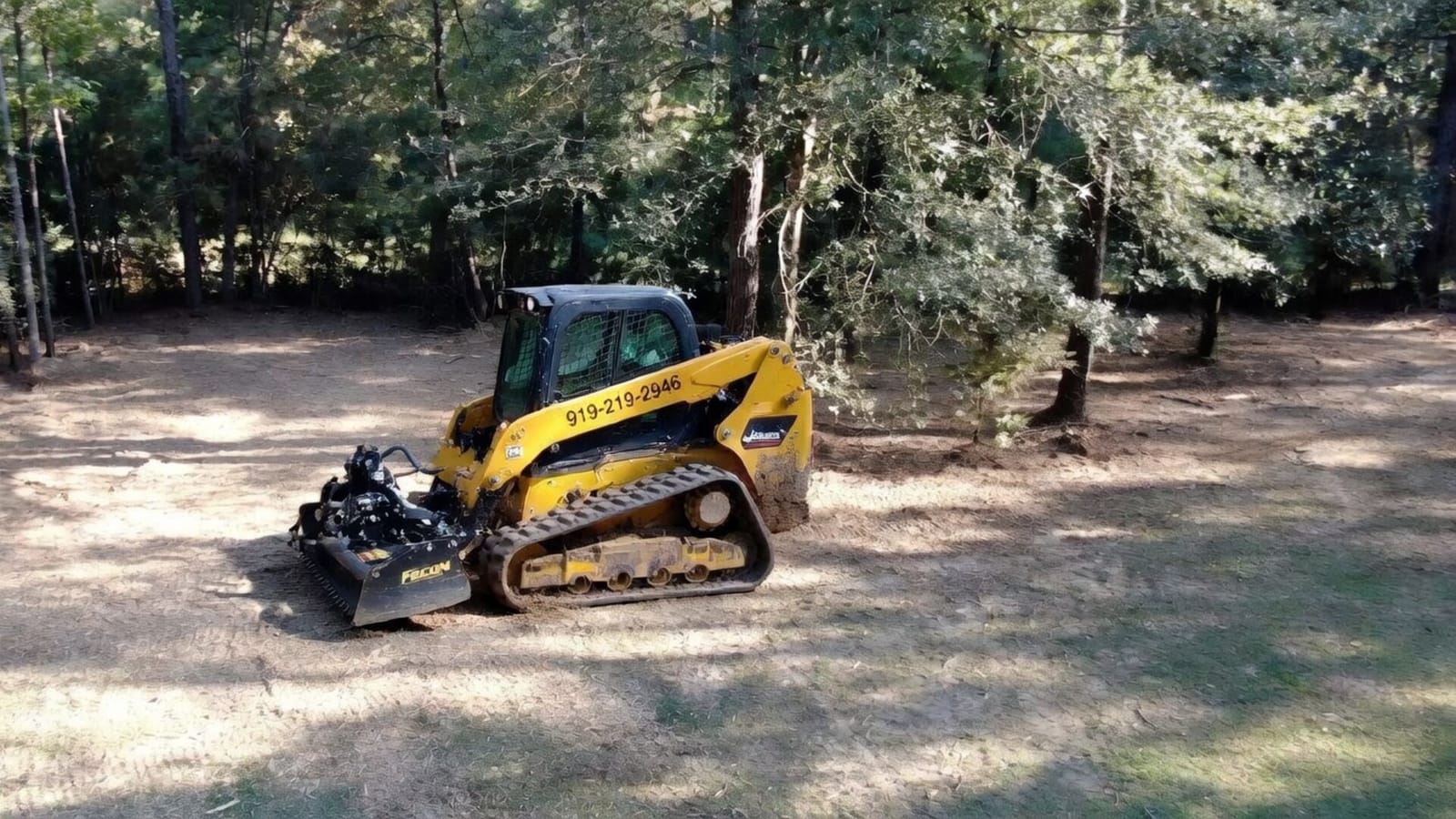
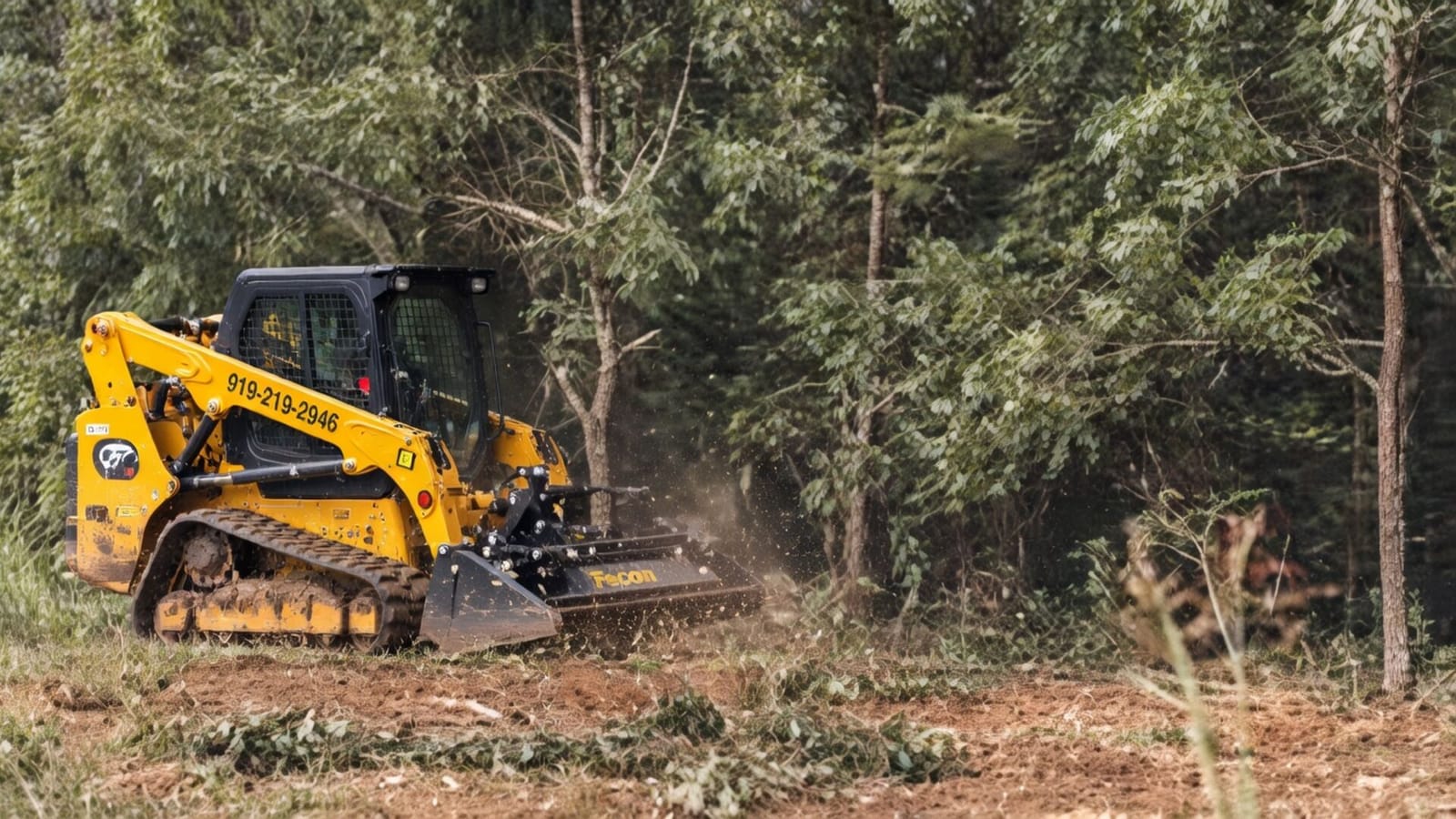
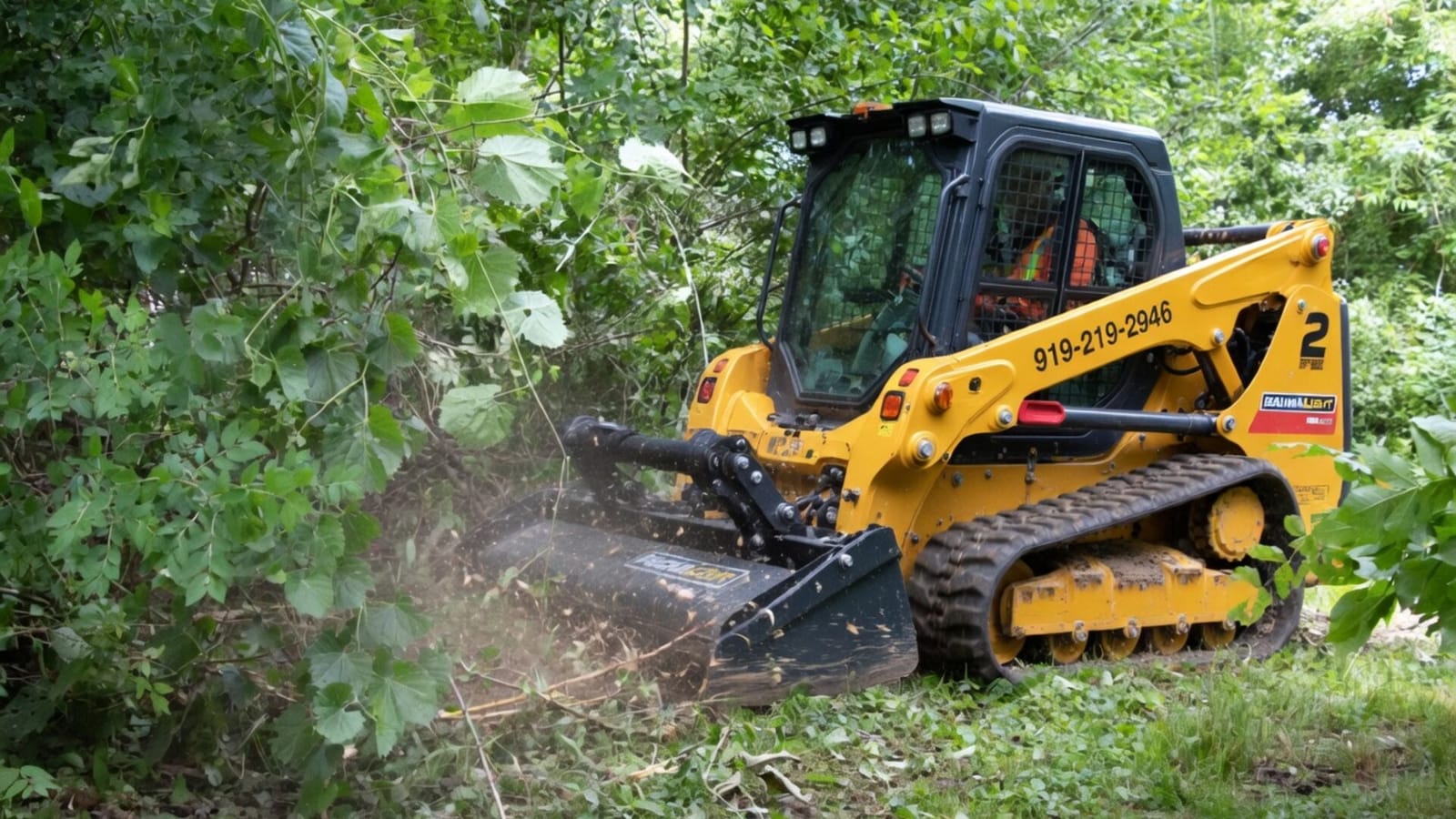
That layer is our work. Our crew runs a forestry mulcher over the tops, slash, brush and cull trees and grinds them into a mulch mat where they lie, so there is no pile to burn and nothing to haul. Where stumps have to come out, such as a house site or a driveway, we grind them; stump grinding cost in NC covers that price. Grading comes after us, from your grading contractor.
Before we quote a cut-over tract, we look at three things the harvest decided: how tall the stumps were left, how deep the slash lies, and whether loaded skidders rutted soft ground. Tall stumps and slash heaped high in rows slow the machine down. Thin, spread slash and low stumps go faster.
What Should the Timber Contract Say About Stumps and Tops?
Never sell timber without a written agreement, and put the cleanup in it. Three terms in the timber sale contract decide what you are left with:
- Acceptable stump heights. If you plan to clear after the harvest, settle this before the bid. Stumps cut close to the ground leave less for anyone to grind later.
- Who owns the tops, limbs, chips and bark. Settle it in writing so neither side assumes the other will deal with them.
- How limbs, tops and other unusable material are disposed of, and where they are left. Ask that slash be kept off the area you plan to build on and off the drive and road frontage.
Have the contract name the trees sold, the price and payment terms, and the harvest deadline, and as a precaution record it at the courthouse. If the boundary lines are unclear, only a registered land surveyor can set them.
Can Selling Timber Before a Build Hold Up My Building Permit?
It can. Under G.S. 160D-921, timber harvesting tied to converting forestland to non-forest use counts as “development”, not forestry. Local governments cannot regulate forestry on land in present-use-value forestry or managed under a plan from a registered forester. But if a harvest removes all or substantially all of the trees a local ordinance protects on the tract, the town or county may refuse a building permit or a site or subdivision plan for up to three years after the harvest, or five years if the harvest willfully broke the local rules.
So if a house is the goal, ask your town or county planning office whether a tree protection rule covers the parcel before the first tree is cut, not after.
The erosion rules change too. Timber harvesting is exempt from North Carolina’s sedimentation law only when it follows the Forest Practice Guidelines. Once the work is for a build, disturbing more than one acre needs an erosion and sediment control plan, and violations carry fines of up to $5,000 per day. That plan belongs to you or your builder; for local detail, see Johnston County land clearing permits, and for the order of work on a homesite, land clearing for new construction.
Is a Forester Worth the Fee on a Small Tract?
On a small tract, it pays off the most. Sales run by a consulting forester drew 51 percent higher total bids on tracts of 25 acres or less, against 18 percent at 26 to 50 acres and 14 percent above 200 acres. Fees vary: hourly, daily, by the acre, or a percentage of the gross sale, so ask how yours is charged.
In one Extension example, a $20,000 unsolicited offer on 20 acres became $39,895 through a sealed-bid sale, and landowners who used professional help averaged 23 percent more income per acre.
North Carolina foresters must pass an exam, keep up continuing education and be registered with the state. A free first step: your NC Forest Service county forest ranger can examine your timber before you talk to any buyer. Whoever runs the sale, get at least three bids.
How Many Acres Do You Need to Sell Timber in NC?
The floor is set by whether the volume pays to move a logging crew, not by a rule. Across the Southeast, 10 to 20 acres is a common minimum for a logging contract, and a tract of 5 to 20 acres is hard to sell on its own; a neighbor’s harvest nearby makes it easier.
What grows there matters as much as the acreage. Pine sawlogs can be worth five to seven times more per unit volume than pine pulpwood. In well-managed pine, a pulpwood thinning comes at 12 to 15 years and sawlogs at 25 to 30. A young stand or a brushy lot of sweetgum and scattered pine is usually a clearing cost, not an income. Our guide to clearing pine trees in NC covers that case, and cost to clear 10 acres in NC prices the clearing on a larger tract.
What Is Timber Worth in NC Per Ton?
Stumpage is what you are paid for standing trees; the buyer cuts and hauls. These are statewide average prices per ton from the NC Standing Timber Price Report 2026:
| Product | Q1 2026 | Q2 2026 |
|---|---|---|
| Pine sawtimber | $27.05 | $27.66 |
| Pine chip-n-saw | $22.62 | $20.34 |
| Pine pulpwood | $8.33 | $7.02 |
| Mixed hardwood sawtimber | $28.46 | $28.03 |
| Oak sawtimber | $45.58 | $48.96 |
| Hardwood pulpwood | $5.56 | $5.15 |
These are averages across the whole state and can miss a particular stand or region by a wide margin. Pulpwood dropped from one quarter to the next; sawtimber held. What your tract is worth depends on its product mix and volume, which only a timber cruise measures.
Can Logging End Up Costing More Than It Pays?
On a small or low-value stand, it can. A pulpwood sale on a few acres may bring less than the cleanup it leaves. Get the timber bid and the clearing quote as two separate numbers before you sign either one. An offer to “clear your land free in exchange for the timber” deserves the same test: on a valuable stand, that trade gives the wood away.
For our side of the math, forestry mulching and land clearing start around $1,500 an acre, and most residential clearing runs $1,500 to $4,500 an acre. The pricing guide lists every starting point, and land clearing cost per acre in NC explains what moves the number. If the timber is not merchantable, skip the sale and clear in one pass.
Should I Trust a Buyer Who Knocks on My Door?
Be careful with anyone who calls or comes to the door offering cash for your timber. Treat the offer as an opening bid, get several quotes, and sign nothing without a written contract. If you sell directly to a buyer, the buyer must give you load tickets for the wood hauled (G.S. 14-135 and 14-135.1). Pressure to sign this week is a reason to slow down: standing timber does not spoil.
Would Taxes Take Most of the Profit?
Usually not most, but plan for them. In a lump-sum sale, the proceeds count as a capital gain only if the timber was a capital asset and you held it long enough; otherwise they are ordinary income, and the gain is figured on IRS Form T, Part III. North Carolina’s individual income tax rate is a flat 3.99 percent for tax years after 2025, so budget for state tax on the gain too. Talk to a tax preparer who has handled timber sales before the sale closes.
Frequently Asked Questions
Will the logging crew clear my land completely?
No. Loggers remove the merchantable wood and leave stumps, slash, cull trees and understory. Finishing the job takes a land clearing crew to mulch what is left and grind stumps where you need them gone.
Does Cut Brush buy timber or run the harvest?
No. We do not buy timber, log or grade. We mulch the tops, slash and brush after the harvest, grind stumps, and clear the brush and small trees that have no mill value.
Get a Free Quote for Cleanup After Your Timber Sale
When the loggers pull out, request a free quote and our crew will contact you to talk through the property, access and the clearing you need. You can also call us at (919) 525-3950.
Related Services
Learn more about the services mentioned in this article.


Serving These Areas
We provide land clearing services in these towns and surrounding areas.
More from the Cut Brush Blog
Keep reading for more tips and guides on land clearing.
 Guide
Guide Clearing Land for a Mobile Home in NC: Septic and Pad Rules
Clear only for access before the septic evaluation, then clear the home site with stumps and sod out of footing areas. NC order of work, rules and costs.
 Guide
Guide Clearing Wet Land in NC: Wetland Rules and Soggy Ground
Cutting brush above ground, roots left alone, is not a discharge under federal rules; pulling stumps or moving soil can be, and the Corps decides which applies.
 Guide
Guide How Long Does It Take to Clear an Acre of Land in NC?
No fixed days per acre: tree density, slope, wet clay and access set machine time, and NC wants an erosion plan approved 30 days ahead past one acre.
Let's Get Started on Your Land
Request a free quote. We'll contact you to discuss your property, access, and the clearing you need.
Get a Free QuoteOr call us directly: (919) 525-3950