
Clearing Sloped Land in NC: Machine Limits and Rules
Cut Brush Team · July 14, 2026 · 8 min read

Clearing sloped land in NC comes down to three limits: which machine can safely work the grade, how fast bare ground has to be covered, and how wide the strip beside a creek must stay. Tracked equipment is generally held to about a 40 percent slope. On a permitted site, bare slopes steeper than 3:1 must be covered within 7 days. Steep ground pushes cost toward the higher end of our $1,500 to $4,500 per acre range.
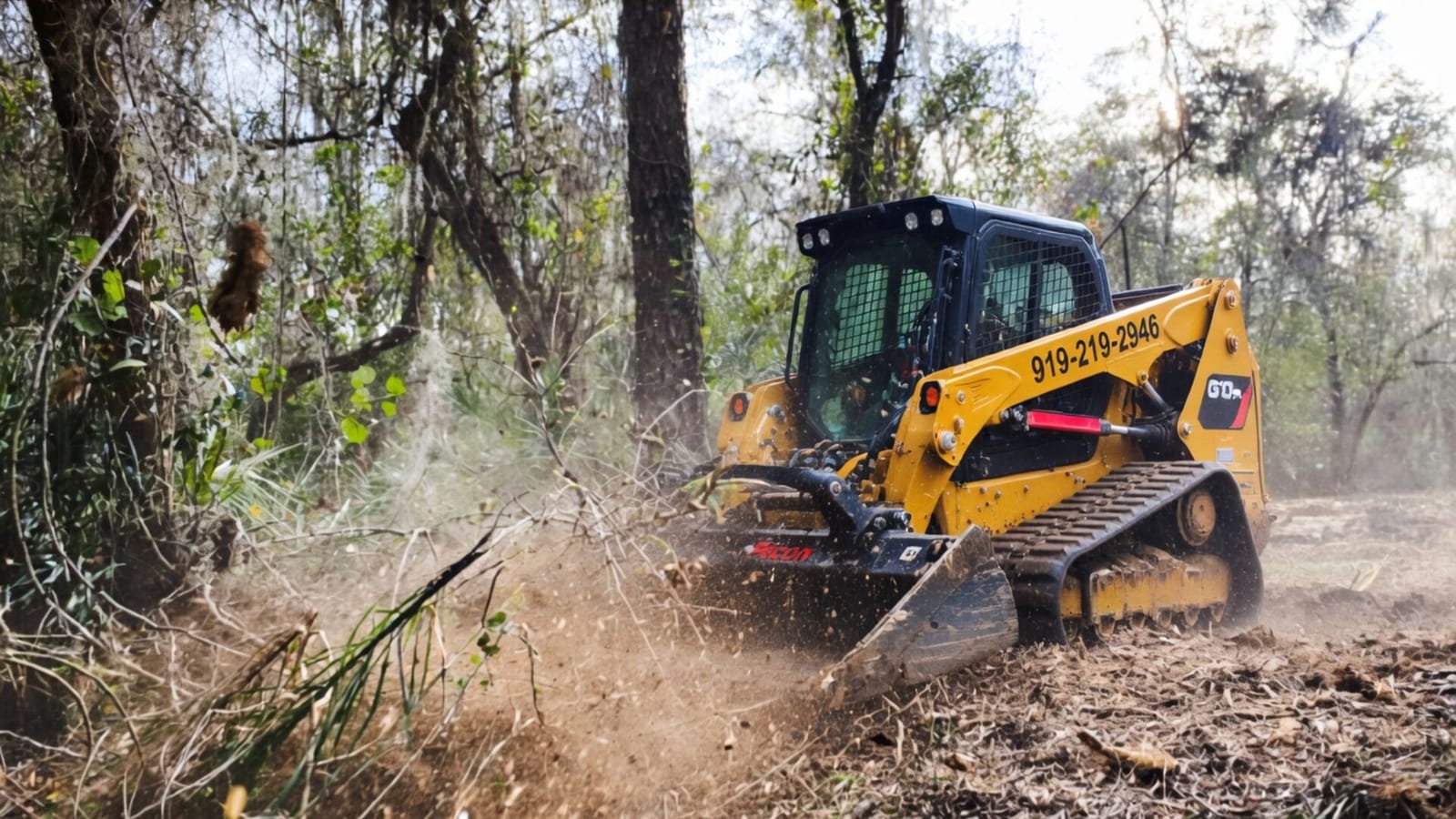
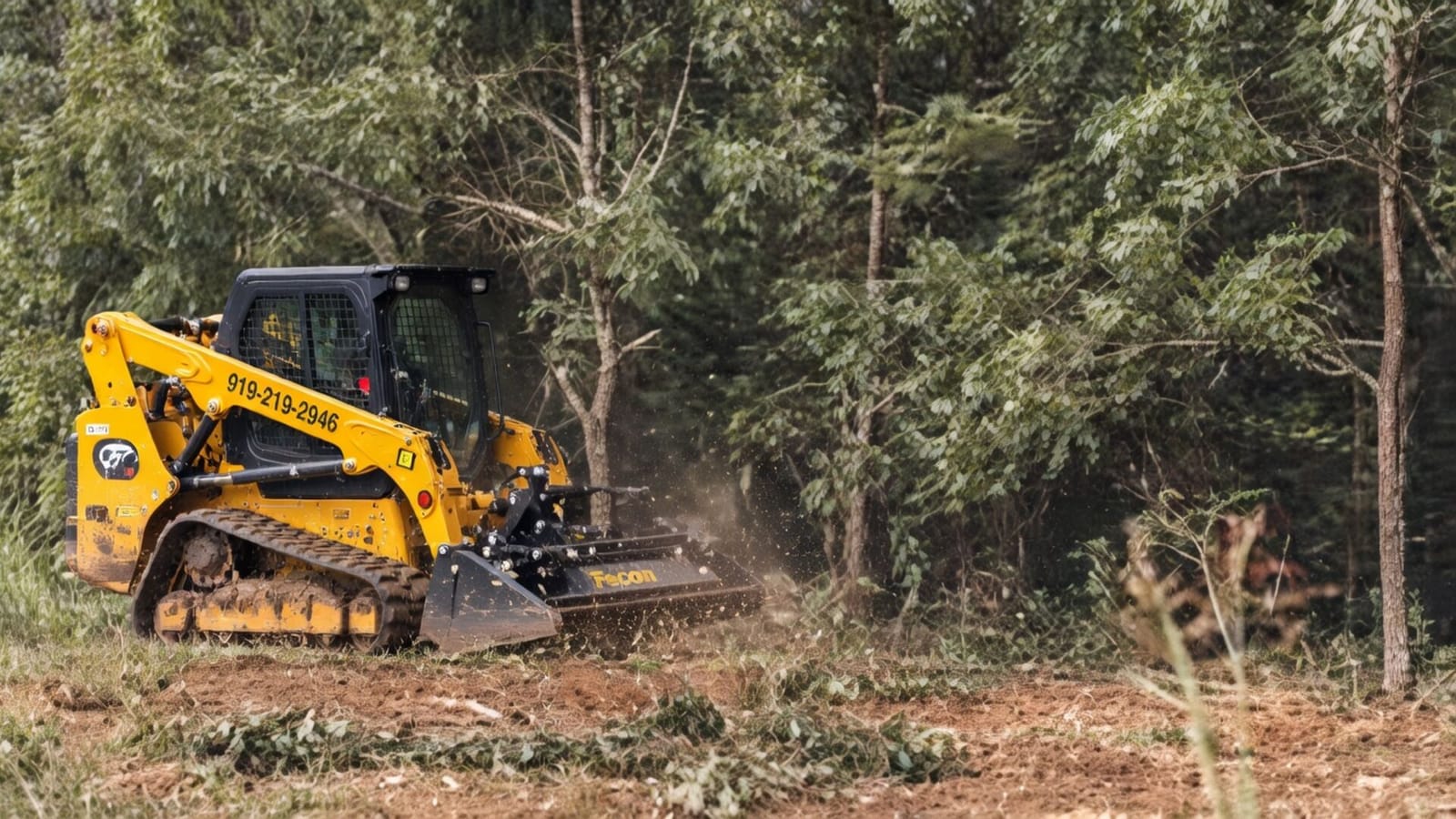
We clear with a forestry mulcher, which grinds brush and trees where they stand and leaves the roots in the soil. We do not grade. If your slope is going to be cut, filled or shaped for a house or driveway, we clear it first and your grading contractor takes it from there.
How steep is too steep for a machine?
As general guidance for land managers, the operating limit for tracked equipment is about a 40 percent slope, and about 30 percent for wheeled equipment. Those figures move with the job being done and with the soil and conditions on the hill. The same guidance singles out compact tracked loaders: a short track and narrow stance limit their use on slopes.
Our mulcher runs on a tracked skid steer, so that caveat applies to us. We do not publish a slope rating for it; we judge each slope on the walk, because the grade number is only part of it. What actually stops a machine on a Piedmont hillside:
- Wet seeps and springheads. Soft clay on a slope gives way under tracks long before the grade alone would.
- Loose rock and ledges. Broken ground tips a machine that would hold on the same grade of solid soil.
- Slope length and what sits at the bottom. A short bank above a field is a different risk from a long face that ends in a creek.
Steeper ground calls for different machines. Excavator-mounted mulchers are used on slopes greater than 30 percent because they reach from a stable spot, and some remote-controlled mulching carriers are rated for slopes of 45 to 55 degrees. We do not run either. If part of your lot is past what our machine should work, we mark it on the walk so you can leave it standing or bring in the right equipment.
Reading your own slope: percent, ratio and degrees
Slope gets written three ways. Percent is rise over run: a 25 percent slope climbs 1 foot for every 4 feet across. A ratio such as 3:1 means 3 feet across for 1 foot up. Degrees sound smaller than they are: a 45 degree slope is a 100 percent grade.
| Percent | Ratio | Degrees | Why it matters |
|---|---|---|---|
| 25% | 4:1 | 14° | From here up to 3:1, a permitted site has 14 days to cover bare ground (10 in the Falls Lake watershed) |
| 30% | about 3.3:1 | 17° | General limit for wheeled equipment |
| 33% | 3:1 | 18° | Steeper than this, bare ground on a permitted site must be covered in 7 days |
| 40% | 2.5:1 | 22° | General limit for tracked equipment |
| 50% | 2:1 | 27° | Short slopes (10 feet or less) no steeper than this get 14 days instead of 7 |
| 100% | 1:1 | 45° | Where remote-controlled carrier ratings begin |
Pro tip: You can measure a slope with a 4 foot level. Rest the uphill end on the ground, raise the downhill end until the bubble centers, and measure the gap to the ground in inches. Divide by 48 and multiply by 100: a 12 inch gap is a 25 percent slope, and 16 inches is 33 percent, right at 3:1.
In Orange County, the steep ground is mostly where Morgan Creek, New Hope Creek and the Eno River have cut into the land, so the steepest part of a lot is often also the part nearest a stream, where buffer rules apply.
How long can a bare slope sit before it has to be covered?
The clock gets shorter as the slope gets steeper. Under the state construction stormwater permit, NCG010000, which covers disturbance of one acre or more, ground stabilization is due after land disturbance stops:
- Slopes steeper than 3:1: within 7 days. Slopes 10 feet long or less that are no steeper than 2:1 get 14 days.
- Slopes from 3:1 to 4:1: within 14 days, or 10 days in the Falls Lake watershed.
Separately, the Sedimentation Pollution Control Act sets an outer limit of 21 calendar days after any phase of grading for exposed slopes to have temporary or permanent cover. The same statute requires an erosion and sedimentation control plan, filed and approved at least 30 days before work starts, when an activity will disturb more than one acre. The plan trigger is “more than one acre” and the permit trigger is “one acre or more”, so a site of exactly one acre falls under the permit but not the plan rule. Civil penalties under the construction permit can reach $25,000 per day for each violation.
Do not assume mulching keeps a job outside these rules. The statute defines land-disturbing activity as development use that changes the natural cover or topography of the land and may cause sedimentation, and its exemptions cover agriculture and timber harvesting done under the state’s forest practice guidelines, not clearing for a house or a sale. Ask your local erosion control program what applies before work starts. Filing the plan is the owner’s or engineer’s job; we clear to the plan.
What counts as cover
On a mulched slope, the chip layer we leave is the cover. North Carolina’s erosion manual names organic mulches such as straw, wood chips and shredded bark as the most effective means of controlling erosion before vegetation establishes, with erosion mats kept for waterways, channels and other critical areas. Leave the chips on the slope rather than raking them off.
Where the slope is graded after we leave, seeding is the owner’s or grading contractor’s job, on the clock above. The same manual lists temporary cover for the Piedmont by season: German millet from May 1 to August 15, rye grain from August 15 to December 30, and a late winter mix from January 1 to May 1. For how a mulched lot moves on to grading and footings, see can you build on mulched land.
Does my slope change how close I can clear to a creek?
Yes. Under the construction permit, the recommended undisturbed buffer between the work and a lake or watercourse widens with slope: 25 feet for slopes of 3 to 5 percent, then 25 feet plus 1 foot for every percent over 5. A 20 percent slope works out to 40 feet; a 35 percent slope to 55 feet. The width is set so visible sediment stays in the quarter of the strip nearest the work. It is a recommended width, not a fixed line.
Local and basin rules sit on top of that:
- Orange County requires stream buffers of at least 50 feet on both sides, with an additional 15 or 30 feet based on the severity of the slope. Ephemeral drainage does not carry a buffer there. Our Orange County land clearing guide covers the rest of the county’s rules.
- Neuse basin, including Falls Lake, and the Jordan Lake watershed each protect a 50 foot buffer: 30 feet nearest the water and 20 feet beyond it. In the Neuse rule, a stream counts if it is shown on the soil survey map or the USGS National Map, then confirmed on site; ephemeral streams are not covered. See Neuse River buffer rules and clearing land in the Jordan Lake watershed.
- Around Roxboro, Hyco Lake and Mayo Reservoir are in the Roanoke River basin, so the Neuse and Jordan buffer rules do not reach them. Check with Person County before clearing toward either lake; our Person County guide has the local picture.
On the walk we flag every draw and stream channel, and we stop the machine at the buffer edge.
Should the stumps come out on a slope?
Usually not. A mulcher cuts at ground level and leaves the roots in the soil, where they keep holding the bank. Pulling stumps tears open the steepest ground on the lot and turns clearing into earthwork, which we do not do. If you want the stumps flush below the surface, we offer stump grinding in North Carolina, which leaves the root systems in place. For the full comparison of mulching against bulldozer clearing, see forestry mulching vs bulldozer land clearing.
How much does it cost to clear sloped land?
Forestry mulching and land clearing start at around $1,500 an acre, and most residential clearing falls between $1,500 and $4,500 an acre. Steep hillsides, soft soil, ravines and rock slow the machine and push a job toward the higher end of that range. We do not add a set slope surcharge; the grade is priced along with vegetation density, acreage and access when we see the ground. A steep acre of light brush can cost less than a flat acre of mature hardwoods.
Our pricing page shows how each factor moves an estimate; land clearing cost per acre in NC covers flat ground by vegetation type.
Frequently Asked Questions
Will a cleared hillside sprout back?
Yes, in most cases. Many hardwoods, sweetgum among them, send up new shoots from the roots left in the ground, which is the trade for keeping those roots holding the slope. Plan on a follow-up mulching or mowing pass where the ground allows it, or have a licensed applicator treat the sprouts.
Do I need a permit to clear a sloped lot in NC?
A plan is required above one acre of disturbance and the state permit applies from one acre. Below that, local rules can still apply, especially near streams, so ask your county or city erosion control office first.
Get Your Slope Walked and Quoted
Request a free quote and our crew will contact you to talk through the property, the access and the clearing you need. We will walk the slope, mark the draws and buffer edges, and tell you which ground our machine will take. You can also call us at (919) 525-3950.
Related Services
Learn more about the services mentioned in this article.


Serving These Areas
We provide land clearing services in these towns and surrounding areas.
More from the Cut Brush Blog
Keep reading for more tips and guides on land clearing.
 Guide
Guide Jordan Lake Watershed Land Clearing: Buffer Rules by Town
Near Jordan Lake, your town or county runs the stream buffer, not the state. 50 feet is the floor, Cary and Apex go to 100, and unlisted clearing is barred.
 Guide
Guide What Is Forestry Mulching? A Complete Guide
What is forestry mulching? See how a forestry mulcher grinds trees and brush into mulch in one pass, what it handles, and when to use it. Get a free estimate.
Guide Can You Build on Mulched Land? NC Footing and Slab Rules
Yes, but not on the mulch. NC footing trenches must be clear of roots, debris and loose soil, and slabs need stone or engineered fill. What to clear first.
Let's Get Started on Your Land
Request a free quote. We'll contact you to discuss your property, access, and the clearing you need.
Get a Free QuoteOr call us directly: (919) 525-3950