
Jordan Lake Watershed Land Clearing: Buffer Rules by Town
Cut Brush Team · June 14, 2026 · 8 min read

In the Jordan Lake watershed, the town or county your land sits in runs the stream buffer program under Rule 15A NCAC 02B .0267, and it decides what you may clear near a creek or pond. The state minimum is 50 feet on each side; Cary, Apex, Wake County and Chatham County require up to 100 feet in some cases. Inside the buffer, only the uses the rule names as exempt are free to do, such as mowing the outer 20 feet. Everything unnamed is prohibited without a variance.
The rule is being readopted, so confirm the current version with your local planning or stormwater office before a machine goes near the water. This is a plain reading of the rule, not legal advice.
Who decides what I can clear: the state or my town?
Usually your town or county. Every local government in the watershed had to build its own buffer program and apply the rule across its jurisdiction. The N.C. Division of Water Resources (DWR) keeps four kinds of work:
- forest harvest (timber cut under forestry rules);
- agriculture;
- work by state, federal and other government bodies; and
- land where no local program is in place.
DEQ keeps a list of the local governments that run buffer programs. If yours is on it, call them; if it is not, DWR is the buffer authority. For Jordan Lake, 33 are designated, among them Apex, Cary, Carrboro, Chapel Hill, Durham, Morrisville, Pittsboro, and Chatham, Durham, Orange, Wake, Alamance, Caswell, Guilford and Rockingham counties. Holly Springs is not on the Jordan list.
Cary, Apex and Morrisville each sit partly in the Neuse basin, where a different buffer rule applies and the state runs it. Cary administers the Jordan buffer itself, while DEQ handles the Neuse side. If your land drains east toward the Neuse, read our Neuse River buffer guide instead of this one.
How wide is the Jordan Lake buffer on my land?
At least 50 feet on every side of a regulated stream, lake, reservoir or pond. Zone One is the inner 30 feet; Zone Two is the outer 20. On a stream, the width is measured from the top of the bank; on a lake or pond, from the normal water level. The rule lets local governments require more, and several do:
| Where the land is | Who answers the buffer question | Buffer width |
|---|---|---|
| Cary, Jordan side | Town of Cary | 100 feet total on USGS-mapped intermittent and perennial streams: the state’s 50 plus Cary’s 50-foot Urban Transition Buffer. Single-family lots platted before July 27, 2000 are exempt from the added 50. |
| Apex, Jordan side | Town of Apex | 100 feet on perennial streams, 50 feet on intermittent |
| Unincorporated Wake County | Wake County | 100 feet in water supply watersheds |
| Chatham County, lot not being subdivided | Chatham County | 50 feet on intermittent and perennial streams, lakes, ponds and reservoirs |
| Chatham County, subdividing or after a county buffer confirmation on site | Chatham County | 100 feet perennial, 50 feet intermittent, 30 feet ephemeral |
| Other designated towns and counties | That local government | 50 feet at minimum; ask whether the local program is wider |
| No local program, or timber, farming or government work | DWR | 50 feet |
Before we quote a lot near water, we check which jurisdiction it is in and which basin it drains to, because one creek can carry 50 feet on one side of a town line and 100 on the other.
Can I mow, brush hog or mulch inside the buffer?
Only the work the rule names as exempt can go ahead without any approval. That list is short:
- mowing or harvesting plant products, in Zone Two only;
- planting;
- pruning forest vegetation;
- removing individual hazard trees;
- removing individual trees that are dead, diseased or damaged;
- removing poison ivy, and invasive exotic plants on the state’s list; and
- emergency fire control.
Mowing Zone One is not on that list. Neither is grinding woody brush and saplings with a mulcher, in either zone. Uses the rule calls allowable need written authorization from your local government, not DWR; if the office does not act within 60 days, the certificate is treated as issued, with some exceptions.
Anything the rule does not categorize is prohibited unless a variance is granted. A minor variance, for work in Zone Two only, is decided locally. A major variance, for anything touching Zone One, goes on to the state Environmental Management Commission. One condition of any variance is that the applicant did not buy the property after August 11, 2009 and then ask for one. If you bought after that date, plan on the buffer staying as it is.
On a job, we brush hog Zone Two where it is mowing, take out listed invasives and individual dead or dangerous trees, and leave standing brush in the buffer alone unless the local office has signed off in writing.
My yard or field was already there. Does the buffer still apply?
Not to the footprint of a use that was in the buffer on the date your local program took effect and has continued since. Where DWR is the authority, that date is August 11, 2009. Buying or inheriting the land does not count as a change of use, so the protection carries over to you.
Pro tip: Ask your town or county the exact date its Jordan buffer program took effect. That date, not 2009, sets your existing-use cut-off, and it decides whether a mowed strip by the creek can stay mowed.
The protection covers only that footprint. Clearing beyond it is new work, and the rule bars new clearing, grading or development in violation of it.
Does the buffer apply to my creek or pond?
A water body is covered if it is approximately shown on the NRCS soil survey or on the USGS 1:24,000 topographic map, and not covered if it appears on neither. The map is chosen stream by stream: if one creek on a property appears only on the USGS map, that map governs that creek.
A site visit can take a mapped feature out of the rule if it turns out to be:
- an ephemeral stream;
- a ditch that is not a modified natural stream;
- a man-made pond that sits off a natural drainage way; or
- missing on the ground.
Your local program, or DWR where it is the authority, makes that call; until then, treat the mapped line as regulated.
Cutting timber near the water goes to the state
Timber harvest in the buffer is one of the jobs DWR keeps. The N.C. Forest Service rules for harvest in the Jordan buffer require a forest management plan or present-use-value forestry deferment. In the 10 feet beside the water, only high-value trees may be cut: pines at least 14 inches in diameter at breast height, hardwoods at least 16. In the rest of Zone One, up to half the trees over 5 inches may be removed, with one re-entry each 15 years. Clearing land for a house is not a timber harvest.
Penalties for buffer violations can reach $25,000 per violation for each day; for timber removed from a buffer, the penalty is capped at the value of that timber.
Clearing outside the buffer
Most of a creek lot sits outside the buffer, and that is where we do the bulk of the work. New development in the watershed needs a stormwater plan once it disturbs one acre for single-family homes, duplexes and recreation, or half an acre for commercial, industrial, institutional, multifamily and local government projects. Your county’s sediment and permit thresholds are in our land clearing permit guide, and county detail is in our Chatham County and Orange County guides.
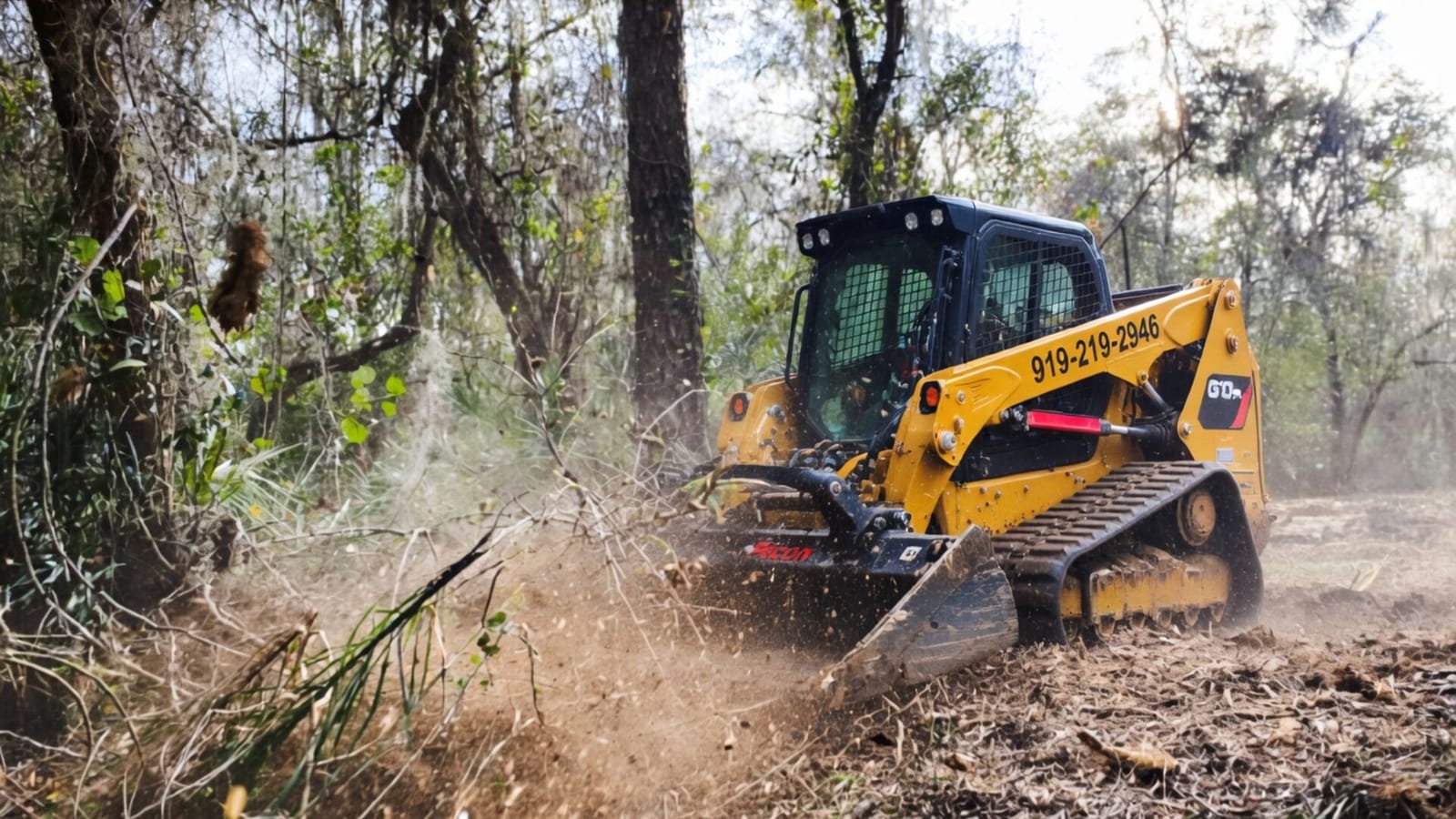
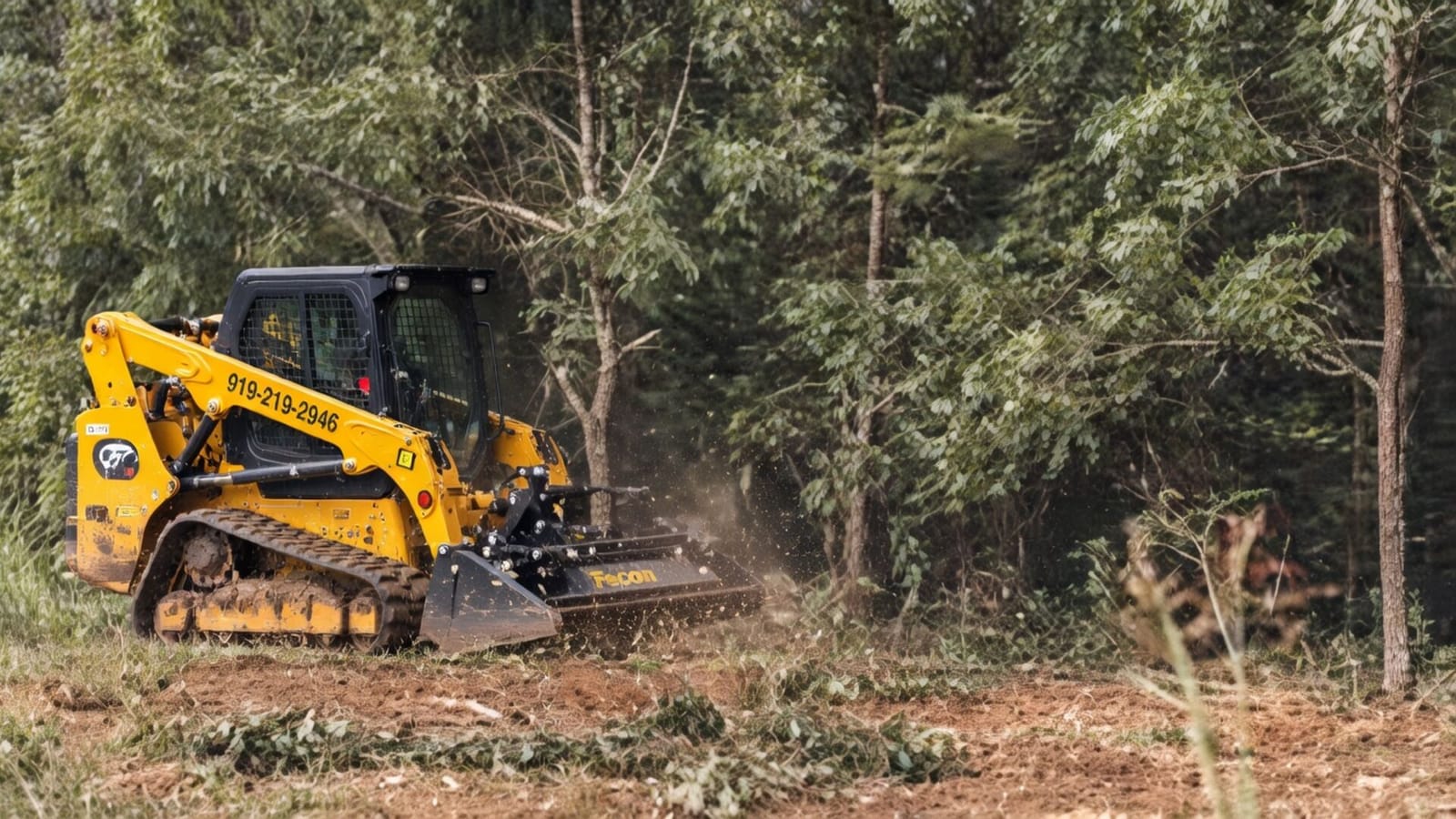
Forestry mulching grinds brush and small trees in place, leaves roots in the soil and covers the ground with chips, so the land next to the buffer is not left bare. Where a homesite has to go to bare ground, we clear it and your grading contractor takes over. The rule allows grading and revegetating Zone Two if Zone One stays healthy; that is a question for your local office and your grading contractor. Forestry mulching and land clearing start around $1,500 per acre, and most residential clearing falls between $1,500 and $4,500 per acre; brush hogging starts around $75 per acre. See the pricing page for what moves the number.
The rule is being rewritten
The Jordan Lake rules have been under readoption since 2020. The December 2024 draft of the buffer rule kept its scope, every exemption, the existing-use protection and the zone widths, but a draft is not the adopted rule. Ask your local office which version it is applying the week you plan the work. Falls Lake land falls under the Neuse buffer instead; see our Falls Lake guide.
Frequently asked questions
Do I need a permit to clear land near Jordan Lake?
Not for the exempt list, such as mowing Zone Two or taking down a dead tree. Uses the rule calls allowable need written authorization from your local government. Anything unlisted is prohibited without a variance. Clearing outside the buffer may still need local permits.
Does DWR approve buffer work in Cary or Apex?
Not on the Jordan side. Each town runs its own program there. DWR or DEQ handles the Neuse side of both towns and any timber harvest.
Get a free quote for land near Jordan Lake
Request a free quote and our crew will contact you to talk through the property, the access and the clearing you need, or call (919) 525-3950. We clear the ground outside the buffer, do the exempt work inside it, and wait for written approval before anything else goes near the water.
Related Services
Learn more about the services mentioned in this article.


Serving These Areas
We provide land clearing services in these towns and surrounding areas.
More from the Cut Brush Blog
Keep reading for more tips and guides on land clearing.
 Guide
Guide Falls Lake Watershed Land Clearing: 1-Acre Rule by County
Since 6 October 2025, a house or duplex under 1 acre in the Falls Lake watershed needs no Falls stormwater plan. Buffers, erosion and Durham rules still apply.
 Guide
Guide Clearing Sloped Land in NC: Machine Limits and Rules
Clearing sloped land in NC: tracked machines are held near 40% grade, permitted slopes steeper than 3:1 need cover in 7 days, and steep lots get wider buffers.
Guide Neuse River Buffer Rules: What You Can Clear in NC
In the Neuse basin, 50 feet beside a mapped creek or pond is protected: Zone 2 can be mowed, but woody clearing in Zone 1 needs written approval from NC DWR.
Let's Get Started on Your Land
Request a free quote. We'll contact you to discuss your property, access, and the clearing you need.
Get a Free QuoteOr call us directly: (919) 525-3950