
Falls Lake Watershed Land Clearing: 1-Acre Rule by County
Cut Brush Team · June 9, 2026 · 7 min read

Since 6 October 2025, a single-family home or duplex in the Falls Lake watershed that disturbs less than one acre in total, and is not part of a larger common plan of development, needs no stormwater permit or plan under the Falls Lake New Development Rule or any local ordinance adopted under it. The rest still applies: stream buffers, the state erosion plan above one acre, Durham’s 12,000 square foot permit, and the 12,000 square foot trigger for non-residential projects.
So the first question is not “Falls or not” but which office decides your parcel. That office, not the state map, sets what you file before a machine arrives.
What changed for houses under an acre in Falls Lake?
For years the Falls rule caught a home site at half an acre of disturbance. Section 21(c) of Session Law 2025-94 moved that line: no stormwater permit, management plan or post-construction controls are required, under the Falls rule or any local ordinance adopted under it, for single-family and duplex dwellings that cumulatively disturb less than one acre and are not part of a larger common plan of development. The bill became law without the Governor’s signature on 6 October 2025 and took effect that day.
Read the limits before you plan around it:
- Houses and duplexes only. Commercial, industrial, institutional, multifamily and local government projects still meet the rule at 12,000 square feet.
- Cumulative. The acre counts all the disturbance for the dwelling, not one phase at a time. The trees come out before the house goes in, so plan the clearing as part of that total.
- Not inside a larger plan. A lot in a subdivision being built out under one plan does not get the exemption on its own.
- Federal law still wins. The section opens with “except as required pursuant to federal law or permit.”
- It is a bridge. The law governs until the Environmental Management Commission adopts a revised permanent rule. As of 22 October 2026 we have not seen that rule take effect.
- Older pages lag. Durham County’s single-family guidance page still shows the half acre for Falls. The session law is newer and controls.
Our Granville County guide walks through the same change for Butner, Creedmoor and Stem.
Under an acre in Falls Lake, what do I still need?
The 2025 law removed one layer. These are the ones it left alone:
- Stream buffers. The Falls rule itself requires new development to show compliance with the riparian buffer rules, and the exemption does not touch them.
- The state erosion plan above one acre. Statewide, more than one acre of disturbance needs an approved erosion and sedimentation control plan before work starts. Our NC permit thresholds guide has the county-by-county numbers.
- Local programs with lower triggers. In Durham, any land-disturbing activity over 12,000 square feet needs a permit, inside city limits too, and over 20,000 square feet needs signed plans. That is roughly a quarter acre, well under the Falls exemption.
- Raleigh’s tree area. Inside Raleigh’s Falls Watershed Protection Overlay District, every lot must keep an area set aside for trees equal to at least 40% of the lot. Clearing a north Raleigh lot edge to edge can run straight into that.
The upshot: a modest house lot in Wake County may now need nothing for Falls, while the same lot in Durham can still need a permit for the clearing alone.
Which office decides my parcel: county, town or state?
Local governments, not the state, run the Falls rules day to day. The watershed covers about 770 square miles across six counties, so the answer depends on where the parcel sits.
| Where the parcel is | Who to ask first | What we verified |
|---|---|---|
| Unincorporated Wake County | Wake County Watershed Management | Stormwater permit when a new home cumulatively disturbs over 1 acre; non-residential over 12,000 sq ft. Wake adopted its Falls rules on 2 July 2012 |
| City of Raleigh | City of Raleigh | Falls overlay district: 40% of each lot kept as tree area |
| Wake Forest | Town of Wake Forest | Wake County’s list of towns it issues land disturbance permits for does not include Wake Forest, so start with the town |
| Durham, city or county | Durham County stormwater and erosion control | Permit over 12,000 sq ft; signed plans over 20,000 sq ft; its own Falls buffer widths |
| Granville County (Butner, Creedmoor, Stem) | Granville County | State erosion plan above 1 acre; county watershed details in our Granville guide |
| Parts of Orange, Person and Franklin | That county | Also in the watershed; we have not checked their programs |
For Wake County’s erosion thresholds and fees outside the Falls question, see do I need a permit to clear land in Wake County.
Is my creek buffer 50 feet?
Sometimes. The state’s Neuse buffer is 50 feet on mapped streams, and our Neuse River buffer rules guide covers what you can cut in each zone and who approves it. Falls Lake sits inside the Neuse basin, so that rule is the floor.
Durham is the exception to plan around. Durham’s buffer ordinance sets its own widths for the Falls and Jordan overlays, by overlay and by stream type, and they can be wider than the state’s 50 feet. Two lines in it matter for a landowner: it applies “in all cases, including where State standards are less stringent,” and “there is no disturbed area minimum.” A small job is not too small for it. Confirm the width for your stream with Durham before anyone cuts near the water; we will not guess a number for you.
Jordan Lake, on the other side of the Triangle, runs on its own rules; our Jordan Lake guide covers them.
Does clearing with no house planned count?
The Falls rule and the 2025 law are written around development and dwellings. What we read does not say whether clearing a field or a wooded lot with no building planned counts as new development under the Falls rule, so ask the office in the table before a large job.
Two things do not depend on that answer. Durham’s permit covers any land-disturbing activity over 12,000 square feet, building or not. And buffers apply to the work, whatever the reason for it.
Where forestry mulching fits on watershed land
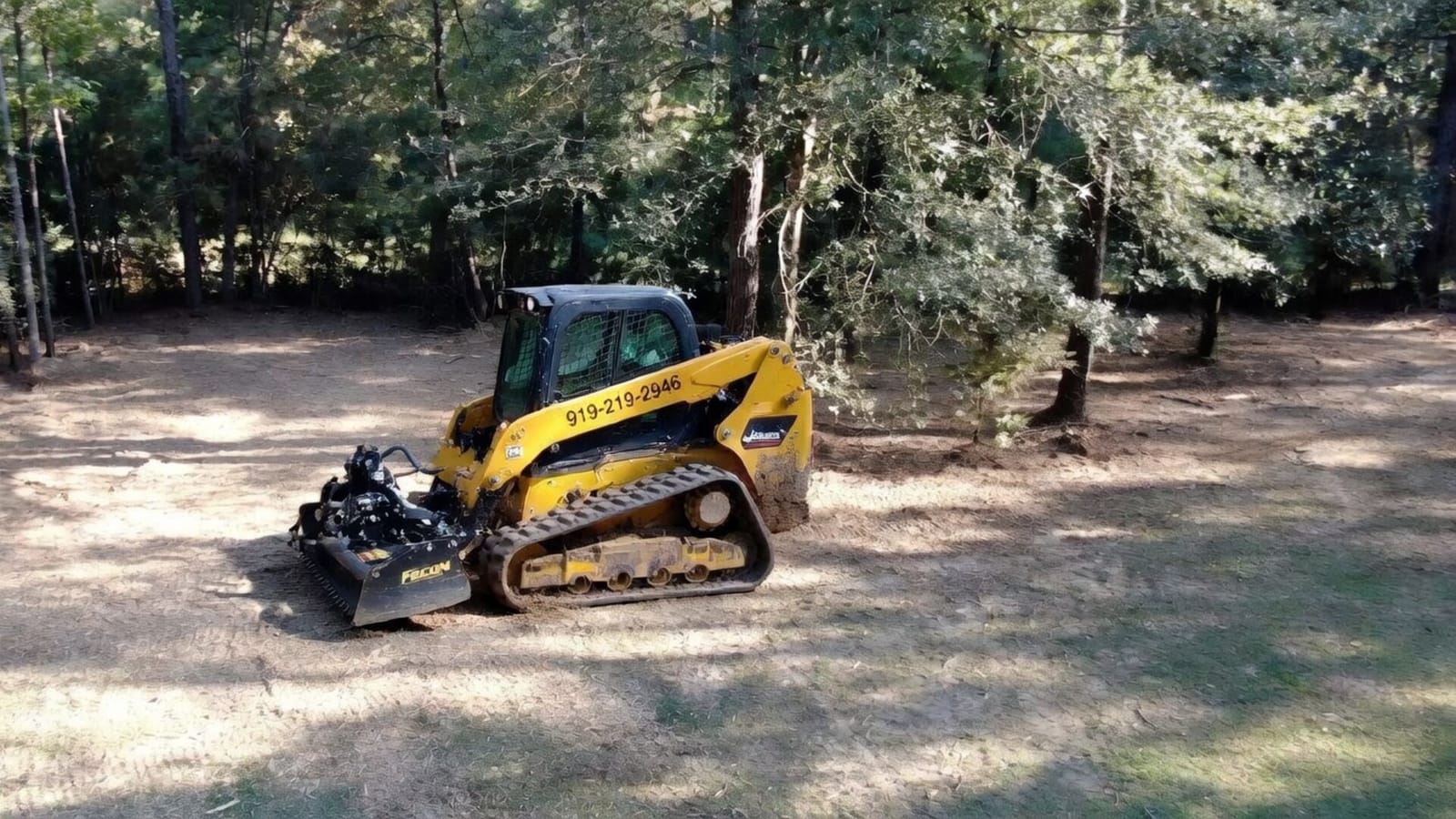
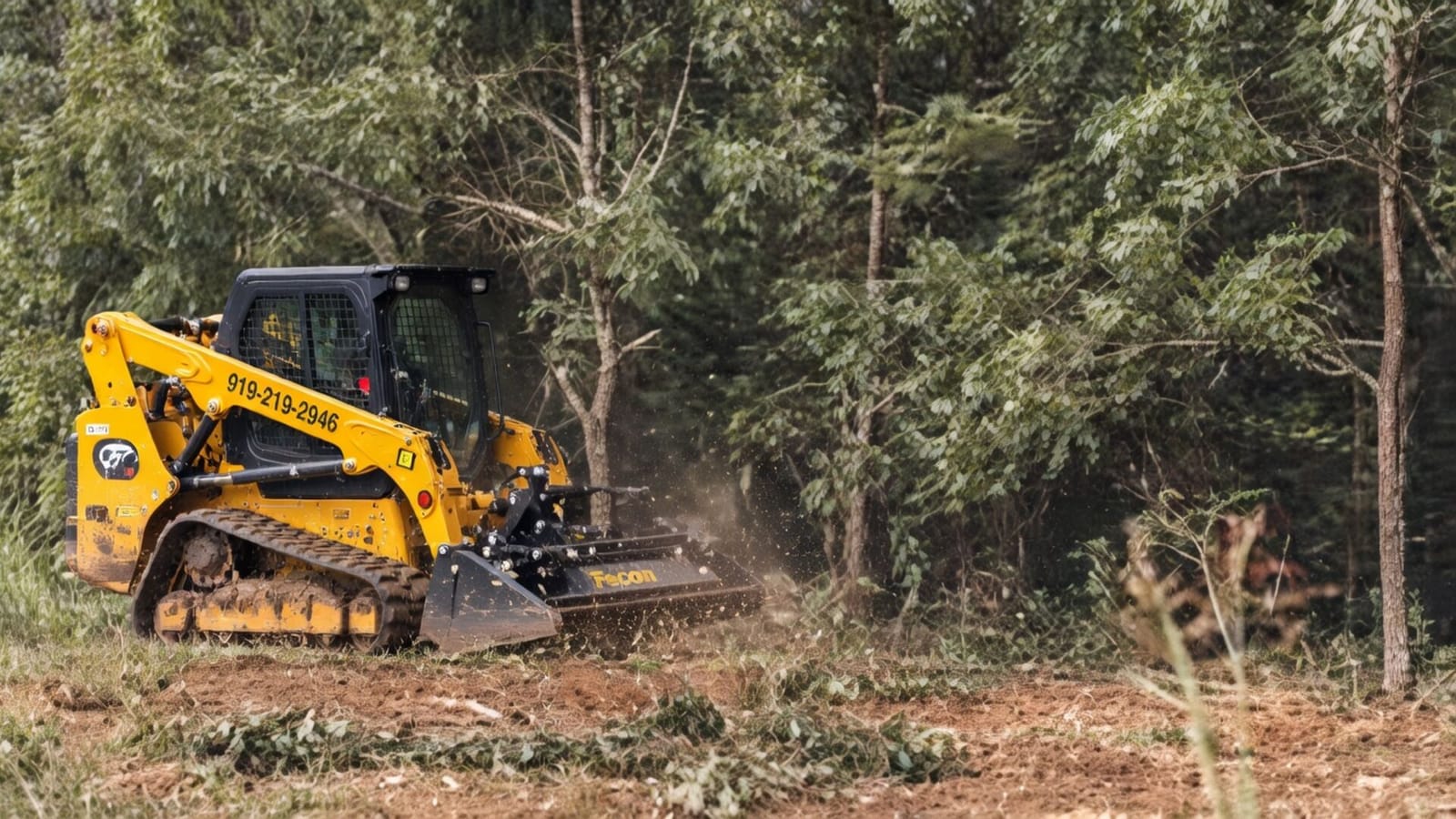
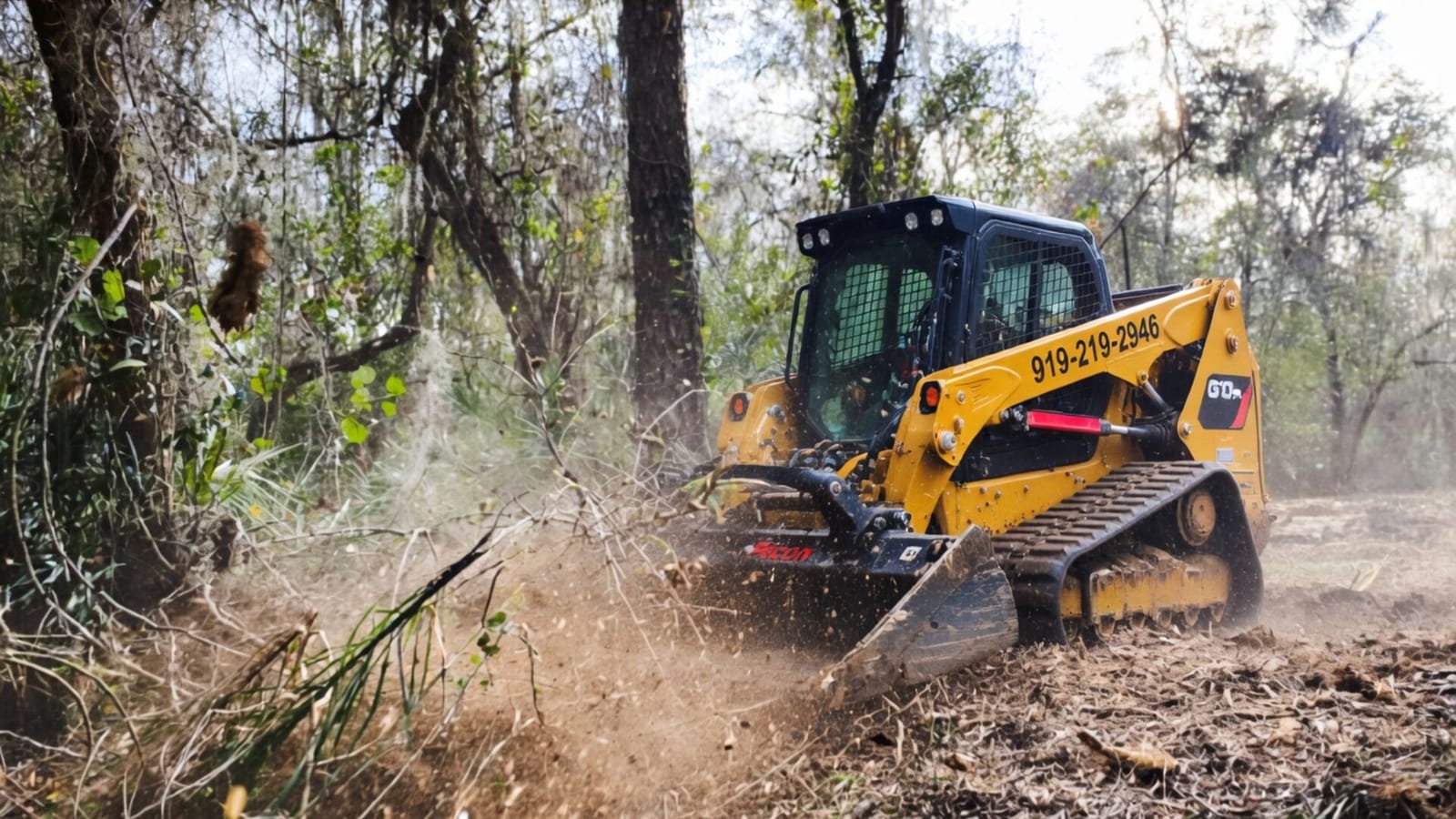
On watershed land, forestry mulching is the method we reach for first: one machine grinds brush and small trees where they stand and leaves the chips on the ground. Roots stay in the soil, nothing is burned and nothing is hauled. On sloped lots that drain toward a creek, that is a sensible way to open ground. It is a method, not a permit answer: we do not treat mulching as a way around any threshold above, and the office decides how it counts the job.
Before we quote a watershed lot, our crew looks at:
- Where the water is. Creeks, wet draws and the line of any buffer or tree set-aside. We cut inside a buffer only as far as the rule or a written approval allows.
- What happens after. If a house follows, we clear and your grading contractor grades. We do not grade, build pads or file plans; your builder or engineer handles the paperwork.
- Ground conditions. Piedmont creek bottoms stay soft after rain, and soft ground slows a tracked machine or moves the date.
- What grows back. Sweetgum, privet and other sprouters come back from stumps after mulching. We offer stump grinding, and follow-up mowing keeps the regrowth down. Any herbicide work belongs to a licensed applicator.
Our forestry mulching starts around $1,500 an acre, and most residential clearing falls between $1,500 and $4,500 an acre depending on density, slope and access. The pricing page explains what moves the number.
Frequently asked questions
Does the half-acre Falls Lake rule still apply?
Not to a single-family home or duplex. Since 6 October 2025, those dwellings need no Falls stormwater plan under one acre of cumulative disturbance, unless they are part of a larger common plan. Non-residential projects still meet the rule at 12,000 square feet.
Do I need a permit to clear land near Falls Lake?
It depends on the office. In Durham, yes, above 12,000 square feet of disturbance. Elsewhere, the state erosion plan starts above one acre, and Wake County’s Falls stormwater permit for a new home starts above one acre. Buffers apply at any size.
Which towns are in the Falls Lake watershed?
Parts of Raleigh, Durham, Wake Forest, Butner, Creedmoor, Stem and Hillsborough, across Wake, Durham, Granville, Orange, Person and Franklin counties. Falls Lake and Swift Creek are the main water sources for Raleigh, Garner, Knightdale, Rolesville, Wake Forest, Wendell and Zebulon.
Get a free quote for land in the Falls Lake watershed
Request a free quote and our crew will contact you to talk through the property, access and the clearing you need, including where the creeks and buffers sit. You can also call (919) 525-3950. We clear and mulch; your local office and your builder settle the plans.
Related Services
Learn more about the services mentioned in this article.

Brush Clearing
Remove overgrown brush, shrubs, and small trees to reclaim your land.

Forestry Mulching
Single-step land clearing that mulches trees and brush in place.

Land Clearing
Full land clearing for residential and commercial development projects.

Invasive Species Removal
Identify and remove invasive plants that threaten native ecosystems.
Serving These Areas
We provide land clearing services in these towns and surrounding areas.
More from the Cut Brush Blog
Keep reading for more tips and guides on land clearing.
 Guide
Guide What to Do With Land Clearing Debris in NC: Rules and Costs
Mulch it, burn it or haul it. NC allows a land clearing fire 500 feet from neighbors' homes with no ban on; a Wake County debris yard posts $30 a pickup load.
 Guide
Guide Neuse River Buffer Rules: What You Can Clear in NC
In the Neuse basin, 50 feet beside a mapped creek or pond is protected: Zone 2 can be mowed, but woody clearing in Zone 1 needs written approval from NC DWR.
 Guide
Guide Jordan Lake Watershed Land Clearing: Buffer Rules by Town
Near Jordan Lake, your town or county runs the stream buffer, not the state. 50 feet is the floor, Cary and Apex go to 100, and unlisted clearing is barred.
Let's Get Started on Your Land
Request a free quote. We'll contact you to discuss your property, access, and the clearing you need.
Get a Free QuoteOr call us directly: (919) 525-3950