
Tree of Heaven Removal in NC: Why You Don't Cut First
Cut Brush Team · August 16, 2026 · 7 min read

Tree of heaven is the one invasive on this list where the obvious move, cutting it down, is the single worst thing you can do first. This fast-growing Asian import (Ailanthus altissima) colonizes field edges, fence rows, and disturbed ground across Central North Carolina, and its root system responds to a chainsaw the way a dandelion responds to mowing: it multiplies. Tree of heaven removal done in the wrong order turns one trunk into a colony of dozens of root suckers, some sprouting fifty feet from the original stump.
There’s also a new reason this tree is suddenly on North Carolina landowners’ minds: it’s the preferred host of the spotted lanternfly, the invasive insect now documented in several NC Piedmont counties. This guide covers how to identify tree of heaven, the lanternfly connection, the treat-then-cut sequence that actually kills it, and what removal costs.
How Do I Identify Tree of Heaven?
Crush a leaf: tree of heaven smells like rancid peanut butter, and that smell separates it instantly from the native trees it imitates. The tree is a skilled mimic of sumac, walnut, and pecan, so the nose test matters.
| Trait | Tree of heaven (invasive) | Staghorn sumac (native) | Black walnut (native) |
|---|---|---|---|
| Crushed leaf smell | Rank, burnt peanut butter | Faint, not offensive | Spicy citrus |
| Leaflet edges | Smooth except 1–2 gland bumps at the base | Toothed all the way | Finely toothed |
| Bark | Smooth, gray, like cantaloupe skin | Fuzzy twigs | Deeply furrowed |
| Growth | To 80 ft, colonies of root suckers | Small colonies, stays short | Single large tree |
| Seeds | Huge clusters of twisted samaras on female trees | Fuzzy red cone | Green ball nuts |
Speed is the other tell. Tree of heaven can grow six feet or more in a year and hit 80 feet at maturity, and a female tree drops upwards of 300,000 winged seeds annually. It thrives where nothing else will, along gravel drives, old barn foundations, roadsides, and the compacted edges of cleared lots around Durham and Butner.
It fights dirty underground too. The roots release chemicals that suppress the growth of neighboring plants, so a colony doesn’t just shade out competition, it poisons it.
What’s the Spotted Lanternfly Connection?
Tree of heaven is the spotted lanternfly’s preferred host plant, and removing it is the number one property-level defense against the insect now spreading through North Carolina. The lanternfly, a sap-feeding pest that damages grapes, fruit trees, and hardwoods, has been documented in several Piedmont counties, and state agriculture officials expect it to keep moving.
The insect can feed on many plants, but it congregates on Ailanthus in dramatic numbers, and research from states hit earlier shows that properties with tree of heaven carry far heavier lanternfly loads. Taking out the host trees now, before the insect is established in your county, is cheap insurance for anyone with an orchard, a vineyard row, or valuable shade trees.
That’s turned tree of heaven removal from a cosmetic job into a protective one, and it’s why we’ve started flagging Ailanthus colonies on properties we walk for other invasive species removal work.
Why You Treat Tree of Heaven Before You Cut It
Cutting a live tree of heaven triggers its survival response: the root system sends up dozens of suckers across a radius of 30 to 50 feet, converting one manageable trunk into a spreading colony. The same happens after burning, girdling, or a storm break. The tree interprets injury as an instruction to multiply.
The sequence that works reverses the usual order:
- Treat first, in mid-summer through early fall. The living tree gets a targeted herbicide treatment, through the bark on smaller stems or through spaced cuts on big trunks, in the July-to-October window when the tree is moving energy down to its roots. The treatment rides that flow and kills the root system that would have suckered.
- Wait for the kill. Over the following weeks the canopy yellows and the roots die with it. A dead root system can’t sucker.
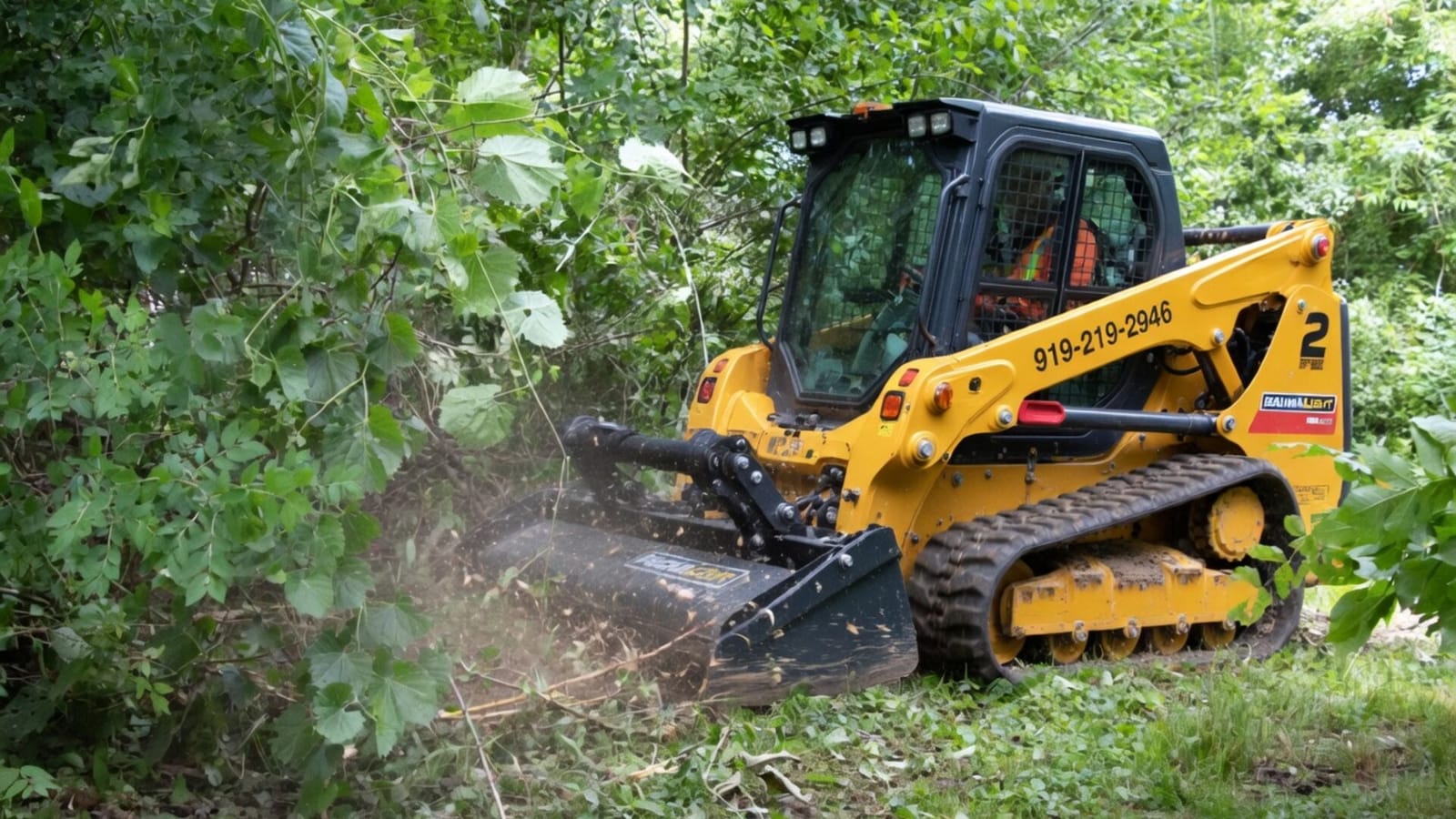
- Then cut and mulch. Once the tree is dead, our crew drops the stems and a forestry mulching pass grinds the colony, the saplings, and the brush around them. Dead Ailanthus is soft and mulches fast.
- Sweep for seedlings. Seedlings, as opposed to root suckers, pull easily when small and haven’t yet built the root system that makes the adult tree so stubborn. An annual walk-through or mowing pass handles them.
Pro tip: You can tell a seedling from a root sucker with one gentle pull. A seedling comes up with a little taproot; a sucker snaps off and stays connected to the mother root below. Seedlings you can pull and forget. Suckers mean there’s a live root system nearby that needs the treat-first sequence, not more pulling.
What Does Tree of Heaven Removal Cost in NC?
A typical tree of heaven colony on a field edge costs $150–$300 per hour for the treatment visit, then $1,000–$2,500 per acre for mulching the dead colony, with small single-tree jobs landing near most crews’ $800–$1,200 minimum. The two-visit structure is the price of doing it in the order that works.
| Work Phase | Typical Cost | Timing |
|---|---|---|
| Treatment visit (hack-and-treat or basal bark) | $150–$300 per hour | July–October |
| Mulching the dead colony and brush | $1,000–$2,500 per acre | 4–8 weeks after treatment |
| Large single trees near structures | Arborist territory, $500–$1,500+ per tree | After treatment |
| Seedling sweep or annual mowing | $75–$400 per acre | Each spring |
One honesty note: a big dead Ailanthus leaning over a house is a job for an insured tree service with rigging gear, and we’ll tell you so on the walk-through. Our lane is the colonies, field edges, and fence rows where machine work makes sense. Our land clearing pricing guide explains how we price mixed hand-and-machine jobs, and a free estimate gets you numbers for both phases up front.
Frequently Asked Questions
How do you kill tree of heaven permanently?
Treat the living tree with a systemic herbicide in the July-to-October window, wait for the roots to die, then cut and mulch. Permanence comes from killing the root system before any cutting happens. Cut first and you’ll spend years chasing suckers across half the property.
What happens if you just cut down a tree of heaven?
The roots respond by sending up dozens of suckers, often 30 to 50 feet from the stump, within weeks. We’ve walked properties near Creedmoor where one cut tree became a quarter-acre colony in two seasons. Cutting a live Ailanthus without prior treatment is the most expensive mistake you can make with this species.
Is tree of heaven the same as sumac?
No, and the confusion protects the invader. Native staghorn sumac has toothed leaflet edges and no offensive smell, and it’s a modest, wildlife-friendly shrub worth keeping. Tree of heaven has smooth leaflet edges with a couple of gland bumps at the base and reeks of rancid peanut butter when crushed. Check before you treat anything.
Should I remove tree of heaven because of spotted lanternfly?
If you have Ailanthus and you care about fruit trees, grapevines, or mature hardwoods nearby, yes, and sooner is better than later. The lanternfly is documented in several NC Piedmont counties and concentrates on tree of heaven wherever both occur. Removing the host now is far cheaper than fighting an established insect population later.
When is the best time of year for tree of heaven removal?
Mid-July through early October for the treatment, because that’s when the tree carries the herbicide down to its roots, then any time after the kill for the cutting and mulching. A colony treated in late summer near Hillsborough is typically ready for the machine work by fall, when the ground is firm.
How did tree of heaven get to North Carolina?
It was imported from China in the late 1700s as an ornamental and spread along railroads and roadsides ever since. It’s the same tree made famous by the novel “A Tree Grows in Brooklyn,” celebrated there for growing anywhere, which is exactly the trait that makes it a problem on your fence line.
Tree of Heaven Removal Across Central North Carolina
This is the invasive that punishes the obvious move, and rewards the patient one. Cut Brush handles tree of heaven removal across Central North Carolina, from field-edge colonies around Durham and Butner to fence rows near Roxboro, running the treat-then-cut sequence with the mulching and follow-up built in.
Get your free estimate or call (919) 525-3950. We respond within 24 hours, and if your Ailanthus is a yard tree over the roof instead of a colony in the field, we’ll point you to the right kind of crew honestly.
Related Services
Learn more about the services mentioned in this article.

Brush Clearing
Remove overgrown brush, shrubs, and small trees to reclaim your land.

Forestry Mulching
Single-step land clearing that mulches trees and brush in place.

Land Clearing
Full land clearing for residential and commercial development projects.

Invasive Species Removal
Identify and remove invasive plants that threaten native ecosystems.
Serving These Areas
We provide land clearing services in these towns and surrounding areas.
More from the Cut Brush Blog
Keep reading for more tips and guides on land clearing.
 Services
 Wisteria Removal in NC: How to Kill It and Save Your Trees
Wisteria removal in NC: how invasive Chinese wisteria strangles mature trees, why pulling vines fails, and what removal costs. Get a free estimate today.
Services How to Get Rid of Invasive Honeysuckle in NC
How to get rid of invasive honeysuckle in NC: identify Japanese and bush honeysuckle, why mowing fails, and what removal costs per acre. Get a free estimate.
Services Multiflora Rose Removal in NC: Reclaim Thorny Pasture
Multiflora rose removal in NC: how to get rid of the invasive thorn thickets choking pastures and fence lines, and what clearing costs. Get a free estimate.
Let's Get Started on Your Land
Request a free quote. We'll contact you to discuss your property, access, and the clearing you need.
Get a Free QuoteOr call us directly: (919) 525-3950