
How to Get Rid of Invasive Honeysuckle in NC
Cut Brush Team · August 16, 2026 · 8 min read

That sweet smell drifting over your fence line every May comes with a bill. Japanese honeysuckle is the most widespread invasive plant in North Carolina woodlots, and if you own a few acres anywhere in Central North Carolina, you almost certainly have it: green ropes braided through the fence, a knee-deep mat swallowing the woods’ edge, saplings bent double under vines. Figuring out how to get rid of invasive honeysuckle is less about any single treatment and more about understanding a plant that regrows from every scrap you leave behind.
This guide covers how to tell the two invasive honeysuckles apart from the native one worth keeping, why mowing and hand-pulling keep failing, the clearing sequence that actually works on acreage, and what honeysuckle removal costs per acre.
Which Honeysuckle Do You Have? Vine, Bush, or Native
Central North Carolina has two invasive honeysuckles, a climbing vine and an upright shrub, plus one native vine you should leave alone. Getting the ID right matters, because the removal plan is different for each.
| Trait | Japanese honeysuckle (invasive vine) | Bush honeysuckle (invasive shrub) | Coral honeysuckle (native, keep it) |
|---|---|---|---|
| Form | Twining vine, forms ground mats | Arching shrub, 6–15 feet tall | Well-behaved climbing vine |
| Flowers | White fading to yellow, strong fragrance | White to pink pairs along stems | Red trumpets, little scent |
| Berries | Black, on vines into fall | Bright red, clustered at leaf joints | Orange-red |
| Winter habit | Holds green leaves most of winter | Leafs out first in spring, drops last in fall | Semi-evergreen |
| Quick test | Ropes twisted around anything vertical | Snap a stem: hollow center means invasive | Blue-green paired leaves, no smothering |
The hollow-stem test settles the shrub question in seconds. Native shrubs have solid white pith; invasive bush honeysuckle stems are hollow between the joints.
Around older neighborhoods in Durham and Chapel Hill, we usually find both invaders on the same parcel: bush honeysuckle holding the understory and Japanese honeysuckle running the fences and treetops.
Why Does Honeysuckle Take Over NC Woodlots?
Japanese honeysuckle wins by cheating the calendar: it holds green leaves deep into winter and leafs out before native trees, so it photosynthesizes for weeks while everything around it sleeps. In the mild winters of the NC Piedmont, that head start compounds year after year.
The vine spreads two ways at once. Birds eat the berries and drop seed along every fence and field edge, and the runners root at each node that touches soil, so one plant becomes a colony without any help. A honeysuckle mat can put down hundreds of rooted points across a single backyard woodlot.
Left alone, the mat shades out wildflowers and tree seedlings, and the climbing vines girdle young trees the same way wisteria strangles mature ones. If your problem vines are woody and wrist-thick, read our wisteria removal guide instead; if they’re green, wiry, and everywhere, this is the honeysuckle playbook.
Why Mowing and Pulling Invasive Honeysuckle Fails
Mowing a honeysuckle mat without a follow-up plan is pruning, not removal: the roots respond by sending up denser, younger growth than you started with. Every landowner who has bush hogged a honeysuckle edge in June knows the sinking feeling of seeing it back by September.
Hand-pulling works on seedlings after rain, and that’s about it. Established Japanese honeysuckle breaks off at the crown when pulled, leaving the root to resprout, and mature bush honeysuckle shrubs are anchored by root systems that laugh at a weekend with loppers. Piedmont red clay makes it worse: dry, it grips roots like concrete.
There’s also a scale problem. Pulling vines off one arbor is a Saturday chore. An acre of infested understory has thousands of rooted stems, and no amount of weekend labor gets ahead of a plant that regrows from fragments. That’s the point where machine work stops being a luxury.
Pro tip: Honeysuckle’s winter greenery is a gift for treatment timing. On a mild December or January day in Central North Carolina, the invasive vine is one of the only green things in the woods, so a targeted follow-up treatment hits the honeysuckle and almost nothing else. We schedule follow-up visits in exactly that window.
The Clearing Sequence That Works on Acreage
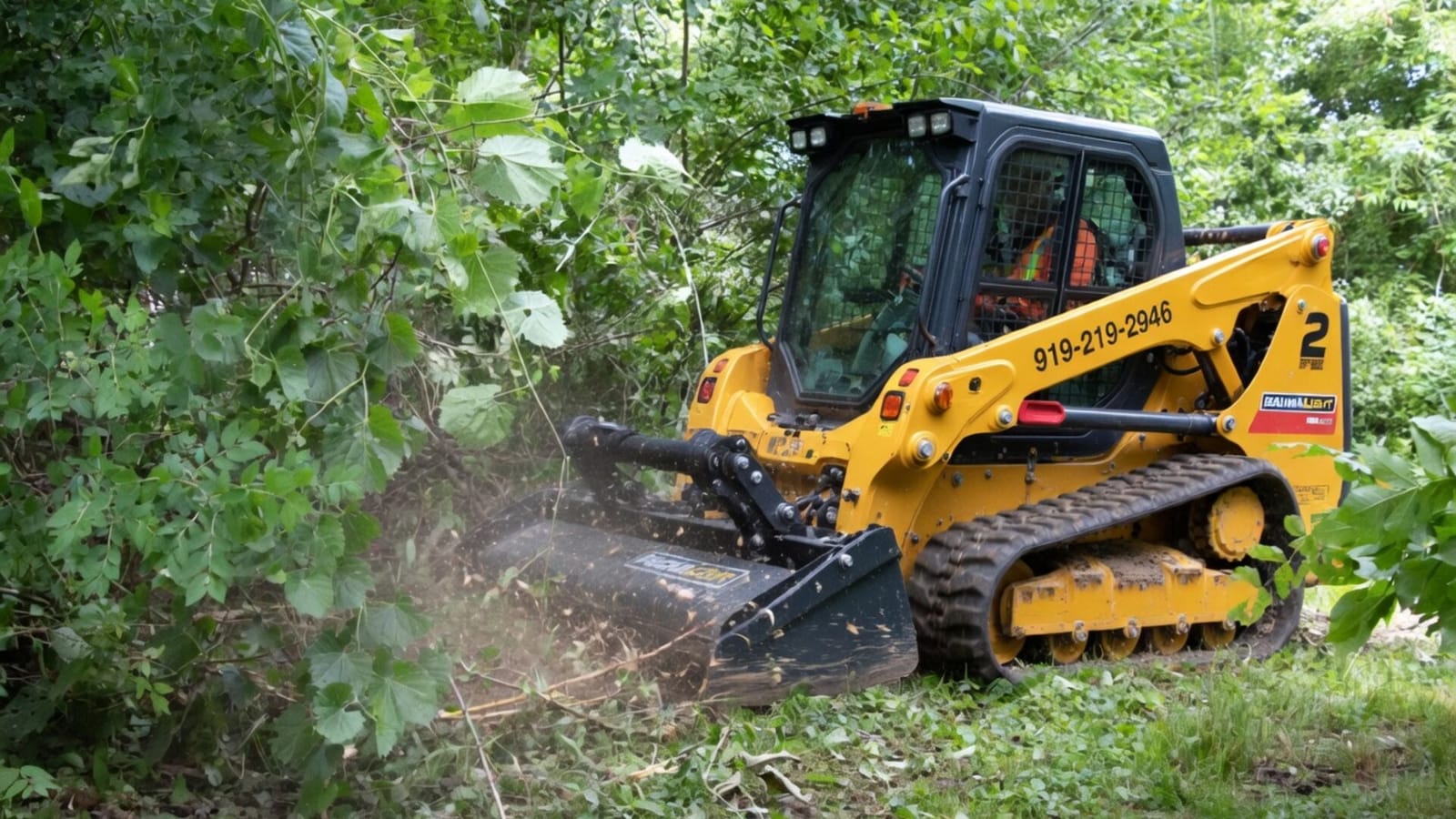
Getting rid of invasive honeysuckle at property scale takes three steps: mulch the mats and shrubs to ground level, treat the regrowth while it’s young, and repeat a short follow-up until the root reserves quit. Here’s how we run it:
- Mulch the infestation. A forestry mulching machine grinds the mats, the bush honeysuckle thickets, and the brush they’ve been hiding in, leaving a mulch layer instead of brush piles. Vines wound into the canopy get cut low so the tops die in place.
- Let it resprout, then treat. Honeysuckle will push new growth from the roots in 4–8 weeks. That young regrowth is the vulnerable stage, and treating it then drains the roots instead of just trimming them.
- Follow up 1–2 times. Most parcels need one or two short return visits over the following year. Each round is cheaper than the last because there’s less plant fighting back.
Fence lines deserve special mention, because honeysuckle is the number one reason Piedmont fences disappear into green walls. Our fence line clearing crews strip the wire without wrecking it, and an annual mowing pass keeps the line open once it’s clear.
What Does Honeysuckle Removal Cost in NC?
Honeysuckle removal in Central North Carolina typically runs $1,000–$2,500 per acre for the mulching pass, which sits at the lighter end of the standard $1,000–$3,500 forestry mulching range because honeysuckle is soft material. Dense bush honeysuckle understory with mixed brush prices toward the middle of the range.
| Job Type | Typical Cost | Notes |
|---|---|---|
| Mulching honeysuckle understory or mats | $1,000–$2,500 per acre | Soft growth mulches fast |
| Fence line stripping (hand and machine) | $150–$300 per hour | Priced by the line, not the acre |
| Follow-up regrowth visits | Fraction of initial cost, per visit | Usually 1–2 visits over a year |
| Small-lot minimum | $800–$1,200 | Applies under roughly half an acre |
Access moves the number more than the plant does. An open woodlot edge near Wake Forest mulches quickly; a backyard ravine with one gate and a slope takes longer. Our forestry mulching cost guide breaks down every factor, and our land clearing pricing guide shows where honeysuckle work sits alongside the rest.
Frequently Asked Questions
How do I get rid of honeysuckle permanently?
Cut or mulch it to the ground, treat the regrowth while it’s young, and repeat once or twice over the following year. Permanence comes from exhausting the roots and then shading the ground, because birds will keep delivering new seed to open, sunny edges. A mulched surface plus healthy regrowth of natives is the best long-term defense.
Is Japanese honeysuckle illegal to have in North Carolina?
No. Japanese honeysuckle is listed as invasive across the Southeast, but NC doesn’t require landowners to remove it. Removal is about protecting your own timber, fences, and pasture edges, and most of our honeysuckle calls in Clayton and surrounding towns come from owners tired of losing ground to it, not from any regulation.
Will goats get rid of invasive honeysuckle?
Goats will eat honeysuckle down to bare stems, but they don’t kill the roots, so the vine returns as soon as the goats leave. Grazing works as a knockdown ahead of treatment or as permanent maintenance if the goats stay. For a one-time reclamation, mulching plus follow-up finishes the job faster.
When is the best time of year to remove honeysuckle in NC?
Late fall through winter is the sweet spot. The invasive vine stays green after native plants go dormant, making it easy to spot and safe to treat, and firm winter ground is ideal for brush clearing equipment. Summer works fine for the initial mulching pass, with follow-up scheduled for the cold months.
How much does it cost to clear an acre of honeysuckle?
Plan on $1,000–$2,500 per acre for the mulching pass in Central North Carolina, plus modest per-visit charges for one or two follow-ups. Heavier mixed brush pushes toward $3,500. Request a free quote and we’ll walk the parcel and price both phases up front.
Does honeysuckle kill trees?
It can. Japanese honeysuckle girdles saplings and small trees as the vine tightens around growing trunks, and heavy mats can bend young trees to the ground. Mature trees usually survive the vine itself but lose their next generation, because no seedling makes it through an established honeysuckle mat.
Invasive Honeysuckle Removal Across Central North Carolina
Honeysuckle took your fence line one season at a time, and it gives ground the same way, to a crew that mulches, treats, and comes back. It’s also rarely alone; our guide to invasive plants in Central NC helps you identify its usual accomplices. Cut Brush handles invasive honeysuckle removal across Central North Carolina, from woodlot edges in Hillsborough and Durham to farm fences around Wake Forest and Clayton, as part of our invasive species removal service.
Get your free estimate or call (919) 525-3950. We respond within 24 hours with an honest read on what your acreage needs and what it will cost.
Related Services
Learn more about the services mentioned in this article.

Brush Clearing
Remove overgrown brush, shrubs, and small trees to reclaim your land.

Forestry Mulching
Single-step land clearing that mulches trees and brush in place.

Fence Line Clearing
Clear vegetation along fence lines to protect fences and improve access.

Invasive Species Removal
Identify and remove invasive plants that threaten native ecosystems.
Serving These Areas
We provide land clearing services in these towns and surrounding areas.
More from the Cut Brush Blog
Keep reading for more tips and guides on land clearing.
 Services
 Multiflora Rose Removal in NC: Reclaim Thorny Pasture
Multiflora rose removal in NC: how to get rid of the invasive thorn thickets choking pastures and fence lines, and what clearing costs. Get a free estimate.
Services Bamboo Removal in NC: How to Stop Running Bamboo
Bamboo removal in NC: why running bamboo escapes old privacy screens, which removal methods actually work, and what barriers cost. Get a free estimate today.
Services Chinese Privet Removal in NC: How to Stop It for Good
Chinese privet removal in NC: why this invasive shrub takes over fence lines, which removal methods work, and how to stop resprouting. Get a free estimate.
Let's Get Started on Your Land
Request a free quote. We'll contact you to discuss your property, access, and the clearing you need.
Get a Free QuoteOr call us directly: (919) 525-3950