
Wisteria Removal in NC: How to Kill It and Save Your Trees
Cut Brush Team · July 20, 2026 · 9 min read

Somebody planted that wisteria on purpose. Around historic towns like Hillsborough, Pittsboro, and Creedmoor, it went in on porches, arbors, and farmhouse fences generations ago, and for a few decades it behaved. Then the arbor rotted, the homestead changed hands, and the vine walked into the woods. Now you own a woodlot where purple blooms hang 40 feet up in the oaks each April, and the trees underneath them are dying. Wisteria removal is a different job than clearing ordinary brush, because this vine is woody, patient, and anchored to root crowns that have been building strength since your grandparents’ time.
This guide covers how to tell invasive Chinese and Japanese wisteria from the native American kind, how the vine actually kills mature trees, why yanking it down solves nothing, and what the cut-and-treat approach costs on a wooded acre.
Is Your Wisteria Invasive? Chinese and Japanese vs American Wisteria
Most wisteria running loose in Central North Carolina woodlots is invasive Chinese wisteria (Wisteria sinensis) or Japanese wisteria (Wisteria floribunda), not the native American species. The old homestead plantings around Hillsborough and Pittsboro were almost all Asian varieties, because that’s what nurseries sold for a century.
There is a native, better-behaved cousin, American wisteria (Wisteria frutescens), and it’s worth checking before you declare war. Here’s how to tell them apart:
| Trait | Chinese / Japanese Wisteria (invasive) | American Wisteria (native) |
|---|---|---|
| Bloom time | April, before or with leaf-out | June, after leaves emerge |
| Flower clusters | Long, drooping, 8–20 inches | Compact, 4–6 inches |
| Seed pods | Velvety, fuzzy | Smooth, hairless |
| Growth habit | Climbs 40+ feet, trunks thicken to several inches | Stays smaller, rarely swamps mature trees |
| Behavior | Escapes into woods, kills trees | Manageable on a trellis |
The quick field test: if it bloomed hard in early April before the leaves showed, and the vine trunks at the base are as thick as your wrist or bigger, you’re dealing with the invasive kind. American wisteria almost never builds that kind of wood.
How Does Wisteria Kill Mature Trees?
Wisteria kills trees by girdling: the vine wraps the trunk in a tightening spiral, and as both the tree and the vine grow thicker, the vine strangles the flow of water and nutrients under the bark. You can see it on any infested woodlot edge, spiral grooves carved into trunks like a screw thread.
Girdling is the slow kill. The fast one is weight. A mature wisteria vine loads a canopy with hundreds of pounds of woody stem and dense foliage, shades out the tree’s own leaves, and makes the whole top heavy. Central North Carolina’s summer thunderstorms and ice events finish the job, and we’ve cleared plenty of oaks around Chapel Hill and Pittsboro that came down with the vine still wrapped around them.
This is where wisteria differs from its faster cousin. Kudzu buries trees in a blanket of soft annual growth; wisteria climbs fewer trees but builds permanent wooden cables around them. Kudzu smothers. Wisteria strangles and topples. If your problem is a green blanket rather than twisted woody vines, start with our guide to kudzu removal in NC instead, and if it’s wiry green vines braided through fences and the understory, that’s invasive honeysuckle, because each playbook is different.
Why Pulling Wisteria Vines Down Isn’t Enough
Pulling wisteria out of trees without killing the root crowns accomplishes almost nothing, because the plant regrows from woody crowns at the soil line and from runners that root wherever they touch ground. A single old homestead vine can spread into a colony of dozens of crowns across a woodlot, all connected by ground-running stems.
Those crowns are the real enemy. Wisteria spreads slower than kudzu, but every year it stands, its root system gets woodier and harder to kill. A crown that’s been established since the 1970s will resprout for several seasons after a bare cut, pushing out 10-foot runners each summer.
There’s a safety problem with the pull-it-down approach, too. Ripping a woody vine out of a mature canopy tears off live limbs and drops heavy debris, and it often does more damage to the tree than another year of the vine would. That’s why our invasive species removal crews cut vines and leave the tops to die in place.
The Cut-and-Treat Approach That Actually Works
Killing wisteria takes a cut-vine-and-treat sequence: sever every climbing vine, treat every cut stump immediately, mulch the ground colony, and knock back resprouts for one to two growing seasons. Here’s how we run it on a typical old-homestead infestation:
- Cut a window in every climbing vine. Each vine gets cut twice, once near the ground and again at chest height, so the section between comes out and the vine can’t fuse back together. The upper vine stays in the tree and dies.
- Treat the stumps on the spot. The ground-side cut gets treated within minutes, while the cut is fresh. Skip this step and the stump resprouts like it was pruned, not killed.
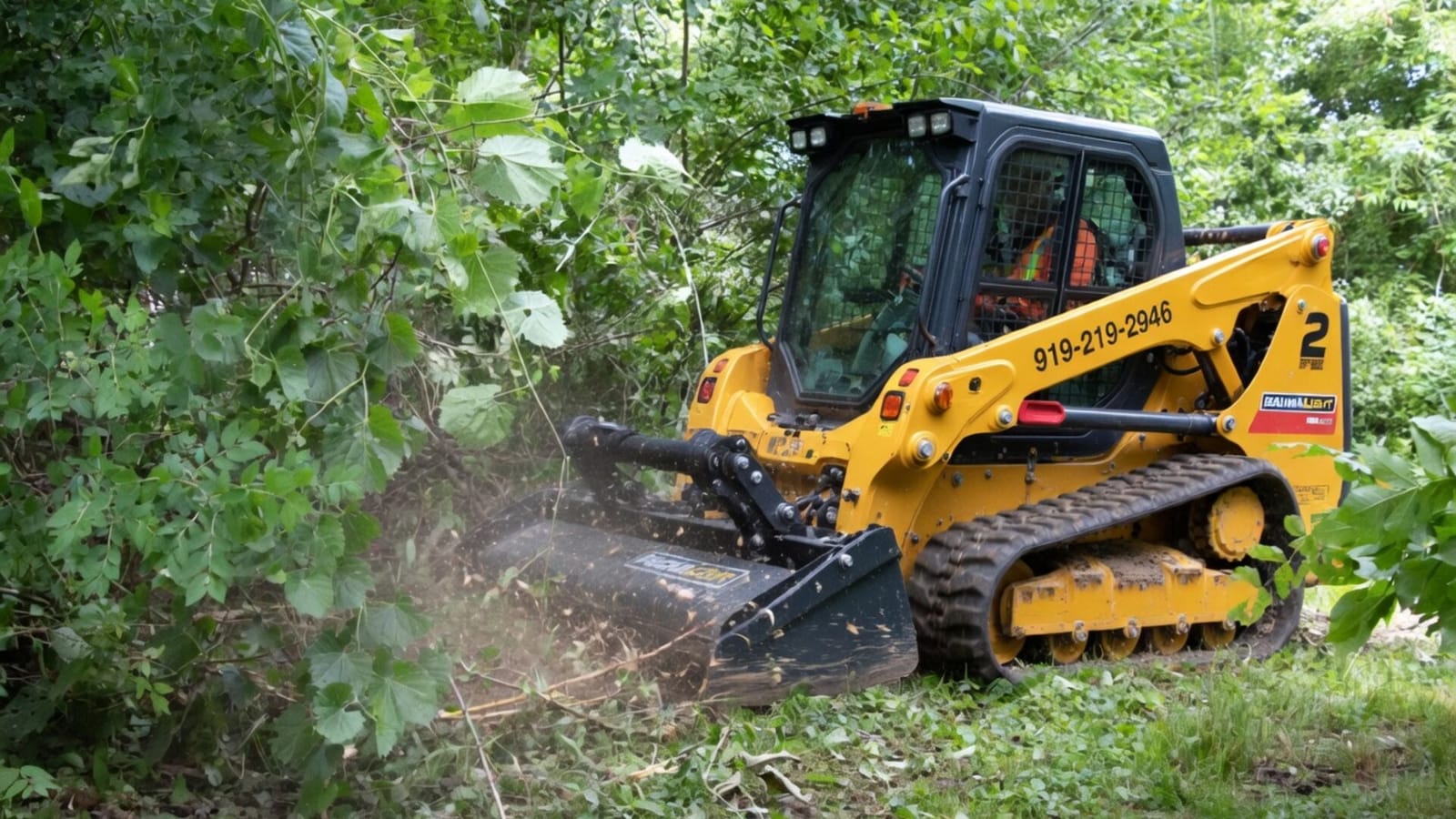
- Mulch the ground colony. A forestry mulching pass grinds the runners, rooted crowns, and the tangle of brush the wisteria has been hiding in, and leaves a mulch layer instead of a burn pile.
- Follow up through the next season or two. Old crowns will test you. Each resprout that gets cut or treated drains the root system a little more, and most colonies are done after 2–4 short follow-up visits.
Pro tip: Don’t compost or pile cut wisteria vines on bare soil, and don’t chip green runners into a shady corner. Like kudzu, wisteria stems can root where nodes touch moist ground. Mulching in place with a drum mulcher grinds the material too fine to re-root, which is one more reason it beats hand-clearing on a big colony.
The dead vines up in the canopy look rough for a season, then dry out, lose their grip, and drop in pieces. That’s the trade: one ugly winter in exchange for keeping the tree’s limbs intact.
Can You Save a Tree Already Wrapped in Wisteria?
Yes, most trees survive if the vine is cut before girdling closes the circle. A trunk with spiral grooves but healthy bark between them will usually recover once the vine dies and the constriction stops tightening. A trunk where the vine has fused into the bark all the way around is likely past saving, and it becomes a hazard-tree conversation instead.
The window matters. On the old farm parcels we work around Hillsborough and Creedmoor, the difference between a save and a loss is often just a few seasons. If the canopy still leafs out above the highest vine wrap, the tree is fighting and worth the rescue cut.
For specimen trees, the ones shading the old farmhouse, we slow down: hand cuts on every vine, no machine work inside the drip line where roots are shallow, and mulching only outside that circle. Saving the tree is the whole point of the job.
What Does Wisteria Removal Cost for a Wooded Acre?
For a wooded acre draped in wisteria in Central North Carolina, expect roughly $1,500–$3,500 for the mulching knockdown, plus hourly hand work on the trees you’re saving, typically $150–$300 per hour. Follow-up visits in later seasons cost far less and are quoted per trip.
| Work Phase | Typical Cost | Timeline |
|---|---|---|
| Cut-and-treat climbing vines (per wooded acre) | $150–$300/hr hand crew, often 1 day | Day 1 |
| Forestry mulching of ground colony and brush | $1,500–$3,500 per acre | 1–2 days |
| Follow-up resprout visits | Priced per visit, a fraction of the initial cost | 2–4 visits over 1–2 seasons |
Density drives the price. A single porch vine that jumped to three trees is a half-day job. An acre behind a Pittsboro farmhouse where the vine has had 40 years to colonize is the full sequence above. Our land clearing pricing guide breaks down how we price this kind of mixed hand-and-machine work, and if you want a real number for your parcel, request a free quote and we’ll walk it with you.
Frequently Asked Questions
How do I tell wisteria apart from kudzu?
Wisteria has woody, gray-brown stems that twist around trunks like cable and hang on year-round; kudzu is a soft, hairy green vine that dies back to brown strings every frost. If the vine on your tree is thick enough that you can’t snap it by hand in January, it’s wisteria.
Will wisteria grow back after you cut it?
Yes, unless every cut stump is treated and the resprouts are handled for a season or two. Untreated wisteria stumps resprout reliably, and buried runners send up new shoots along their whole length. The cut is the start of the kill, not the kill itself.
Is Chinese wisteria invasive in North Carolina?
Yes. Chinese and Japanese wisteria are both listed as invasive across the Southeast, and escaped homestead plantings are a common sight in the older landscapes around Hillsborough, Pittsboro, and Chapel Hill. American wisteria is the native alternative if you want the bloom without the war.
How long does it take to get rid of wisteria completely?
Plan on one to two growing seasons. The initial cut-and-treat plus mulching takes one to three days on a wooded acre, and old root crowns typically need 2–4 short follow-up visits before they quit. It’s faster than a kudzu campaign, but the woody crowns are individually tougher to kill.
Can wisteria damage my house or fence?
Yes. The same vines that girdle trees will pry siding, lift gutters, and rack a wooden fence as the stems thicken. Porch and arbor vines need a hard decision by the time their trunks pass an inch or two thick: commit to aggressive annual pruning or take them out. Wisteria also rarely runs alone; the same neglected edges usually hide privet, and our Chinese privet removal guide covers that fight.
When is the best time of year for wisteria removal?
Late fall through winter is prime: the vines are easy to trace without leaves, the ground is firm for equipment, and treating cuts in the dormant season still works on woody vines. Cutting just after the April bloom flush is a strong second choice, since the plant has just spent stored energy on flowers.
Wisteria Removal in Central North Carolina
That vine has a hundred-year head start, but it loses to a crew that cuts, treats, and comes back. Wisteria is also rarely the only invader on an old parcel; our guide to invasive plants in Central NC helps you spot what else moved in. Cut Brush handles wisteria removal across Central North Carolina, from historic in-town lots in Hillsborough and Pittsboro to old farm woodlots around Creedmoor and Chapel Hill. We save the trees that can be saved, grind the ground colony into mulch, and schedule the follow-up that finishes the roots.
Get your free estimate or call (919) 525-3950. We respond within 24 hours, and we’ll give you an honest read on which trees are worth the rescue and what the whole job costs.
Related Services
Learn more about the services mentioned in this article.


Serving These Areas
We provide land clearing services in these towns and surrounding areas.
More from the Cut Brush Blog
Keep reading for more tips and guides on land clearing.
 Services
 Tree of Heaven Removal in NC: Why You Don't Cut First
Tree of heaven removal in NC: identify the invasive Ailanthus, the spotted lanternfly link, why cutting first backfires, and what removal costs. Get a quote.
Services Kudzu Removal in NC: How Long It Takes and When to Cut
Kudzu removal in NC takes several growing seasons: a mulcher clears the mat, the crowns regrow, and return cuts wear them down. Timeline, calendar and costs.
Services How to Get Rid of Invasive Honeysuckle in NC
How to get rid of invasive honeysuckle in NC: identify Japanese and bush honeysuckle, why mowing fails, and what removal costs per acre. Get a free estimate.
Let's Get Started on Your Land
Request a free quote. We'll contact you to discuss your property, access, and the clearing you need.
Get a Free QuoteOr call us directly: (919) 525-3950