
What Is Forestry Mulching? A Complete Guide
Cut Brush Team · June 27, 2026 · 8 min read

Forestry mulching is a single-machine land clearing process that grinds standing trees, brush, and stumps into mulch on-site in one pass. One machine drives onto your property, shreds the vegetation where it stands, and leaves a protective layer of mulch instead of bare dirt and burn piles. Nothing gets hauled away, and nothing gets burned.
If you’ve been searching “what is forestry mulching” after a contractor mentioned it, or after watching a machine chew through a pine thicket in a video, this guide covers the whole picture. We run forestry mulchers across Central North Carolina every week, from quarter-acre backyards in Raleigh to multi-acre tracts in Johnston and Chatham counties.
Below you’ll learn how the machine actually works, what it can and can’t handle, how it stacks up against traditional clearing, and when it’s the right tool for your land.
What Is a Forestry Mulcher and How Does It Work?
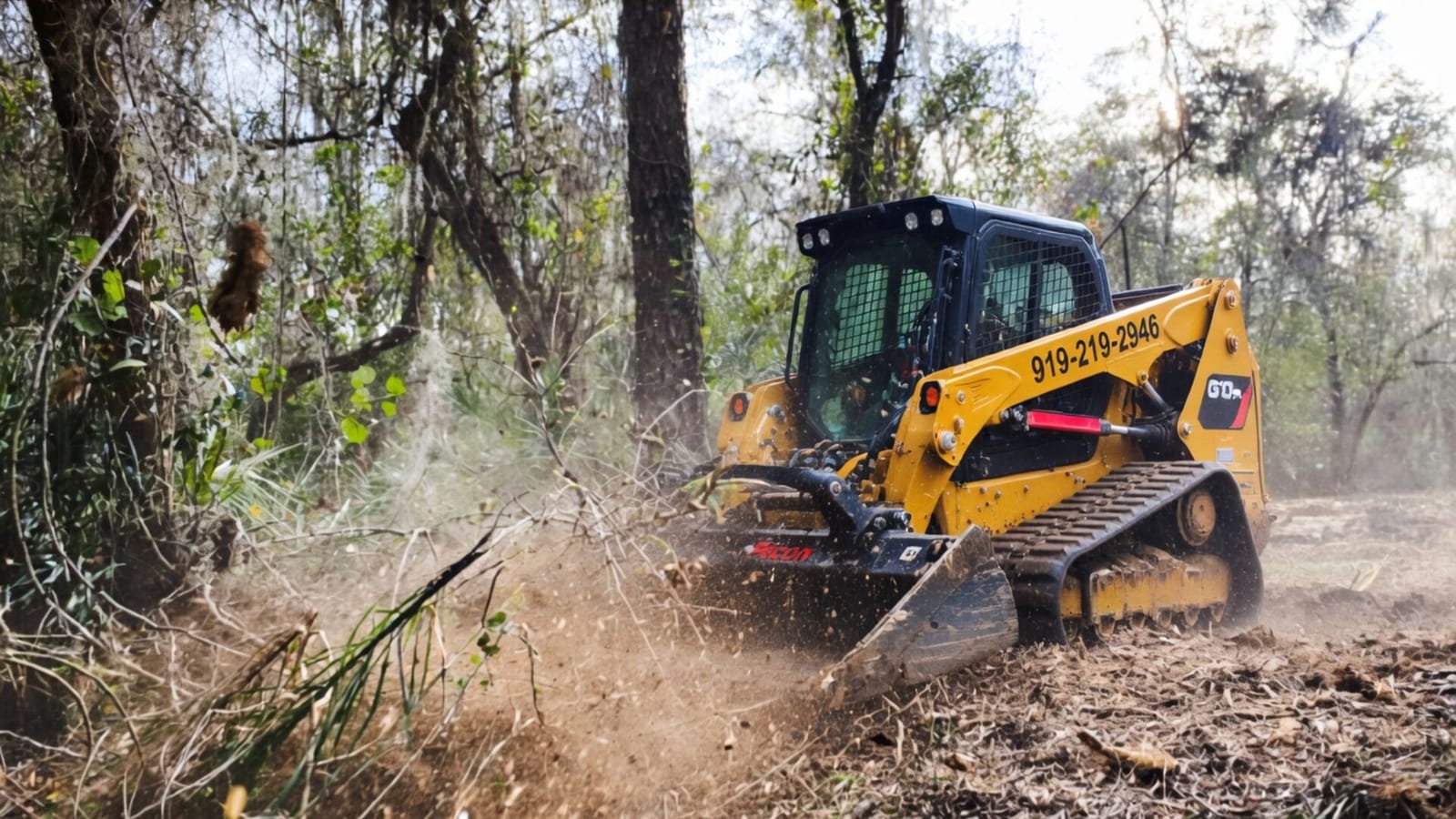
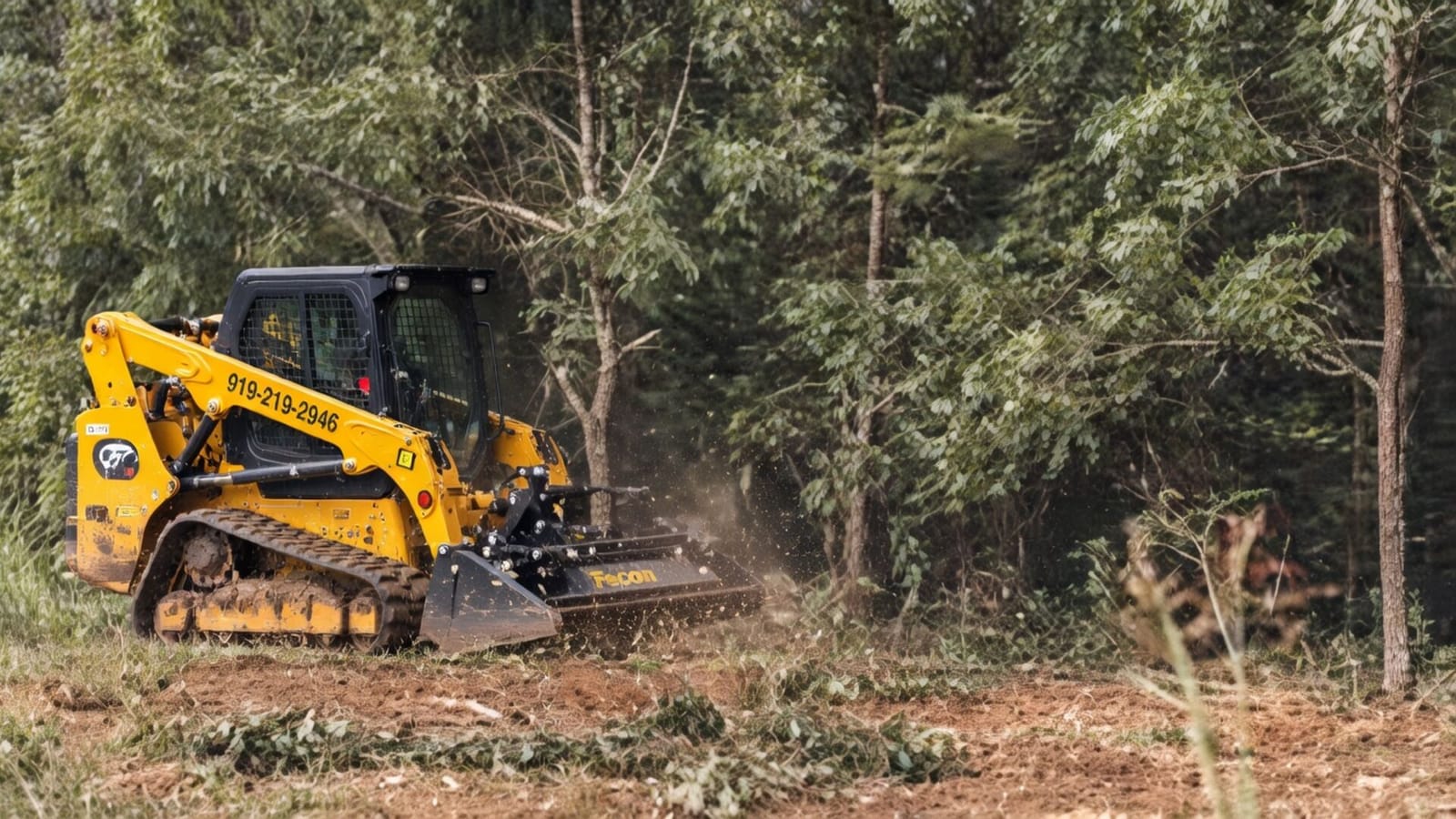
A forestry mulcher is a steel drum covered in carbide teeth that spins at high speed and shreds vegetation on contact. The drum mounts on the front of a tracked skid steer or the arm of an excavator and runs off the machine’s hydraulic system. It’s the same equipment behind our forestry mulching service.
The process is simple to watch and hard to look away from. The operator drives up to a tree, pushes it over or grinds it from the top down, and processes the trunk and limbs into chips in minutes. Then the drum drops to ground level and grinds the stump flush.
The operator works the property in overlapping passes, the way you’d mow a field. Light brush disappears at near walking speed. Mid-size trees take a few minutes each. When the machine leaves, the land is open, walkable, and covered in a 2–4 inch layer of mulch.
We run drum mulchers on high-flow tracked machines because they handle the Central North Carolina mix well: loblolly pine, sweetgum, eastern red cedar, and the dense understory that fills in around them. The wide tracks also spread the machine’s weight, so it works on soft ground without leaving deep ruts.
What Can Forestry Mulching Handle?
A forestry mulcher handles brush, vines, briars, saplings, and trees up to about 8 inches in diameter as routine work. Trees in the 10–12 inch range are still doable, just slower: the operator may fell them first and then process them on the ground. Anything bigger usually gets cut with a saw before the mulcher cleans up what’s left.
That range covers most of what takes over neglected land in our region: Chinese privet, Japanese honeysuckle, blackberry, cedar, sweetgum saplings, and young pine. If your property is mostly thick shrub growth rather than standing trees, that’s classic brush clearing work, and a mulcher makes fast work of it.
Just as important is what a forestry mulcher does not do:
- It doesn’t pull roots out of the ground. Stumps get ground to grade or slightly below, but the root system stays in the soil.
- It doesn’t move or grade dirt. There’s no blade or bucket involved.
- It doesn’t salvage timber. Trees become mulch, not lumber, so valuable mature hardwoods are usually logged before mulching.
Knowing those limits is the key to deciding whether mulching fits your project, which we’ll get to below.
Forestry Mulching vs. Traditional Land Clearing
Traditional land clearing uses an excavator and bulldozer to rip vegetation out by the roots, pile it, and then burn it or truck it away. Forestry mulching replaces that whole chain with one machine and one pass. Here’s how the two methods compare at a glance:
| Factor | Forestry Mulching | Traditional Clearing |
|---|---|---|
| Equipment on site | One machine | Excavator, dozer, dump trucks |
| Passes over the land | One | Multiple |
| Debris | Ground into mulch, stays on-site | Burned or hauled to a landfill |
| Burn permits and haul fees | None | Often required |
| Soil disturbance | Minimal, topsoil stays intact | Heavy, bare dirt exposed |
| Erosion control | Mulch layer protects the soil | Silt fence and seeding usually needed |
| Typical Central NC cost | $1,000 – $3,500 per acre | $2,500 – $6,000+ per acre |
| Build-ready foundation pad | Needs grading afterward | Closer to build-ready |
Neither method wins every job. Traditional clearing earns its cost when a site must be 100 percent root-free for a foundation or septic field. For everything else, mulching is usually faster, cheaper, and far easier on the land. For a deeper side-by-side, read our comparison of forestry mulching vs bulldozer land clearing.
The Benefits of Forestry Mulching
The biggest forestry mulching benefits come from what the process skips: no burn piles, no dump trucks, no bare dirt. Here’s what that means in practice for a Central North Carolina property:
- Lower cost. One machine and zero disposal fees keep the price down. Debris hauling alone can add thousands to a traditional clearing job.
- Faster timeline. Most residential jobs finish in 1–3 days, because there’s no waiting on burn windows or truck rotations.
- Built-in erosion control. Our red clay washes badly when it’s stripped bare. The mulch layer shields the soil from hard Piedmont rains, which matters even more on lots near creeks or inside the Falls Lake and Jordan Lake watersheds.
- Selective clearing. The operator can grind the privet and sweetgum while steering around the oaks and dogwoods you want to keep.
- Healthier soil over time. The mulch breaks down and feeds organic matter back into the ground, instead of leaving compacted subsoil behind.
- Light footprint. Tracked machines exert low ground pressure, so yards, trails, and pasture edges aren’t torn up in the process.
Pro tip: Before the crew arrives, walk your property with a roll of flagging tape and mark every tree you want to keep. A clear keep-or-clear plan lets the operator move fast and saves you from staring at a stump where your favorite shade tree used to be.
When Is Forestry Mulching the Right Choice?
Forestry mulching is the right choice when you want overgrown land opened up and usable without hauling debris off-site or tearing up the soil. That covers most of the calls we get across Central North Carolina:
- Reclaiming an overgrown backyard or unused lot in Raleigh or Cary
- Knocking back brush and saplings on pasture, fence lines, and field edges
- Cutting trails and access lanes through wooded acreage
- Opening up hunting land, food plots, and shooting lanes
- Thinning understory around a homesite for visibility and fire safety
It’s the wrong tool when your project needs root-free, graded soil, like a house pad, garage slab, or septic field. Mulching still handles the clearing step on those jobs, but an excavation contractor grubs the roots and grades the pad afterward. It’s also not the answer for harvesting mature timber, since the mulcher turns trees into chips rather than logs.
Not sure which side of that line your project falls on? Request a free quote and we’ll look at your property and give you a straight answer.
Frequently Asked Questions
Is forestry mulching cheaper than traditional land clearing?
Yes, in most cases. Forestry mulching runs $1,000 – $3,500 per acre in Central North Carolina, while traditional grub-and-haul clearing often lands at $2,500 – $6,000+ per acre once trucking and disposal are counted. One machine, one pass, and no haul-off fees keep the total down.
How big of a tree can a forestry mulcher cut?
Up to about 8 inches in diameter as standard work, with 10–12 inch trees possible at a slower pace. That range covers the young loblolly pine and sweetgum that dominate overgrown lots around Apex and the rest of the Triangle. Larger hardwoods get felled with a saw first, then the mulcher processes the tops and grinds the stump.
What happens to the mulch left behind?
It stays on the ground as a 2–4 inch layer that suppresses regrowth, holds the soil in place, and slowly turns into topsoil. In North Carolina’s humid climate, most of it breaks down within 1–3 years. You can seed right through it, spread it thinner, or simply let it work.
Can you build on land cleared by forestry mulching?
For driveways, pasture, trails, and recreation, yes, right away. A house foundation is different: the mulch gets stripped off and the pad graded to compacted bare soil before any concrete is poured. We break down exactly which uses are mulch-ready in our guide to whether you can build on mulched land.
How long does forestry mulching take?
Most crews clear about 1 acre per day in medium-density growth, and 2–3 acres per day in light brush. A typical overgrown half-acre backyard is usually finished in a single morning, including stump grind-down and cleanup passes.
Ready to See What Forestry Mulching Can Do for Your Land?
Now you know what forestry mulching is: one machine, one pass, and an overgrown property turned back into usable land with the soil still protected. It’s the method we’ve built our business on, and we run it every week on properties in Raleigh, Cary, Apex, Clayton, and across Central North Carolina.
If you’ve got a lot, field, or wooded tract that needs opening up, get a free estimate or call us at (919) 525-3950. We’ll walk the property with you, flag what stays and what goes, and respond to every request within 24 hours.
Related Services
Learn more about the services mentioned in this article.


Serving These Areas
We provide land clearing services in these towns and surrounding areas.
More from the Cut Brush Blog
Keep reading for more tips and guides on land clearing.
 Guide
Guide Jordan Lake Watershed Land Clearing: Buffer Rules by Town
Near Jordan Lake, your town or county runs the stream buffer, not the state. 50 feet is the floor, Cary and Apex go to 100, and unlisted clearing is barred.
 Guide
Guide Clearing Sloped Land in NC: Machine Limits and Rules
Clearing sloped land in NC: tracked machines are held near 40% grade, permitted slopes steeper than 3:1 need cover in 7 days, and steep lots get wider buffers.
Guide Can You Build on Mulched Land? NC Footing and Slab Rules
Yes, but not on the mulch. NC footing trenches must be clear of roots, debris and loose soil, and slabs need stone or engineered fill. What to clear first.
Let's Get Started on Your Land
Request a free quote. We'll contact you to discuss your property, access, and the clearing you need.
Get a Free QuoteOr call us directly: (919) 525-3950