
Autumn Olive Removal in NC: Kill the Old Farm Invader
Cut Brush Team · August 16, 2026 · 7 min read

Autumn olive was a government recommendation before it was a problem. From the 1950s through the 1980s, conservation agencies handed out seedlings across the Southeast for erosion control and “wildlife habitat,” and farm families planted them in good faith along field edges and old terraces. Fifty years later, autumn olive removal is one of the most common jobs on the idle farmland we clear across Central North Carolina, because those helpful hedgerows turned into 20-foot thickets that swallow whole field edges and shrug off every attempt at cutting.
This guide covers how to identify autumn olive by its silver leaves, why it spreads faster than almost any other shrub on old farms, why cutting alone makes it angry instead of dead, and what removal costs per acre.
How Do I Identify Autumn Olive?
Flip a leaf over: autumn olive leaves are green on top and unmistakably silver underneath, and on a breezy day a whole thicket flashes silver from a hundred yards away. No other common shrub on a Piedmont farm edge does that.
| Trait | Autumn olive | Chinese privet | Multiflora rose |
|---|---|---|---|
| Leaf underside | Bright silver, scaly | Plain green | Green |
| Flowers | Pale yellow tubes, April–May, sweet smell | White sprays, May | White clusters, May–June |
| Fruit | Red berries speckled with silver dots, fall | Dark blue-black berries | Small red hips |
| Form | Arching shrub or small tree, 15–20 ft | Dense hedge thicket | Thorny arching canes |
| Stems | Often with sharp spur thorns | Smooth | Heavily thorned |
The silver-speckled red berries are the second giveaway, and they’re the engine of the invasion. One mature shrub produces up to 200,000 seeds a year, birds strip the branches every fall, and every fence line and field edge downstream gets planted for free. The berries are actually edible for people too, but no amount of jam-making keeps up with a thicket.
There’s a hidden problem under the soil as well. Autumn olive fixes its own nitrogen, which sounds like a benefit until it changes the soil chemistry of a field edge and gives fertilizer-loving weeds the upper hand over the natives that belong there.
On the old tobacco and cattle land we work around Youngsville, Franklinton, and Bunn, autumn olive is usually the biggest woody thing on the field edge, standing over the privet and rose that moved in with it.
Why Does Cutting Autumn Olive Make It Worse?
A cut autumn olive stump responds by throwing up a ring of vigorous new sprouts, so a chainsaw session without follow-up turns one trunk into a ten-stem thicket by the next summer. Extension programs across the Southeast list it among the most stubborn resprouters on the farm.
Burning gives the same result: the tops die and the root collar sends up a fresh, denser flush. Bush hogging young stands works only if you keep mowing several times a season, every season, indefinitely, because any break in the schedule lets the root systems win the exchange.
Hand-pulling has a real but narrow role. Seedlings up to a couple of feet tall pull cleanly from moist ground, roots and all, and a landowner who walks the field edges each spring can keep new arrivals from establishing. The mature shrubs are past that stage; their root systems anchor too deep in the clay.
Pro tip: Late August through October is the kill window for autumn olive in North Carolina. That’s when the shrub pulls energy down into its roots for winter, so a cut-stump or foliar treatment made now rides that flow down and kills the whole root system instead of just the top. If you’re reading this in late summer, you’re reading it at exactly the right time to schedule the work.
The Removal Sequence for Autumn Olive Thickets
Effective autumn olive removal pairs mechanical clearing with same-day stump or regrowth treatment, timed for late summer or fall when the plant moves energy to its roots. Here’s how we run it on a field edge:
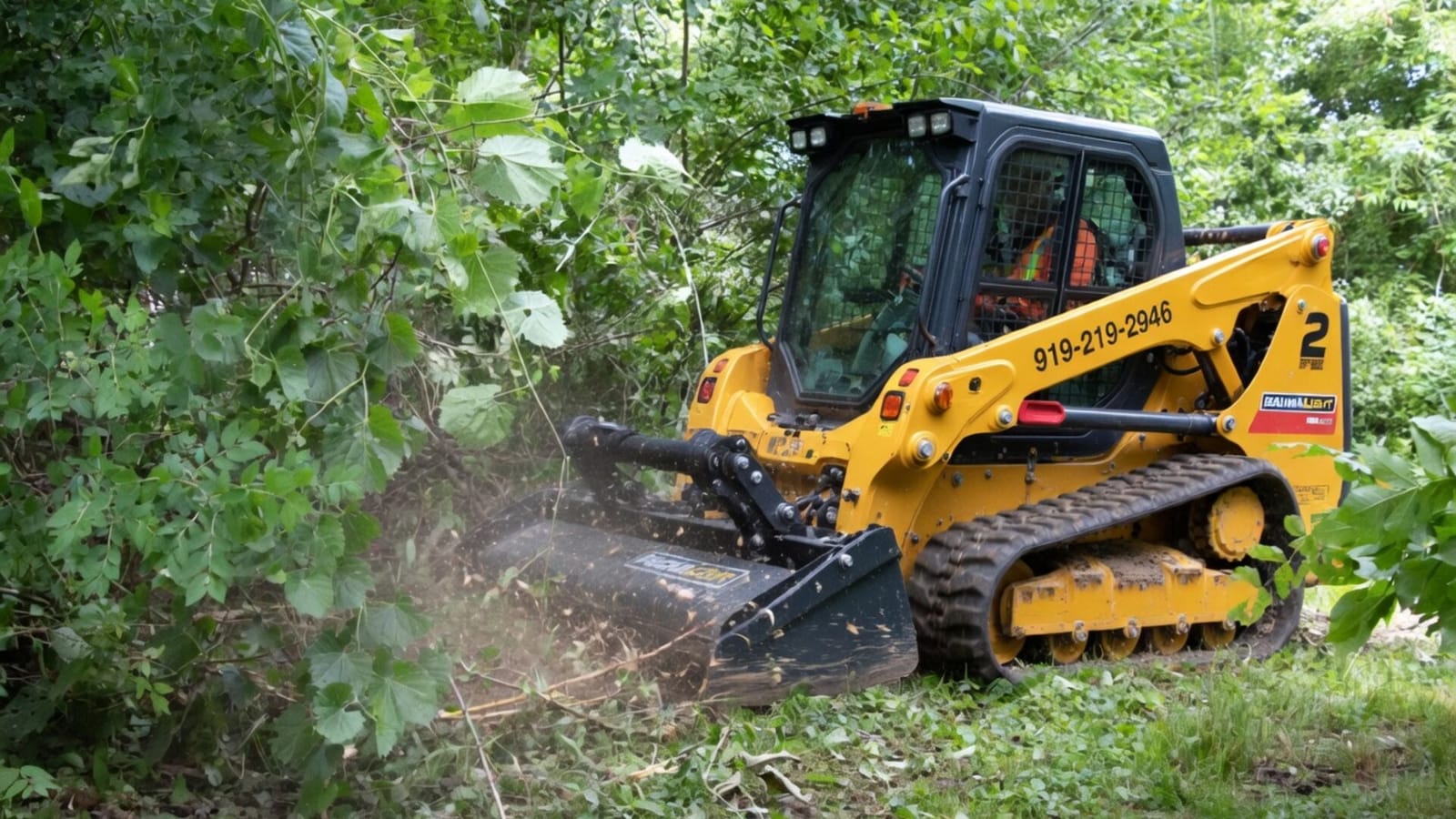
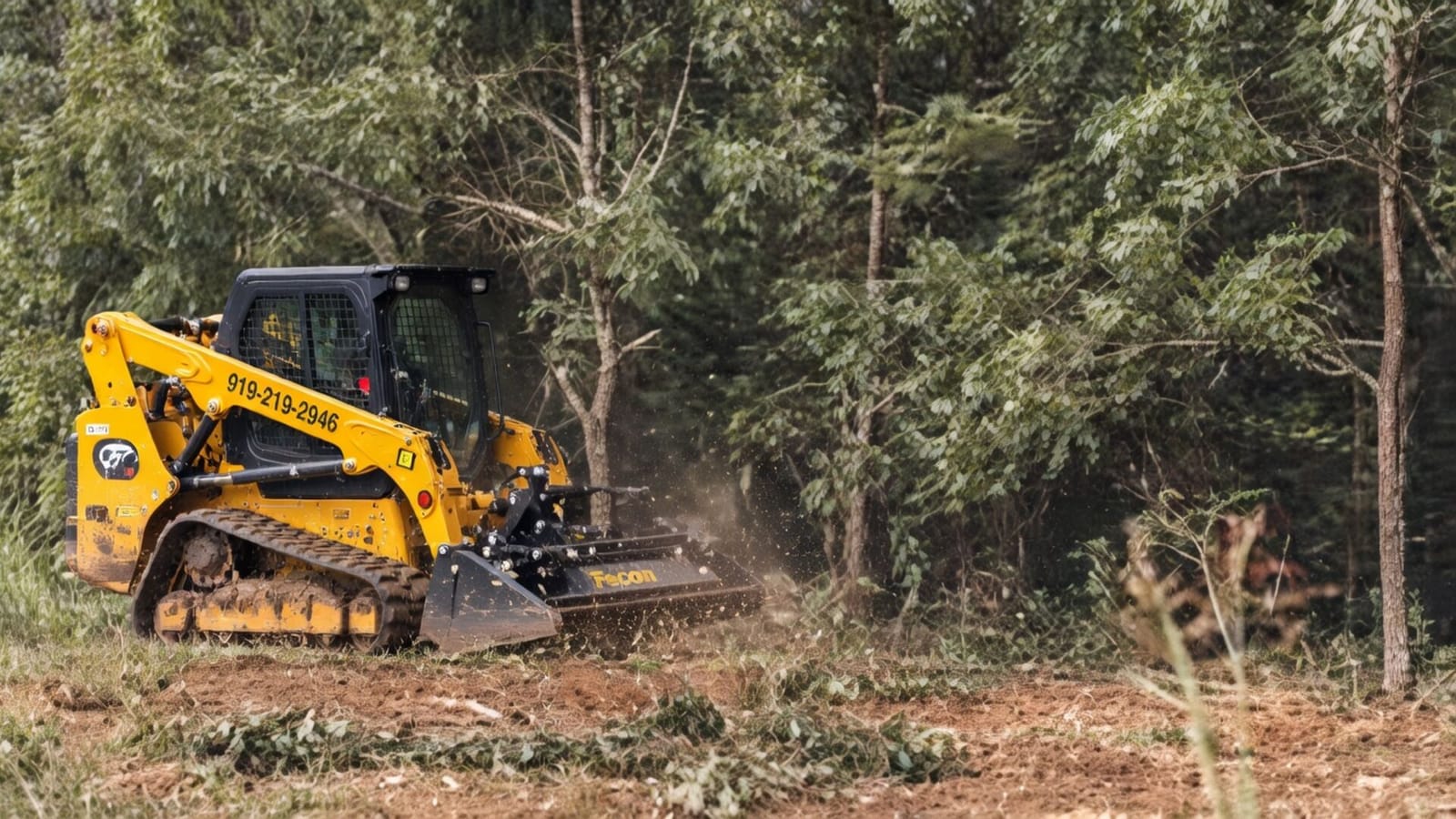
- Mulch the thicket. A forestry mulching pass grinds the shrubs, spur thorns and all, into a mulch layer. Big thickets that took decades to build come down in hours.
- Treat the stumps and resprouts. Fresh-cut stumps get treated on the spot in the fall window. Any regrowth that appears later gets a follow-up treatment while it’s soft and vulnerable.
- Mow the edges annually. Birds will keep delivering seed from every untreated thicket in the neighborhood. An annual brush hogging pass at $75–$400 per acre takes out seedlings before they get woody, which is the difference between a cleared field and a briefly interrupted invasion.
If the autumn olive is one player in a bigger mess, which is the usual situation on land idle for a decade, the multiflora rose along the fence and the sweetgum coming up through the middle get handled in the same mobilization. Our guide to reclaiming an overgrown pasture covers that whole-field picture.
What Does Autumn Olive Removal Cost in NC?
Mulching autumn olive runs $1,000–$3,500 per acre in Central North Carolina, with typical field-edge infestations landing in the $1,500–$2,500 middle of the range. Scattered shrubs across open ground price low; a continuous 20-foot hedgerow thicket prices toward the top.
| Situation | Typical Cost | Timeline |
|---|---|---|
| Scattered shrubs in open field | $1,000–$1,800 per acre | Hours |
| Continuous field-edge thicket | $1,500–$2,500 per acre | 1 day for most edges |
| Mixed reclamation (olive, rose, sweetgum) | $1,500–$3,500 per acre | 1–2 days |
| Fall stump treatment and follow-up | Fraction of initial cost, per visit | 1–2 visits |
| Annual seedling mowing | $75–$400 per acre | Half a day |
Access and density set the price, and our land clearing pricing guide walks through both. For a real number, request a free estimate and our crew will contact you to discuss the field edge.
Frequently Asked Questions
How do you get rid of autumn olive permanently?
Mulch or cut the shrubs, treat the stumps the same day, and follow up on regrowth for a season, with the treatment timed for late summer or fall when energy flows to the roots. Then mow annually so bird-dropped seedlings never mature. Skipping the stump treatment is the classic failure; a cut without it just resets the thicket.
Why was autumn olive planted on purpose?
Conservation agencies promoted it from the 1950s onward for erosion control, mine reclamation, and wildlife food, and it was cheap and nearly indestructible, which is exactly why it became a problem. Many of the thickets on old farms around Roxboro and Franklinton are the direct descendants of those plantings.
Can you eat autumn olive berries?
Yes, the ripe red berries are edible and rich in lycopene, and some people make jam from them. That doesn’t slow the invasion; one shrub makes up to 200,000 seeds a year and the birds get most of them. Harvest what you like in September, then take the thicket out.
Will goats control autumn olive?
Goats browse it and will suppress a thicket while they’re on it, but the shrubs resprout when grazing stops, and the silver leaves are low on their preference list compared to greenbrier and rose. Grazing is a maintenance tool; removal takes the mulch-and-treat sequence.
What’s the difference between autumn olive and Russian olive?
They’re close cousins with the same silver foliage, but autumn olive is the one you almost certainly have in North Carolina; Russian olive is rare in the Southeast. Autumn olive has red speckled berries, Russian olive has mealy yellow-silver ones. The removal approach is identical either way.
How fast does autumn olive spread?
Fast enough to claim a field edge in under a decade. A shrub fruits within a few years of sprouting, birds carry the seed to every perch line, and the nitrogen it adds to the soil helps its own seedlings outgrow the natives. Around Middlesex and Bunn we regularly clear hedgerows that didn’t exist fifteen years ago.
Autumn Olive Removal Across Central North Carolina
The agency that recommended autumn olive isn’t coming back to remove it, but we will. Cut Brush clears autumn olive thickets across Central North Carolina’s farm country, from Franklin County field edges around Youngsville and Bunn to Person County land near Roxboro, as part of our invasive species removal service, with the fall treatment window worked into the schedule.
Get your free estimate or call (919) 525-3950. We respond within 24 hours, and late summer bookings land right in the kill window.
Related Services
Learn more about the services mentioned in this article.

Forestry Mulching
Single-step land clearing that mulches trees and brush in place.

Land Clearing
Full land clearing for residential and commercial development projects.

Brush Hogging
Heavy-duty mowing for overgrown fields, pastures, and large lots.

Invasive Species Removal
Identify and remove invasive plants that threaten native ecosystems.
Serving These Areas
We provide land clearing services in these towns and surrounding areas.
More from the Cut Brush Blog
Keep reading for more tips and guides on land clearing.
 Services
 Multiflora Rose Removal in NC: Reclaim Thorny Pasture
Multiflora rose removal in NC: how to get rid of the invasive thorn thickets choking pastures and fence lines, and what clearing costs. Get a free estimate.
 Services
 Eastern Red Cedar Removal in NC: Reclaim Your Field
Eastern red cedar removal in NC: why cedars take over idle pasture, why they don't resprout from stumps, removal costs, and when to leave a few. Free estimate.
Services Tree of Heaven Removal in NC: Why You Don't Cut First
Tree of heaven removal in NC: identify the invasive Ailanthus, the spotted lanternfly link, why cutting first backfires, and what removal costs. Get a quote.
Let's Get Started on Your Land
Request a free quote. We'll contact you to discuss your property, access, and the clearing you need.
Get a Free QuoteOr call us directly: (919) 525-3950