
Eastern Red Cedar Removal in NC: Reclaim Your Field
Cut Brush Team · July 15, 2026 · 10 min read

You stopped mowing the back field a few years ago, and now dozens of stiff, green Christmas-tree shapes are marching across it. They started as ankle-high seedlings you barely noticed. Now the biggest ones are over your head, the grass underneath them is thinning out, and the field you used to hay or graze is turning into a cedar thicket. If you own land around Middlesex, Kenly, Bunn, or Zebulon, eastern red cedar removal is one of the most common reclamation jobs out here in the rural east.
Here’s the good news up front: cedars are actually easier to beat than privet or sweetgum, because a cut cedar does not grow back. Kill the top and you’ve killed the tree. This guide covers why cedars colonize idle pasture, why they cause real problems, how removal works, what a cedar-choked field costs to clear, and why you might want to leave a few of the big ones standing.
Why Do Eastern Red Cedars Take Over Idle Pasture?
Eastern red cedar is a native pioneer tree that colonizes any pasture or field the mowing stops on, because birds spread its berries everywhere and the seedlings thrive in full sun on worn-out ground. It isn’t a foreign invader like kudzu or privet. It’s a North Carolina native that simply does what pioneer species do: it grabs open, disturbed land first.
The spread comes down to birds. Cedar produces small blue-gray berries that cedar waxwings, robins, and mockingbirds strip off all winter, then drop the seeds along fence lines, under power lines, and across open fields. Every perch becomes a planting site.
Those seeds love exactly the conditions an idle pasture offers: full sun, thin competition, and the acidic, compacted red clay common across Nash, Johnston, and Franklin counties. Cedar shrugs off drought and poor soil that would stall other trees.
Left alone, the sequence is predictable. Broomsedge and briars take the field first, and cedar seedlings push up through them within a few years. This is the same old-field succession we cover in our guide to reclaiming an overgrown pasture in NC – cedar is just one of the first woody players to show up. Thorny wild callery pear runs the same play on many Piedmont fields, and our Bradford pear removal guide covers that invader.
Why Are Eastern Red Cedars a Problem in a Field?
A field full of eastern red cedar loses grazing and hay value, spreads a fungus that damages nearby apple and pear trees, builds dangerous fire fuel, and worsens seasonal allergies. A few scattered cedars are harmless. A field taking them on by the dozen is a working pasture slipping away.
Here’s what a cedar takeover actually costs a landowner:
- Lost forage. Cedars cast dense, year-round shade and their dropped needles acidify the soil beneath them, so fescue and bermuda thin out under and around each tree. More cedars mean less grass.
- Cedar-apple rust. Eastern red cedar is the alternate host for a fungus that needs both cedar and apple trees to complete its life cycle. If you or a neighbor has an orchard or backyard apple and pear trees, nearby cedars spread the orange galls that scab the fruit and spot the leaves.
- Fire ladder fuel. Cedar foliage is loaded with volatile oils and burns hot and fast. A cedar growing up under or beside larger trees acts as a “ladder,” carrying a low grass fire up into the canopy. That matters on rural parcels with structures nearby.
- Allergies. Cedar and juniper pollen is a well-known irritant, and a field full of mature cedars pumps out a lot of it in late winter.
Pro tip: Walk your field in winter and count the cedars before they hide in green-up. Cedar is one of the only things in an eastern NC field still solid green in January, so a cold-weather walk gives you an honest map of how far the takeover has gone. Small ones you miss in July stand out plainly against brown broomsedge.
What’s the Best Way to Remove Eastern Red Cedar?
The best way to remove eastern red cedar from a field is to cut or mulch it at ground level, and because cedar does not resprout from the stump, that single cut kills the tree for good. This is the big advantage cedar gives you. With privet, sweetgum, or kudzu, cutting is only step one and the roots fight back for years. With cedar, the cut is the whole job.
Here’s how the common removal methods compare for a cedar-choked field:
| Method | Best For | Effectiveness | The Catch |
|---|---|---|---|
| Hand cutting with a saw | A handful of scattered cedars | High – no resprout | Slow and brutal past a few dozen trees |
| Brush hogging | Seedlings and whips under ~2” | Moderate | Bounces off anything wrist-thick or bigger |
| Forestry mulching | Dense fields of cedar up to 8” | High – grinds and kills in one pass | Needs machine access to the field |
| Dozer or grubbing | Total clearing for construction | High | Bare soil, erosion, higher cost |
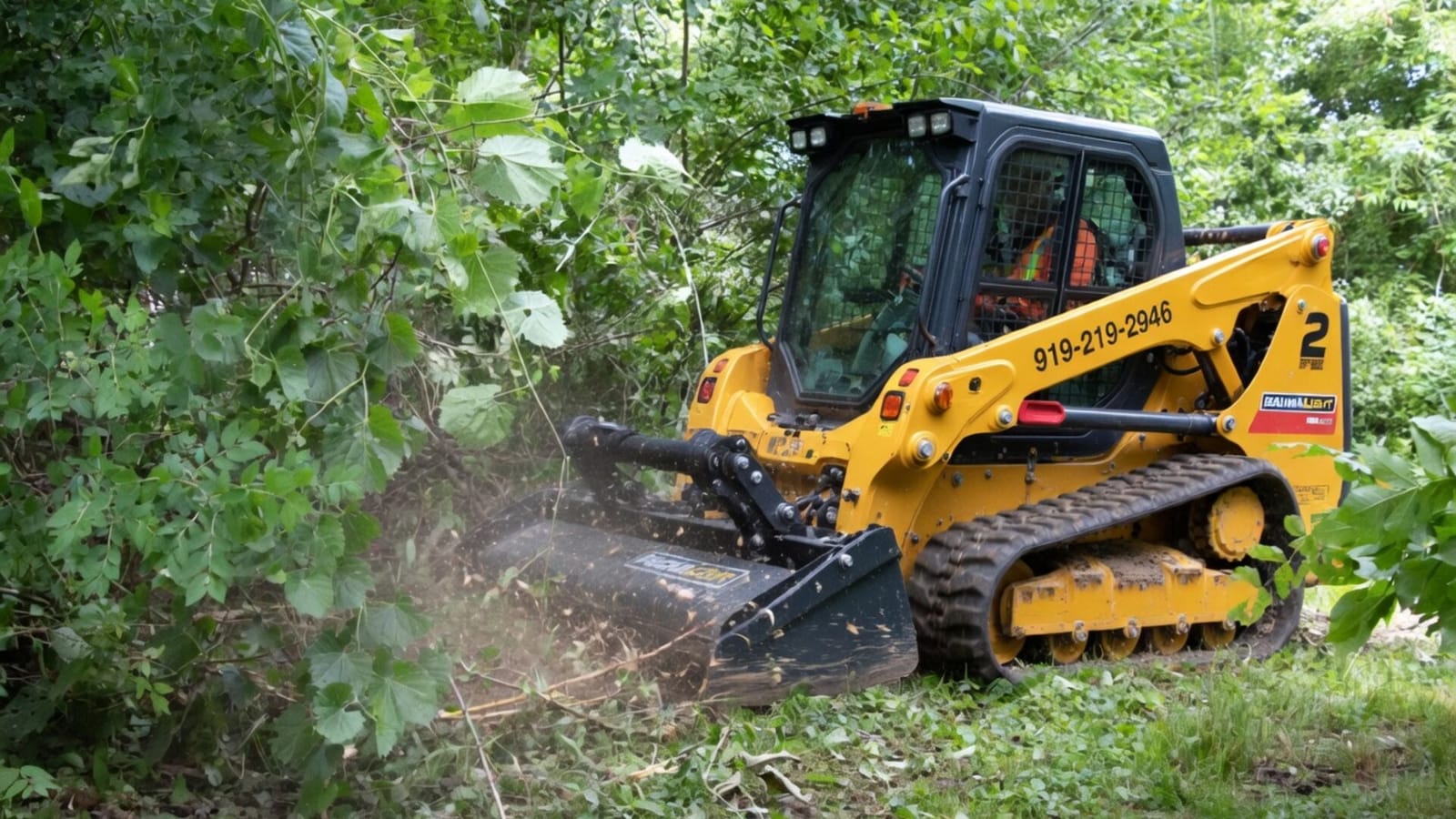
For most reclamation work around Middlesex and Kenly, forestry mulching is the clear winner. A tracked mulcher grinds standing cedars up to 6 to 8 inches thick into a mulch layer that stays on the field, with no burn piles, no stump rows along the fence, and nothing to haul off.
Because there’s no resprout to chase, cedar removal is often a one-and-done job rather than the multi-season campaign that invasive shrubs demand. That said, birds keep delivering new seeds, so a light brush hogging pass every year or two catches the next crop of seedlings before they turn woody. For cedars tangled into fence lines and property edges – their favorite spots – our fence line clearing service strips the whole run and grinds the stumps low.
If your field is a mix of cedar plus privet, sweetgum, and briars – which is typical – it falls under broader invasive species removal, and one mobilization handles all of it at once. Our guide to invasive plants in Central NC helps you identify the whole mix before the machine arrives.
What Does It Cost to Reclaim a Cedar-Choked Field?
Reclaiming a cedar-choked field runs about $1,500 to $2,500 per acre with forestry mulching, so a typical 5-acre field costs roughly $7,500 to $12,500 depending on cedar size and density. Open fields price toward the low end because the machine has clean access with no big hardwoods to work around.
Here’s how field condition maps to method and cost across eastern Central North Carolina:
| Field Condition | What’s Growing | Right Method | Typical Cost Per Acre |
|---|---|---|---|
| Scattered seedlings | Cedar whips under 2”, broomsedge | Brush hogging | $75 – $400 |
| Filling in | Cedars 2–5”, briars, privet edges | Heavy hogging + spot mulching | $800 – $1,500 |
| Cedar takeover | Cedars 5–8” across the field | Forestry mulching | $1,500 – $2,500 |
| Young cedar woods | Dense stand, trees 8”+ | Forestry mulching | $2,500 – $4,000 |
Those ranges line up with the broader numbers in our forestry mulching cost guide for NC. Hourly rates in this market run $150 to $300 per hour, and small jobs carry an $800 to $1,200 mobilization minimum, since loading and hauling the machine costs the same whether the job takes two hours or a full day.
Cedar has one quirk worth knowing: it’s a slow, dense wood, so a mature stand can chew up machine time faster than the same acreage of soft pine. On the flip side, you’re paying for one pass with no follow-up treatment, unlike a privet or kudzu job. For a full breakdown of what drives the number on your specific field, see our land clearing pricing guide.
Need a real number for your field? Request a free quote and we’ll walk the property with you and price it by what’s actually growing.
Should You Leave Any Cedars Standing?
Yes – leaving a few select mature cedars is often the smart move, because they make excellent windbreaks and outstanding wildlife cover. Total removal isn’t always the goal. The problem is a field full of cedar, not the cedar itself.
Mature cedars along a north or west field edge break winter wind for livestock and cut heating loss for nearby barns and homes. A line of them makes a living fence that needs no maintenance.
For wildlife, cedar is hard to beat. The dense evergreen foliage gives deer, turkey, songbirds, and quail thermal cover through winter storms, and the berries are a key cold-weather food source. Hunters and landowners managing for wildlife on rural tracts around Bunn and Zebulon often keep cedar thickets in the corners on purpose.
The winning approach on most fields is selective: mulch the cedars taking over the open, productive ground, and leave a windbreak line or a wildlife block where it does more good than harm. Tell your operator which trees to save before the machine starts, and flag them so nothing good gets ground up by mistake.
Frequently Asked Questions
Do eastern red cedars grow back after being cut?
No. Eastern red cedar does not resprout from the stump or roots, so a clean cut at ground level kills the tree permanently. This is the big difference between cedar and invasive shrubs like Chinese privet, which resprout thicker after cutting. With cedar, one pass is usually the whole job – no stump treatment and no multi-season follow-up.
How much does it cost to clear cedar trees from a field in NC?
Forestry mulching a cedar-choked field runs $1,500 to $2,500 per acre in eastern Central North Carolina, so a 5-acre field typically costs $7,500 to $12,500. Lightly grown fields with small cedars can be brush hogged for $75 to $400 per acre. Request a free estimate and we’ll price your field by cedar size and density.
Is eastern red cedar an invasive species?
No, eastern red cedar is native to North Carolina, not an invasive species. It’s a pioneer tree that naturally colonizes open, disturbed land like idle pasture, especially where fire and mowing no longer keep it in check. It behaves invasively on unmanaged fields, but ecologically it’s a native that also provides real wildlife value. Our invasive species removal crew clears it the same way regardless.
Why are cedars bad for apple and pear trees?
Eastern red cedar is the alternate host for cedar-apple rust, a fungus that needs both a cedar and an apple or pear tree to complete its life cycle. Cedars near an orchard spread spores that scab the fruit and spot the leaves. Removing cedars within a few hundred feet of fruit trees breaks the cycle. This is a common concern on the small farms and homesteads around Kenly and Middlesex.
When is the best time to remove cedar trees?
Late fall through winter is ideal for cedar removal in NC. Cedars are easy to spot when they’re the only green thing in a brown field, the ground is firmer for equipment, and there’s no nesting activity in the trees. For the full season-by-season breakdown, see our guide to the best time of year to clear land in NC.
Do you remove cedars in Nash, Johnston, and Franklin counties?
Yes, the rural fields and small farms of the eastern counties are the heart of our service area. We run cedar and pasture reclamation jobs around Zebulon, Bunn, Middlesex, and Kenly, plus across Nash, Johnston, and Franklin county farmland. See our Franklin County land clearing guide for county-specific details.
Get Eastern Red Cedar Removal in Central North Carolina
A cedar takeover doesn’t reverse itself, and every winter the berries land a fresh crop across your field. Cut Brush handles eastern red cedar removal across the rural east of Central North Carolina, from grown-up hayfields outside Middlesex and Kenly to reverting pasture around Bunn and Zebulon. Our forestry mulcher grinds a cedar-choked field back to open ground in a day or two, kills every cut tree for good with no resprout to chase, and leaves the windbreaks and wildlife cover you actually want to keep.
Get your free estimate and we’ll respond within 24 hours, or call us at (919) 525-3950 to talk through your field. Tell us how long it’s been idle, and we’ll usually have the method and a ballpark before we ever walk it.
Related Services
Learn more about the services mentioned in this article.


Serving These Areas
We provide land clearing services in these towns and surrounding areas.
More from the Cut Brush Blog
Keep reading for more tips and guides on land clearing.
 Services
 Multiflora Rose Removal in NC: Reclaim Thorny Pasture
Multiflora rose removal in NC: how to get rid of the invasive thorn thickets choking pastures and fence lines, and what clearing costs. Get a free estimate.
Services Autumn Olive Removal in NC: Kill the Old Farm Invader
Autumn olive removal in NC: identify the silver-leaf invader, learn why cutting fails, when to treat, and what clearing costs per acre. Get a free estimate.
Services How to Get Rid of Invasive Honeysuckle in NC
How to get rid of invasive honeysuckle in NC: identify Japanese and bush honeysuckle, why mowing fails, and what removal costs per acre. Get a free estimate.
Let's Get Started on Your Land
Request a free quote. We'll contact you to discuss your property, access, and the clearing you need.
Get a Free QuoteOr call us directly: (919) 525-3950