
Defensible Space Clearing in NC: Zones, Acres, Cost
Cut Brush Team · June 23, 2026 · 7 min read

In North Carolina, defensible space should reach at least 100 feet from your house and any attached deck or fence, and as far as 200 feet where the ground slopes more than 20 percent. Around a 40 by 50 foot house, the 30 to 100 foot ring alone is about 0.95 acre. Our forestry mulching starts around $1,500 an acre. The first 5 feet is hand work, and wood mulch does not belong there.
Defensible space is not bare ground. Healthy, well-spaced trees stay. The point is to break up the fuel so a fire stays low and slow, and so embers land on nothing that will light near the walls. Most home losses in a wildfire come from embers, not from flames touching the house.
How Far Do You Clear Around a House for Wildfire in NC?
On ground that slopes less than 20 percent, the minimum is 100 feet in every direction. On steeper ground it may need to reach 200 feet. Measure from the house and from anything attached to it: a wooden deck or a fence that runs off the wall moves the starting line outward.
On a bigger parcel, work out to 200 feet is worth weighing even where the land is flat. And where a neighbor’s woods start inside your 100 feet, your ring stops at the property line and the job gets smaller than the math below.
This matters across the Piedmont. North Carolina has more wildland-urban interface than any other state, and more than half of its residents live in it: homes set into pine and hardwood stands, the way so many lots around Chapel Hill, Pittsboro and Hillsborough are.
The Three Zones, and Who Does What
Firewise USA and the NFPA use three zone names, all measured from the house.
| Zone | Distance | What it calls for | Who usually does it |
|---|---|---|---|
| Immediate | 0–5 ft | No trees or shrubs; wood mulch swapped for gravel or crushed stone; limbs and shrubs trimmed back | The homeowner, by hand |
| Intermediate | 5–30 ft | Grass mowed to 4 inches; trees pruned up 6–10 ft from the ground; at least 18 ft between tree crowns; anything that can burn moved 30 ft out | The homeowner, with our crew for brush and small trees |
| Extended | 30–100 ft | Dead material and heavy ground litter removed; small conifers between mature trees taken out; 12 ft between canopies at 30–60 ft, 6 ft at 60–100 ft | Our crew, with a mulcher |
Those crown gaps are a floor. On a slope, or in a stand of resinous trees, the spacing may need to be much wider. Keep the edge of any tree’s canopy at least 10 feet from the house.
Pines, junipers and most other conifers are highly flammable because of their resin, while most deciduous trees rate low. Eastern red cedar is a juniper, so the cedars filling in a field edge are among the first things we take out of an Extended zone, along with the young pines crowding between mature ones. Our guide to clearing pine trees covers what a mulcher can and cannot take down.
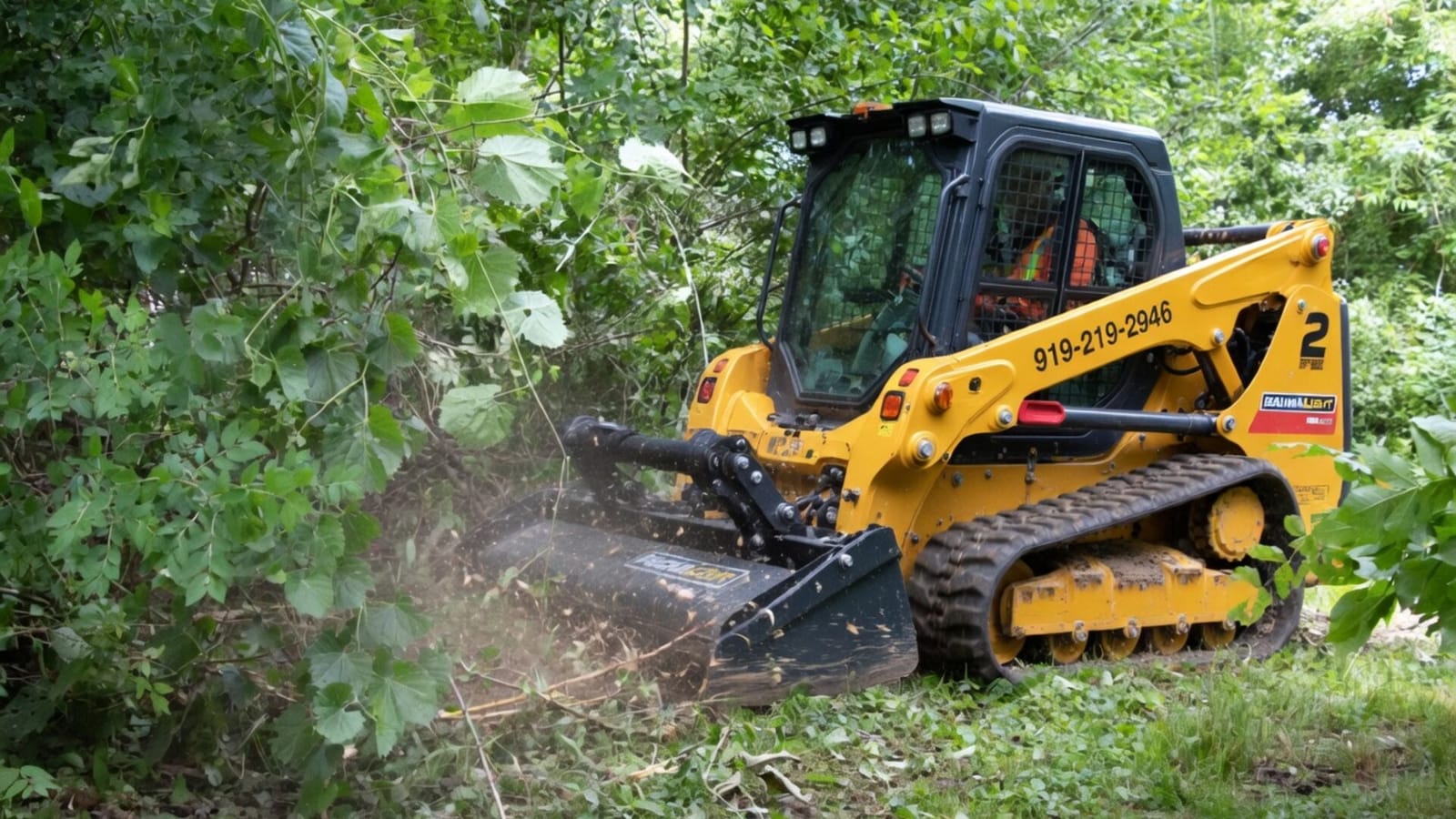
In the Extended zone, our forestry mulching machine grinds brush, small conifers and dead wood where they stand, so nothing is piled or burned. We keep the machine out of the Immediate zone; that strip is rake and pruner work. Between 5 and 30 feet, a lighter brush clearing pass often fits better than a full mulcher.
How Many Acres Is 100 Feet of Defensible Space?
This is arithmetic, not a published figure, so here is the math. Take a 40 by 50 foot house. The ground within a distance d of it, with the corners swept in a curve and the house itself left out, is:
2 × (40 + 50) × d + 3.1416 × d² square feet, and an acre is 43,560 square feet.
- Within 30 feet (Immediate plus Intermediate): 5,400 + 2,827 = 8,227 sq ft, about 0.19 acre.
- Within 100 feet: 18,000 + 31,416 = 49,416 sq ft, about 1.13 acres. Take away the inner 0.19 acre and the 30 to 100 foot ring is about 0.95 acre.
- Within 200 feet (a steep lot or a larger parcel): 36,000 + 125,664 = 161,664 sq ft, about 3.71 acres, so the 30 to 200 foot ring is about 3.5 acres.
Only the wooded part of that ring needs a machine. Lawn, driveway and garden inside it do not.
What Does Defensible Space Clearing Cost?
Using our published starting points on the pricing page, and the same example house:
- A fully wooded 30 to 100 foot ring: 0.95 acre × around $1,500 = about $1,425 at our starting rate. Most residential clearing falls between $1,500 and $4,500 an acre, so thick woods could take the same ring to about $4,275.
- A 30 to 200 foot ring on a steep lot: 3.5 acres × $1,500 to $4,500 = about $5,250 to $15,750, if all of it is wooded.
- A small job, such as brush in the Intermediate zone only: brush clearing starts around $1,200 a project.
Those are starting-point math, not quotes. Before we price a property, we look at how much of the ring is actually wooded, how thick the understory is, the slope, and how a machine gets in. Our forestry mulching cost guide breaks down what moves the per-acre rate.
Is the Mulch Left Behind a Fire Hazard?
It can burn, so treat it as fuel. Mulching does not haul anything away; it turns standing brush into a layer of chips on the ground. Three things follow.
Keep it out of the first 5 feet. Wood mulch in the Immediate zone should be replaced with gravel or crushed stone, because burning mulch throws embers that light nearby mulch and can carry flame to the building. The corners where two walls meet are the most exposed spots. We keep chips away from the foundation, and any landscape mulch already there should be raked out at least 5 feet.
The benefit is real but short. In Florida pine flatwoods, mulching cut flame heights by 66 percent, but shrubs grew back within six months and limited the gain. That was Coastal Plain ground, not the Piedmont, but the lesson carries: lowering the fuel is a first step, and the sprouts that follow decide how long it lasts.
Plan the follow-up. Once regrowth comes in, a mowing or brush hogging pass, or a lighter mulching pass, keeps the Extended zone open. We can price that with the first job.
Does the State Pay for Defensible Space Clearing in Central NC?
Usually not. The NC Forest Service’s Disaster Mitigation Program does wildfire risk reduction work at no cost to eligible landowners, but only in 39 federally declared disaster counties from Hurricane Helene. Its projects follow Firewise USA principles, with machine mulching kept within 100 feet of the home.
When we checked in October 2026, Wake, Orange, Durham, Chatham, Johnston, Harnett, Franklin and Granville did not appear on the federal designated-county list for that disaster. Check the county map on the program page before you count yourself in or out. Outside those counties, the owner pays for the work.
Do I Need a Burn Permit to Burn Brush in NC?
Between midnight and 4 p.m., you need a burn permit for any fire in woodland protected by the NC Forest Service or within 500 feet of it. The permit is free. City burning rules are separate, and a statewide burn ban overrides any permit.
Escaped yard debris burns are the leading cause of wildfires in North Carolina, close to half of them. That is the main reason we mulch defensible space instead of piling it: there is no pile to light.
When Should You Schedule It?
Spring wildfire season runs March through May, and fall activity climbs from October through early December. Getting the Extended zone done before either window means the work is in place for the busy weeks. For how the seasons affect ground conditions and scheduling, see our guide to the best time of year to clear land in NC.
Do I Have to Cut Down My Trees?
No. Defensible space does not mean a yard without trees. It means spacing them, lifting their lower limbs and clearing the brush and young conifers beneath them. Most of a wooded lot’s character can stay.
Get a Free Quote on Defensible Space Clearing
Request a free quote and our crew will contact you to talk through the property, access and the clearing you need, from the Extended zone out to 200 feet on a steep lot. You can also call (919) 525-3950. Our defensible space and Firewise clearing service page explains how we handle the work across Central North Carolina.
Related Services
Learn more about the services mentioned in this article.


Serving These Areas
We provide land clearing services in these towns and surrounding areas.
More from the Cut Brush Blog
Keep reading for more tips and guides on land clearing.
 Services
 Wisteria Removal in NC: How to Kill It and Save Your Trees
Wisteria removal in NC: how invasive Chinese wisteria strangles mature trees, why pulling vines fails, and what removal costs. Get a free estimate today.
Services How to Get Rid of Invasive Honeysuckle in NC
How to get rid of invasive honeysuckle in NC: identify Japanese and bush honeysuckle, why mowing fails, and what removal costs per acre. Get a free estimate.
Services Bamboo Removal in NC: Timeline, Buffers and Neighbors
Bamboo removal in NC takes two to three years: cut the grove, then keep cutting or treating regrowth. Who does what, creek buffers and neighbor limits.
Let's Get Started on Your Land
Request a free quote. We'll contact you to discuss your property, access, and the clearing you need.
Get a Free QuoteOr call us directly: (919) 525-3950