
How to Get Rid of Greenbrier and Briars in NC
Cut Brush Team · August 16, 2026 · 7 min read

Every overgrown lot in Central North Carolina has a boss, and it’s usually greenbrier. The thorny vine, briars, catbrier, “that stuff that tears you up,” is what turns a walkable patch of woods into ground you can’t cross, and it’s the plant most likely to draw blood when you try. Figuring out how to get rid of greenbrier frustrates more landowners than kudzu and privet combined, because this one isn’t even an invader: it’s a native that stores years of fight in a root system you can’t see.
This guide covers what greenbrier actually is, why it regrows from a root network no amount of pulling defeats, what works at yard scale versus acreage scale, and what briar removal costs.
What Is Greenbrier, and Why Is It So Tough?
Greenbrier is a native thorny vine (Smilax species) that grows from a massive underground network of woody rhizomes and tubers, and that hidden root system is why it laughs at cutting, pulling, and burning. What you see above ground, the green canes, the thorns, the heart-shaped leaves, is the smallest part of the plant.
An established greenbrier patch may have decades of energy banked in tubers the size of potatoes, strung together on rhizomes that run for yards in every direction. Cut every cane to the dirt and the network just sends up more, using a reserve tank you’ve barely dented.
| Plant | What it is | Thorns | Regrows from |
|---|---|---|---|
| Greenbrier (Smilax) | Native climbing vine | Stout, scattered on green canes | Rhizome and tuber network |
| Blackberry | Native bramble | Dense, on arching canes | Root crowns |
| Multiflora rose | Invasive shrub | Curved, on woody canes | Root crowns and tip-rooting |
Being native means greenbrier has real wildlife value, deer browse it and birds eat the berries, and it also means it’s everywhere and always coming back from seed. The goal on most properties isn’t eradication of every sprig; it’s breaking the thickets that make land unusable, then keeping them broken. Briars rarely work alone, either: the same neglected ground usually carries blackberry, invasive honeysuckle, and multiflora rose in one tangled mat.
Why Does Greenbrier Keep Coming Back?
Greenbrier returns because every control method that only touches the top growth leaves the tuber network untouched, and the network can refill the gap for years. That single fact explains most briar frustration:
- Pulling snaps the cane off at a rhizome joint and the joint resprouts. Even careful digging misses connected tubers, and a left-behind fragment grows a new plant.
- Mowing once is a haircut. The reserve tank refills the patch by fall.
- Burning removes the tops and stimulates the rhizomes, the same as mowing.
- Spraying established canes is slow going, because the waxy leaves shed most products and the tubers outlast a single application.
What actually drains the tank is repetition. Every time new growth gets cut before it can photosynthesize long enough to pay back the energy it cost, the reserve shrinks. Do that on a schedule, by repeated mowing or by grazing, and even an old patch runs dry over a season or two.
Pro tip: Goats are genuinely elite briar control. Greenbrier sits near the top of a goat’s preference list, and a stocked paddock strips a briar patch to bare canes and keeps hitting the regrowth exactly on the schedule that drains the tubers. If you keep livestock anyway, point them at the briars and save the machine work for what they won’t eat.
How to Clear Briars at Yard Scale vs. Acreage Scale
Small patches yield to persistent digging and repeat cutting; anything measured in acres calls for a machine knockdown followed by scheduled mowing. The method should match the size of the fight.
For a garden-edge patch, dig out every tuber you can find after a soaking rain, then cut regrowth monthly through the season. Persistence wins at this scale, and thick gloves are non-negotiable.
For an overgrown lot or field edge, the sequence we run looks like this:
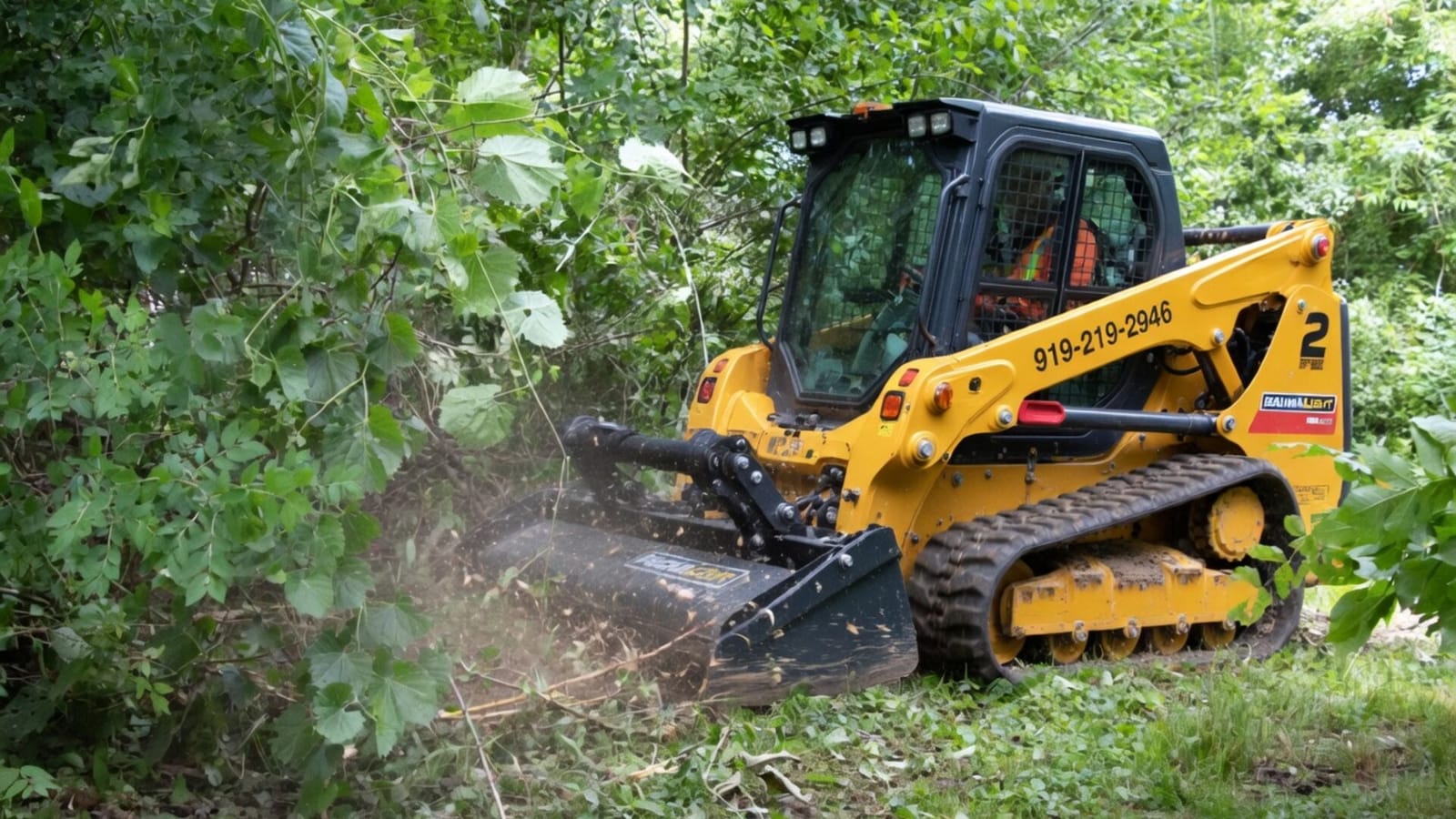
- Mulch the thicket. A forestry mulching pass grinds the briar mat, the brush inside it, and the saplings holding it up, leaving clean, walkable ground in a day. This is standard brush clearing work, and briar thickets are the most common thing we grind.
- Mow on schedule. An annual or twice-yearly brush hogging pass at $75–$400 per acre cuts the regrowth before it rebuilds the reserve. Two seasons of scheduled mowing takes a briar patch from impenetrable to incidental.
- Spot-treat the survivors. Stubborn resprout clusters get targeted treatment in fall, when the vine pulls energy down to the tubers.
The knockdown-plus-mowing pattern is the same one that reclaims any neglected Piedmont ground; our guide to clearing an overgrown lot puts it in the bigger picture.
What Does Briar Removal Cost in NC?
Mulching briar thickets runs $1,000–$2,500 per acre in Central North Carolina, sitting at the lighter end of the standard mulching range because briars are soft material, with the follow-up mowing at $75–$400 per acre. Thickets laced with saplings and woody brush price toward the middle of the standard $1,000–$3,500 range.
| Situation | Typical Cost | Timeline |
|---|---|---|
| Briar mat with light brush | $1,000–$2,000 per acre | Hours to a day |
| Thicket mixed with saplings and vines | $1,500–$2,500 per acre | 1 day |
| Small-lot minimum | $800–$1,200 | Half a day |
| Scheduled mowing (the part that makes it stick) | $75–$400 per acre | 1–2 passes per year |
The honest math: the mulching pass buys you usable land immediately, and the cheap mowing schedule is what keeps it. Skip the schedule and the tubers refill the patch within a couple of seasons. Request a free estimate and we’ll quote the knockdown and the maintenance plan together.
Frequently Asked Questions
How do you get rid of greenbrier permanently?
Drain the root reserve: knock the thicket down, then cut or mow every flush of regrowth before it can rebuild the tubers, for one to two seasons. At garden scale you can add tuber digging after rain; at acreage scale the mulch-then-mow schedule does the same job with machines. One-time efforts of any kind fail against this plant.
Is greenbrier invasive?
No, greenbrier is native to North Carolina, which is why it’s in every county and every woodlot. It earns removal by behavior, not origin: the thickets make land unusable and hide the wire on fence lines. Like eastern red cedar, another native we clear constantly, it’s managed, not eradicated.
Will Roundup kill greenbrier?
Over-the-counter glyphosate struggles against established greenbrier because the waxy leaves shed spray and the tuber network outlasts single applications. Fall spot-treatment of regrowth after a mechanical knockdown works far better than spraying a mature thicket, and repeated mowing kills patches without any spraying at all.
What equipment clears briar thickets best?
A forestry mulcher for the knockdown and a brush hog for the maintenance. The mulcher grinds the mat and everything woody inside it at ground level; the hog keeps regrowth cut cheaply on the schedule that drains the roots. Around Garner and Clayton, briar thickets are the single most common thing our mulcher grinds.
Are briars and brambles the same thing?
Landowners use both words for any thorny tangle, but briars usually mean greenbrier (a vine with scattered stout thorns) and brambles mean blackberry and its relatives (arching canes with dense thorns). They grow together, and the clearing approach, mulch then mow, handles both at once along with the multiflora rose that usually joins them.
Can I clear briars myself?
A patch the size of a room, yes: dig tubers after rain, cut regrowth monthly, wear leather. An acre, realistically no; hand-clearing greenbrier at that scale means months of bloody weekends that a machine replaces in a day. Fit the method to the acreage, not to stubbornness. We say that with respect, having met a lot of stubborn landowners near Angier mid-project.
Briar and Greenbrier Clearing Across Central North Carolina
The thorns win the small fights; the schedule wins the war. Cut Brush clears greenbrier and briar thickets across Central North Carolina, from overgrown lots in Garner and Fuquay-Varina to field edges around Willow Spring and Angier, and sets up the mowing plan that keeps the ground yours.
Get your free estimate or call (919) 525-3950. We respond within 24 hours, and we’ll tell you honestly whether your patch is a Saturday job or a machine job.
Related Services
Learn more about the services mentioned in this article.

Brush Clearing
Remove overgrown brush, shrubs, and small trees to reclaim your land.

Forestry Mulching
Single-step land clearing that mulches trees and brush in place.

Brush Hogging
Heavy-duty mowing for overgrown fields, pastures, and large lots.

Invasive Species Removal
Identify and remove invasive plants that threaten native ecosystems.
Serving These Areas
We provide land clearing services in these towns and surrounding areas.
More from the Cut Brush Blog
Keep reading for more tips and guides on land clearing.
 Services
 Multiflora Rose Removal in NC: Reclaim Thorny Pasture
Multiflora rose removal in NC: how to get rid of the invasive thorn thickets choking pastures and fence lines, and what clearing costs. Get a free estimate.
Services Bradford Pear Removal in NC: Bounty, Costs & Thickets
Bradford pear removal in NC: the free tree bounty program, what removal costs, and how to clear the thorny wild callery pear thickets. Get a free estimate.
Services Autumn Olive Removal in NC: Kill the Old Farm Invader
Autumn olive removal in NC: identify the silver-leaf invader, learn why cutting fails, when to treat, and what clearing costs per acre. Get a free estimate.
Let's Get Started on Your Land
Request a free quote. We'll contact you to discuss your property, access, and the clearing you need.
Get a Free QuoteOr call us directly: (919) 525-3950