
Chinese Privet Removal in NC: Regrowth, Plan and Cost
Cut Brush Team · June 19, 2026 · 7 min read

Chinese privet grows back after it is cut or mulched. Sprouts show within about six months, and only 14% of stumps cut without herbicide were dead at 18 months. With herbicide on the fresh cut, 89% to 94% died. So removal in Central North Carolina is two jobs: our crew mulches the thicket and comes back to cut regrowth, and a separate licensed applicator treats the stumps. Brush clearing starts around $1,200 a project.
Cut Brush does the machine work. We do not spray. The rest of this page is the plan we walk owners through before we quote: what comes back, who does which step and when, and what it costs.
Will Privet Grow Back After You Cut or Mulch It?
Yes, and it comes back from below ground. Privet resprouts from the root collar and from lateral roots, so cutting or shredding alone commonly gives poor control. On test plots in Alabama, the numbers looked like this:
- Cut, nothing on the stump: 14% of stumps dead 18 months later. The other 86% were still alive.
- Cut, herbicide on the fresh stump: 89% to 94% dead.
- When sprouts appear: within about 6 months of the cut, whether the cut was made in spring or fall.
- Which stumps sprout hardest: the larger ones.
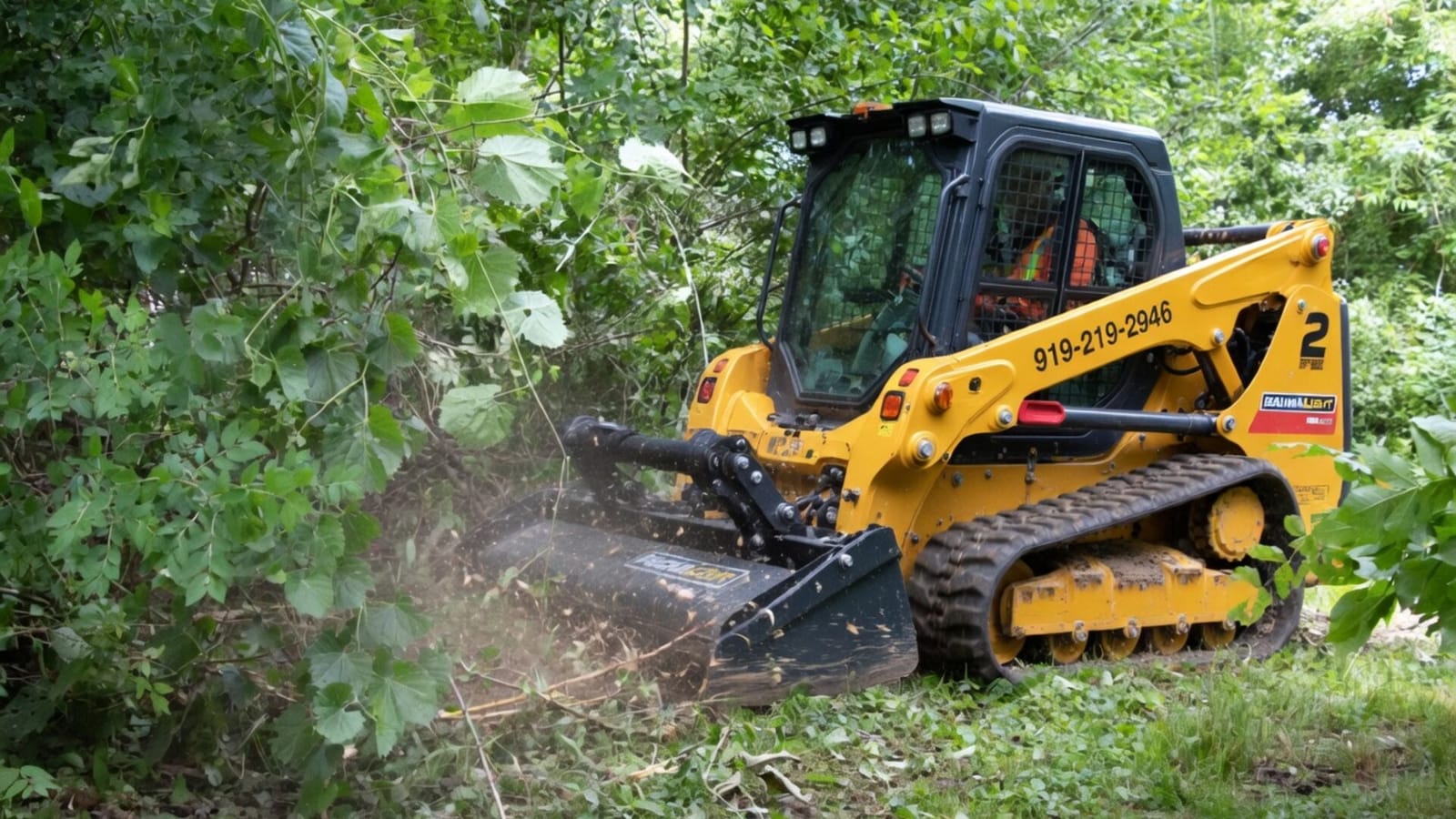
Mulching works the same way. A forestry mulcher clears the shrub layer in one pass and leaves the root system in the ground, which is what we want on a slope or near a creek, because the roots hold the soil. It also means the stand will try to come back. On Georgia creekside plots where privet was mulched out of the shrub layer, the privet left in the low growth still needed a foliar herbicide pass a year later.
What that means for your plan: budget for the first clearing plus a return cut within the first growing season, because that is when the sprouts will be up. The six month figure is why we plan the second visit; it is our reading of that figure, not a rule. Return cuts are quoted with the first visit. Established stands take many seasons of effort to clear fully, so we never promise privet is gone for good after one visit.
Who Treats the Stumps, and When?
A licensed applicator, from a separate company. Owners often expect one company to do both, and the second invoice surprises them. Here is how the two jobs fit on one calendar:
| Step | When | Who |
|---|---|---|
| Mulch the thicket to the ground | Clearing day | Cut Brush |
| Treat the freshly cut stumps | The same day, right behind the machine | A separate licensed applicator |
| Cut or mow the sprouts | Within the first growing season | Cut Brush |
| Treat regrowth, if the applicator advises it | The applicator’s call | A separate licensed applicator |
Timing is the reason to book both together. A cut-stump treatment has to go on a freshly cut stump, within 5 minutes of the cut. A stump cut on Tuesday and treated on Friday has missed that window. Tell us when you book if an applicator is coming, and we plan the clearing day around their crew.
The season matters too, and North Carolina sources differ on it. Cut-surface treatments work from mid-February through most of the growing season and are generally less effective in December and January; other NC guidance allows cut-stump work any time the ground is not frozen. The product, the rate and the window are the applicator’s decisions, so pick the applicator before you pick the clearing date. If stump treatment is not in the plan, we can clear in any season the ground will carry the machine, and the return cuts do the work instead.
Pro tip: If the applicator cannot make clearing day, ask whether treating the low regrowth later suits your site. That is the route the Georgia plots took a year after mulching, and it lets us clear on the date that suits the ground.
What Does Privet Removal Cost in Central NC?
Most backyard and fence-row privet prices as a brush clearing project, starting around $1,200; most of those run $1,200 to $3,500. Larger thickets and wooded edges price by the acre as forestry mulching, around $1,500 an acre, and most residential clearing in Central North Carolina falls between $1,500 and $4,500 an acre. Fence line clearing starts around $500 a project; our fence line cost guide covers a privet-choked fence run in detail.
What moves the number:
- Stem size and density. Thick, old stems in a solid wall slow the mulcher more than scattered young shrubs.
- Wet ground. Privet favors creek bottoms, and soft ground means slower passes or waiting for it to firm up.
- Slope and access. A gate wide enough for a tracked machine beats squeezing past a house.
- The return cut. We quote it with the first visit so the full plan is on one page.
Herbicide is priced by the applicator, not by us. Our pricing page shows how acreage, density and access move a clearing quote.
Can I Just Bush Hog It?
Bush hogging cuts the tops, and cutting alone is the method that leaves 86% of stumps alive. It also has a size limit: a rotary cutter handles stems up to about 2 inches, and once privet passes 2 to 3 inches it is mulcher work, not a brush hog job.
Where a brush hog earns its place is after the clearing. Once a field or edge is open, regular mowing knocks the sprouts back before they harden off, and brush hogging starts around $75 an acre. Keeping the ground open after the first clearing is most of the long-term job.
Can I Pull Privet Out by Hand?
Only while it is small. Seedlings with stems under half an inch across can be hand-pulled, and pulling tools can extract stems up to 2 inches. Past that, pulling is not practical, and a thicket of those stems is a machine job. Pulling seedlings is the right follow-up for an owner, though: walk the cleared edge each year and pull the new ones while they are still small.
How to Tell Chinese Privet From Yaupon Holly and Native Shrubs
Check before anything is cut, because a few natives look close:
- Leaves in pairs. Privet leaves sit opposite each other on the stem. Yaupon holly, the most common mix-up, has alternate leaves and red fruit; privet fruit is black.
- Size and habit. Privet is a semi-evergreen shrub 6 to 15 feet tall that spreads by seed and by root suckers into thickets.
- Winter green. It often holds leaves into winter, which makes it easy to spot. So do some natives, so green alone does not prove privet.
- Natives worth keeping: Carolina cherry laurel, blackhaw, American olive and bracted viburnum can all be mistaken for privet. On an invasive species removal job we mulch the privet and leave the natives you want standing.
Chinese privet was introduced to the United States in 1852 as an ornamental. Today it sits in Rank 1, Severe Threat, on the North Carolina Invasive Plant Council list, and it has taken over thousands of acres of North Carolina hardwood bottomlands. For the other invasives on a Central NC property, see our guide to invasive plants in Central North Carolina.
Privet Along a Creek: Check the Buffer First
In the Neuse basin, the buffer rule’s table of uses lists removal of understory nuisance vegetation, as defined on a state exotic plant list, as allowable vegetation management. Confirm whether privet is on that list for your lot before creekside work starts. In the Jordan Lake watershed, an activity not listed in the table of uses needs a variance, and land in the Falls Lake watershed sits under the Neuse buffer. Our Neuse buffer guide covers the detail; for any creekside lot, ask the buffer office before the machine arrives: your town or county in the Jordan watershed, the NC Division of Water Resources in most other places.
Frequently Asked Questions
Will privet be gone for good after one clearing?
No. Cut stumps and roots resprout, seed keeps arriving from thickets nearby, and an established stand takes many seasons to clear fully. The clearing, a return cut, an applicator’s stump treatment if you want one, and yearly seedling pulls together give you the best chance of keeping it down.
Does mulching privet leave the roots in the ground?
Yes. A mulcher grinds the stems where they stand and leaves the roots, which protects the soil but means sprouts will come. If you want roots out, our comparison of forestry mulching and grubbing explains the trade.
Is Chinese privet invasive in North Carolina?
Yes. It is in Rank 1, Severe Threat, the highest rank on the North Carolina Invasive Plant Council list.
Get Chinese Privet Removal in Central North Carolina
Request a free quote and our crew will contact you to talk through the property, the access and the clearing you need, including whether an applicator is joining the job and when a return cut makes sense. You can also call (919) 525-3950. Cut Brush clears privet across Central North Carolina, including Cary, Apex and Chapel Hill.
Related Services
Learn more about the services mentioned in this article.


Serving These Areas
We provide land clearing services in these towns and surrounding areas.
More from the Cut Brush Blog
Keep reading for more tips and guides on land clearing.
 Services
 Bamboo Removal in NC: Timeline, Buffers and Neighbors
Bamboo removal in NC takes two to three years: cut the grove, then keep cutting or treating regrowth. Who does what, creek buffers and neighbor limits.
Services How to Get Rid of Invasive Honeysuckle in NC
How to get rid of invasive honeysuckle in NC: identify Japanese and bush honeysuckle, why mowing fails, and what removal costs per acre. Get a free estimate.
Services Multiflora Rose Removal in NC: Reclaim Thorny Pasture
Multiflora rose removal in NC: how to get rid of the invasive thorn thickets choking pastures and fence lines, and what clearing costs. Get a free estimate.
Let's Get Started on Your Land
Request a free quote. We'll contact you to discuss your property, access, and the clearing you need.
Get a Free QuoteOr call us directly: (919) 525-3950