
Invasive Plants in Central NC: A Landowner's Guide
Cut Brush Team · August 16, 2026 · 9 min read

Walk the edge of any woodlot, fence line, or idle field in Central North Carolina and you’re looking at a fight already in progress. The honeysuckle in the fence, the privet under the pines, the briars where the garden used to be, none of it arrived by accident, and none of it leaves on its own. Invasive plants cost North Carolina landowners usable pasture, timber value, fence lines, and weekends, and the losses compound every season the plants get for free.
This is the master guide to that fight. It covers the twelve plants we’re called about most across Central North Carolina, how to identify each one in under a minute, which ones to fight first when you have several (you have several), the one strategy that works on all of them, and what removal actually costs. Each species links to its own full battle plan.
The Twelve Plants, Identified in One Minute Each
Most Central North Carolina properties carry at least three of the plants on this list, and the fastest way to plan a fight is to know exactly which ones you have. Every plant here has one tell that settles the ID:
| Plant | The one-minute tell | What it costs you | Full guide |
|---|---|---|---|
| Kudzu | Green blanket burying everything by August | Trees, structures | Kudzu removal |
| Wisteria | Woody vines spiraled around trunks, purple April bloom | Mature trees | Wisteria removal |
| Japanese honeysuckle | Wiry vines braided through fences, green in winter | Fences, understory | Honeysuckle removal |
| Chinese privet | Dense hedge nobody planted, white May flowers | Fence lines, woods | Privet removal |
| Multiflora rose | Arching thorn canes, fringed stipule at each leaf base | Pasture, fences | Multiflora rose removal |
| Autumn olive | Leaves flash silver underneath | Field edges | Autumn olive removal |
| Bradford / callery pear | Early white March bloom, thorny wild seedlings | Idle fields, tires | Bradford pear removal |
| Tree of heaven | Crushed leaf smells like rancid peanut butter | Everything nearby | Tree of heaven removal |
| Bamboo | You know bamboo | Yards, property lines | Bamboo removal |
| Greenbrier / briars | Thorny vines from tubers, tears you up | Land access | Greenbrier removal |
| Eastern red cedar | Evergreen columns marching across idle fields | Pasture | Red cedar removal |
| Sweetgum saplings | Star leaves and gumballs by the thousand | Idle fields | Sweetgum reclamation |
Three of the twelve, greenbrier, red cedar, and sweetgum, are natives that behave invasively on unmanaged land rather than true invaders. The distinction matters for ecology and not at all for your fence line, so they’re on the list.
Why Is Central North Carolina So Invadable?
The Piedmont is nearly perfect habitat for invasive plants: mild winters that barely pause growth, a long humid growing season, thousands of acres of disturbed former farmland, and fence lines and power cuts that work as seed highways. Every advantage a plant could ask for is here.
History loaded the dice too. Kudzu, multiflora rose, and autumn olive were promoted by government programs for erosion control and wildlife habitat. Privet, wisteria, Bradford pear, and bamboo were sold by nurseries for a century. Most of what’s eating your land was planted on purpose by somebody, and the birds have been distributing the inventory ever since.
The pattern that follows is predictable. Land goes idle, the seed rain arrives, and within a decade old-field succession runs its course: briars and broomsedge first, then rose and olive on the edges, then cedar, sweetgum, and pear through the middle, with honeysuckle and privet filling the shade underneath. A property owner who understands that sequence can read any field’s history, and its future, at a glance.
Which Invasive Should You Fight First?
Triage by what’s being destroyed: save trees from active killers first, break the field-claimers second, and schedule the understory sweep last. When a property carries five of these plants, and many do, order of operations is the difference between a plan and a panic.
Tier 1, the tree killers: wisteria, kudzu, and tree of heaven. A vine actively girdling a mature oak is destroying decades of value this season, and every year of delay loses trees you can’t replace. Tree of heaven earns tier 1 for a different reason: it must be treated before anything cuts it, and it’s the preferred host of the spotted lanternfly now documented in NC’s Piedmont, so the clock matters.
Tier 2, the field claimers: callery pear, autumn olive, multiflora rose, cedar, and sweetgum. These convert open, usable, mowable land into woody thicket, and their price climbs a tier every few years as stems thicken. A field caught at year three costs a fraction of the same field at year ten.
Tier 3, the understory and edge: privet, honeysuckle, greenbrier, bamboo. These are damaging but slower-moving, and they’re often best handled in the same mobilization as a tier 1 or tier 2 job, since the machine is already on site. Bamboo is the exception that jumps the queue when it’s headed for a property line and a neighbor dispute.
Pro tip: Fight the season, not just the plant. March identifies your callery pear (only thing blooming white), April flags the wisteria (purple in the canopy), May lights up multiflora rose and privet (white blooms), winter exposes the honeysuckle (only green thing in the woods). One property walk in each season with a phone camera builds a complete invasion map, and fall, when plants pull energy to their roots, is the kill window for treating almost all of them.
The One Strategy That Works on All Twelve
Every plant on this list is beaten the same way: a mechanical knockdown, treatment of the regrowth, and a cheap maintenance schedule that keeps the pressure on, and every plant on this list beats a one-time effort of any kind. The details differ by species; the shape of the fight never does.
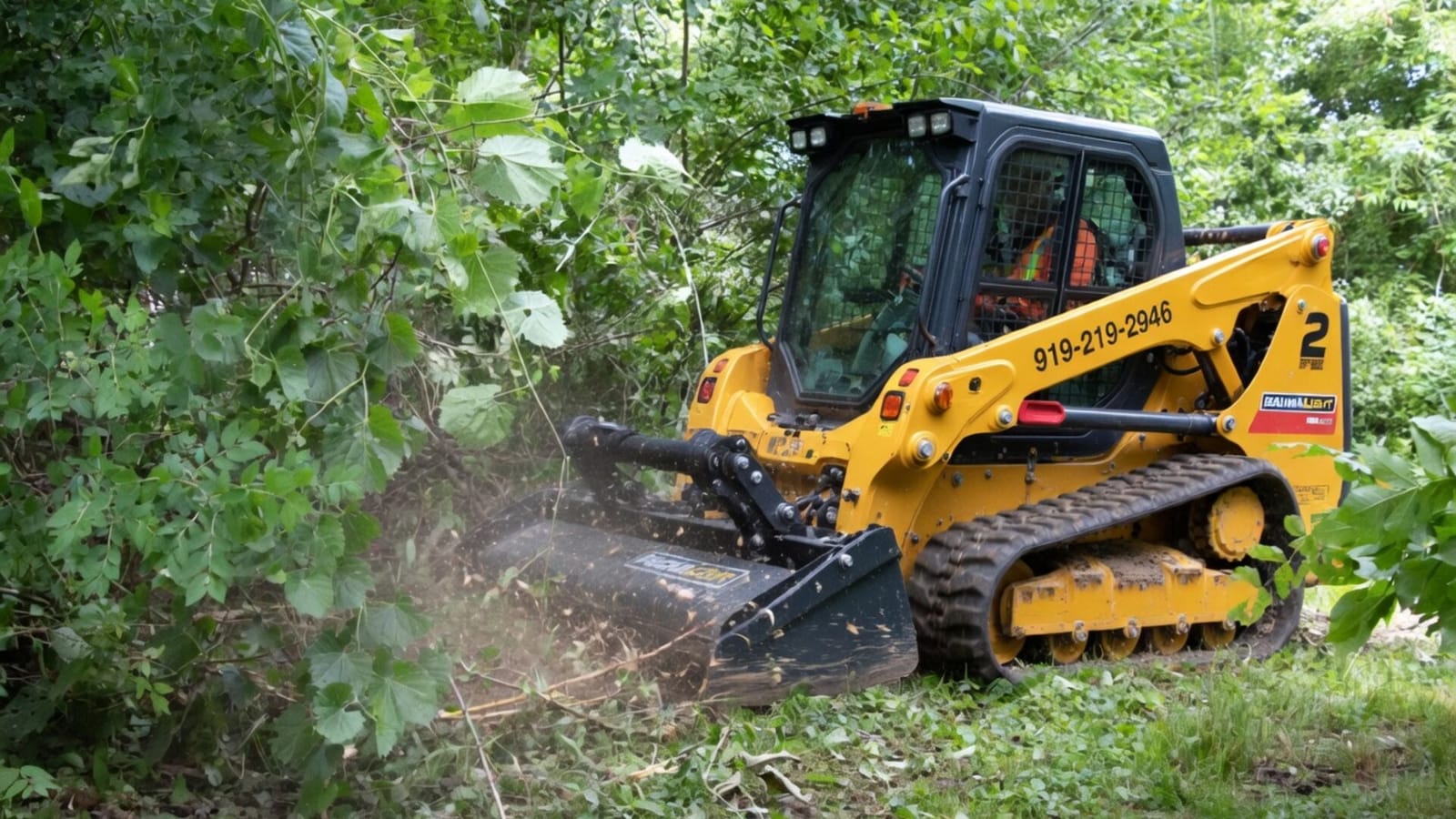
The knockdown is machine work. A forestry mulching pass grinds thickets, mats, and saplings into a mulch layer at ground level, converting years of overgrowth into walkable ground in a day, with no burn piles and no hauling. That single pass handles whatever mix of the twelve is standing on the parcel.
The treatment is what makes it stick. Cut stumps and young regrowth get targeted herbicide at the right season, which for most species means late summer through fall. This is the step DIY efforts skip, and skipping it is why the plants come back; roots that survive a knockdown rebuild everything within a couple of seasons.
The maintenance is cheap and permanent. An annual brush hogging pass at $75–$400 per acre mows seedlings and resprouts before they get woody, and it’s the difference between clearing land once and clearing the same land every five years. Birds never stop delivering seed; the schedule makes it not matter.
What Does Invasive Plant Removal Cost in NC?
Most invasive removal in Central North Carolina lands between $1,000 and $3,500 per acre for the mulching knockdown, with follow-up visits priced as small fractions of that and maintenance mowing at $75–$400 per acre. Where a job falls in the range tracks density and stem size, not species.
| Job profile | Typical cost | Examples |
|---|---|---|
| Soft mats and understory | $1,000–$2,500 per acre | Honeysuckle, briars, young sweetgum |
| Dense woody thickets | $1,500–$3,500 per acre | Privet, rose, olive, pear, cedar |
| Vine campaigns with hand work | $150–$300 per hour plus mulching | Wisteria, kudzu, tree of heaven |
| Follow-up treatment visits | Fraction of initial cost | All species |
| Maintenance mowing | $75–$400 per acre, 1–2x yearly | All species |
Two costs worth naming honestly: small parcels hit crew minimums of $800–$1,200 regardless of acreage, and single mature trees near structures (a splitting Bradford over the driveway, a dead tree of heaven by the house) are arborist work priced per tree, not our machine work. Our land clearing pricing guide breaks down every factor that moves the number.
Should You DIY or Hire It Out?
Match the method to the acreage: hand tools win on patches, machines win on acres, and the honest line between them is about half an acre of established growth. Landowner labor is genuinely effective on seedling patrol, small honeysuckle patches, garden-edge briars, and pulling young autumn olive after rain.
Past that line, the math turns. An acre of established thicket is weeks of punishing hand labor or a single day of machine work, and the hand-cleared version usually skips the treatment step that determines whether the work lasts. The expensive outcome isn’t hiring the machine; it’s spending the weekends first and hiring the machine anyway.
The middle path is the one many of our customers take: we do the knockdown and first treatment, and the landowner owns the annual mowing and seedling patrol from there. It puts the machine where it’s irreplaceable and your labor where it’s actually decisive.
Frequently Asked Questions
What are the worst invasive plants in North Carolina?
For Piedmont landowners the heavy hitters are kudzu, Chinese privet, Japanese honeysuckle, multiflora rose, callery pear, autumn olive, wisteria, and tree of heaven, with native greenbrier, cedar, and sweetgum doing invasive-style damage on idle land. Which is worst on your land depends on what’s at stake; a vine killing mature oaks outranks a thicket claiming a field corner.
How do I know which invasive plants I have?
Use the one-minute tells: silver leaf undersides (autumn olive), rancid peanut smell (tree of heaven), fringed leaf stipules (multiflora rose), green vines in January (honeysuckle), early white March bloom (callery pear). Walk the property once per season and the plants identify themselves. Or send a quote request, and our crew will confirm the lineup when we walk the property.
Can invasive plants be removed permanently?
The realistic goal is control that holds with cheap maintenance, not a one-time eradication, because seed keeps arriving by bird and wind. A proper knockdown-and-treat sequence plus an annual mowing pass keeps land clear indefinitely; any one-time effort, DIY or hired, buys a couple of seasons at most.
Is there financial help for invasive removal in NC?
Sometimes. The NC Bradford Pear Bounty trades free native trees for removed pears, and federal cost-share programs through NRCS’s EQIP occasionally fund invasive control on qualifying farm and forest land; your county Soil and Water Conservation District office knows the current programs. For most residential parcels around Raleigh and Cary, though, removal is an out-of-pocket land investment.
What’s the best time of year to remove invasive plants?
Machine knockdowns work year-round, and late summer through fall is the best window for the treatments that make removal permanent, because plants are pulling energy down to their roots. Winter adds bonus advantages: firm ground, dormant natives, and evergreen invaders like honeysuckle and privet standing out plainly. Spring is for mapping, fall is for killing.
Do you handle all of these plants?
Yes; the twelve on this list are the core of our invasive species removal work across Central North Carolina, usually several per property in one mobilization. The exceptions we hand off honestly are single large trees near structures, which belong to insured arborists with rigging gear.
One Property, One Plan, All Twelve Plants
Every plant in this guide wins by being ignored and loses to the same three moves: knock it down, treat what returns, and mow on schedule. Cut Brush runs that sequence across Central North Carolina, from Wake County suburbs in Apex and Holly Springs to the farm country beyond, taking whatever mix of the twelve your land is carrying in one job instead of twelve.
Get your free estimate or call (919) 525-3950. We respond within 24 hours, walk the property with you, and hand you the triage plan whether or not you hire the machine.
Related Services
Learn more about the services mentioned in this article.

Brush Clearing
Remove overgrown brush, shrubs, and small trees to reclaim your land.

Forestry Mulching
Single-step land clearing that mulches trees and brush in place.

Brush Hogging
Heavy-duty mowing for overgrown fields, pastures, and large lots.

Invasive Species Removal
Identify and remove invasive plants that threaten native ecosystems.
Serving These Areas
We provide land clearing services in these towns and surrounding areas.
More from the Cut Brush Blog
Keep reading for more tips and guides on land clearing.
 Services
 How to Get Rid of Invasive Honeysuckle in NC
How to get rid of invasive honeysuckle in NC: identify Japanese and bush honeysuckle, why mowing fails, and what removal costs per acre. Get a free estimate.
Services Chinese Privet Removal in NC: How to Stop It for Good
Chinese privet removal in NC: why this invasive shrub takes over fence lines, which removal methods work, and how to stop resprouting. Get a free estimate.
Guide How Long Does Land Clearing Take Per Acre in NC?
How long does land clearing take per acre in NC? Most lots run 1–3 days per acre. See timelines by method, density, and lot size. Get a free estimate.
Let's Get Started on Your Land
Request a free quote. We'll contact you to discuss your property, access, and the clearing you need.
Get a Free QuoteOr call us directly: (919) 525-3950